
Adumu Jumping Dance: Meaning and Context
Understand Adumu through Maa language, ilmurran, singing, age-set life, ceremony, tourism and the choices that make a cultural visit respectful.
- Begin with the short answer
- Put women, elders and children back in the story
- Choose the visit before the performance
- Read clothing and beadwork without inventing a code
- Make accessibility part of cultural respect
- Protect the game drive and the cultural visit from each other
- Remember what the jump cannot show alone
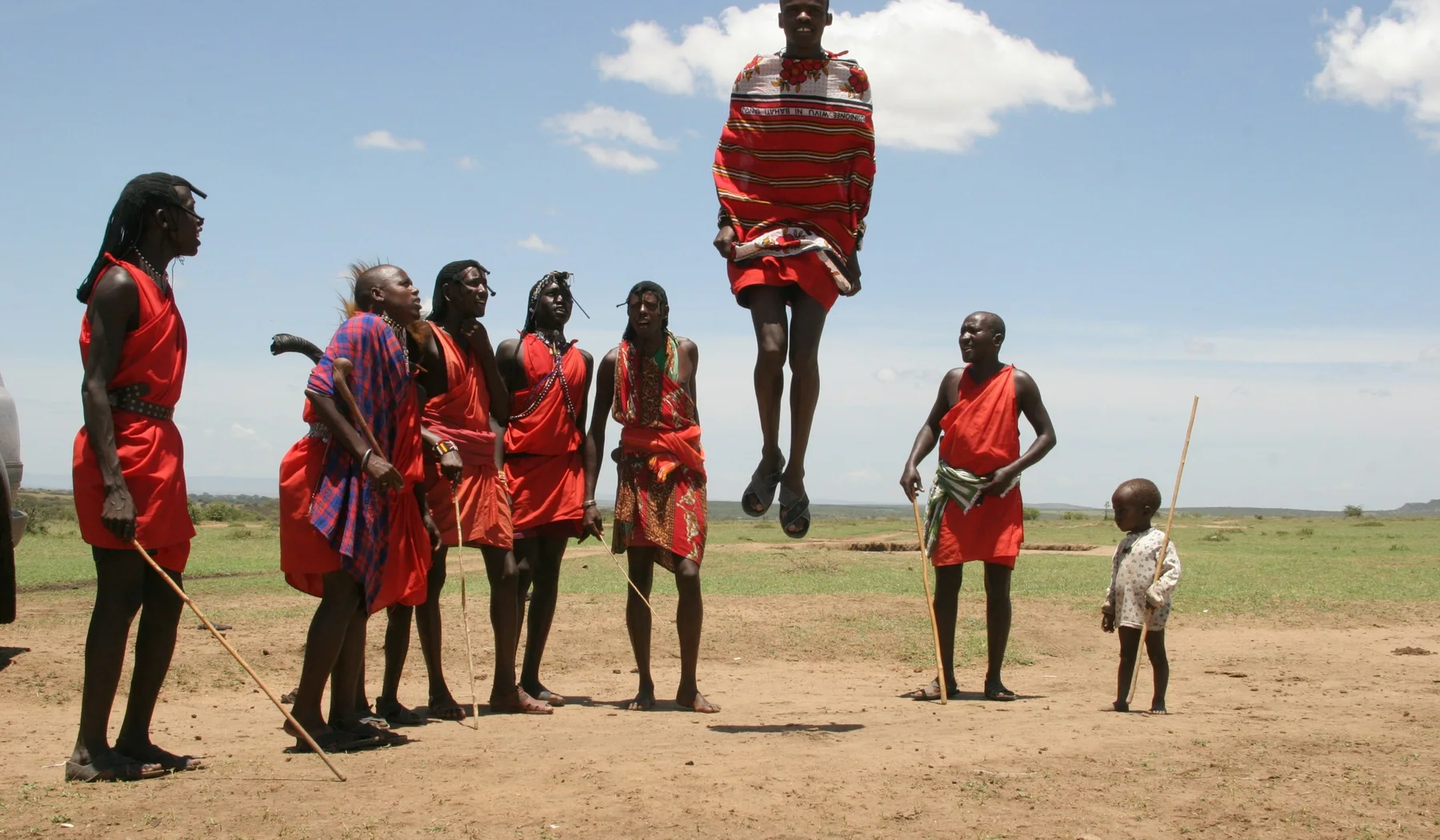
The photograph catches a man in the air. His body is almost vertical, his red cloth bright against the sky, while the people around him sing. The camera naturally follows the jump. That is also where most explanations go wrong. Adumu is reduced to a feat of height, and the group that makes the moment possible disappears from the story.
The Adumu jumping dance is better understood as movement, singing, rhythm and relationship. It belongs to living Maasai communities in Kenya and Tanzania, especially to the social world of ilmurran, the male youth often translated as warriors. It also appears today in weddings, gatherings and performances adapted for visitors. Those settings overlap, but they are not identical.
Begin with the short answer
Adumu is a Maa word used for jump movements in dancing and for the vertical high-jump dance associated with ilmurran. One or more young men move forward from a singing group and perform repeated double-legged jumps while staying responsive to the shared tempo. The height is visually striking, but peer-reviewed research found that reducing the dance to a sports contest misses its playful, interactive and collective character.
| Question | Short answer |
|---|---|
| What is Adumu? | A Maa jumping dance practice |
| Who is closely associated with it? | Ilmurran, Maasai male youth |
| Is height the whole point? | No, rhythm and interaction matter |
| Is every performance ceremonial? | No, setting and purpose vary |
Say the word without pretending one spelling solves everything
English writing uses Maasai and Masai, while local language is called Maa. This article uses Maasai for the people and Adumu for the dance. Spelling varies when Maa words move into English, and pronunciation differs across speakers and regions. A respectful visitor does not need to sound like a linguist. It is better to ask a host how they say a word than to correct them with a safari brochure.
Do not use Adumu, Eunoto and Enkipaata as synonyms
Online descriptions often collapse several names into one “jumping ceremony.” That is inaccurate. Adumu is a dance practice. Eunoto is a much wider ceremony connected with age-set transition. Enkipaata is a different initiation-related process. A ten-minute welcome performance for visitors is not Eunoto simply because Adumu appears in both worlds. Ask the speaker to explain the specific event and local context.
Meet the ilmurran at the centre of the dance
The PLOS ONE study describes ilmurran as male youth who form an age set and take on social responsibilities that have included long-distance herding and safeguarding livestock and people. “Warrior” is the common English shorthand, but it can freeze contemporary young men into an old adventure story. They may also study, work, farm, use smartphones, run businesses and move between rural and urban life.
Understand an age set as a social relationship
An age set is not simply a group of people who share a birthday range. It helps organise identity, responsibility, ceremony and relationships through life. The PLOS research observed that Adumu allowed youth from different places, clans, educational backgrounds and economic situations to move and sing together. That togetherness is one reason a purely athletic explanation feels so thin.
Put the occasion back around the movement
Adumu can appear in different social settings. The detailed research discussed here examined one performance during a wedding ceremony. Other sources connect jumping with age-set celebrations and visitor welcomes. No single study or village performance should be made to represent every Maasai community. When you see the dance, ask what occasion this is, who is participating and what the group wants visitors to understand.
Read the PLOS study for what it actually found
Researchers filmed seventeen male youths during a wedding Adumu and analysed a seven-minute section of singing and movement. Fifteen performed repeated jumps. The study combined ethnographic context with movement analysis and examined height, repetition, timing and cheering. Its value is not a definitive measurement of all Adumu. It is the way the findings challenge the popular idea that the dance is simply a competition to jump highest.
Respect the study’s own limits
The authors explicitly say their wedding findings should not be generalised to every jumping experience. They also note that the study focused on body movement and did not fully include the performers' own verbal explanations of intention. That humility is a useful model for travel writing. Evidence can correct a myth without claiming one final meaning for every person, village and occasion.
See the formation before the first jump
In the studied wedding performance, the participants stood in a half-circle and sang. Other performances may use a fuller circle or line. The formation creates a shared space for the solo movement and keeps the jumper connected to the group. When a travel photograph crops everyone else out, it removes the structure that supports the person in the air.
Listen for the song leader
Maasai vocal performance can include a soloist who leads melodic or textual material and a group that responds or sustains the vocal pattern. In Adumu, the jump is organised within that singing. Do not assume the most visually dramatic person is the only leader. Ask who begins the song, what the response means and whether the words can be explained to visitors.
Let rhythm replace the scoreboard
The PLOS study found that jump timing remained more consistent than height. Participants controlled movement so that landing stayed with the group's singing. The researchers concluded that the men in this wedding performance were not simply competing for height. The dance valued responsiveness, repeated tempo and the ability to move with others. That finding changes what an attentive visitor watches.
Watch how a jumper enters and leaves
The movement begins before take-off. A participant follows the song, steps into the central space, bends and begins repeated jumps. He finishes with a marked landing, then moves back to the line or arc. The entrance and return matter because they keep the individual turn inside a continuous social performance. A single frozen photograph cannot show that sequence.
Correct the “no knee bend” myth
Travel captions often say Maasai jumpers rise without bending their knees. The legs can look remarkably straight in the air, but the research description records knee and upper-body flexion before the repeated jumps and a deeper flexion in the final landing. The skill lies partly in the narrow, upright appearance and rapid rhythm, not in breaking human biomechanics.
Notice the upper body and cloth
The studied performers often kept one hand on a stick and another on their clothing while maintaining an upright torso. Cloth, hair, ornaments and the movement of the stick make the jump visually powerful, but they are not decorative props supplied for a photograph. They belong to personal presentation, age-stage identity and the social setting. Ask before touching, borrowing or wearing anything.
Understand cheering as interaction
The researchers observed cheering before, during and after jump sessions. Cheering was not reserved only for the highest jumpers. Singers and friends could also be encouraged. This is another reason the event cannot be understood through an individual winner. The group makes and responds to the energy together.
Avoid inventing drumbeats
Some generic articles add drums to every African dance description. The PLOS wedding account centres singing and body rhythm. Other communities and staged performances may use different sound elements, but a visitor should describe what is actually heard. If there are no drums, do not add them because a stock soundtrack expects one.
Put women, elders and children back in the story
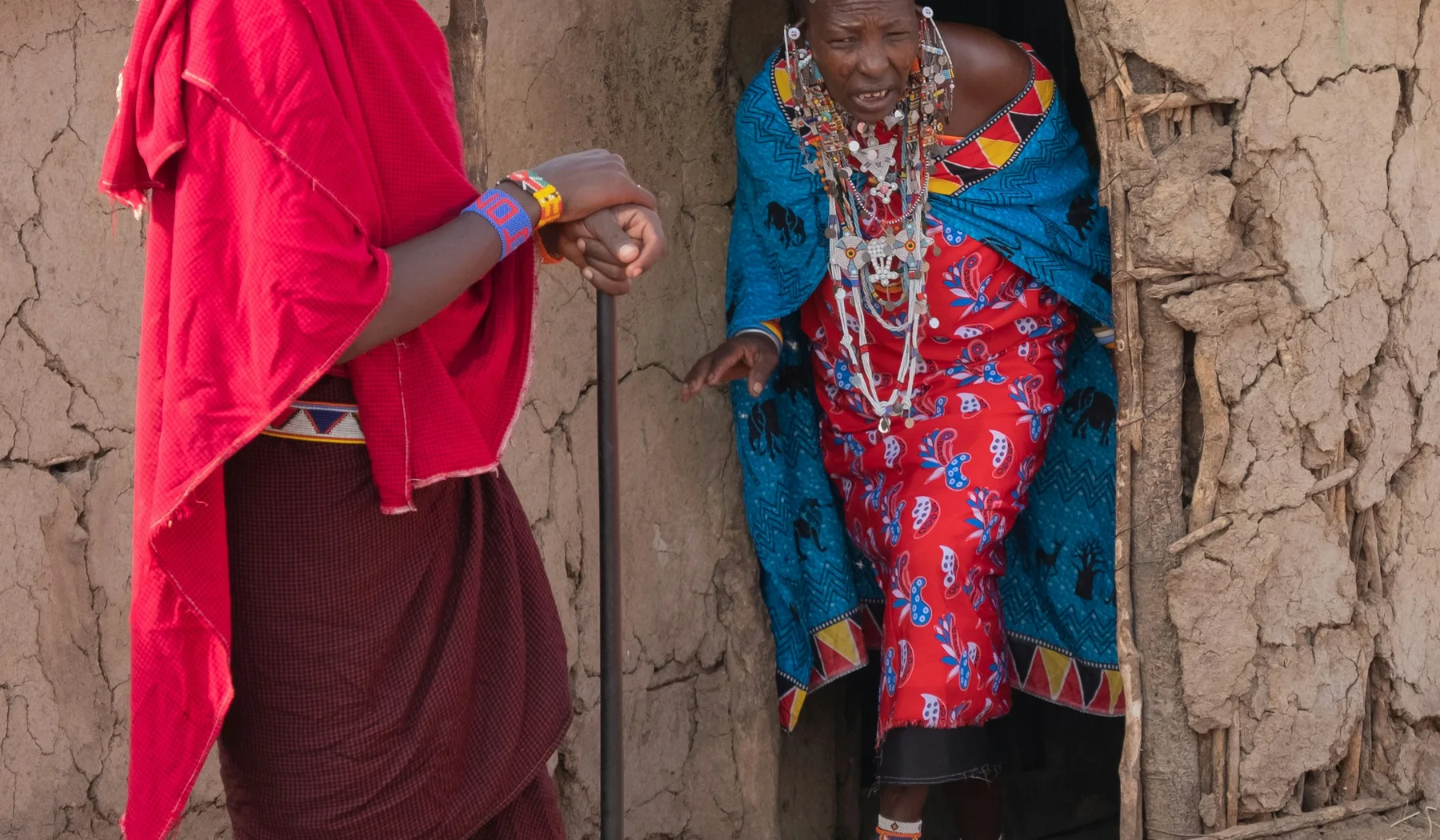
The iconic image usually shows young men, yet community life is not a male jumping line. The study noted elders, boys and women nearby. Children watched and mimicked movement, gaining embodied knowledge. Women have their own songs, dances, work, authority and beadmaking traditions. Elders hold knowledge and social roles. A cultural visit that only photographs jumping men leaves most of the community invisible.
| Community member | Ask about |
|---|---|
| Women | Songs, beadwork, work and decision-making |
| Elders | History, age sets and change |
| Children | School, play and consent |
| Ilmurran | Herding, work, study and age-stage life |
See how children learn by watching
The PLOS researchers observed boys imitating the youth at close range. That detail shows cultural transmission as ordinary attention, play and bodily practice, not only formal instruction. Visitors should resist turning children into performers on demand. If children join naturally, photography still requires adult and, where appropriate, child assent.
Stop saying the highest jumper wins a bride
The claim is repeated so often that it now sounds like fact. The PLOS wedding study found no simple height competition and no evidence that the tallest jump determined marriage. Courtship, marriage and age-set life are far more complex than one jump. A host may explain attraction, admiration or performance in a specific setting, but that is different from a universal rule that “the winner gets the girl.”
Do not link every jump to lion hunting
Another common story says Adumu trained warriors to kill lions or proved who could hunt. Maasai histories of protection, wildlife conflict, warrior identity and conservation are real subjects, but a dance should not be given a dramatic origin without evidence from the community and scholarship. Modern conservation initiatives have also changed relations between young men, livestock and predators. Ask, rather than repeat a legend because it excites visitors.
Let contemporary life into the picture
Maasai people are not living museum exhibits. Pastoralism remains important in many families, while education, business, wage work, tourism, farming, politics, conservation and urban life also shape the present. A smartphone, school uniform or concrete building does not make someone less Maasai. Authenticity should not require poverty, isolation or refusal of technology.
Understand tourism as adaptation
The PLOS paper notes that jumping performances in tourism are one example of local adaptation. Communities can choose to share dance, earn income and shape a public identity through visitors. Adaptation does not automatically make a performance false. The better question is who controls it, who is paid, what is explained and whether participants can set boundaries.
Retire the authentic-or-fake trap
A wedding performance and a visitor welcome are not the same, but both can involve real people using living skills and meanings. A visitor performance may be shortened, repeated or explained in English. That makes it adapted, not automatically fraudulent. At the same time, poor organisation can create pressure, stereotypes and a hard sell. Judge the relationships rather than searching for a village untouched by modern life.
Choose the visit before the performance
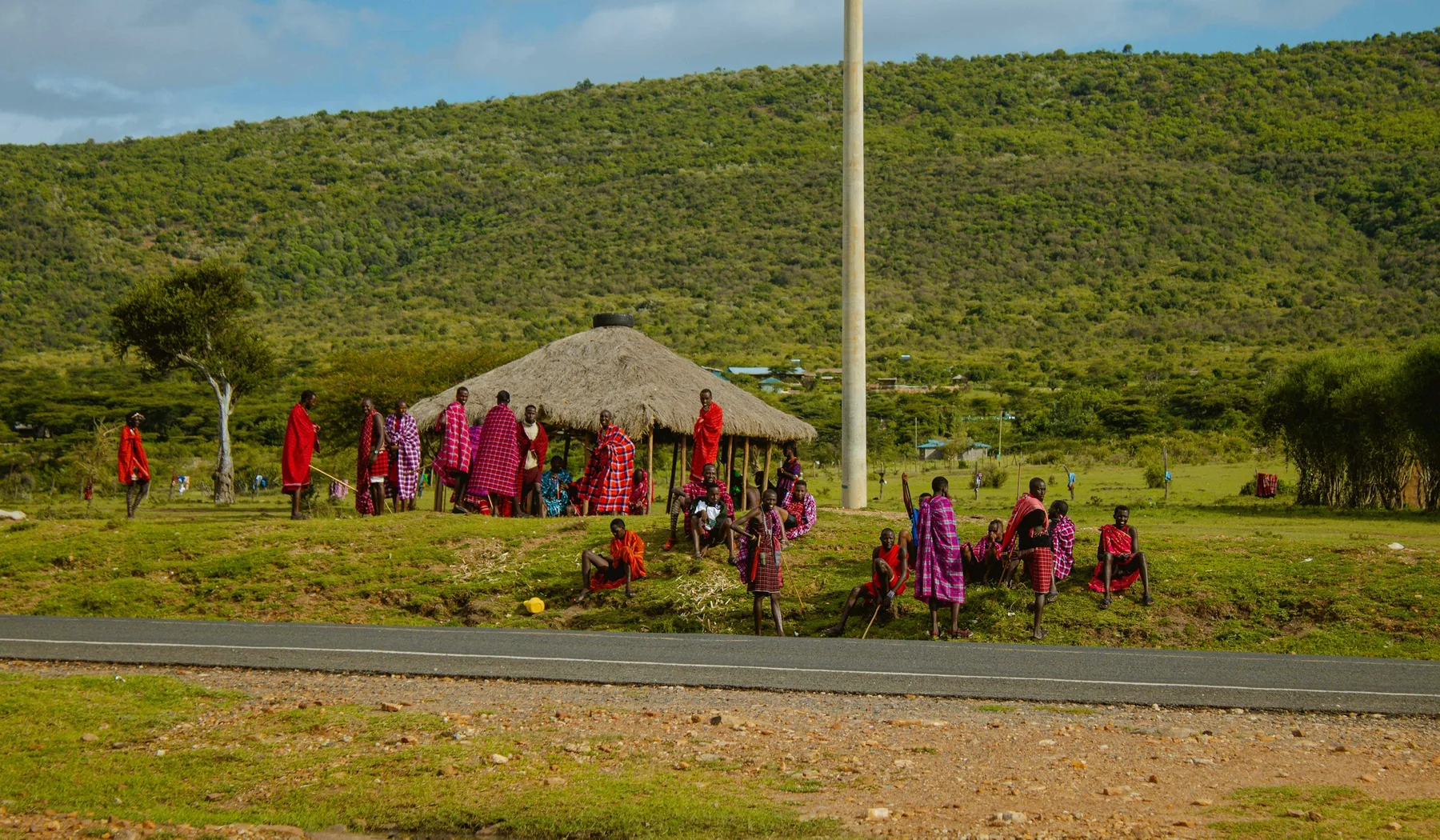
Do not book “Maasai dance” as if ordering entertainment from a menu. Choose a host and visit format first. Ask whether the community offers a welcome song, conversation, homestead tour, beadwork, cattle walk, school discussion, food or overnight stay. The guide to spending a day with the Maasai shows why time and conversation produce more understanding than a rushed stop.
| Visit format | Depth |
|---|---|
| 45-minute stop | Brief introduction |
| Two-hour visit | Conversation plus selected activities |
| Full day | Daily rhythm and deeper questions |
| Overnight | Time, meals and changing light |
Ask who benefits before arrival
The booking should state the community fee, guide fee, included activities and how income is shared. A village should not depend on surprise shopping pressure because the entry payment was unclear or captured elsewhere. The planned guide to Maasai village visit cost will separate entry, guiding, crafts, tips and transport.
Agree the length honestly
A cultural visit added after a full game drive often receives the tired final hour of the day. Hosts wait, visitors rush and nobody has time for questions. Put the visit into the itinerary with a realistic arrival and departure. If the group only has forty-five minutes, say so before the community prepares a longer programme.
Arrive with curiosity, not a checklist
Visitors often demand the same sequence: jumping, fire, hut, school, market. That turns people into stations. Ask the host what they want to share today and what has changed in their community. A drought, school term, livestock movement, ceremony or market day may shape a much more relevant visit than the standard script.
Listen before lifting the camera
The first seconds of a welcome are not a race for the front row. Keep the camera down until introductions and photography guidance are complete. Watch the formation, hear the soloist and notice how the jumper responds. The memory becomes richer when the visitor understands what the image contains.
Ask consent at the right level
Permission to photograph the group does not automatically cover a close portrait, child, home interior, private ceremony, drone or commercial campaign. Ask again when the use changes. If someone turns away, covers their face or says no, stop. Consent should be freely given, specific and revocable.
Keep drones out unless explicitly approved
A drone changes privacy, livestock behaviour, sound and safety far beyond a handheld camera. It may also be restricted by aviation, protected-area and property rules. Never launch over a homestead or ceremony because the landscape looks dramatic. Secure legal permission, landholder consent and community approval, and accept that the respectful answer may be no.
Join only when invited
During visitor performances, hosts may invite guests into the line or jumping space. Joining can be warm and funny when everyone understands the invitation. It becomes disrespectful when a visitor barges in, mocks the movement or turns it into a victory pose. Watch first, follow the rhythm, leave space and accept guidance.
Do not stage a height contest
Inviting a guest to try a jump is not permission to announce a tourist-versus-Maasai competition. The research already shows why height alone is a poor frame. Avoid grabbing a stick, demanding repeated takes or asking performers to jump until the photograph looks higher. The people are hosts, not athletic equipment.
Know when not to participate
A private or sacred ceremony may not be open to visitors at all. A community may welcome observation but not participation. A traveller with knee, ankle, balance, heart or pregnancy concerns should not jump to be polite. Participation is optional on both sides. A respectful visit leaves room for people to say no.
Read clothing and beadwork without inventing a code
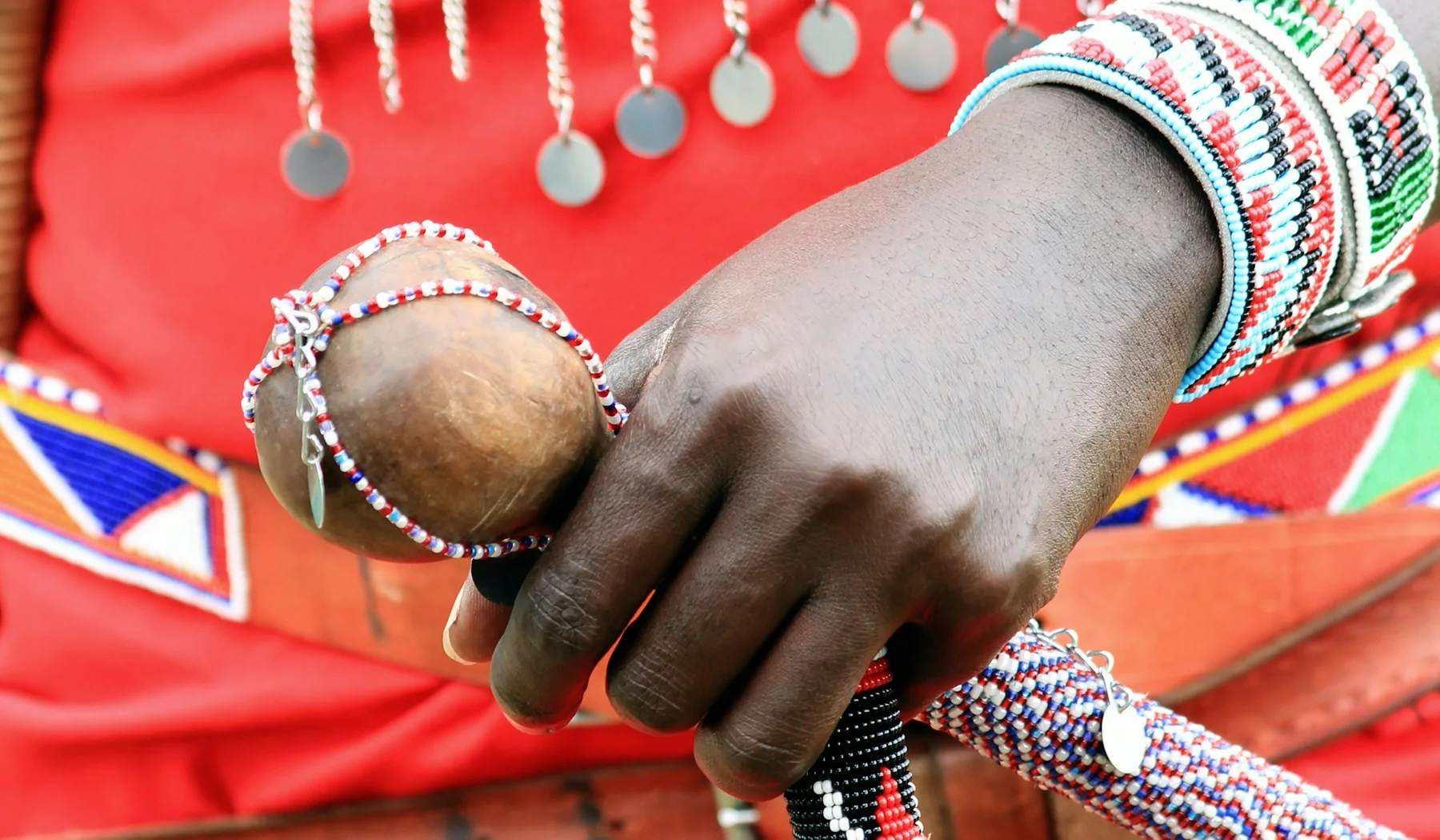
Red cloth and elaborate beadwork are widely recognised, but colour meanings, patterns and use can vary by maker, age, place and occasion. The guide to Maasai beadwork, clothing, food, cattle and daily life will explore this in detail. Ask the person wearing or making an item what it means to them.
| What you see | What to ask |
|---|---|
| Necklace | Who made it and for what occasion? |
| Bracelet | Personal, age or market design? |
| Shuka | Everyday, ceremonial or visitor dress? |
| Stick | Practical, social or performance role? |
Borrow clothing only with permission
Some visitor programmes invite guests to wear a shuka or beadwork. Treat the item as someone's work and property, not a comic costume. Ask how it is worn, keep it off the ground and return it directly. Never take a staff member's personal jewellery for a photograph unless they freely offer it.
Buy beadwork from a named maker
Craft purchases can support skilled work when the maker, price and payment are clear. Ask who made the piece, how long it took and whether the seller receives the money. Bargaining should not erase labour. The planned guide to tipping, gifts, photography and buying beadwork will give a fuller framework.
Learn a few Maa words with a real speaker
A greeting can soften the distance between visitor and host, but pronunciation and usage matter. The Maa language phrases guide will be built with local verification. Do not turn sacred songs into phonetic entertainment or repeat words whose meaning you do not know. Ask permission before recording a language lesson.
| Language action | Respectful practice |
|---|---|
| Greeting | Learn from the host |
| Name | Repeat carefully |
| Song | Ask meaning and recording permission |
| Translation | Credit the speaker |
Use the right words for the homestead
Tourism copy often uses manyatta, boma, village and homestead as if they mean exactly the same thing. The planned guide to Maasai manyatta, boma, homestead and village will separate the terms and regional usage. During a visit, follow the host's word and ask what it refers to here.
Let cattle and land enter the conversation
Adumu cannot explain pastoral life on its own. Cattle, goats, grazing, water, drought, wildlife, land tenure and markets shape many Maasai households. Ask how livestock move, who herds, how school fits daily work and what happens in a dry year. Do not assume every family owns the same number of animals or follows one livelihood.
Ask about change without calling it loss
Education, new houses, paid work, solar power, motorbikes and conservation partnerships can exist alongside Maa language, age sets and ceremony. Change is not automatically cultural decline. Ask what elders, women and young people want to preserve, what they want to adapt and what outsiders misunderstand.
Put women in the economic story
Beadwork groups, food production, household management, livestock responsibilities, employment and leadership can all involve women, with differences between communities and households. Do not present women as a colourful chorus behind male dancers. Ask a woman guide or maker about her own work and priorities, and pay her directly when appropriate.
Never turn schoolchildren into an attraction
A school visit should serve an educational purpose approved by the school and community. Children are not available to sing because tourists arrived. Ask whether visits are permitted, how learning is protected, whether photography is banned and what support the school actually requests. Unplanned gifts can create disruption and inequality.
Plan a family visit around attention, not performance
The Kenya safari with children guide helps shape the wider trip. Young visitors often learn more from meeting one child guide, seeing livestock or trying beadwork than from a long lecture. Tell hosts the children's ages, prepare respectful questions and do not promise that they can enter homes or join dances.
Make accessibility part of cultural respect
A rural homestead may have uneven ground, narrow doors, smoke, low seating and no accessible toilet. Ask before arrival rather than forcing hosts to improvise publicly. A community can sometimes adapt the meeting place, bring chairs, shorten walking or arrange an accessible performance and conversation at the lodge. Respectful access is planned with the host, not demanded at the last minute.
| Access need | Ask |
|---|---|
| Wheelchair | Surface, slope and doorway width |
| Limited stamina | Walking distance and seating |
| Smoke sensitivity | Outdoor conversation instead of hut |
| Hearing loss | Interpreter position and quiet setting |
Photograph poverty neither romantically nor cruelly
Cracked walls, bare feet and smoke can become visual shorthand that strips people of name, work and choice. Do not hunt for the image that proves a community is “untouched.” Ask what a person wants photographed and how they would like to be identified. Share images when promised.
Keep geotags under control
Exact homestead coordinates can expose residents to unplanned visitors, commercial photography or intrusive tour traffic. Ask whether the community wants its location shared. A broad destination tag may be enough. Never publish a child's home, school route or private ceremony location without permission.
Choose gifts that were requested
Pens, sweets and old clothes are not automatically useful. Sweets can create health and litter problems, while random handouts can undermine agreed community systems. Ask the host organisation what is needed, how it will be distributed and whether cash to a transparent fund is better. Do not give gifts directly to children for photographs.
Tip without replacing fair payment
A tip should recognise good guiding or hospitality, not compensate for an entry fee captured by someone else. Ask whether a service charge is included, who receives tips and whether a group envelope is preferred. Do not wave cash during the dance or reward individual children for performing.
Read positive reviews for the details that worked
One visitor wrote that “the dancing and singing at the end was the highlight.” Another called the day “a very educational and enriching experience.” These are individual opinions, but they point to a useful pattern: performance becomes more meaningful when it follows conversation, daily activities and patient explanation.
Notice when visitors valued more than jumping
A reviewer wrote, “Jumping with Maasai is not the only fun part of this tour,” then mentioned beadmaking, milking, food and family conversation. Another said, “It was amazing to learn about and experience a bit of their culture.” The lesson is not to copy every activity. It is to design a visit around people and learning.
Use emotional reviews carefully
On another tour page, a guest wrote, “Their storytelling, dances, and way of life were deeply moving.” Another said, “I felt like I was learning something much bigger than a simple tour.” Emotion matters, but it should not become a claim that visitors now understand an entire people after one day.
Learn from negative reviews too
An Amboseli visitor described pressure after the welcome and wrote, “The rest of the visit was based on the almost obligatory purchase of handmade souvenirs.” Another review of a different visit warned that unclear prices and sales pressure damaged the experience. The answer is not to avoid every village. It is to agree the fee, shopping and time before arrival.
Treat “felt authentic” as a personal reaction
One visitor said, “The entire experience felt genuine and interactive.” That sentence describes how the visit felt to that person. It does not certify a community. Use reviews to identify explanation, warmth, pressure, timing and organisation, not to award authenticity scores to people's lives.
Compare Masai Mara and Amboseli visit settings
The planned Masai Mara versus Amboseli village visit guide will compare route, landscape, timing and community models. The Masai Mara safari guide and Amboseli safari guide provide destination context. Neither area guarantees a deeper visit. Host quality and time matter more than the park name.
Consider Maji Moto and the Loita Hills for depth
The planned Maji Moto cultural stay and Loita Hills guide will cover longer, landscape-led experiences. Time outside the busiest reserve gate can allow walking, livestock, meals and conversation to matter more than a compressed performance. Verify ownership, guide credentials, accommodation comfort, walking distance and exactly which community receives income.
| Longer stay | Check |
|---|---|
| Maji Moto | Host, programme and sleeping arrangement |
| Loita Hills | Guide, route and conservancy context |
| Village camp | Community role and land agreement |
| Homestay | Privacy, bathroom, food and consent |
Decide between a short stop, day and overnight
The planned guide to staying overnight in a Maasai village will cover comfort and boundaries. An overnight creates time for evening and morning, but it is not automatically deeper if guests remain in a tourist compound. A well-led two-hour visit can be better than an unclear night. Choose by purpose, host and interaction.
| Format | Strength | Risk |
|---|---|---|
| Short stop | Fits limited itinerary | Becomes a performance checklist |
| Full day | Questions and activities | Long road day |
| Overnight | Shared time and landscape | Staged camp or unclear privacy |
Use an independent video as a window, not proof
An independent traveller's 2014 video of Adumu at a Maasai village shows a circle, singing and one or two jumpers entering the centre. It can help a reader notice group formation before a trip. It cannot explain the performers' intentions by itself, and a Tanzania visitor setting should not be treated as a template for every Kenyan community.
| Video can show | Video cannot prove |
|---|---|
| Formation and movement | Universal meaning |
| Sound and pace | Consent beyond filming |
| Visitor context | Every community's practice |
| Date and place | Complete ceremony |
Ask better questions after watching
Instead of asking how high someone can jump, ask how the song begins, who chooses the jumper, what makes a turn feel complete and how children learn. Ask which parts belong to the visitor welcome and which belong to community events. These questions invite explanation rather than a repeated myth.
Build Adumu into a wider learning arc
Before the visit, learn basic Maa terms and the difference between dance and ceremony. During the visit, listen and ask. Afterward, read about land, livestock, education and conservation. Adumu becomes a doorway rather than the whole house.
Price the visit inside the whole safari
The Kenya safari cost guide helps keep transport, park fees, lodges and cultural visits in one budget. The cheapest village stop is not necessarily best value, and a high fee is not proof of fair benefit. Compare community payment, guide quality, time, transport and included activities.
Protect the game drive and the cultural visit from each other
A village stop at sunset can shorten wildlife viewing and force hosts to rush. A long morning visit can delay a transfer. Decide which matters most that day. On a three-night safari, place the cultural visit in a clear half-day or on the arrival route, not in a vague gap.
| Itinerary problem | Better design |
|---|---|
| Visit after late game drive | Dedicated time block |
| Guests tired and hungry | Meal before or after agreed |
| Host waiting without update | Driver calls ahead |
| Sunset photography conflict | Choose one priority |
Prepare the local guide, not only the driver-guide
The safari driver may introduce the visit, but community members should interpret their own culture. Confirm the name and language of the local host, whether translation is needed and how questions will be handled. Do not accept a guide inventing dramatic answers when a host is available.
Keep a respectful photography brief
Tell the host if the group includes serious photographers, journalists, influencers or commercial creators. Their equipment and intended use differ from holiday snapshots. Agree fees, releases, credit, delivery and restrictions before the camera day. A cultural visit fee does not buy commercial image rights.
Credit people in captions
“Maasai warrior jumps in Africa” erases the person's name, place and occasion. When permission allows, record the correct name and spelling, community, host organisation and context. If the person prefers not to be named, say so. Never invent ceremonial meaning for a stronger caption.
Share photographs when you promise
Visitors often say they will send images and then forget. Ask for the best delivery method before leaving: WhatsApp, email, printed copies through the guide or a community office. Send a small, usable selection rather than hundreds of files. Do not post publicly first if private sharing was agreed.
Leave without claiming expertise
A good visit should make the traveller more curious and more careful, not newly qualified to explain all Maasai culture. Say “our host explained” and name the setting. Avoid “the Maasai believe” unless a credible source supports a broad statement and local speakers agree. One hour can begin a relationship with knowledge; it cannot complete it.
Use a final respectful-visit checklist
The visit is ready when the host, purpose, timing, fee, guide, activities, photography rules, accessibility and shopping expectations are clear. The dance should never be the only line in the plan. Build enough space for introduction and questions, and let the community decide what is appropriate that day.
Send a Maasai cultural visit brief
Include safari route, date, group size, children's ages, available hours, mobility, language, photography goals, cultural interests and budget. Say whether you want a short introduction, full day or overnight. If Adumu matters, explain that you want context and consent, not a performance on demand.
Remember what the jump cannot show alone
The Adumu jumping dance can reveal skill, energy, beauty and the strength of shared rhythm. It cannot, by itself, explain age sets, marriage, pastoralism, women's work, land, education, conservation or the choices young Maasai people make today. A respectful traveller enjoys the moment and then keeps listening.
Sources and further reading
The main analytical source is Tian, Sado, Yanohara and Mwangi's peer-reviewed PLOS ONE paper, “Jumping is not just about height”. It studied one wedding Adumu and should not be generalised beyond its setting. Visitor quotations come from linked Tripadvisor experience pages and are presented as individual opinions. The independent video is used only to illustrate visible formation and movement.
| Source | Used for |
|---|---|
| PLOS ONE research | Maa terms, movement, rhythm and limits |
| Community-host explanations | Local meaning and boundaries |
| Traveller reviews | Positive and negative visit patterns |
| Independent video | Visible formation, not universal meaning |
Plan a respectful Maasai experience
Share route, dates, group, interests, preferred depth and any photography or access needs.