
Masai Mara in April and May: Rain, Wildlife, Camps, Roads and Who Should Go
Understand the long-rains tradeoff, choose a resilient camp and route, protect the journey home and decide whether uncertainty suits the people travelling.
- April and May are related, not identical
- “Rainy season” does not mean continuous rain
- “It only rains for an hour” is not a planning rule
- Weather and ground are separate
- Ground and river are separate
- Averages hide the part travellers care about
- Use official forecasts properly
- Narok forecasts add local context
- Three forecast horizons
- Historical records belong in the decision
- April 2024
- May 2024
- March 2026
- Recovery can be fast in one place and slow in another
- History should produce questions, not panic
- Severe-event context table
- The Mara is not empty of wildlife
- The great migration is not the April promise
- Resident predators
- Elephants
- Giraffes
- Plains game
- Birding
- Insects and frogs
- Newborn animals are possible, not scheduled
- Tall grass changes the search
- Green does not mean uniformly tall
- Wildlife expectations table
- Fewer vehicles can change the quality
- Low season is not empty season
- Some camps close
- Some camps use the period for maintenance
- Some camps reduce services
- Seasonal rates need itemised comparison
- Do not quote a generic percentage saving
- Ask about minimum occupancy
- Ask which room block operates
- Ask what happened in recent severe rain
- Accommodation comparison table
- Roads from Nairobi
- Black-cotton soil
- Bridges and drifts
- Gate choice
- Fly-in trips
- Bush-flight schedules
- Airstrip transfer
- Balloon flights
- Self-driving
- Road versus fly-in table
- Game drives usually continue in ordinary rain
- Split drives can adapt well
- A full day can use a clear window
- Do not chase dry ground off-road
- Rain and vehicle design
- Vehicle seating
- Field breakfast and lunch
- Night drives
- Game-drive adjustment table
- Photography can be exceptional
- Photography can also be frustrating
- Carry simple rain protection
- Use the sky
- Expect contrast changes
- Private vehicle for photographers
- Photography tradeoff table
- First-time safari travellers
- Repeat safari travellers
- Families with young children
- Teenagers
- Older travellers
- Limited mobility
- Honeymooners
- Birders
- Travellers who dislike uncertainty
- Traveller-fit table
- What to pack
- Keep essentials in hand luggage
- Avoid an all-cotton wardrobe
- Pack two shoe systems
- Camera packing
- Laundry
- Health and insects
- Packing table
- Three-night trip
- Four-night trip
- Five-night trip
- Split stay
- Nairobi buffer
- Beach extension
- Sample resilient itinerary
- Quote inclusions need detail
- Check cancellation timing
- Check relocation terms
- Check insurance before a warning
- A price is not value without access
- Quote comparison table
- Check 30 days before travel
- Check seven days before travel
- Check 72 hours before travel
- Check on departure morning
- If a flood warning is active
- If the camp says it is safe
- If the route changes
- If the activity cancels
- Pre-travel checkpoints table
- Traveller voice: rain can be manageable
- Traveller voice: drives can continue
- Traveller voice: resident wildlife remains
- Traveller voice: rain did not ruin one repeat visit
- Traveller voice: not every day is all rain
- Traveller voice: some people prefer the low season
- Traveller voice: storm light can be special
- Traveller voice: healthy-looking wildlife
- Traveller voice: a repeat guest would return
- Traveller voice: the green landscape
- Reviews reveal tolerance
- Reviews cannot confirm current operations
- Common mistake: booking migration expectations
- Common mistake: treating every storm as a flood
- Common mistake: treating a flood as ordinary rain
- Common mistake: choosing a camp only by price
- Common mistake: assuming every camp is open
- Common mistake: tight international connections
- Common mistake: self-driving to save money
- Common mistake: packing only for heat
- Common mistake: forcing every activity
- Common mistake: expecting an exact rain clock
- How to book in ten steps
- Final recommendation
- Frequently asked questions
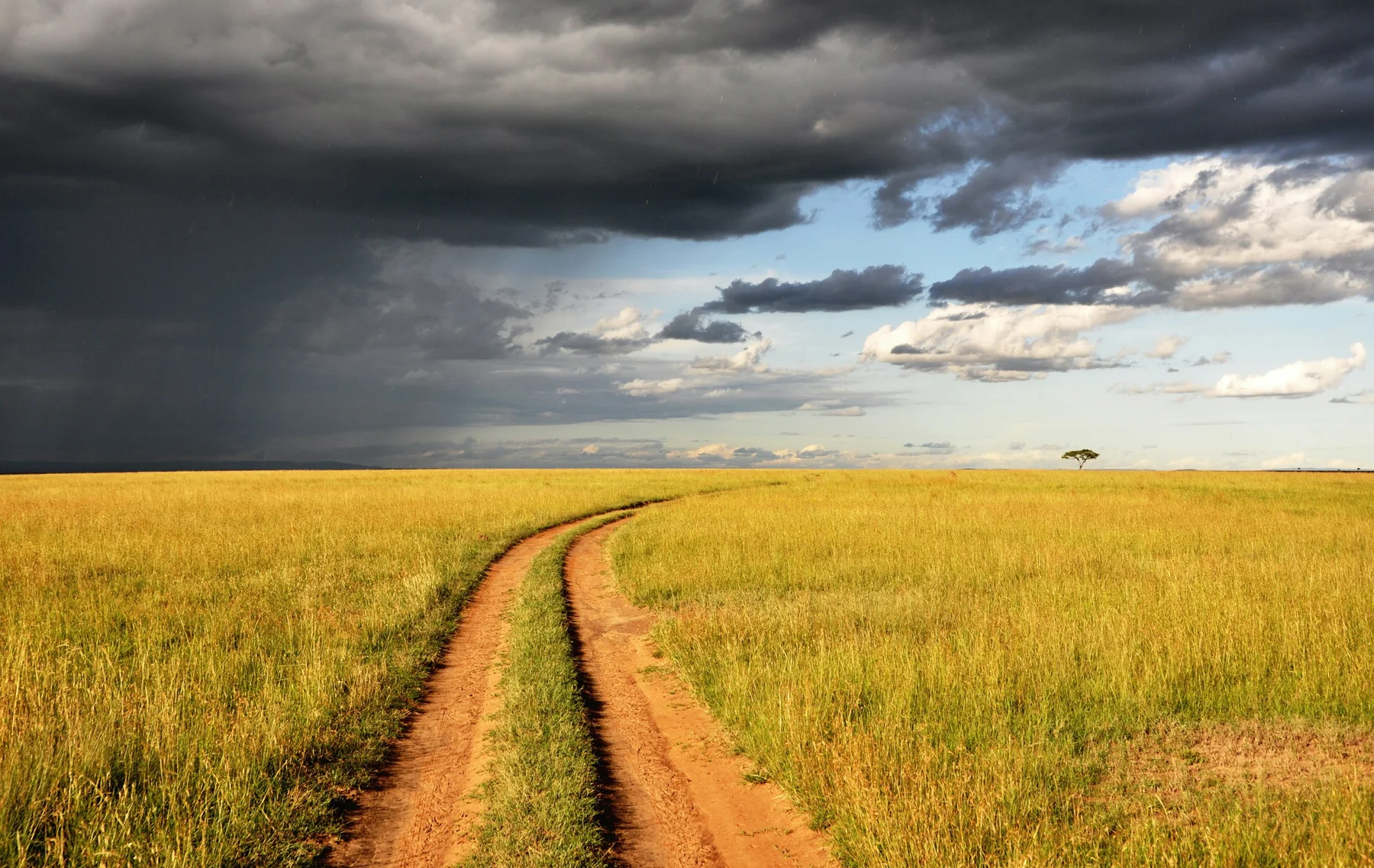
Rain moves across the Mara in curtains. One side of the plain can disappear beneath a charcoal cloud while another remains bright. A track darkens, the smell of warm dust changes and the first drops strike the roof. Twenty minutes later, elephants may be walking through washed green grass in a light that feels made for them. Another week can bring saturated ground, damaged roads and a river that no itinerary can argue with.
That range is the honest answer to visiting the Masai Mara in April and May. These are usually long-rains months and often the quietest part of the tourism year. They can deliver low visitor numbers, dramatic skies, abundant resident wildlife and intimate camps. They can also bring closures, mud, delayed flights, difficult bridges and rare but serious flooding. The decision is less about whether rain is “good” or “bad” and more about whether the exact camp, route and travellers can adapt.
Start with the Masai Mara safari guide if you are still choosing a sector. April and May magnify geographic differences. A well-sited camp with short habitat access and clear alternatives can be more valuable than a famous name at the end of a fragile route.
April and May are related, not identical
April often sits near the heart of the long rains. May can remain wet, especially early, then shift toward drier intervals. Seasonal onset, peak and cessation vary by year, and local storms do not follow a monthly calendar.
| Factor | April tendency | May tendency | What to verify |
|---|---|---|---|
| Rain | Often frequent or intense | Can remain wet, sometimes easing later | Current official forecast and local observation |
| Ground | Greater chance of saturation | May still be muddy, with recovery varying | Exact access roads and game-drive tracks |
| Camps | More seasonal closures possible | Some properties reopen during the month | Exact opening date and services |
| Visitor numbers | Usually low | Often low, sometimes increasing late | Occupancy and vehicle-sharing policy |
| Vegetation | Rapidly green and growing | Green, with taller grass in places | Sector and wildlife visibility |
| Travel confidence | Needs the strongest flexibility | Can improve, never guaranteed | Bridges, airstrips, flights and alternatives |
“Rainy season” does not mean continuous rain
Rain may fall at night, in an afternoon storm, across several hours or in repeated bursts. Some days are clear. Other periods become persistently wet. Anyone promising a fixed daily pattern is oversimplifying weather.
“It only rains for an hour” is not a planning rule
Short storms do occur, but severe sustained events have damaged camps, roads and bridges. Plan for the wider range, then enjoy the easier days when they arrive.
Weather and ground are separate
A sunny morning can follow a storm that left black-cotton tracks impassable. The drive plan depends on what happened overnight and upstream, not only the sky at breakfast.
Ground and river are separate
Mud can restrict routes without threatening accommodation. A high river can isolate a dry camp by closing a bridge. Ask about both.
Averages hide the part travellers care about
Monthly rainfall totals cannot tell you whether water arrived gently over many nights or in one destructive storm. Intensity, location and previous saturation decide impact.
Use official forecasts properly
The Kenya Meteorological Department seasonal forecast provides broad probability for the long-rains period. A seasonal outlook helps choose context, not a particular game-drive day.
Narok forecasts add local context
The Narok County seasonal forecast for one recent season expected April to be the peak and showed rainfall variation across the county. Future travellers must use the forecast issued for their own year.
Three forecast horizons
| Check | When | Best use | Limitation |
|---|---|---|---|
| Seasonal outlook | Before booking | Broad probability and preparedness | Cannot predict exact camp or day |
| Seven-day Narok forecast | Near departure | Rain pattern and warning context | Cannot confirm a private track |
| Daily weather | During travel | Clothing and drive timing | May miss upstream runoff or damage |
| Camp update | Before each transfer | Property, path, strip and access | Does not cover the whole ecosystem |
| Land-manager update | During disruption | Gates, roads, bridges and rules | May not describe one room block |
Historical records belong in the decision
The Mara Conservancy archive documents both ordinary wet months and extraordinary ones. History does not forecast your dates, but it shows which questions are reasonable.
April 2024
The April 2024 report recorded 300 millimetres in the Triangle, sustained storms, waterlogged roads and Talek River flooding at the end of the month.
May 2024
The May 2024 report documented an unprecedented Talek flood, a bridge washed away, serious damage to at least 20 riverside camps and lodges and rescues. This was a severe event, not the definition of every May.
March 2026
The March 2026 report described very high river levels, damaged bridges, culverts and drifts and a Triangle cut off for days. April and May planners should understand that saturated conditions may begin before arrival.
Recovery can be fast in one place and slow in another
Main approaches may reopen while secondary tracks, airstrip transfers or lower room areas still need work. “Open” is not the same as fully normal.
History should produce questions, not panic
Ask what happened at the exact property, which room zones were affected, what changed, how access works now and what triggers relocation. Do not label every river camp from one event.
Severe-event context table
| Evidence | What it proves | What it does not prove |
|---|---|---|
| Talek flood damaged camps | Severe local flooding can affect accommodation | Every riverside camp has equal risk |
| Bridge was lost | Access can depend on one structure | The same bridge is unsafe today |
| Roads became waterlogged | Route range can narrow | All game drives stop in rain |
| Balloon flights have been suspended in very wet periods | Weather-sensitive activities may stop | Ballooning never operates in April or May |
| Repairs followed | Operations can recover | Every repair or route is identical |
The Mara is not empty of wildlife
Lions, leopards, cheetahs, elephants, giraffes, buffalo, hippos, hyenas, antelope and many birds are resident in the ecosystem. The absence of migration herds is not the absence of safari.
The great migration is not the April promise
The vast northern movement and famous river-crossing window normally belong to later months, though herd movement varies. Do not sell April or May as a cheaper migration crossing trip. The migration season versus green season guide compares the experiences directly.
Resident predators
Cats remain in their territories and follow resident prey. Tall grass, wet roads and local distribution can change visibility and route access. The guide’s knowledge matters more than a species checklist.
Elephants
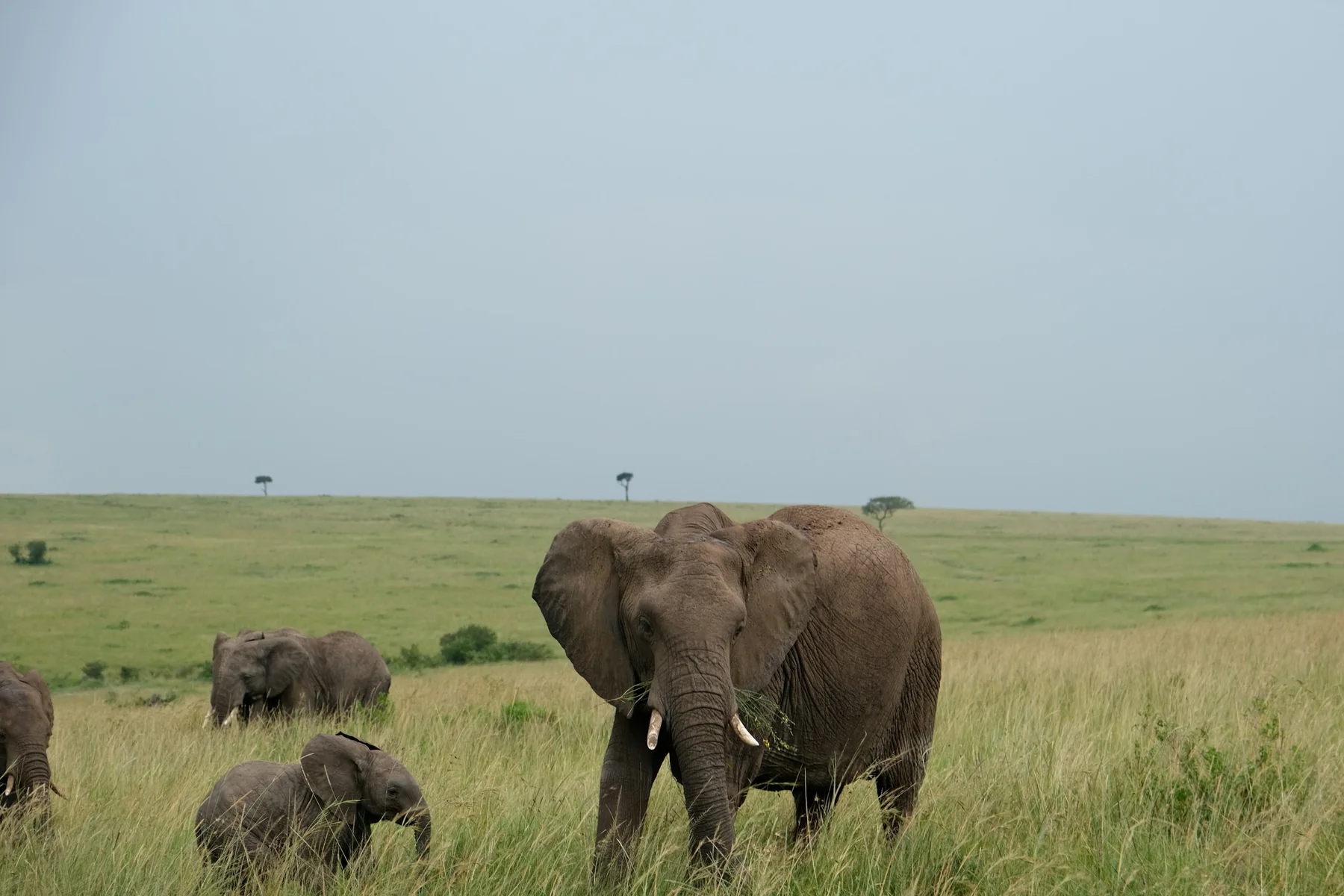
Green forage and water shape movement across the wider ecosystem. Family groups can appear in open grass or woodland, but no particular herd or route is guaranteed.

Giraffes
Giraffes remain visible across suitable habitat, sometimes dramatic against storm skies. Taller vegetation can change the view of smaller animals more than of giraffes.
Plains game
Topi, zebra, gazelles, impala and other herbivores support the resident predator system. Distribution follows grazing, water and safety rather than a visitor map.
Birding
Wet-season conditions can support rich bird activity, breeding plumage, migrants depending on timing and a strong variety of raptors, waterbirds and grassland species.
Insects and frogs
Rain brings smaller life into focus. Termite emergences, frogs and insects feed birds and enrich the night soundscape. Screens, lighting and repellent still matter for comfort.
Newborn animals are possible, not scheduled
Guests may see young elephants, antelope, cats or other species, but there is no Mara-wide April birth calendar that guarantees babies. Avoid booking around an invented promise.
Tall grass changes the search
Small cats and cubs can vanish into growth, while ears, tails, birds and tracks become more important. A skilled guide slows down instead of racing toward radio reports.
Green does not mean uniformly tall
Grazing pressure, soil, fire history and storm pattern create a patchwork. One sector can remain open while another grows dense.
Wildlife expectations table
| Interest | April and May potential | Honest limitation |
|---|---|---|
| Big cats | Resident populations and cool-hour activity | Tall grass and route limits affect visibility |
| Elephants | Families across feeding areas | Exact herd location changes |
| Birds | Strong diversity and wet-season activity | Some target species need specialist guiding |
| Migration | Resident or local wildebeest and zebra | Famous large herds and crossings are not the promise |
| Young animals | Possible across several species | Birth timing is not guaranteed |
| Photography | Storm light, colour and few vehicles | Rain protection and muddy access matter |
| Behaviour | Long, uncrowded observation can be possible | Weather and animal choice still decide |
Fewer vehicles can change the quality
A sighting with one or two vehicles allows quieter observation and cleaner photography. Low occupancy may also mean shared departures are combined or some services run on a reduced pattern. Ask.
Low season is not empty season
Some well-known properties remain open, local communities continue daily life and resident wildlife remains. The tourism rhythm is simply quieter.
Some camps close
Small, mobile, seasonal or maintenance-focused camps may close for part or all of April and May. A property listed online is not proof that it accepts guests on your dates.
Some camps use the period for maintenance
Ask whether construction, rebuilding, path work or reduced room inventory affects the stay. Quiet occupancy is not useful beside a maintenance project.
Some camps reduce services
Spa hours, specialist guides, private dining, bush meals, cultural programmes or multiple daily flights may differ. Request the actual operating plan.
Seasonal rates need itemised comparison
Rooms may be cheaper, but private vehicles, Reserve day trips, transfers and revised flights can add cost. Compare the complete itinerary using the Kenya safari cost guide.
Do not quote a generic percentage saving
The difference changes by property, room, market, length and inclusion. Ask for the exact date and cancellation term.
Ask about minimum occupancy
A camp may combine vehicles when few guests stay. Photographers and families should confirm whether private use needs a supplement.
Ask which room block operates
Some sections may close while the main camp remains open. Confirm room position, paths, drainage and distance to common areas.
Ask what happened in recent severe rain
A detailed answer should separate room safety, access road, bridge, airstrip and game-drive area. General reassurance is weaker than specific learning.
Accommodation comparison table
| Question | Camp A | Camp B | Why it matters |
|---|---|---|---|
| Open for exact dates | Avoids building around a seasonal closure | ||
| Room block and ground | Wet paths and river setting vary | ||
| Recent severe-event effect | Shows relevant experience and changes | ||
| Primary and alternative route | One closure should not end the plan | ||
| Primary and alternative airstrip | Fly-in still needs local transfer | ||
| Private or shared vehicle | Low occupancy can change scheduling | ||
| Services operating | Avoids brochure-only expectations | ||
| Weather terms | Clarifies relocation, refund and credit |
Roads from Nairobi
The main approach can be good while the final local section is wet. Ask the driver for the current route, daylight departure and alternative rather than relying on an old journey time.
Black-cotton soil
Some tracks become extremely slippery when saturated. A capable 4×4 helps, but route judgement and local knowledge matter more than bravado.
Bridges and drifts
One damaged crossing can reorganise a sector. The Masai Mara flooding guide maps the access chain in detail.
Gate choice
The nearest-looking gate on a map may not be the practical entry after rain. Use the road conditions and gate guide and reconfirm on the day.
Fly-in trips
Flying avoids much of the long road but not weather, airstrip condition or the strip-to-camp route. It can be resilient when the camp has a workable alternative strip and generous onward margins.
Bush-flight schedules
Low demand can affect frequency or circuit. Confirm the ticketed service, baggage and connection using the Masai Mara airstrip guide.
Airstrip transfer
A 15-minute normal transfer can become longer if a low track is closed. Ask for the wet-weather route and vehicle.
Balloon flights
Ballooning depends on safe weather and ground conditions. Treat the hot-air balloon safari as optional and refundable or reschedulable under the written terms.
Self-driving
April and May are not sensible learning months for a first Mara self-drive. Read the self-drive guide and do not enter flooded crossings or closed tracks.
Road versus fly-in table
| Factor | Road safari | Fly-in safari |
|---|---|---|
| Main advantage | Vehicle continuity and luggage flexibility | Shorter Nairobi-to-Mara travel when operating normally |
| Wet-season weakness | Mud, detours, bridge and local road | Weather, airstrip and schedule disruption |
| Local knowledge need | Driver needs current end-to-end route | Camp still needs safe strip transfer |
| Best buffer | Daylight and alternative route | Wilson and international connection margin |
| Strong traveller fit | Private itinerary and flexible baggage | Short stay and road-fatigue concerns |
| Essential question | Which road and crossing changed overnight? | Which strip and transfer are operating today? |
Game drives usually continue in ordinary rain
Guides may lower side curtains, pause, change route or return. Severe storms, flooded tracks or authority restrictions can cancel or shorten a drive.
Split drives can adapt well
Morning and afternoon outings create two decisions. If one period is wet, the other may operate. The Masai Mara game-drive guide compares formats.
A full day can use a clear window
When roads and weather are stable, a long drive can reach varied habitat. It needs food, toilet, rain and recovery planning.
Do not chase dry ground off-road
Creating parallel tracks around mud damages grass and soil. Follow the game-drive rules and etiquette guide.
Rain and vehicle design
Open sides provide wonderful viewing until hard rain arrives. Canvas or windows protect guests but can reduce visibility. Ask how the vehicle closes.
Vehicle seating
One person per side or row improves photography when curtains limit openings. A crowded vehicle becomes much harder in wet weather.
Field breakfast and lunch
Picnics protect wildlife time but need shelter, food safety and a legal safe place. The Mara bush-dining guide helps choose the format.
Night drives
Some private conservancies offer them when conditions and rules permit. Wet tracks, visibility and animal welfare may change the plan. Reserve rules differ.
Game-drive adjustment table
| Condition | Better adjustment | Avoid |
|---|---|---|
| Overnight heavy rain | Use main all-weather tracks and local sightings | Testing a flooded shortcut |
| Afternoon storm forecast | Drive earlier or stay close to camp | A distant route with no return margin |
| Tall grass | Slow tracking and broader species interest | Racing only to big-cat radio calls |
| Low occupancy | Agree drive format in advance | Assuming private use is automatic |
| Clear stable day | Consider one purposeful long drive | Filling every day dawn to dusk |
| Hard rain in open vehicle | Use protection or return safely | Demanding visibility through unsafe conditions |
Photography can be exceptional
Storm layers, rain shafts, clean air, wet coats, reflections and saturated colour give April and May a distinctive visual language.
Photography can also be frustrating
Rain on glass, plastic curtains, condensation, muddy supports and dark light test equipment. A beautiful season still requires preparation.
Carry simple rain protection
Use a camera cover, dry bag, cloths and separate pouches for batteries and cards. Do not change lenses in hard rain.
Use the sky
Wide scenes often tell April and May better than close portraits. Place the storm, road, grass and animal in one frame.
Expect contrast changes
Bright wet grass beneath a dark sky can exceed the camera’s dynamic range. Expose for important highlights and review the histogram.
Private vehicle for photographers
It allows dry gear storage, deliberate side choice and waiting without forcing other guests to sit through technical decisions. Use the photography guide for the full equipment plan.
Photography tradeoff table
| Opportunity | Challenge | Preparation |
|---|---|---|
| Dramatic storm sky | Fast-changing exposure | Wide lens and highlight check |
| Clean post-rain air | Water on front element | Hood and cloths |
| Wet animal coats | Low light | Stable support and suitable shutter speed |
| Fewer vehicles | Shared schedule may be fixed | Confirm private use |
| Green landscape | Small subjects hide in growth | Guide, binoculars and patience |
| Reflections and puddles | Muddy or closed route | Never request habitat damage for angle |
First-time safari travellers
April and May can be wonderful when dates are fixed and flexibility feels exciting. Travellers whose one safari must follow a precise species and route list may prefer a more stable period.
Repeat safari travellers
Low crowds, birds, resident predators and atmosphere can make these months especially rewarding. Repeat guests often value process over a checklist.
Families with young children
Choose a compact camp, private vehicle, short habitat access, indoor common space, early meals and a clear medical plan. Long wet detours can overwhelm a child quickly. The Kenya safari with children guide covers the wider family plan.
Teenagers
Photography, tracking, birds and storm watching can create ownership. Include dry camp time rather than forcing every possible drive.
Older travellers
Wet paths, vehicle steps and long transfers matter. A lodge-style property with short, stable routes may suit better than a remote tent reached across several drainage lines.
Limited mobility
Use the accessible safari guide to verify room-to-vehicle path, alternative airstrip, wet ramp, toilet and evacuation.
Honeymooners
Green privacy and a quiet camp can be deeply romantic. Fixed outdoor dinners, proposals and balloon plans need indoor alternatives and flexible timing.
Birders
These months can justify specialist guiding, slower drives and multiple habitats. Ask which camp guides are confident with calls, raptors and small species.
Travellers who dislike uncertainty
If a changed route, flight or activity will spoil the holiday, choose another period. No discount compensates for the wrong emotional fit.
Traveller-fit table
| Traveller | Strong fit when | Weak fit when |
|---|---|---|
| Photographer | Storm light and patience appeal | Gear cannot be protected |
| Birder | Specialist guiding and small species matter | Only migration spectacle matters |
| Family | Camp is compact and vehicle private | Long detours and shared schedule are likely |
| Honeymoon | Privacy and flexibility matter | Every outdoor detail must happen exactly |
| Limited mobility | Full wet-weather chain is verified | Paths or alternative transport fail the need |
| First safari | Dates are fixed and expectations broad | Once-only checklist demands stable access |
| Repeat safari | Quiet observation is the aim | Specific distant sector is non-negotiable |
What to pack
Bring a lightweight waterproof shell, warm layer, quick-dry clothes, closed shoes with grip, a second pair of shoes, dry bags, torch, insect repellent and sun protection.
Keep essentials in hand luggage
Medicine, documents, one dry change, glasses, batteries and child essentials should remain with the traveller during flight or road changes.
Avoid an all-cotton wardrobe
Heavy cotton and denim dry slowly. Quick-dry trousers and layers are easier to manage.
Pack two shoe systems
One closed pair can dry while the other is worn. Camp sandals help on sheltered paths where staff say they are suitable.
Camera packing
Separate bodies, lenses and batteries into water-resistant modules. A single wet open bag should not expose the whole kit.
Laundry
Damp conditions can slow drying. Carry enough socks and base layers rather than assuming same-day laundry.
Health and insects
Seek personalised medical advice for malaria prevention, vaccines and medicines. Rain does not remove sun or dehydration risk.
Packing table
| Item | Purpose | Common mistake |
|---|---|---|
| Waterproof shell | Drives and camp paths | Heavy coat that remains damp |
| Warm layer | Cool dawn and wet wind | Assuming Kenya is always hot |
| Quick-dry trousers | Comfort after rain | Only packing jeans |
| Two closed shoe pairs | Rotation and grip | One fashionable pair |
| Dry pouches | Electronics and papers | Loose plastic that becomes litter |
| Small torch | Wet paths and power interruption | Depending on phone battery |
| Medicine reserve | Delays and relocation | Checked-luggage-only supply |
| Refillable bottle | Hydration | Avoiding water to reduce toilet stops |
Three-night trip
Keep one camp, use arrival afternoon gently, plan split drives and allow one clear day to extend. Do not add a long cross-Mara transfer.
Four-night trip
One camp with local habitat and one purposeful Reserve or conservancy day can work. Put flexibility into the middle, not only the final morning.
Five-night trip
Consider one camp or two geographically complementary camps only when the transfer chain is resilient. More nights create weather margin.
Split stay
Two camps relying on the same bridge are not true alternatives. Compare access dependencies, not marketing regions.
Nairobi buffer
Keep a night near the international airport after the Mara when the long-haul ticket is difficult to replace. Weather margin is part of safari design.
Beach extension
A flexible coast stay after the Mara can absorb a delay better than placing the Mara immediately before the flight home.
Sample resilient itinerary
| Day | Plan | Flexibility |
|---|---|---|
| 1 | Early road or bush flight, local afternoon drive | Skip drive if transfer is delayed |
| 2 | Dawn drive, camp lunch, afternoon drive | Change route after overnight rain |
| 3 | Purposeful full day if clear | Convert to split local drives |
| 4 | Specialist birds, photography or conservancy activity | Use camp time during storm |
| 5 | Protected transfer to Nairobi buffer | Avoid same-day long-haul pressure |
Quote inclusions need detail
Ask for exact camp, room, board, Reserve and conservancy fees, private or shared vehicle, airport transfers, alternative route, weather terms and every activity.
Check cancellation timing
The cheapest non-refundable offer may be poor value when the season requires flexibility. Compare the date at which risk transfers to you.
Check relocation terms
Ask which alternative property may be used, whether it is comparable, who pays transport and whether you can decline.
Check insurance before a warning
Known-event exclusions can apply after an official warning or widely reported flood. Buy suitable cover early and read weather, curtailment and missed-connection sections.
A price is not value without access
An inexpensive camp that loses hours to a gate or difficult road may cost more in vehicle time and opportunity. Compare complete days.
Quote comparison table
| Field | Offer A | Offer B |
|---|---|---|
| Exact operating dates | ||
| Room block and ground | ||
| Vehicle private or shared | ||
| Camp-to-habitat time | ||
| Fees and day trips | ||
| Flight frequency | ||
| Alternative route or strip | ||
| Weather cancellation | ||
| Relocation responsibility | ||
| International-flight buffer |
Check 30 days before travel
Confirm the camp is opening as planned, the selected room operates and no maintenance changes the experience. Review the correct year’s seasonal outlook.
Check seven days before travel
Read the official weekly forecast, request current access and verify flights, roads, bridges and airstrips.
Check 72 hours before travel
Ask what changed after the latest rain, which route the driver will use and whether the camp accepts arrivals normally.
Check on departure morning
Confirm overnight road, bridge, flight and airstrip status. Leave enough daylight to reroute.
If a flood warning is active
Use current official and operational information, not this seasonal guide. Ask for a written go, relocate, postpone or refund decision and the time it must be made.
If the camp says it is safe
Ask whether that covers room, access, power, water, airstrip transfer and evacuation. Specificity builds confidence.
If the route changes
Request the revised travel time, vehicle, daylight margin and onward effect. A safe detour is a successful plan.
If the activity cancels
Use the written refund, reschedule or replacement term. Do not pressure a pilot, guide or manager to operate unsafely.
Pre-travel checkpoints table
| Time | Ask camp | Ask transport | Traveller action |
|---|---|---|---|
| 30 days | Opening, room and maintenance | Schedule and route assumptions | Review insurance and forecast year |
| 7 days | Access and services | Flight, road, bridge and strip | Pack wet-weather equipment |
| 72 hours | Changes after recent rain | Named alternative | Protect onward booking |
| Morning | Overnight operational status | Final route and contacts | Carry essentials and water |
Traveller voice: rain can be manageable
One contributor wrote, “April can be wet but not that bad”. That was personal experience, not a daily forecast.
Traveller voice: drives can continue
The same comment said “you will still enjoy your game drives”. Current roads and safety still decide each outing.
Traveller voice: resident wildlife remains
Another guest wrote, “we saw a lot” during a rainy-season visit. A short quote avoids turning one species list into a promise.
Traveller voice: rain did not ruin one repeat visit
A repeat visitor said “the rain did not spoil our enjoyment or game viewing”.
Traveller voice: not every day is all rain
The same person recalled, “It doesn’t rain all day every day”. Severe sequences remain possible, which is why access planning matters.
Traveller voice: some people prefer the low season
One experienced traveller wrote, “I do personally prefer the lower season in the Masai Mara”.
Traveller voice: storm light can be special
That contributor described how “the light when the dust is washed out of the air is incredible for photography”.
Traveller voice: healthy-looking wildlife
The same account noticed “lots of young babies and fat and happy looking animals”. This remains observation, not a birth guarantee.
Traveller voice: a repeat guest would return
Another experienced visitor said, “I would happily go in April”.
Traveller voice: the green landscape
That post added, “the bush is also delightfully green”.
Reviews reveal tolerance
The key difference between these positive accounts and negative ones is often not weather alone. It is how the traveller feels about mud, changes, rain protection and uncertainty.
Reviews cannot confirm current operations
They cannot prove that a camp is open, a bridge repaired, a road dry or a flight scheduled on your date. Use them to identify preferences and questions.
Common mistake: booking migration expectations
April and May should be sold on resident wildlife and green-season character, not a guaranteed river spectacle.
Common mistake: treating every storm as a flood
Ordinary rain and serious flooding are different. Check exact local impact.
Common mistake: treating a flood as ordinary rain
When warnings, bridge closures or evacuation apply, stop using reassuring season averages.
Common mistake: choosing a camp only by price
Access, vehicle, room ground and alternatives matter more in these months.
Common mistake: assuming every camp is open
Confirm the exact date and services before booking transport.
Common mistake: tight international connections
One delayed bush flight can be more expensive than the Nairobi buffer night omitted.
Common mistake: self-driving to save money
Recovery, damage, detours and risk can erase the saving. Local expertise is valuable.
Common mistake: packing only for heat
Open vehicles can feel cold after rain. Layers and dry shoes matter.
Common mistake: forcing every activity
Ballooning, bush dinners and distant drives should move or cancel when conditions say so.
Common mistake: expecting an exact rain clock
No planner controls onset, storm length or road drying. Buy resilience, not certainty.
How to book in ten steps
- Decide whether flexibility feels exciting or stressful.
- Choose the exact camp and room ground.
- Confirm operating dates and services.
- Map road, bridge, gate, airstrip and transfer dependencies.
- Compare road and fly-in alternatives.
- Use a private 4×4 where timing and comfort need control.
- Read cancellation, relocation and insurance terms.
- Add a Nairobi or onward buffer.
- Complete 30-day, seven-day, 72-hour and morning checks.
- Let the guide change the wildlife plan without treating safety as failure.
Final recommendation
Choose the Masai Mara in April and May when you value quiet roads, resident wildlife, birds, green landscapes and the possibility of extraordinary storm light more than a fixed migration or activity checklist. Stay longer in fewer places, choose the camp for access as well as style and protect the final flight home. If mud, uncertainty or a changed route will overshadow the landscape, choose another season without regret. The right answer depends as much on the traveller as on the rain.
Frequently asked questions
Is April a good month for the Masai Mara?
It can be for flexible travellers who value few vehicles, resident wildlife, birds and green scenery. It has a higher chance of rain, mud, closures and disruption.
Is May better than April?
May may become drier later in the month, but patterns vary. Check the forecast, camp operations and exact access for the travel year.
Does it rain all day in the Masai Mara in April?
Not necessarily. Rain can come in storms or longer spells, and severe sequences can occur. No fixed daily pattern is reliable.
Will I see wildlife in April and May?
Resident wildlife remains in the ecosystem. Visibility, distribution, road access and sightings change, and no species is guaranteed.
Is the Great Migration in the Masai Mara in April?
The famous large-herd and river-crossing season normally belongs to later months. April should not be booked for a guaranteed crossing.
Are all camps open in April and May?
No. Some close for season, maintenance or site reasons. Confirm the exact operating dates and services.
Are game drives cancelled in rain?
Ordinary rain may not stop a drive. Unsafe roads, high water, hard storms or authority restrictions can change or cancel it.
Is it better to fly or drive?
Flying saves road time but still faces weather, schedule, airstrip and local transfer risk. Road travel offers vehicle continuity but may face mud and detours.
Do I need a 4×4?
Yes, a capable maintained 4×4 with an experienced driver is the sensible baseline. It must not enter flooded crossings or closed tracks.
Is April good for photography?
It can offer storm skies, clean air, green colour and fewer vehicles. Bring rain protection and accept route limits.
What should I pack?
Bring a waterproof shell, warm layer, quick-dry clothes, two pairs of closed shoes, dry bags, torch, repellent and essentials in hand luggage.
Should I buy travel insurance?
Yes. Check weather disruption, supplier cancellation, missed connections, curtailment and evacuation before a warning becomes a known event.
Sources and further reading
Seasonal context comes from the Kenya Meteorological Department and an example Narok County long-rains forecast. Travellers must use the forecast issued for their own dates. Event and infrastructure history comes from the Mara Conservancy archive, including April 2024, May 2024 and March 2026. Traveller quotations link to individual discussion pages and describe personal experience rather than guaranteed conditions.
Let us build the flexible version of the trip
Share dates, camps, transport, travellers, wildlife and photography aims and onward flights. We will compare the tradeoffs before building the route.