
Can You Self-Drive the Masai Mara?
Understand where independent driving is possible, what a genuine 4×4 must carry, how gates and conservancies differ, and when a local guide gives you a better safari.
- The short answer
- Quick verdict
- What does self-drive actually mean?
- Fully independent driving
- Self-drive to the Mara, then use a camp vehicle
- Rental vehicle with a local guide
- Is self-driving legal in the National Reserve?
- National Reserve is not the same as a conservancy
- Why conservancies often restrict self-drive
- The rules that matter before the first sighting
- The honest difficulty is not the highway
- Which vehicle do you need?
- Land Cruiser, Prado, safari van or crossover?
- The pop-up roof is more than a luxury
- Tyres decide more than the badge
- One spare may not be enough
- Recovery equipment
- Rental questions that cannot wait until collection
- Driving licence and identification
- Insurance language to read slowly
- Nairobi to Sekenani
- Nairobi to Oloololo and the Mara Triangle
- Talek and Ololaimutia approaches
- The seven designated gates in the management plan
- Choose the gate from the bed, not the map centre
- Fuel
- Navigation
- Do not follow tyre marks blindly
- Rain changes the Mara in minutes
- Black-cotton soil
- Dry season is not risk-free
- A ditch can stop a capable vehicle
- When to stop before getting stuck
- Water crossings
- The self-drive season
- April and May
- Migration season
- River crossings
- Weather apps do not read individual tracks
- Mobile signal
- Emergency contacts
- Battery and charging
- Water and food
- Clothing and dust
- Camping inside the Reserve
- Public versus private campsites
- Food in camp
- Staying outside the Reserve
- Staying inside the Reserve
- Secure parking when using a camp vehicle
- Hiring a guide for one day
- The guide is not only a wildlife finder
- Wildlife spotting while driving
- Why radios change the guided experience
- Do not chase a convoy
- The five-vehicle rule
- Photography from a self-drive vehicle
- Passenger position
- Animals on the road
- Elephants
- Lions and cheetahs
- Buffalo and hippos
- Getting out of the vehicle
- Night driving
- Border awareness
- Breakdown procedure
- If you are stuck
- If the vehicle overheats
- If you get lost
- Medical emergencies
- Self-drive with children
- Babies and toddlers
- Travellers with limited mobility
- Back pain
- Self-drive on a honeymoon
- Solo self-drive
- Driving after an international flight
- Self-drive costs
- Is self-drive cheaper?
- Park fees and ticket rules
- Vehicle fees
- The cost of a guide day
- Three sensible ways to do it
- A three-night plan
- A five-night plan
- Do not plan a grand crossing every day
- Mara Triangle for self-drivers
- Narok side for self-drivers
- Crossing between sides
- Combining Mara with Nakuru and Naivasha
- Combining Mara with Amboseli
- Combining Mara with Tanzania
- Flying one way
- What independent travellers actually say
- Why a confident road driver can still struggle
- Why a cautious driver can succeed
- The freedom you genuinely gain
- The expertise you genuinely lose
- Self-drive versus private guide
- Self-drive versus shared safari
- Self-drive versus fly-in camp
- The best compromise
- Common self-drive mistakes
- A vehicle handover checklist
- A departure checklist
- A daily game-drive checklist
- Questions for the rental company
- Questions for the accommodation
- Questions for yourself
- When we recommend self-drive
- When we recommend a driver-guide
- When we recommend flying
- Final verdict
- Frequently asked questions
- Can you self-drive the Masai Mara without a guide?
- Do I need a Land Cruiser?
- Can I use a rental Prado?
- Can I self-drive into a private conservancy?
- Is the road from Nairobi paved?
- Is Google Maps enough?
- Can I drive at night?
- Can I camp anywhere?
- What happens if I get stuck?
- Is self-drive cheaper?
- Is self-drive good for a first safari?
- What is the safest compromise?
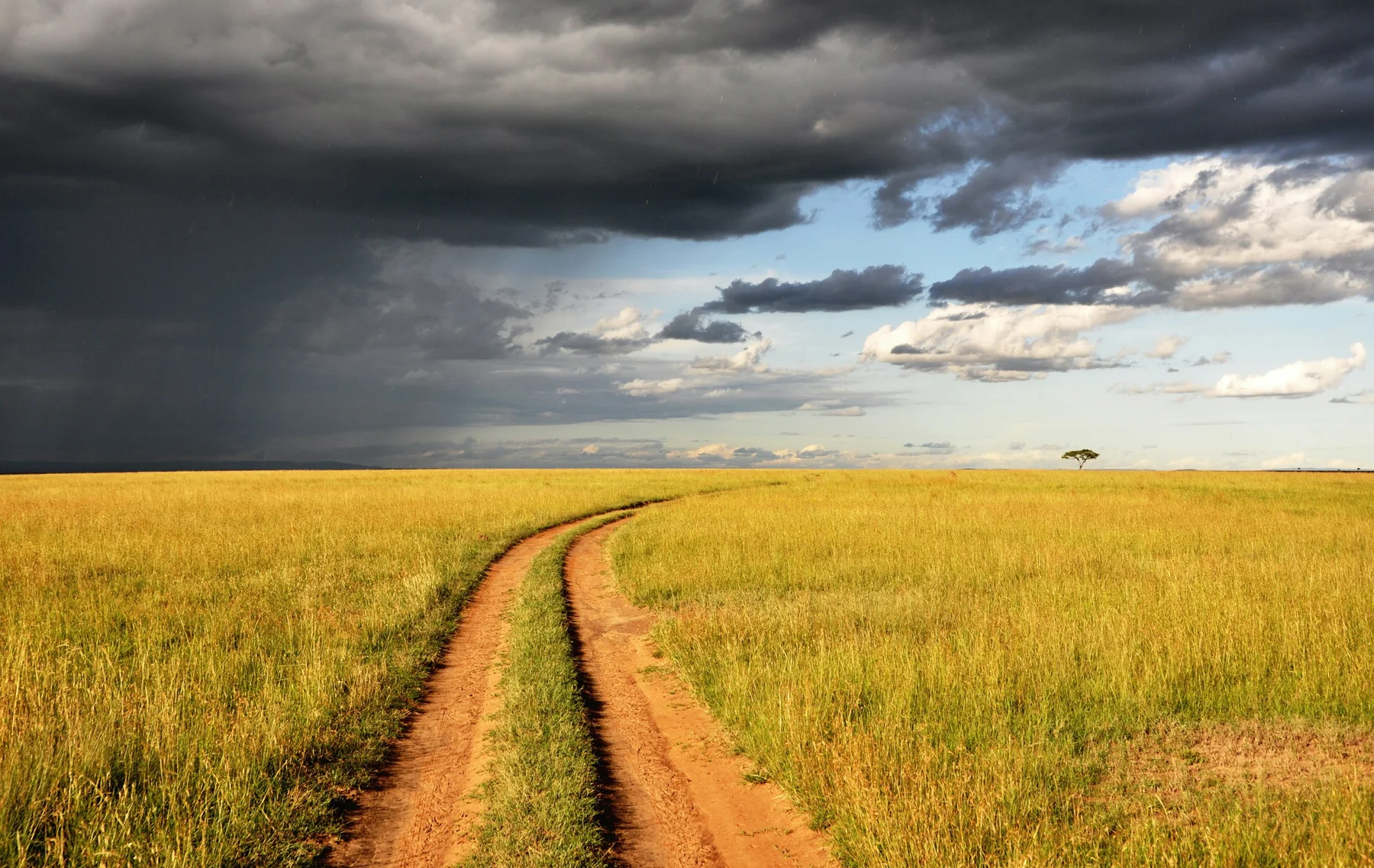
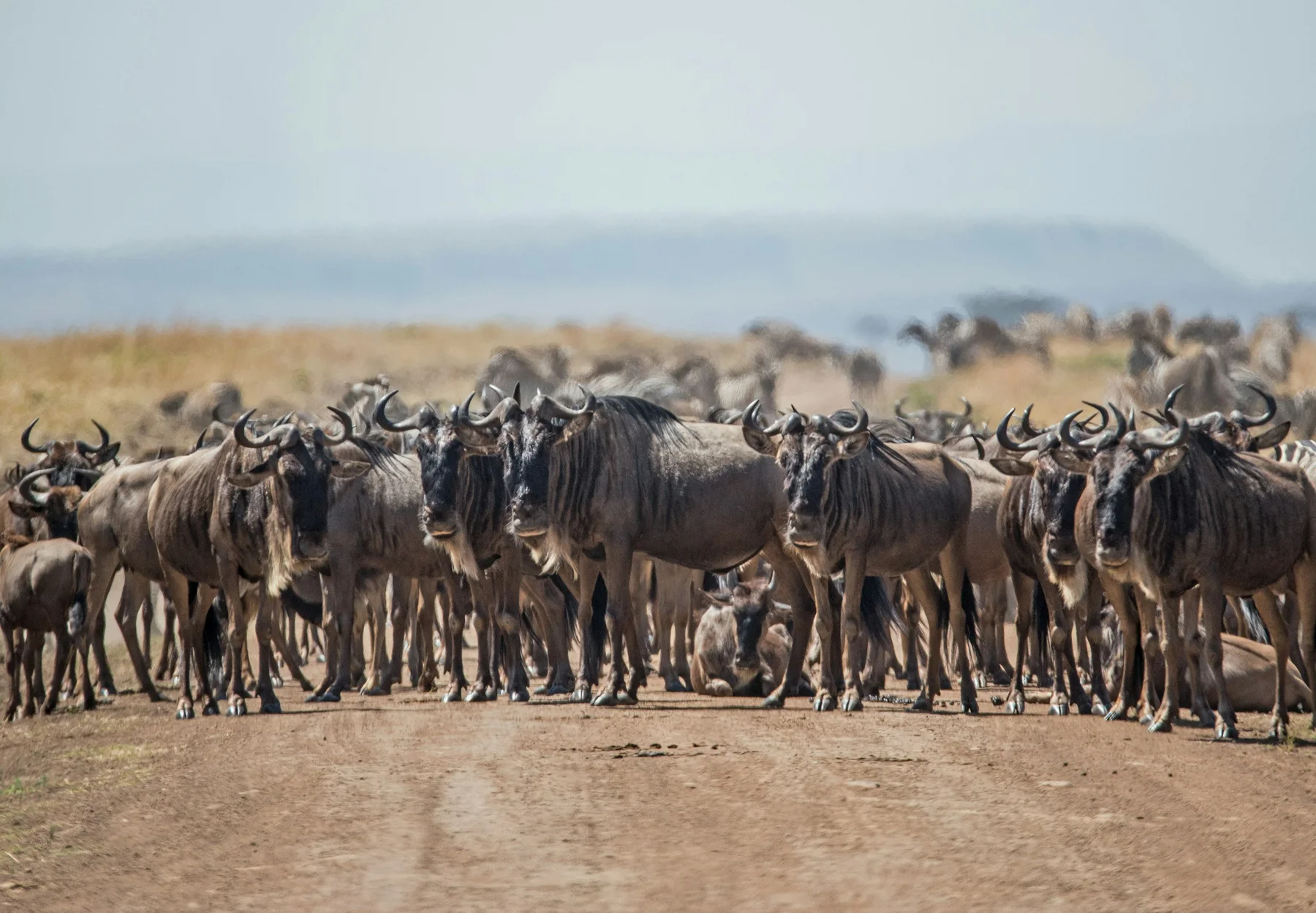
The road bends through waist-high grass, and for a moment there is nothing ahead but two wheel tracks and an acacia tree. Then a line of wildebeest steps onto the road. No guide calls the sighting over a radio. No driver chooses where to stop. You turn off the engine and wait while the herd makes the decision for you.
That freedom is the dream behind a Mara self-drive. It is real, but it comes with mud, confusing tracks, rental fine print, wildlife rules and the possibility that the lion everyone else found remains invisible to you.
So, can you self-drive the Masai Mara? Yes, experienced travellers can drive themselves in the public Maasai Mara National Reserve with the right vehicle and current entry information. That answer does not automatically apply to the private conservancies, and it does not mean self-driving is the best choice for every visitor.
The short answer
Self-driving is possible in the National Reserve. Use a genuine high-clearance four-wheel-drive vehicle, confirm the chosen gate will admit that vehicle for game driving, carry the correct documents, and understand the current Narok County or Mara Triangle rules before arrival.
Private conservancies work differently. Many restrict independent vehicles and arrange wildlife drives through their member camps and licensed guides. A reservation at a conservancy camp is not permission to wander through neighbouring private land in a rental car.
Quick verdict
| Traveller | Verdict | Main reason |
|---|---|---|
| Experienced African self-driver with 4×4 skills | Strong possibility | Understands rough tracks, recovery and uncertainty |
| First safari with no off-road experience | Choose a driver-guide | Driving and wildlife learning compete for attention |
| Repeat Mara visitor who knows one sector | Good candidate | Familiarity reduces navigation and sighting risk |
| Family with a baby or very young child | Usually guided | Less stress, better help and more attention for the child |
| Photographer working alone | Usually guided | A driver frees both hands and watches the track |
| Couple wanting a relaxed honeymoon | Guided or private vehicle | Nobody has to navigate, recover or argue over directions |
| Traveller with a painful back | Consider flying and a private guide | The game-drive tracks remain rough even after a flight |
| Guest staying in a private conservancy | Use the camp vehicle | Independent access is commonly restricted |
What does self-drive actually mean?
People use “self-drive” for three different arrangements. The distinction matters because only one leaves you completely alone with the steering, map and recovery gear.
Fully independent driving
You rent a vehicle, drive from Nairobi, enter the Reserve, navigate game drives and reach the accommodation without a guide. This offers the most freedom and the highest responsibility.
The driver must watch ruts, animals and other vehicles while someone else navigates. If travelling solo, those jobs happen at the same time.
Self-drive to the Mara, then use a camp vehicle
You drive to accommodation outside or near a gate, park securely, and join guided drives. This keeps the Kenya road-trip freedom while handing the difficult wildlife tracks to a professional.
Confirm secure parking before booking. Leaving a rental beside a gate for several days can breach the rental agreement or create an insurance problem.
Rental vehicle with a local guide
You remain responsible for the hired 4×4 but add a guide who knows the gates, zones, tracks and animal behaviour. Some guides drive; others navigate and spot while you drive.
This hybrid can be excellent. Agree in writing who is insured to drive, how the guide returns home, who pays accommodation and whether the vehicle has the necessary tourism permissions.
Is self-driving legal in the National Reserve?
The Maasai Mara National Reserve management plan writes its visitor regulations for “visitors and their guides” and lists designated road gates, vehicle speeds and behaviour. The Mara Triangle’s official visitor information also answers vehicle questions directly and says a four-wheel-drive vehicle is suited to the drive.
That supports independent access to the public Reserve. Entry can still depend on current county notices, vehicle classification, gate operations, payment systems and the condition of the road that day. Confirm those details before leaving Nairobi.
National Reserve is not the same as a conservancy
The National Reserve is county-managed protected land. The surrounding conservancies are partnerships on private or community land with their own access, camp and vehicle rules.
| Area | Independent vehicle assumption | Safer planning rule |
|---|---|---|
| Central Mara, Narok side | Self-drive may be admitted with a suitable vehicle | Confirm gate and vehicle requirements |
| Mara Triangle | Official visitor information addresses self-drive 4x4s | Use current Oloololo or Purungat information |
| Private conservancy | Do not assume access | Ask the booked camp or conservancy in writing |
| Community road outside protected land | Public access varies by road | Do not turn onto tracks that look open |
| Camp driveway | Access belongs to the property | Request exact arrival coordinates and escort advice |
The distinction is especially important when a map draws the whole Greater Mara as one green space. Wildlife crosses it freely. Visitors and vehicles do not.
Why conservancies often restrict self-drive
Conservancies sell a lower-density experience and control vehicle numbers through their member camps. They also manage grazing, landowner agreements, night drives, walking and limited off-road viewing under rules that differ from the Reserve.
An unregistered rental vehicle can undermine that system. Book the conservancy for its guided experience, then use self-drive days in areas where independent access is expressly permitted.
The rules that matter before the first sighting
The current Reserve management plan names designated gates and clear behaviour standards. These are not optional tips.
| Rule | What it means from the driver’s seat |
|---|---|
| Enter and exit at designated gates | Do not follow an informal shortcut across an open boundary |
| Maximum 50 km/h on graded roads | Slow further for dust, bends, people and animals |
| Maximum 30 km/h on other roads | A narrow track is not a rally stage |
| Keep about 25 metres from wildlife where possible | Leave the animal room to move or leave |
| Maximum five vehicles at key predator sightings | Wait back when the group is full |
| Do not chase or follow animals | A photograph never justifies pressure |
| No off-road driving in High Use or Mara River zones | Read signs and know the zone before leaving a track |
| Use designated places to alight | A quiet patch of grass is not automatically safe |
| No entry after 18:30 | Plan arrival with a large margin |
| Return to accommodation or exit by 19:00 | Sunset is not permission to race home |
Read the separate Masai Mara game-drive rules and wildlife etiquette guide before collecting the car. It explains crowding, crossings and considerate viewing in more detail.
The honest difficulty is not the highway
A tarmac approach can create false confidence. Reaching Sekenani on a good road does not make the game tracks easy. Inside the Reserve, rain pools in wheel ruts, grass hides holes, animals block the road and one promising shortcut may dissolve into many faint tracks.
One traveller summarised the contrast as “Roads to the Mara are totally fine”, then warned that driving inside is the harder part. Another wrote that “The tracks for the game drives are very rough”.
Both impressions can be true on the same trip.
Which vehicle do you need?
Use a genuine 4×4 with high clearance and low-range gearing. A badge that says SUV is not enough. Many urban crossovers drive all four wheels but lack clearance, suitable tyres, recovery points or the gearing needed to crawl through mud without wheel spin.
The Mara Triangle’s official driving guidance says any 4×4 is suited and tells visitors to ensure the vehicle has four-wheel drive. For the wet season and less-used tracks, a safari-prepared Land Cruiser provides a much larger margin than a soft-roader.
Land Cruiser, Prado, safari van or crossover?
| Vehicle | Dry main tracks | Wet or remote tracks | Wildlife viewing | Verdict |
|---|---|---|---|---|
| Safari Land Cruiser | Strong | Best margin when driven well | Excellent pop-up roof | First choice |
| High-clearance Prado | Often capable | Depends on tyres, recovery and driver | Side-window viewing | Workable for experienced drivers |
| 4×4 safari van | Common on main routes | Lower clearance can limit choices | Good pop-up roof | Better with a professional driver |
| Compact AWD crossover | May reach a gate | Weak recovery and clearance margin | Limited | Do not plan Mara game drives around it |
| 2WD saloon | Road approach only in favourable conditions | Unsuitable | Poor | Not a game-drive vehicle |
Vehicle capability does not cancel bad judgement. A Land Cruiser on highway tyres with a tired battery and no recovery points is a poor expedition vehicle.
The pop-up roof is more than a luxury
A pop-up roof improves visibility over grass and lets passengers look in different directions without leaning out of windows. It also changes height, wind noise and how the vehicle behaves on a side slope.
Check that the roof locks securely when driving. Nobody should sit or stand on the fixed roof, and passengers must come down before the vehicle moves quickly or enters uneven ground.
Tyres decide more than the badge
Inspect all four tyres and both sides of each sidewall. Ask when they were replaced, what pressure the rental company recommends for tarmac and tracks, and whether the spare matches the wheel size.
All-terrain tyres with good tread improve puncture and traction margins. They do not make black-cotton mud harmless.
One spare may not be enough
Remote driving is more comfortable with two usable spares, a jack that can lift the loaded vehicle, a broad jack base, wheel brace and puncture repair kit. Practise finding the jacking points before entering the Reserve.
Changing a tyre beside wildlife is not a casual roadside task. Call rangers or camp staff and remain in the vehicle until a safe plan is agreed.
Recovery equipment
At minimum, carry a rated recovery strap, shackles compatible with proper recovery points, shovel, gloves and traction boards. A winch is useful only when there is a safe anchor and someone knows how to rig it.
Never attach a recovery strap to a tow ball. Stand well clear of a loaded strap and do not let a helpful stranger turn the recovery into a dangerous spectacle.
Rental questions that cannot wait until collection
| Question | Why it matters |
|---|---|
| Is game driving in the Maasai Mara permitted by this contract? | Some policies exclude unsealed or park roads |
| Which named people may drive? | An unlisted guide may not be insured |
| Is recovery from the Reserve covered? | A tow can become a large personal bill |
| Is underbody, tyre and windscreen damage covered? | These are common exclusions |
| Is water damage covered? | Most sensible policies exclude reckless crossings |
| Does the vehicle have tourism or gate paperwork currently required? | Entry practice may change |
| How many spares and recovery points are supplied? | “Fully equipped” is too vague |
| Who answers the emergency phone after dark? | A daytime office number is not a rescue plan |
| Can the vehicle cross into Tanzania? | Usually not without prior cross-border authority |
| Where may it be parked during camp drives? | Unattended-vehicle clauses still apply |
Photograph every panel, tyre, wheel, glass surface and the underbody at handover. Put existing warning lights and noises on the inspection sheet.
Driving licence and identification
Carry your original driving licence, passport, rental agreement and any International Driving Permit required by Kenyan law or the rental company. The name and class must match the vehicle.
Keep digital copies offline, but expect gates and police to request originals. A photograph of a licence is not the same document.
Insurance language to read slowly
“Comprehensive” can still exclude off-road use, water, tyres, roof damage, negligence, night driving or an unnamed driver. Ask for the policy wording, not a WhatsApp assurance.
If the itinerary includes a conservancy, campsite or border route, name it and ask the insurer to confirm coverage in writing.
Nairobi to Sekenani
Sekenani is the usual approach for the eastern and central Narok side. The road from Narok is tarmacked, but traffic, road works, weather and the final camp access still affect travel time.
Do not use a map estimate as a gate appointment. Leave Nairobi early, refuel in Narok and plan to reach the area in daylight with time to solve a tyre or navigation problem.
Nairobi to Oloololo and the Mara Triangle
For properties near the western escarpment, the Aitong approach can be more logical than entering at Sekenani and crossing the Reserve. The correct route depends on the camp’s exact position.
The official Mara Triangle driving page distinguishes the Sekenani route for Mara Serena from the Aitong route for several western properties. Ask accommodation for a current pin and written approach notes.
Talek and Ololaimutia approaches
Talek and Ololaimutia serve different eastern and south-eastern areas. A camp described as “Masai Mara” may be 30 or 60 minutes from the gate that looks closest on a small map.
Use the forthcoming Mara Triangle vs Talek vs Sekenani guide to compare sectors before choosing the road.
The seven designated gates in the management plan
The Reserve plan lists Sekenani, Talek, Musiara, Ololaimutia, Sand River, Enoompuai and Oloololo. Purungat Bridge is an important control point between the Narok side and Mara Triangle.
Not every gate suits every journey. Sand River sits near the international border and is not a casual shortcut into Tanzania.
Choose the gate from the bed, not the map centre
Start with the exact accommodation coordinates, then choose the legal approach that reaches it before closure. “Inside the Mara” is not an address.
Ask the camp for the final 20 kilometres, the gate, landmarks, phone contact and a point beyond which a staff escort is recommended.
Fuel
Fill before entering. The Mara Triangle notes that some lodge or camp stations may sell fuel but shortages happen. Treat that supply as backup, not the plan.
Estimate game-drive distance generously, then retain a reserve for wrong turns, idling, recovery and the return to Narok or the next reliable station.
Navigation
Google Maps is useful for the highway and unreliable as a complete game-drive guide. Tracks appear and disappear, seasonal closures change, and a line on the screen may cross a drainage channel or protected zone.
Carry offline mapping, a paper visitor map and camp directions. Mark the gate, accommodation, bridge, airstrip and safe landmarks before the first drive.
Do not follow tyre marks blindly
The freshest tracks may belong to a ranger, a camp vehicle with permission, or a driver who already made a mistake. A visible line through grass is not proof that the route is legal or passable.
When unsure, stop on firm ground and call. Reversing half a kilometre is cheaper than proving the map wrong at the bottom of a gully.
Rain changes the Mara in minutes
Dark clouds over dry grass are beautiful until the first water reaches black-cotton soil. A firm-looking top layer can become slick, and deep ruts channel a vehicle toward the lowest point.
The Masai Mara road conditions and gate guide explains the route differences and seasonal trouble spots in detail.
Black-cotton soil
This clay-rich soil holds water and becomes slippery, sticky and heavy. Spinning the wheels digs down, fills tyre tread and damages the track.
Engage the correct four-wheel-drive setting before the difficult patch, keep gentle momentum and avoid abrupt steering. If the vehicle stops moving, stop digging.
Dry season is not risk-free
Dry tracks bring corrugations, dust, hidden holes and sharp stones. Dust also reduces visibility when another vehicle overtakes or approaches a sighting.
Leave a long gap. If you cannot see the road, slow down rather than following the red cloud.
A ditch can stop a capable vehicle
An independent Kenya traveller wrote “I immediately got stuck” after one side of a small jeep dropped into a ditch near camp. That sentence is useful because the problem was not a cinematic river crossing. It was a hard-to-read depression close to accommodation.
Another account described being “bogged down to the axle” and waiting for another game-drive vehicle to pull them free.
Recovery is part of self-drive planning, not evidence that the holiday failed.
When to stop before getting stuck
Walk the route only in a place where alighting is permitted and wildlife risk has been checked. Otherwise wait inside and ask a ranger or professional driver to assess it.
Warning signs include standing water with no visible exit, churned mud, other vehicles turning back, water above the hub line, a steep side slope and a track disappearing into reeds.
Water crossings
Do not enter water without knowing depth, surface, current, exit angle and the vehicle’s wading limit. Floodwater can hide a washed-out culvert.
If a local guide turns around, that is information. Waiting for another vehicle to attempt the crossing does not make it safe.
The self-drive season
| Period | Driving character | Self-drive implication |
|---|---|---|
| January to March | Often drier, dusty and hot | Better track confidence, but punctures and dust remain |
| April to May | Long-rain risk and green landscape | Experienced wet-condition drivers only |
| June | Drying transition | Conditions depend on the preceding rain |
| July to October | Busy migration season and generally drier | More traffic, crowds and crossing pressure |
| November to December | Short-rain variability | One storm can change a track quickly |
Season labels are not forecasts. Ask the camp about the previous 48 hours and the road you will actually use.
April and May
The quieter green season can be wonderful for experienced drivers who accept weather disruption. It is a poor moment to learn four-wheel-drive recovery with children in the vehicle.
Read Masai Mara in April and May before choosing lower rates over access confidence.
Migration season
The migration adds traffic, pressure at river crossings and a temptation to follow convoys. Self-driving does not grant a better crossing position.
Drivers must keep routes open, avoid blocking herds and obey rangers. The migration is a moving ecology, not an appointment at one bend in the river.
River crossings
Never leave the vehicle at a crossing. Do not park between a herd and water, close an escape line or drive through animals to reach the front.
Our Great Migration river crossings guide explains timing uncertainty and ethical viewing without promising a plunge.
Weather apps do not read individual tracks
A phone may show light rain for the region while a thunderstorm drops heavily on one drainage line. Satellite coverage and mobile data can also fail.
Use forecasts for awareness, then use rangers, camps and vehicles returning from the route for current ground truth.
Mobile signal
Coverage varies by sector and network. A full signal near a lodge does not guarantee communication beside the river or escarpment.
Carry two local networks where possible, save emergency numbers offline and tell someone where you intend to drive.
Emergency contacts
Save the rental company, camp, relevant gate, reserve authority, insurer and medical evacuation provider. Put the same list on paper.
An emergency plan that exists only in the cloud disappears with the signal or a flat phone.
Battery and charging
Bring a vehicle charger, power bank and cable that works without balancing a phone against the dashboard. Keep one phone for communication rather than exhausting every battery on navigation and video.
Test the vehicle’s sockets at handover.
Water and food
Carry drinking water for everyone plus an emergency margin. Add simple food that tolerates heat, and keep it sealed.
Do not feed wildlife, leave scraps or step out for a picnic unless the location is designated and currently safe.
Clothing and dust
Use comfortable clothes, closed shoes, sun protection and a light layer for early starts. Keep a scarf or buff for dust, but never let loose fabric interfere with driving.
The Kenya safari packing guide covers light-aircraft limits as well as road-trip essentials.
Camping inside the Reserve
Camping is not permission to stop anywhere at sunset. Use a booked public or private campsite and confirm the current ranger, reservation, fee, fire and waste arrangements.
The Mara Triangle’s official guidance says camping vehicles must use public or private campsites. Wild camping beside a track is unsafe and unauthorised.
Public versus private campsites
Public sites may host several independent groups and offer fewer facilities. Private sites provide exclusivity but require advance booking and can include ranger requirements.
Ask about water, toilets, firewood, food storage, ranger transport and how far the site is from the gate.
Food in camp
Store food securely inside the vehicle or approved container. Do not keep meat, rubbish or scented toiletries in a tent.
Follow ranger instructions even when another camper seems relaxed. Habituated hyenas and baboons are not a small inconvenience.
Staying outside the Reserve
An outside camp can lower accommodation cost and simplify road access. It can also add a gate queue and a long transfer before the first wildlife drive.
Ask for the door-to-gate time, then the gate-to-main-viewing-area time. “Five minutes from the Mara” may mean five minutes from a boundary, not five minutes from the lions.
Staying inside the Reserve
An internal camp reduces daily gate transitions and places you closer to dawn wildlife. The driver still needs to reach it legally before closing time.
Choose the property by sector, not brand alone. Our Masai Mara safari guide explains the geography before you commit to a bed.
Secure parking when using a camp vehicle
If you self-drive to the area and switch vehicles, obtain written confirmation that the rental can remain on the property, where keys are held and whether security cameras or guards cover the parking area.
Remove luggage from sight and follow the insurer’s unattended-vehicle conditions.
Hiring a guide for one day
A first guided day can teach track hierarchy, zone rules, animal distance and the way landmarks fit together. The next independent day becomes far less abstract.
Hire through the camp or a properly licensed source. Confirm whether the guide joins your vehicle or brings one, who may drive and what happens if rain makes the planned route unsuitable.
The guide is not only a wildlife finder
A skilled guide reads alarm calls, tracks, posture and landscape. They also notice a storm over the escarpment, remember a closed route and know when a vehicle gathering is not worth joining.
That knowledge protects time. The value is not measured only by a lion count.
Wildlife spotting while driving
Driving and spotting compete. The driver watches the rut directly ahead while a leopard may be resting in a distant crook of a tree.
Use at least two people: one drives, one navigates and scans. Swap only at a safe designated place.
Why radios change the guided experience
Professional guides share information, but responsible guiding does not turn every sighting into a race. The Reserve rules restrict radio use near wildlife because noise disturbs animals and other guests.
Self-drivers often discover fewer predators but may spend longer with common animals and landscapes. Decide which type of satisfaction matters.
Do not chase a convoy
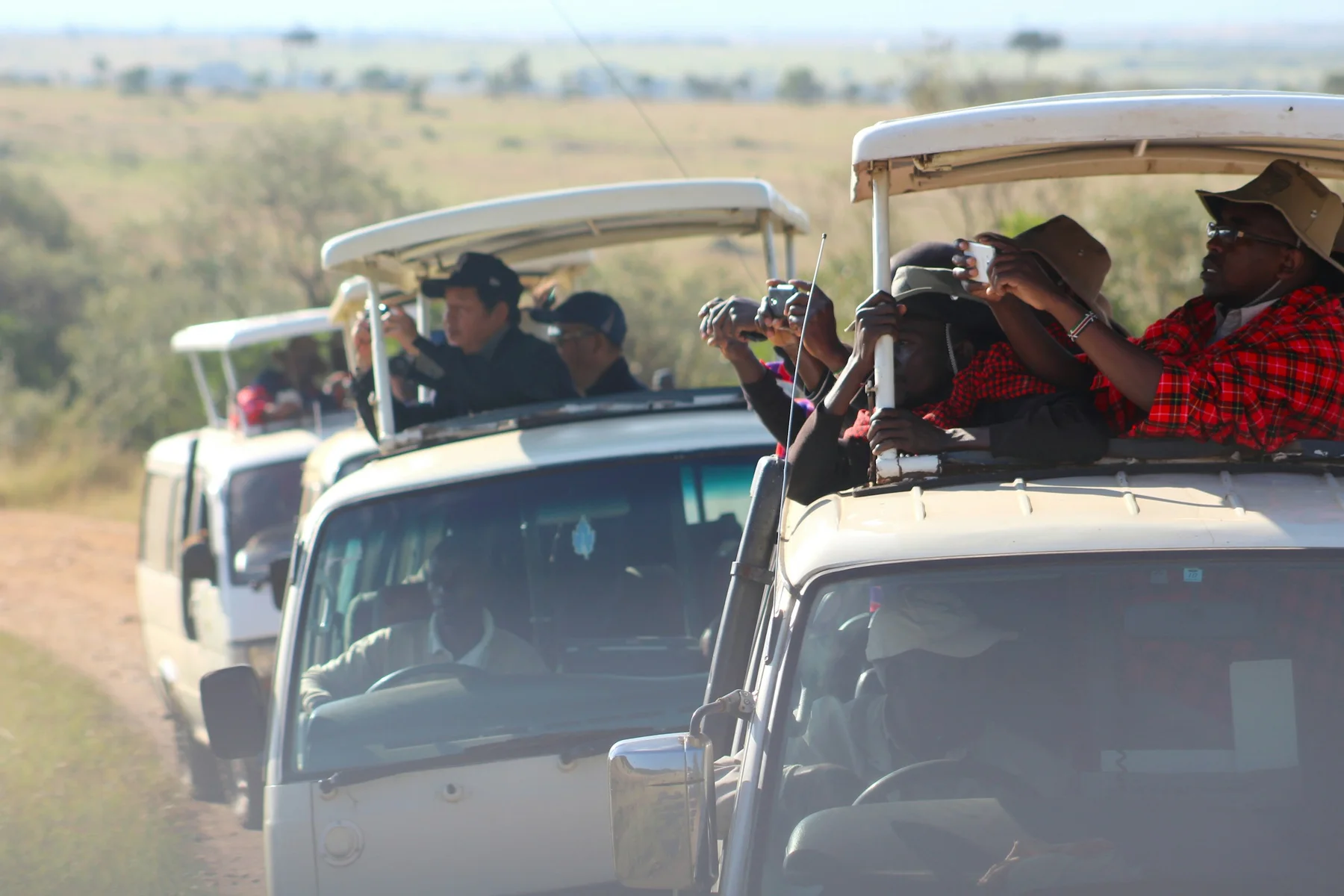
Five vehicles accelerating across the plain probably know about a sighting. Following at speed can create dust, collisions and rule-breaking.
Keep to the speed limit. A quiet elephant family encountered legally is better than arriving late to a stressed cheetah.
The five-vehicle rule
The Reserve management plan limits vehicles around lions, rhinos, leopards and cheetahs. When five are already present, wait at least 100 metres away.
The rule protects the animal and gives every visitor a turn. It also means self-drive freedom includes the freedom to leave.
Photography from a self-drive vehicle
Stop the vehicle, switch off the engine when appropriate and shoot from inside. Beanbags work well on a window frame, while a pop-up roof supports different angles.
The driver should not photograph while controlling a moving vehicle. A separate Masai Mara photography guide covers lenses, settings, dust and light.
Passenger position
Keep bodies inside the vehicle and never sit on the roof. Children should not stand unsupported through a roof opening while the vehicle moves.
Seat belts remain valuable on connecting roads even when the pop-up roof encourages passengers to stand on slow game drives.
Animals on the road
Stop and give the animal priority. Do not edge forward until an elephant, buffalo or predator is forced to move.
A herd across the road may take ten minutes or an hour. The delay is the safari.
Elephants
Watch ears, trunk, head angle and the space between family members. Never place the car between a mother and calf.
If elephants approach, stay quiet and allow them a clear route. Reversing early is easier than reversing after the vehicle is surrounded.
Lions and cheetahs
Keep distance, avoid blocking their path and do not start the engine suddenly beside resting animals. A cat may use the car for shade.
Do not follow a hunting predator off the authorised route. Hunting success matters more than a closer photograph.
Buffalo and hippos
Buffalo can disappear in tall grass beside the track. Hippos may graze far from water after dark or early in the morning.
These are strong reasons to remain in the vehicle outside designated areas.
Getting out of the vehicle
Use designated picnic sites, gates, accommodation and other authorised places. The management plan allows tightly controlled exceptions, but a first-time self-driver should not interpret a broad rule as casual permission.
Ask a ranger. Grass that looks empty can hide a buffalo, snake or drainage hole.
Night driving
Normal visitor game drives in the National Reserve must finish by the stated evening deadline. Night drives are associated with conservancies and their authorised operations, not an independent rental roaming after dark.
Read where Masai Mara night game drives are allowed before adding one to the itinerary.
Border awareness
The Kenya-Tanzania boundary is not fenced across every metre. White markers and maps indicate it in the Mara Triangle.
Do not cross into Tanzania. A Kenyan vehicle, visa and Reserve ticket do not grant Serengeti entry.
Breakdown procedure
Stop in the safest firm position available, stay with the vehicle and make the group visible without walking into the grass. Call the camp, ranger or rental emergency line with coordinates and a clear description.
Do not send one person walking for help. If another vehicle arrives, ask them to contact rangers rather than improvising a tow with unsuitable equipment.
If you are stuck
First stop wheel spin. Assess whether lowering tyre pressure within the vehicle and tyre limits, clearing mud, using boards or a straight gentle pull is appropriate.
If wildlife is nearby or the recovery point is uncertain, wait for trained help.
If the vehicle overheats
Turn off air conditioning, stop safely and shut the engine down if temperature continues rising. Do not open a hot cooling system.
Call the rental company. Continuing can change a small fault into an engine replacement and a safety emergency.
If you get lost
Stop while there is daylight and fuel. Save coordinates, retrace to the last known graded road only if the route is clear, and call the gate or camp.
Driving faster in a guessed direction makes the search area larger.
Medical emergencies
Travel insurance should cover safari activity, road travel and medical evacuation. Declare health conditions and keep essential medication in the cabin.
Flying to Nairobi can still take time. Prevention, hydration and a clear insurer contact matter.
Self-drive with children
Children add stops, food, toilet needs and supervision. The driver cannot manage a distressed child while negotiating mud beside an elephant herd.
A private guided vehicle often provides the same schedule freedom with another adult responsible for road and wildlife decisions.
Babies and toddlers
Bring an appropriate child restraint for highway travel and confirm it fits the rental. Safari pop-up seating is not a substitute for road safety.
Limit long drives and choose accommodation with short gate access. The Kenya safari with children guide covers age-specific pacing.
Travellers with limited mobility
Self-drive can provide control over stops, but high steps, narrow roof openings and roadside breakdowns create challenges. A private adapted itinerary may be safer and more comfortable.
Use the accessible Kenya safaris guide to ask about transfer height, seating, toilet stops and equipment.
Back pain
Flying avoids the long Nairobi road transfer but not rough game-drive tracks. Ask for a private vehicle, supportive seat, shorter drives and rest days.
One recent traveller wrote that “the game drive itself can be challenging” even after discussing a flight. That is the right distinction.
Self-drive on a honeymoon
Some couples love the shared adventure. Others discover that navigation, gate deadlines and recovery do not feel romantic after a long wedding week.
A private guided vehicle preserves privacy and flexible stops without making either partner the permanent driver.
Solo self-drive
Solo driving leaves nobody to navigate, scan, photograph, call for help or watch a wheel through a difficult section. Fatigue arrives sooner.
For a solo first visit, a shared guided departure or fly-in camp is usually better value than carrying every task alone.
Driving after an international flight
Do not collect a 4×4 and drive directly to the Mara after a night flight. Nairobi traffic, unfamiliar controls and fatigue create risk before the rough road begins.
Sleep in Nairobi, inspect the vehicle in daylight and leave early the next morning.
Self-drive costs
Self-drive removes the packaged driver-guide line, but it adds rental, insurance, fuel, vehicle entry, recovery exposure and sometimes a guide hired separately.
| Cost line | Self-drive | Guided private safari |
|---|---|---|
| Vehicle | Daily rental plus deposit | Included in safari price |
| Fuel | Paid directly | Usually included as specified |
| Guide | Optional extra | Included |
| Park visitor fee | Paid directly | Included or itemised |
| Vehicle entry fee | Paid directly | Included or itemised |
| Insurance excess | Traveller risk | Operator vehicle risk |
| Recovery | Policy-dependent | Operator-managed |
| Navigation time | Traveller responsibility | Guide responsibility |
| Wildlife knowledge | Self-taught or hired | Included |
Use the Kenya safari cost guide to compare full trip totals rather than one daily rate.
Is self-drive cheaper?
It can be for two experienced travellers on a longer Kenya circuit, especially when the vehicle also serves Nakuru, Naivasha or the coast. It may not be cheaper for a short Mara visit once insurance, fuel, fees and guide days are added.
Time lost to a wrong gate or breakdown has a real holiday value even when it never appears on a receipt.
Park fees and ticket rules
Fees change, and the Narok side and Mara Triangle have their own payment operations. The Mara Triangle currently explains a 12-hour ticket window, identification requirements and cashless payment on its official conservation fee page.
Check the official rate and payment method for the visit date. Do not build a budget from an old screenshot.
Vehicle fees
Visitor fees and vehicle entry charges are separate concepts. Ask whether the rental category changes the vehicle charge and whether repeated exits are covered within the ticket terms.
Keep receipts and entry records accessible until the trip ends.
The cost of a guide day
A guide day may save fuel, reduce wrong turns and improve sightings. It can be the highest-value addition to an independent itinerary.
Ask whether the fee includes the guide’s gate access, meals, accommodation and return transport.
Three sensible ways to do it
| Plan | Day one | Remaining days | Best for |
|---|---|---|---|
| Guided orientation | Drive to camp | Guide joins first drive, then independent drives | Experienced driver new to the Mara |
| Park and switch | Drive to outside camp | Use camp vehicle throughout | Road-trippers who do not want game-track risk |
| Fully independent | Drive, enter and navigate alone | Self-drive every day | Repeat visitors with recovery skills |
The first option offers the best balance for many confident drivers. It turns local knowledge into a lesson instead of a permanent dependency.
A three-night plan
Day one is an early Nairobi departure, Narok fuel stop and daylight arrival. Do not count on a meaningful game drive after a late gate entry.
Day two is a full guided orientation or a conservative independent loop near the accommodation. Day three explores one named sector. Day four leaves after a short dawn drive only if ticket and gate timing make it legal.
A five-night plan
Five nights allow one weather day, one guided day, two independent areas and a quiet morning without crossing the Reserve. It also reduces pressure to drive in rain because an expensive night feels “wasted.”
Move accommodation only when the new sector saves more road time than the move consumes.
Do not plan a grand crossing every day
Sekenani to the Mara River, the Triangle and back is not a small loop. Distances look shorter on a map than they feel at 30 km/h with animal stops.
The Masai Mara game drives guide compares full-day drives with morning and afternoon outings.
Mara Triangle for self-drivers
The Triangle has strong official visitor information, clear boundary features and important graded roads. It also has strict zones, cameras, speed rules and controlled off-road policy.
Read its current map and collect gate rules. Do not mistake better information for easy terrain.
Narok side for self-drivers
The central and eastern Reserve offers access through Sekenani, Talek, Musiara and other designated gates. It is larger and can feel confusing where multiple tracks cross open plains.
Choose one sector around the accommodation rather than trying to learn the entire side in a day.
Crossing between sides
Purungat Bridge connects the Narok side and Triangle. Ticket and transit rules depend on where you stay and pay.
Confirm the correct process before entering at Sekenani when sleeping in the Triangle. The official fee page specifically tells Triangle guests not to pay in the wrong place when transiting from Sekenani.
Combining Mara with Nakuru and Naivasha
An independent vehicle becomes more valuable on a multi-stop Rift Valley trip. Nakuru is compact, while Naivasha activities happen around different shores and properties.
Use accommodation-specific directions and avoid planning Mara to Nakuru through an unverified western shortcut.
Combining Mara with Amboseli
The direct-looking line is a long road day around Nairobi or across complex regional routes. Do not schedule a dawn Mara drive and an Amboseli sunset on the same day.
Break the journey or use a planned transfer. Long driving hours are not a sign of getting more safari for the money.
Combining Mara with Tanzania
The Reserve touches Serengeti, but tourists cannot drive through the wildlife boundary. Legal crossings, vehicle permissions, temporary importation and rental approval are separate.
Most Kenya rental vehicles cannot be taken into Tanzania without prior written arrangements. Build the international road border into the itinerary.
Flying one way
A one-way flight can remove the most tiring road leg, but a one-way rental drop may be expensive or unavailable. A guided vehicle can drive in while guests fly, then meet them at an airstrip.
The Masai Mara airstrips and flight guide helps match an airstrip to the camp rather than choosing the cheapest flight blindly.
What independent travellers actually say
Forum comments are personal experiences, not regulations. They are still useful because they show how different the same drive can feel.
One recent contributor said “the Mara is certainly doable” for experienced self-drivers. Another long-time regional driver said “I would never do it in Rav4” when describing a difficult western dirt route, not the tarmac to Sekenani.
A separate discussion captured the uncertainty neatly: “it can be done”. Another experienced Kenya driver added that “you do need to be vigilant”.
These are not contradictions. Route, rain, vehicle, skill and tolerance change the answer.
Why a confident road driver can still struggle
Motorway experience does not teach low-range selection, wheel placement in ruts, wildlife distance or how black-cotton soil behaves after one storm.
A good first step is self-driving Nakuru or a well-defined Naivasha circuit, then adding a guided Mara.
Why a cautious driver can succeed
Caution leaves early, turns around, stays on known roads and asks for help. It also accepts that missing one sector is better than returning after gate time.
The worst combination is a capable vehicle, a rigid checklist and a driver who treats every warning as a challenge.
The freedom you genuinely gain
You can stop with giraffes for an hour, leave a crowded lion and eat breakfast when hungry. The day belongs to the group rather than a lodge departure board.
That freedom is the best reason to self-drive. Saving money is secondary.
The expertise you genuinely lose
You lose a trained eye, local route memory, radio context, mechanical familiarity and someone who knows the expression of an uncomfortable elephant.
Good guides do not merely point at animals. They make the landscape legible.
Self-drive versus private guide
| Decision | Self-drive | Private driver-guide |
|---|---|---|
| Daily timing | Complete control | Highly flexible |
| Wildlife spotting | Depends on the group | Skilled local eye |
| Navigation | Your responsibility | Guide handles it |
| Recovery | Your responsibility | Operator handles it |
| Photography while moving | Driver cannot shoot | All guests can shoot |
| Family support | One adult occupied | Driver frees both parents |
| Cost certainty | More variable | More itemised upfront |
| Adventure | High | Still personal in a private vehicle |
Self-drive versus shared safari
A shared safari costs less per person than a private guided vehicle, but departure times and sightings are collective decisions. Self-drive gives control at the cost of competence.
Ask how many window seats and roof positions the shared vehicle actually has.
Self-drive versus fly-in camp
Fly-in suits limited time, back concerns and a single high-quality camp. Self-drive suits a longer Kenya circuit and travellers who enjoy the road itself.
A 45-minute flight does not make game tracks smooth, but it preserves energy for them.
The best compromise
Drive a suitable 4×4 to a secure camp, book a private guide for the first full day, then decide whether later drives should be independent. Keep the guide if rain begins or the itinerary crosses unfamiliar sectors.
There is no prize for refusing help after conditions change.
Common self-drive mistakes
| Mistake | Better choice |
|---|---|
| Renting an AWD crossover because the listing says SUV | Confirm low range, clearance, tyres and recovery points |
| Choosing the gate from Google Maps | Choose it from the exact camp location |
| Arriving near closing time | Sleep en route or leave Nairobi earlier |
| Following every safari convoy | Obey speed and crowding rules |
| Entering mud to prove the 4×4 | Stop before losing traction |
| Assuming conservancy access | Obtain written permission or use the camp vehicle |
| Carrying one phone and no paper map | Use offline, paper and backup power |
| Treating lodge fuel as guaranteed | Fill before entry |
| Photographing while driving | Stop and hand the camera to a passenger |
| Planning every day across the Reserve | Explore one sector properly |
A vehicle handover checklist
Check oil, coolant when cold, brake feel, warning lights, four-wheel-drive engagement, low range, jack, wheel brace, spare tyres, recovery points, tow strap, shovel, first aid, fire extinguisher, lights, wipers, chargers and roof locks.
Drive a short loop with the rental representative. A demonstration is better than a diagram after dark.
A departure checklist
Carry licences, passports, rental contract, insurance contact, gate confirmation, accommodation pin, printed map, water, food, cashless payment options, two phone networks, charger, power bank, rain layer, hats and required medication.
Tell the camp the number plate, expected gate and arrival window.
A daily game-drive checklist
Ask about rain, closed tracks, the chosen loop, sunset, fuel and the last safe turning point. Record the odometer and start with enough daylight to handle delay.
Clean windows and lights before leaving. Dust becomes glare at sunrise.
Questions for the rental company
Ask whether Mara game drives are allowed, which roads are excluded, who may drive, what the excess covers, whether underbody and water are excluded, what recovery costs, how many spares are provided, and whether the emergency line works at night.
Request each answer in writing.
Questions for the accommodation
Ask for the legal gate, final road, latest safe arrival, secure parking, current track condition, guide availability, fuel reality, meal timing and the process if heavy rain begins.
A useful camp answer names landmarks and alternatives. “Follow Google” is not enough.
Questions for yourself
Have you used low range? Can you change a tyre? Can the group stay calm during a two-hour delay? Will the driver enjoy missing photographs? Does anyone have a back, mobility or medical concern?
Honest answers protect the holiday.
When we recommend self-drive
It suits repeat safari travellers, confident 4×4 drivers, flexible schedules and routes that include several Kenyan destinations. At least two capable adults should share navigation, communication and recovery decisions.
The best candidates enjoy the journey even when the big cat is elsewhere.
When we recommend a driver-guide
Choose a guide for a first safari, a short visit, migration crowds, wet-season travel, young children, serious photography, limited mobility or a trip focused on rare sightings.
A private vehicle keeps the flexible pace many self-drivers actually want.
When we recommend flying
Fly when time is scarce, the Nairobi road would consume a large share of the trip, or back and fatigue concerns outweigh road interest. Choose the airstrip from the accommodation location.
Do not fly merely because somebody called every Kenya road dangerous.
Final verdict
If you are asking can you self-drive the Masai Mara because you love independent African road trips, know a real 4×4 and can change the plan when rain arrives, the answer can be yes. Confirm the gate and current vehicle rules, respect the Reserve zones and consider hiring a local guide for the first day.
If you are asking because a driver-guide looks like an avoidable cost, pause. Their skill is part of the wildlife experience, the navigation plan and the safety margin.
The most satisfying choice is the one that lets everyone look up from the track often enough to see the Mara.
Frequently asked questions
Can you self-drive the Masai Mara without a guide?
Experienced travellers can self-drive in the public National Reserve with a suitable vehicle and current entry confirmation. Conservancy rules differ.
Do I need a Land Cruiser?
A safari Land Cruiser offers the best margin. Another genuine high-clearance 4×4 may be suitable in good conditions, but a compact crossover is a poor substitute.
Can I use a rental Prado?
Possibly, if the contract allows Mara game drives, the gate accepts it, the tyres and recovery equipment are suitable, and the driver has relevant experience.
Can I self-drive into a private conservancy?
Do not assume so. Ask the conservancy or booked camp in writing. Many arrange all wildlife drives through authorised camp vehicles.
Is the road from Nairobi paved?
The normal Narok to Sekenani approach is tarmacked. Roads to other sectors and internal game tracks vary greatly.
Is Google Maps enough?
No. Use offline mapping, a paper visitor map, current camp directions and local advice.
Can I drive at night?
Normal Reserve visitors must meet evening entry, exit and accommodation deadlines. Independent night game drives are not allowed.
Can I camp anywhere?
No. Use a booked public or private campsite and follow the current ranger and fee requirements.
What happens if I get stuck?
Stop wheel spin, stay with the vehicle, share coordinates and call the camp, rangers or rental recovery line.
Is self-drive cheaper?
Sometimes, especially on a longer circuit. Compare rental, insurance, fuel, entry, recovery exposure and optional guide costs with a complete guided price.
Is self-drive good for a first safari?
Usually not. A private driver-guide gives similar schedule freedom while adding wildlife, route and safety knowledge.
What is the safest compromise?
Drive to secure accommodation, hire a local guide for the first day and keep later plans flexible around weather and confidence.
Tell us what you want to drive yourself
Share dates, 4×4 experience, vehicle plan, travellers, accommodation, gates and the rest of your Kenya route. We can arrange a private driver-guide, a local guide in your vehicle or a route that keeps the road-trip freedom outside the game tracks.