
Hot-Air Balloon Safari in the Masai Mara: Cost, Timing, Safety and Value
Follow the morning from the alarm to the landing, understand every charge, and decide whether a balloon belongs in your Mara itinerary.

- The short answer
- What “worth it” really means
- The strongest reason to fly
- The weakest reason to fly
- Who usually loves it
- Who may regret it
- A decision in thirty seconds
- What the morning really includes
- A realistic sample timeline
- The wake-up call
- The camp transfer
- The pre-flight briefing
- The inflation
- The launch
- Sunrise from the basket
- The airborne hour
- The burner
- The landing
- The recovery
- The breakfast
- The return to camp
- The complete 2026 cost
- The seasonal flight rate
- Why the headline price can mislead
- The landing fee
- The community levy
- Medical evacuation cover
- Park-ticket questions
- Transfer charges
- Child pricing
- Resident and non-resident categories
- Currency and card costs
- Cancellation terms
- A clean cost comparison
- Flight duration versus morning duration
- What the pilot can control
- What the pilot cannot control
- How wind chooses the route
- Why altitude changes
- Why the route is never exact
- Wildlife from the air
- What large herds look like
- What individual animals look like
- Predator sightings
- Birds from a balloon
- No-animal mornings
- Great Migration expectations
- River-crossing expectations
- Migration from above
- Green-season wildlife
- The April and May question
- Aerial view versus ground drive
- What a ground drive does better
- What the balloon does better
- Can you do both?
- The two-night problem
- The five-night advantage
- Location matters before price
- Reserve launch areas
- Conservancy guests
- Mara Triangle guests
- Talek guests
- Sekenani guests
- Camp choice and balloon choice
- Safety begins before launch
- The operator question
- The aircraft question
- The pilot question
- The weather decision
- The safety briefing
- The landing position
- An upright landing
- A side landing
- Indemnity forms
- Travel insurance
- A safety-question table
- Children
- Why height matters
- Teenagers
- Pregnancy
- Recent surgery
- Back, hip and knee pain
- Limited mobility
- Wheelchair users
- Fear of heights
- Motion sickness
- Anxiety and confined space
- Bathroom timing
- Alcohol and medication
- Passenger suitability checklist
- Weather can cancel a beautiful plan
- Wind limits
- Rain
- Thunderstorms
- Fog and visibility
- Wet landing fields
- When the call is made
- Rebooking
- Refunds
- Your backup morning
- Season by season
- Photography begins with realistic goals
- Camera body
- Lens choice
- Phone photography
- Shutter speed
- Exposure at sunrise
- Condensation and cold
- Basket etiquette for photographers
- What not to carry
- A practical camera setup
- What to wear
- Cold before dawn
- Heat from the burner
- Footwear
- Hats and loose scarves
- The tiny packing list
- Food before flight
- Breakfast dietary needs
- Privacy in a shared basket
- Proposals and celebrations
- Honeymoon value
- Solo travellers
- Private charters
- Traveller voices: the wonder
- Traveller voices: the perspective
- Traveller voices: the early start
- Traveller voices: the limitations
- Traveller voices: the final verdict
- How to read reviews well
- Reviews are not certification
- Common mistake: booking only by price
- Common mistake: expecting a fixed route
- Common mistake: hiding a health issue
- Common mistake: forgetting the next activity
- Common mistake: carrying too much camera gear
- Common mistake: using all the safari budget
- A booking checklist
- Seven days before
- The evening before
- At the launch
- During flight
- Before landing
- After landing
- If the flight cancels
- Who should book
- Who should skip
- The best itinerary position
- The best number of Mara nights
- The final verdict
- Frequently asked questions
- How much is a Masai Mara balloon safari in 2026?
- How long is the flight?
- What time is pickup?
- Is breakfast included?
- Are animals guaranteed?
- Can I see a river crossing?
- Is the landing dangerous?
- Can children fly?
- Can a pregnant person fly?
- Can a wheelchair user fly?
- What if weather cancels?
- What should I bring?
At 4:45 in the morning, the Mara is mostly sound. Canvas moves in the breeze. A hippo grunts somewhere beyond camp. Your coffee arrives in a flask, and the vehicle waiting outside has its headlights dipped. This is the unglamorous beginning of one of Kenya’s most photographed experiences.
An hour or two later, the basket may be drifting above riverine forest, gold grass and animals that look like moving punctuation marks. Or the wind may carry you over a quieter piece of country with fewer large herds. Both mornings can be beautiful. Only one matches the picture most travellers have in mind.
A hot-air balloon safari in the Masai Mara is expensive, weather-dependent and impossible to steer like a game-drive vehicle. It can also reveal the ecosystem’s scale in a way the ground never can. This guide gives you the honest version, including the full cost, the lost sleep, the safety questions, the landing, the breakfast and the travellers for whom it is not good value.
The short answer
Book the flight if aerial landscape, a special occasion and a rare aviation experience matter more than close wildlife control. Think carefully if the safari is only two nights, the budget is tight, or your main aim is eye-level photography of one species.
| Your priority | Balloon value | Why |
|---|---|---|
| Seeing the Mara as one connected ecosystem | Excellent | Height reveals rivers, tracks, herds and habitat boundaries |
| A memorable honeymoon or milestone | Excellent | The morning feels ceremonial from dawn to breakfast |
| Close portraits of big cats | Uncertain | The route is wind-led and the basket cannot stop beside a subject |
| Watching behaviour for a long time | Limited | A flight passes through rather than waiting |
| Migration scale | Potentially excellent | Large herds can be extraordinary from above when they are under the route |
| A low-cost safari upgrade | Poor | The flight and separate fees are a substantial addition |
| Accessibility without careful planning | Variable | Basket entry, standing and landing can be demanding |
What “worth it” really means
Value is not the same as seeing the most animals. A ground drive may produce a longer lion sighting and better portraits. A balloon may give you ten silent minutes watching sunlight travel across an entire valley. Decide which memory you are actually buying.
The strongest reason to fly
The strongest reason is perspective. From the ground, the Mara arrives one acacia, one drainage line and one herd at a time. From the basket, those pieces connect. You see how a stream gathers trees, how tracks radiate from water and how animals use open ground differently from cover.
The weakest reason to fly
Do not book because somebody promised a river crossing from the air. A pilot follows safe wind and landing options. Wildebeest follow rain, grass and instinct. Neither will perform to a reservation time.
Who usually loves it
First-time balloon passengers, landscape photographers, couples celebrating a milestone and travellers with enough Mara nights to protect their ground-drive time are often the happiest. They come for the whole flight rather than one guaranteed animal.
Who may regret it
Regret is more likely when the booking empties the activity budget, the camp transfer begins extremely early, the traveller expected low close-up wildlife, or a painful knee makes the landing position difficult.
A decision in thirty seconds
| If this sounds like you | Best decision |
|---|---|
| “This may be my only visit, and I want one extraordinary dawn.” | Fly, if the full cost is comfortable |
| “I have two Mara nights and live for predator photography.” | Protect both prime ground drives |
| “We are celebrating our honeymoon.” | Fly, then keep the rest of the day gentle |
| “I dislike heights but feel calm in aircraft.” | Discuss basket height and briefing before deciding |
| “I need a seated activity.” | A standard balloon basket is unlikely to suit without specialist arrangements |
| “I want to see migration patterns, not demand a crossing.” | Fly in herd season with realistic expectations |
What the morning really includes
The airborne hour is only the centre of a longer outing. Your morning may include a camp pickup, a dark drive, check-in, safety briefing, balloon inflation, boarding, flight, landing, crew recovery, transfer to breakfast and a return or onward game drive.
A realistic sample timeline
Exact times depend on camp, launch site, sunrise and landing point. Treat this as a planning model, not a promise.
| Approximate time | What happens | What to notice |
|---|---|---|
| 04:30-05:30 | Wake-up and camp pickup | A distant camp may leave much earlier |
| 05:15-06:15 | Drive to launch | Roads can be cold, dark and rough |
| 06:00-06:40 | Briefing, inflation and boarding | Departure shifts with sunrise and conditions |
| 06:20-07:40 | Flight | Duration and direction depend on wind and landing options |
| 07:20-08:15 | Landing and recovery | Stay in position until the pilot releases you |
| 08:00-09:30 | Breakfast | Location and style vary by operator |
| 09:30-11:00 | Return or game drive | Confirm what your booking includes |
The wake-up call
The alarm is not a footnote. If you arrived by road late the previous evening, a 4:30 wake-up can make the first full safari day feel longer than expected. On a honeymoon, build in a quiet afternoon rather than stacking every hour.
The camp transfer
Your camp name matters as much as the advertised flight time. A launch site that is convenient from one Mara sector may require a long pre-dawn drive from another. Ask for the pickup time before paying, not after.
The pre-flight briefing
Listen even if you have flown elsewhere. Basket shape, landing position and pilot commands vary. The briefing should explain how to enter, where to hold, when to crouch and why nobody leaves the basket until instructed.
The inflation
The balloon begins as fabric spread across the grass. Fans fill it with cool air, then burners heat the envelope. The moment it stands upright can happen quickly, so crew instructions become more urgent and passengers need to board without wandering for photographs.

The launch
Takeoff often feels gentler than expected. The ground simply moves away. Burner blasts are loud, but between them the basket can become remarkably quiet.
Sunrise from the basket
Sunrise is a direction, not an event guaranteed to be unobstructed. Cloud, haze, launch timing and terrain affect the view. A beautiful dawn can still happen without a perfect orange disc on the horizon.
The airborne hour
One operator describes sunrise departure at about 06:15 to 06:45, depending on the season. Flight length cannot be exact because the pilot must work with wind layers and safe landing fields. The whole morning is more useful to schedule than an advertised “one-hour flight.”
The burner
The burner is close enough to feel warm overhead. People who imagine uninterrupted silence are surprised by its roar. The quiet intervals are real, but so is the repeated heat needed to maintain altitude.
The landing
Some landings are upright and soft. Others involve a firm touch, a drag or the basket settling on its side. That is why the brace position matters. A side landing can be normal, but it should never be a surprise after a proper briefing.
The recovery
Ground crew follow the balloon and meet it where roads and terrain allow. Passengers may wait in the basket while the aircraft is secured. The recovery vehicle then connects the landing with breakfast or the return route.
The breakfast
Breakfast is part of the theatre, but it should not be the only reason to spend this much. Ask whether dietary needs can be handled, where breakfast usually takes place and whether you return directly to camp or continue on a drive.
The return to camp
Return time can affect spa bookings, onward flights, checkout and a planned game drive. Put the balloon into the itinerary as a half-day commitment, even if the operator often returns earlier.
The complete 2026 cost
One major operator’s official 2026 rate sheet lists the adult flight at US$400 to US$490 depending on the date. Its separate charges include a US$80 adult landing fee, a US$20 non-resident community levy and a US$5 medical-evacuation fee. Those components place the example adult total at US$505 to US$595 before any park ticket or camp-specific transfer issue.
The seasonal flight rate
The same 2026 sheet lists US$430 from January through March, US$400 in April and May, US$430 in June, US$490 from July through October, US$430 from November through 15 December, and US$490 from 16 through 31 December.
| 2026 travel period | Adult flight | Separate adult fees in this example | Example total before any park ticket |
|---|---|---|---|
| January-March | US$430 | US$105 | US$535 |
| April-May | US$400 | US$105 | US$505 |
| June | US$430 | US$105 | US$535 |
| July-October | US$490 | US$105 | US$595 |
| November-15 December | US$430 | US$105 | US$535 |
| 16-31 December | US$490 | US$105 | US$595 |
These are dated 2026 figures from the operator’s official rate sheet, used to show how a complete total is built. Confirm the applicable operator, date, resident category and fee basis for your booking.
Why the headline price can mislead
A single flight figure may not include landing, community, conservation, park or transfer charges. Compare the amount that reaches the final invoice, not the largest number printed in a brochure.
The landing fee
Landing fees support access to the ground used for launch, landing or related arrangements. In the 2026 example above, it is US$80 for an adult and US$35 for a child or guide. It is separate from the flight price.
The community levy
The cited sheet lists a US$20 non-resident community levy. Ask who receives it and whether it is already inside your package. A levy is not interchangeable with a park ticket.
Medical evacuation cover
The example adds US$5 for medical evacuation. Ask what programme it activates, the coverage window and whether your own travel insurance still needs evacuation, treatment and trip-disruption cover.
Park-ticket questions
Park access can be the most confusing line. The cited operator notes that flight-only guests staying outside the Reserve and leaving after breakfast do not require a park ticket under that arrangement, while guests taking a game drive afterwards do if they do not already hold one. This is operator-specific and can change with authority rules.
Transfer charges
A camp pickup may be included within an agreed area, but do not assume every property is equally served. Confirm the camp, pickup time, transfer charge and who provides the vehicle.
Child pricing
Child prices and age limits are not the same thing. A lower rate does not override a minimum age, height or safety restriction. Obtain both in writing.
Resident and non-resident categories
Some levies and park charges differ by residency. Carry the identification required for the rate booked. A passport nationality, Kenyan residency and East African Community category can be treated differently by different authorities.
Currency and card costs
If a US-dollar price is paid in another currency, the conversion method matters. Ask which exchange rate applies and whether card, bank or mobile-money costs are added.
Cancellation terms
Separate passenger cancellation from weather cancellation. If you cancel because of illness, one rule may apply. If the pilot cancels because conditions are unsafe, another should apply. Read both before the non-refundable date.
A clean cost comparison
| Cost line | Ask this exact question | Why it matters |
|---|---|---|
| Flight | What is the flight rate for my exact date? | Seasonal bands differ |
| Landing | Is the landing fee included? | Often listed separately |
| Community | Which levy applies to my residency? | It may be a distinct charge |
| Medevac | What protection does this fee provide? | It is not full travel insurance |
| Park | Do I need a ticket for the flight, breakfast or onward drive? | Route and accommodation location matter |
| Transfer | Is pickup from my named camp included? | Distance can alter cost and wake-up time |
| Cancellation | What is refunded after a weather cancellation? | Rebooking may not fit the itinerary |
| Payment | Which exchange rate and transaction fee apply? | The card total can differ from the quote |
Flight duration versus morning duration
“One hour” describes the part in the sky, not the activity you place in a schedule. From first pickup to return, the outing can consume much of the morning. Protect enough time so nobody watches the clock during breakfast.
What the pilot can control
The pilot controls heat, altitude, climb and descent, and uses different wind layers to influence direction. The pilot also chooses when conditions are unacceptable and searches for a safe landing area.
What the pilot cannot control
A balloon has no engine driving it toward a lion pride or migration crossing. It moves with the air mass. Skill shapes a safe flight, but it does not create a game-drive route.
How wind chooses the route
Wind direction at launch and at different heights determines the broad path. Two flights from the same area on different mornings can see different rivers, plains and wildlife.
Why altitude changes
Different altitudes can carry different wind directions or speeds. The pilot may climb for a broader landscape view, descend for detail when safe, or change level to improve the landing approach.
Why the route is never exact
Map pins suggest certainty that ballooning does not have. Ask for the usual launch region, not a guaranteed flight line. A credible answer includes variation.
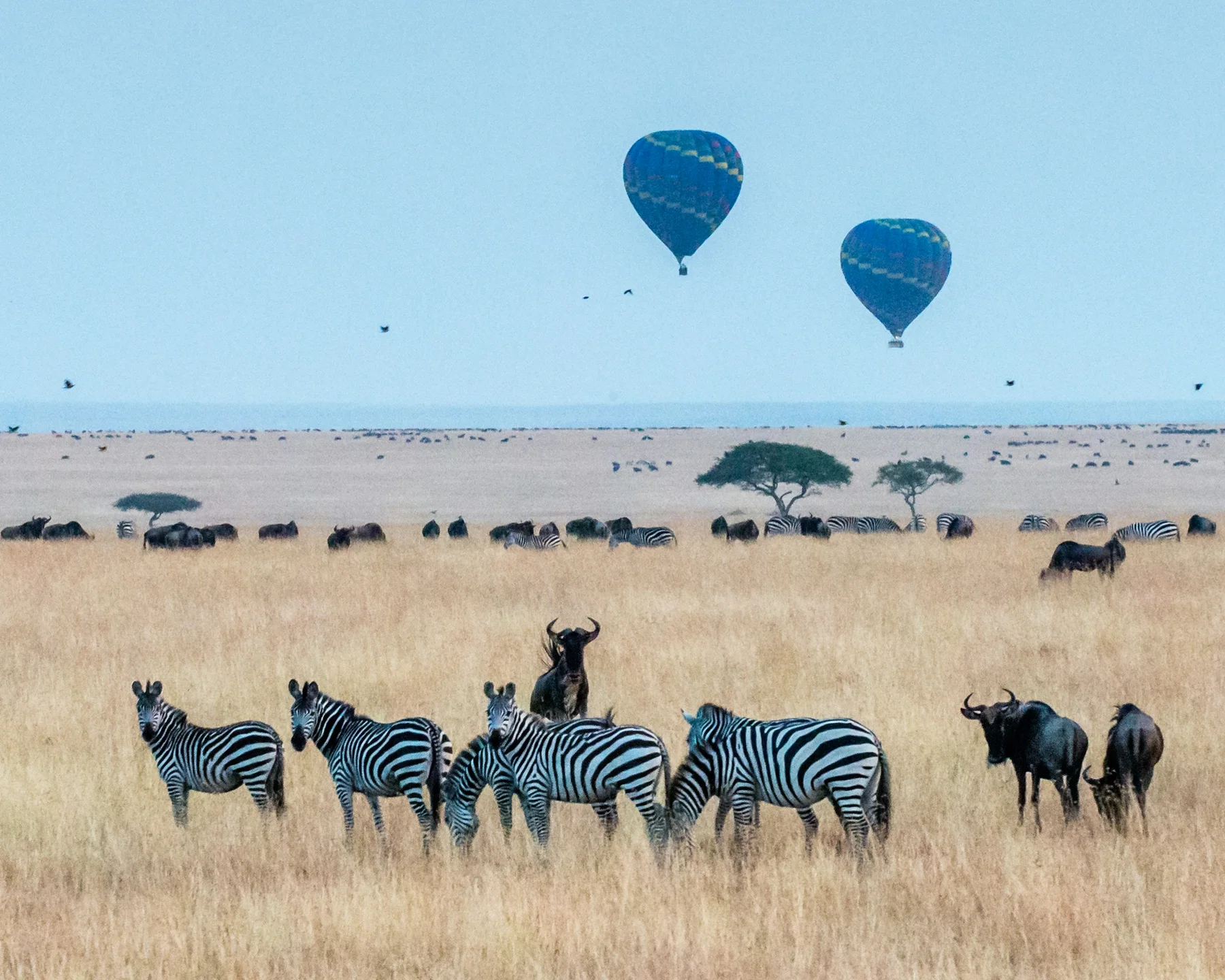
Wildlife from the air
From above, animals often become part of the landscape rather than portrait subjects. Giraffes cast long shadows. Hippo paths form pale lines. Wildebeest herds stretch beyond one frame. This is the balloon’s visual strength.
What large herds look like
A dense migration group can resemble a dark current. Gaps open around vehicles, gullies and water. The view explains movement and pressure in a way a close cluster of animals cannot.
What individual animals look like
Even an elephant becomes small from height. A telephoto lens helps, but the basket’s movement and other passengers limit perfect composition. Expect context more than facial detail.
Predator sightings
Lions and cheetahs may be visible, especially in open ground, but a drifting basket may pass too far away or too quickly for meaningful behaviour. A private ground vehicle remains stronger for patient predator watching.
Birds from a balloon
The flight is not normally a targeted birding activity. You may share the sky with vultures or see waterbirds below, but identification can be difficult and the route cannot be adapted to a species list.
No-animal mornings
One traveller wrote that “no animals were seen”. That is an important counterweight to highlight reels. Landscape, light and flight still need to hold value for you.
Great Migration expectations
Large herds are not spread evenly across the whole ecosystem. Their location changes with rainfall, grazing and river movement. A flight during migration months improves possibility, not certainty.
River-crossing expectations
The Great Migration river-crossing guide explains why a crossing cannot be scheduled. A balloon adds another variable because its route is also controlled by wind.
Migration from above
When the route and herds align, the aerial view can be the flight’s finest moment. You may see columns joining, dust hanging over movement and the sheer distance between grazing fronts.
Green-season wildlife
Green season can bring dramatic cloud, fresh grass, young animals and lower seasonal flight prices. It can also bring showers, softer roads and weather interruptions. Compare the trade-offs in the migration season versus green season guide.
The April and May question
The official 2026 example places April and May in its lowest flight band. Price alone should not decide. Read the Masai Mara in April and May guide for rain, access, camp and game-drive implications.
Aerial view versus ground drive
These are different activities, not rival versions of the same one.
| Question | Balloon | Ground drive |
|---|---|---|
| Can it stop at a sighting? | No | Usually, within rules and terrain |
| Can it choose a sector? | Launch area only, then wind-led | Yes, within access and time |
| Best for | Scale, landscape, novelty | Behaviour, detail, eye-level images |
| Typical noise | Burner bursts and quiet intervals | Engine, voices and road movement |
| Physical demand | Standing, basket entry and landing brace | Vehicle entry and long seated periods |
| Weather sensitivity | High | Lower, though rain affects roads and sightings |
| Privacy | Shared basket unless privately chartered | Private vehicle can be arranged |
| Time control | Limited | More adaptable |
What a ground drive does better
A guide can wait for a leopard to emerge, reposition for light, interpret tracks and leave a crowded sighting. Read the Masai Mara game-drive guide before sacrificing a prime drive.
What the balloon does better
The basket separates you from road logic. You see drainage systems, grazing pressure, animal trails and settlement boundaries as one living map.
Can you do both?
Yes, and this is often the best answer. Fly one morning in a four- or five-night stay, then protect several dawn and late-afternoon ground drives. The experiences become complementary rather than competitive.
The two-night problem
A two-night safari may offer only one full dawn. Giving it to a balloon can reduce the best ground-viewing window. If the balloon is a life wish, book it. If wildlife depth is the priority, add a night or keep the drive.
The five-night advantage
Five nights give room for one balloon morning, multiple ground drives, weather flexibility and a slower day afterward. The decision feels less like a trade.
Location matters before price
The broad Mara ecosystem includes the National Reserve, Mara Triangle and private conservancies. The “same” flight can involve a very different transfer depending on where you sleep.
Use the Masai Mara safari guide to place the launch, camp, Reserve sector and wider route in context before choosing one premium activity.
Reserve launch areas
Ask which launch area serves your camp and where breakfast normally occurs. A Reserve address alone does not make every camp close.
Conservancy guests
Conservancy guests may be transferred to a launch in or near another management area. Confirm access fees, pickup time and whether the morning’s route returns you to the conservancy smoothly.
Mara Triangle guests
The Triangle lies west of the Mara River. A balloon arranged from another sector can be impractical. Compare sector logic in Mara Triangle vs Talek vs Sekenani.
Talek guests
Talek can be convenient for some eastern Reserve operations but still covers a range of properties. Use the named camp and gate, not the town label, when asking for pickup.
Sekenani guests
Sekenani is a gateway, not a guarantee of short transfer. Road condition, actual lodge position and launch site all matter.
Camp choice and balloon choice
Do not move camps only for the balloon unless the new location improves the wider itinerary. A well-chosen base should serve game drives, quiet, budget and transfer needs together.
Safety begins before launch
Commercial ballooning is aviation, not a theme-park ride. Kenya Civil Aviation Authority publishes the country’s civil aviation regulations, and the Ministry of Roads and Transport has consulted on specific civil-aviation balloon regulations. Your practical task is to book an operator that can clearly identify its certification, aircraft, pilot and procedures.
The operator question
Ask which legal entity operates the flight. The lodge, safari planner and balloon company may be different businesses. You need the operator responsible for aviation safety and cancellation decisions.
The aircraft question
Ask whether the aircraft is currently registered and maintained under the applicable requirements. You do not need to become an aviation auditor. You do need a direct answer rather than “everybody uses them.”
The pilot question
Ask whether the pilot holds the appropriate commercial balloon qualification for the operation. A confident operator should explain this without irritation.
The weather decision
The pilot must be free to cancel when wind, visibility, storms or landing conditions are unsuitable. A weather cancellation is disappointing, but pressure to fly would be worse.
The safety briefing
One reviewer said they “felt very safe and well informed”. That confidence should come from a clear briefing, visible crew discipline and passengers following instructions.
The landing position
Most passengers are asked to face a particular way, bend their knees and hold internal handles. Do not hold the basket rim, lift a phone above your head or stand early because the ground looks close.
An upright landing
An upright landing may feel like a firm step or bounce. Remain braced until the pilot confirms the basket is stable.
A side landing
If the basket tips, passengers remain in their compartments and the basket may drag briefly. One traveller called it “the landing was great fun”, but fun depends on expecting the possibility and being physically able to brace.
Indemnity forms
The cited 2026 operator sheet says passengers sign an indemnity. Read it before the morning if possible. An indemnity is not a substitute for operator responsibility, informed consent or your travel insurance.
Travel insurance
Your policy should address medical treatment, evacuation, trip interruption and activities you plan to undertake. Do not assume the operator’s small medevac charge replaces comprehensive cover.
A safety-question table
| Ask before payment | A useful answer should identify | Warning sign |
|---|---|---|
| Who operates the flight? | Legal balloon company | Only the lodge name |
| Who makes the weather call? | Pilot or flight operations | Sales staff promising it will fly |
| What certification applies? | Current aviation approval and registration | Vague reassurance |
| What happens after cancellation? | Rebooking and refund process | “We decide later” |
| What health details are required? | Written passenger restrictions | No questions at all |
| How is landing taught? | Briefing and brace demonstration | Instructions only during descent |
| What emergency support exists? | Communications, crew and medevac process | No clear chain |
Children
One major Mara operator’s current FAQ requires children to be at least eight years old and taller than 1.2 metres. Another operator may apply a different restriction. The child must also follow instructions, stand for the flight and see safely over the basket.
The Kenya safari with children guide covers sleep, drive length, food, health and pacing beyond this single dawn.
Why height matters
A child who cannot see over the basket may be frightened, uncomfortable or tempted to climb. The height rule is about safe position and meaningful experience, not simply ticket pricing.
Teenagers
Many teenagers love the flight, especially when they understand the early start and cannot spend the morning leaning out for phone footage. Give them the briefing beforehand, not at 5:45 in the dark.
Pregnancy
Balloon landings can be firm or sideways, so operators commonly restrict flying during pregnancy. Disclose pregnancy before payment. Do not rely on a social-media answer or hide it to protect a booking.
Recent surgery
Recent abdominal, spinal, hip or knee surgery may make basket entry and landing forces unsuitable. Ask the treating clinician and the actual operator. Both perspectives matter.
Back, hip and knee pain
The flight involves standing, and landing requires bent knees and a secure brace. A comfortable game-drive seat may be the better choice for somebody whose pain worsens under sudden load.
Limited mobility
Standard baskets often require climbing through footholds and standing in a compartment. Some balloon operations elsewhere use accessible doors or seats, but never assume the booked Mara aircraft has them. Start with the accessible Kenya safari guide and obtain aircraft-specific confirmation.
Wheelchair users
Ask about the exact basket, transfer vehicle, boarding surface, lifting policy, support person and emergency evacuation. “We will help” is not a complete access plan.
Fear of heights
Some people find a basket calmer than a balcony because there is no visual connection to a building edge. Others feel exposed. Watch an unedited flight video, ask about basket height and decide without embarrassment.
Motion sickness
The basket generally moves with the air, so the sensation differs from turbulence in a small aircraft. The pre-dawn vehicle transfer may be more nauseating. Ask a clinician about medication if you are prone to motion sickness, and consider the empty-stomach instructions.
Anxiety and confined space
A basket compartment is shared, standing room is fixed and passengers cannot leave once launched. If confined space triggers panic, discuss compartment size and passenger count in advance.
Bathroom timing
There is no bathroom in the basket. Use camp facilities before pickup and ask whether the launch or breakfast site has one. Avoid solving the problem by becoming dehydrated.
Alcohol and medication
Do not fly impaired. Tell the operator about medication or a condition that affects balance, consciousness, strength or the ability to follow emergency instructions.
Passenger suitability checklist
| Consideration | What the flight requires | What to do before booking |
|---|---|---|
| Child | Minimum age, height, standing and instruction-following | Confirm written operator rule |
| Pregnancy | Ability to accept landing forces | Disclose and follow restriction |
| Back or joint condition | Basket entry, standing and bent-knee brace | Ask clinician and operator |
| Limited mobility | Boarding through footholds unless an accessible basket is confirmed | Request aircraft-specific details |
| Anxiety | Shared compartment with no exit in flight | Review realistic video and basket layout |
| Medication | Alertness and balance | Disclose relevant effects |
| Motion sickness | Dark road transfer plus flight | Plan food and medication safely |
Weather can cancel a beautiful plan
Rain at camp is not the only issue. Surface wind, winds aloft, visibility, thunderstorms and the condition of potential landing areas all influence the decision. The pilot may cancel under a clear-looking sky because a hazard is not obvious to passengers.
Wind limits
Strong or gusty wind can make inflation, flight and landing unsafe. The operator should not reduce a safety margin because the date is a honeymoon or the passengers leave Kenya tomorrow.
Rain
Rain can affect the envelope, visibility, launch surface, road access and the comfort of passengers waiting before a decision. Green-season showers do not mean every flight cancels, but flexibility becomes more valuable.
Thunderstorms
Convective weather creates rapidly changing wind and serious aviation risk. A distant dark cloud may matter more than rain directly over the basket.
Fog and visibility
Poor visibility affects navigation, obstacle awareness and landing choices. A pale dawn is not always a safe dawn.
Wet landing fields
Even if the air is suitable, saturated ground can limit vehicle access and landing options. The recovery truck has to reach the balloon without damaging habitat or becoming stuck.
When the call is made
Some decisions are made before pickup; others wait for conditions at launch. Ask how the operator communicates a cancellation and whether guests should still wake and dress.
Rebooking
Rebooking works best when another dawn remains in the Mara. It may fail in high season because baskets are full. This is one reason to schedule the flight early in a longer stay.
Refunds
Ask which components return after operator weather cancellation. Flight, landing, levy, park access and transfer may be processed differently. Obtain the rule in the booking confirmation.
Your backup morning
Keep the camp guide and vehicle plan clear. If the balloon cancels at 5:30, can you still take a dawn drive, sleep again or move breakfast? A backup prevents disappointment from swallowing the whole day.
Season by season
| Period | Possible strengths | Possible compromises | Planning emphasis |
|---|---|---|---|
| January-March | Often open views, young animals in parts of the ecosystem | Heat and haze vary | Confirm current wildlife area |
| April-May | Green landscape, lower example flight band | Rain and cancellation risk | Keep a second morning free |
| June | Fresh landscape and transition | Herd location can be uncertain | Book for scenery, not a crossing promise |
| July-October | Potential migration scale, popular travel period | Highest example rate and heavy demand | Reserve early and choose camp carefully |
| November | Green renewal and dramatic skies | Showers and variable access | Protect a backup plan |
| Festive season | Celebration atmosphere | High demand and peak example band | Confirm cancellation and transfer terms |
Photography begins with realistic goals
The balloon rewards wide environmental frames, patterns and shadow. It is less reliable for close eyes, whiskers or hunting sequences. Build a separate Masai Mara photography plan for the ground.
Camera body
Use equipment you already know. The launch is too dark and busy to learn a new menu. Set date, battery and memory cards the evening before.
Lens choice
A versatile zoom reduces lens changes and loose gear. A wide-to-short-telephoto range suits landscape and medium wildlife, while a longer lens can isolate herd patterns if the operator permits the weight.
Phone photography
Modern phones handle broad scenes well, but secure the device. Do not raise it outside the basket during landing or ignore a pilot command for a final clip.
Shutter speed
The basket moves, animals move and low dawn light tempts slow exposures. Use a shutter speed that protects sharpness, then allow ISO to rise rather than returning with a beautiful blur.
Exposure at sunrise
Bright sky and dark land exceed an easy exposure range. Protect highlights, shoot raw if you edit confidently and capture a few frames away from the sun where colour and detail are often richer.
Condensation and cold
Moving a camera from a warm tent to cool dawn air can create condensation. Keep the kit closed during the transition when necessary and avoid breathing directly onto a cold lens.
Basket etiquette for photographers
Share the view. Do not hold a large lens in another passenger’s face, lean into their compartment or monopolise one corner. A private charter is the solution when complete shooting freedom matters.
What not to carry
Leave tripods, bulky backpacks, dangling accessories and unnecessary lens cases at camp unless the operator explicitly approves them. Loose equipment becomes a landing hazard.
A practical camera setup
| Need | Practical choice | Reason |
|---|---|---|
| Landscape | Wide or standard zoom | Captures river, balloon shadow and horizon |
| Herd patterns | Medium telephoto | Compresses groups without extreme bulk |
| Fast reaction | One body, one versatile lens | No changes in a crowded basket |
| Stability | Secure neck or cross-body strap | Keeps both hands available for landing |
| Low light | Fresh battery and suitable ISO | Dawn drains batteries and needs speed |
| Backup | Phone in zipped pocket | Useful after the camera is secured |
What to wear
Wear layers that can be removed after sunrise. Closed shoes protect feet at the launch and landing. Neutral clothing is sensible for the onward safari, but there is no need to buy a costume for the balloon.
Cold before dawn
The drive and launch wait can feel colder than the flight. A light insulated layer or fleece is useful, especially in open vehicles.
Heat from the burner
The burner warms the top of the basket in short bursts. A removable hat is better than a thick hood that affects hearing.
Footwear
Use closed, stable shoes with grip. The ground may be wet, uneven or covered in grass. Sandals offer little protection during boarding and landing.
Hats and loose scarves
Secure anything the wind can take. Loose scarves can interfere with movement, and a broad brim may block another passenger or catch a burner’s heat.
The tiny packing list
Take a camera or phone, secure strap, compact warm layer, necessary medication and any identification requested. The broader Kenya safari packing guide covers the rest of the trip.
Food before flight
Ask whether camp provides tea, coffee or a small snack and whether the operator has any instruction about eating. Travellers who feel faint without breakfast should raise that before the morning.
Breakfast dietary needs
Share allergies, religious requirements, vegetarian or vegan needs and cross-contamination concerns when booking. A remote breakfast site cannot improvise every requirement after landing.
Privacy in a shared basket
Standard flights are social. You may share a compartment or basket with strangers. Couples expecting a private proposal or uninterrupted anniversary moment should ask about layout or private charter pricing.
Proposals and celebrations
Plan a proposal with the operator, not as a surprise to the pilot. The basket is not a safe place to kneel, move compartments or open loose items. Breakfast is usually the easier setting.
Honeymoon value
The flight can be a luminous honeymoon chapter because it combines anticipation, dawn, landscape and celebration. It should still suit both partners. A fearful passenger should not be pressured into “the romantic thing.”
Solo travellers
Solo guests can book shared flights and often enjoy the company. Ask how transfers work from your camp and whether the final price has any single supplement.
Private charters
A private basket can improve space and ceremony, but it may cost far more and still follows the same wind and weather. Privacy does not buy route control.
Traveller voices: the wonder
One reviewer described the flight as “incredibly smooth and peaceful”. Another called the views “absolutely breathtaking”. Those reactions capture the appeal better than a species checklist.
Traveller voices: the perspective
A guest valued “a completely different perspective”. That is the most defensible promise a balloon makes.
Traveller voices: the early start
For one passenger it was “well worth the early morning rise”. The sentence matters because the wake-up is part of the cost, even when the answer is yes.
Traveller voices: the limitations
Another guest reported that they “missed the sunrise”. A forum contributor put the basic truth plainly: “you are at the mercy of the wind”.
Traveller voices: the final verdict
Some travellers finish with “worth every penny”. Treat that as one person’s value judgement, not proof that every budget or morning should reach the same conclusion.
How to read reviews well
Separate weather, wildlife, crew, breakfast, transfer and expectation. “Disappointing” may mean no lions rather than unsafe operation. “Amazing” may refer to a marriage proposal rather than photographic quality.
Reviews are not certification
A five-star average cannot prove current aircraft maintenance or pilot licensing. Use reviews for passenger experience and use regulatory and operator documentation for aviation questions.
Common mistake: booking only by price
The cheapest headline may exclude fees or start far from camp. Compare complete total, pickup time, operating company and cancellation terms.
Common mistake: expecting a fixed route
No honest seller can promise a particular river bend, pride or crossing. Choose the general launch area and accept the wind-led flight.
Common mistake: hiding a health issue
Do not protect the payment by withholding pregnancy, surgery, pain or a condition that affects landing. The restriction exists before the ticket, not after an incident.
Common mistake: forgetting the next activity
A late return can collide with checkout, an airstrip transfer or a road departure. The Masai Mara airstrip and flight guide helps protect sensible connection time.
Common mistake: carrying too much camera gear
More lenses do not create more freedom in a shared basket. One secure, familiar setup usually produces better photographs and a safer landing.
Common mistake: using all the safari budget
If the flight forces you to cut a Mara night, downgrade the guide or share a vehicle when privacy mattered, compare the trade honestly. The Kenya safari cost guide helps put one premium morning in the full trip budget.
A booking checklist
| Confirm in writing | Why |
|---|---|
| Operating balloon company | Identifies who is responsible for the flight |
| Exact date and seasonal rate | Prevents price-band confusion |
| Every fee and tax | Produces the real total |
| Named camp and pickup time | Reveals transfer burden |
| Child age and height rule | Avoids a dawn refusal |
| Health and mobility restrictions | Protects passenger safety |
| Basket access and standing requirement | Tests practical suitability |
| Weather cancellation and refund | Protects the budget |
| Rebooking procedure | Uses a second morning well |
| Breakfast and dietary arrangement | Prevents avoidable problems |
| Return or onward-drive time | Protects the itinerary |
| Park-ticket basis | Prevents duplicate or missing charges |
Seven days before
Reconfirm flight, camp, pickup, passenger names, ages, health disclosures and dietary needs. Check that travel insurance documents are accessible.
The evening before
Charge batteries, empty memory cards, lay out quiet layers and use the bathroom plan sensibly. Ask camp reception for the confirmed wake-up and vehicle time.
At the launch
Stay with the passenger group, listen for changes and keep camera equipment contained. The crew is working around fans, ropes, vehicles, flame and a large envelope.
During flight
Keep limbs and equipment inside, respect compartments and listen whenever the pilot speaks. Enjoy some minutes without filming. Memory deserves a view unobstructed by a screen.
Before landing
Secure every item, face the instructed direction, bend as demonstrated and hold the internal grip. Do not stand until released.
After landing
Remain in the basket while the crew stabilises it. Once clear, check belongings and follow transport instructions rather than walking across the landing area alone.
If the flight cancels
Confirm the written cancellation, refund or new date before leaving the issue until checkout. Then use the backup ground-drive plan while dawn is still alive.
Who should book
Book if the full total sits comfortably inside the safari budget, the passenger can meet the physical requirements, the itinerary has enough nights, and aerial landscape feels valuable even without a headline wildlife sighting.
Who should skip
Skip if a passenger is medically unsuitable, the cost creates resentment, the only aim is a guaranteed crossing, or the lost ground drive matters more. Saying no can improve the safari.
The best itinerary position
Place the flight on the first or second full Mara morning when possible. That leaves rebooking space and avoids a direct collision with departure day.
The best number of Mara nights
Four or five nights create a comfortable balance. Three can work if the balloon is a priority. Two make every dawn a sharper trade.
The final verdict
A hot-air balloon safari in the Masai Mara is worth it when you want the Mara’s scale, accept a wind-led route and can pay the complete cost without weakening the rest of the trip. It is not a superior game drive, a migration guarantee or an effortless activity for every body.
The best version begins with an honest pickup time and ends without needing to defend the price. You remember the shadow of the basket sliding across the grass, the sudden roar of the burner, and then the silence between. You also still have enough nights left to meet the Mara at eye level.
Frequently asked questions
How much is a Masai Mara balloon safari in 2026?
In one official 2026 example, the adult flight is US$400 to US$490 by season, with a separate US$80 landing fee, US$20 non-resident community levy and US$5 medevac fee. That creates an example total of US$505 to US$595 before any park ticket or special transfer. Confirm your complete total.
How long is the flight?
The airborne portion is often around an hour, but wind and safe landing options affect it. Allow roughly half a day for pickup, launch, flight, recovery, breakfast and return.
What time is pickup?
Pickup is well before sunrise and depends on the camp-to-launch distance. Ask for the time linked to your named accommodation before booking.
Is breakfast included?
Many flights include a bush breakfast. The cited operator’s terms describe agreed camp transfer, flight, cooked breakfast and sparkling wine. Confirm dietary needs and inclusions for your operator.
Are animals guaranteed?
No. The wind chooses the route, and wildlife moves independently. Book for landscape and flight as well as animals.
Can I see a river crossing?
It is possible only when herds, river behaviour, launch area and wind align. It cannot be reserved.
Is the landing dangerous?
Landings vary from gentle and upright to firm or sideways. A certified operation, suitable weather, clear briefing and correct passenger brace reduce risk. Disclose any condition that affects landing tolerance.
Can children fly?
Rules vary. One major operator currently requires a minimum age of eight and height above 1.2 metres. Confirm the actual company’s current rule.
Can a pregnant person fly?
Operators generally restrict ballooning during pregnancy because a firm landing is possible. Disclose pregnancy and follow the operator’s rule.
Can a wheelchair user fly?
Only if the specific aircraft, basket access, restraint, standing or seating arrangement, landing procedure and transfer support meet the traveller’s needs. Standard baskets are often inaccessible, so aircraft-specific confirmation is essential.
What if weather cancels?
Ask for another morning if the itinerary and availability allow. Otherwise use the written refund terms for each fee component.
What should I bring?
Bring secure camera equipment, closed shoes, quiet layers, necessary medication and requested identification. Leave bulky bags and loose accessories at camp.
Tell us where you are staying and what matters most
Share dates, camp, party size, ages, health or mobility considerations, photography goals and budget. We will check the correct launch area, total cost, transfer time and backup plan.