
Famous Animals of the Masai Mara
Meet the historical lions and cheetahs that shaped Mara storytelling, learn the species behind the fame, and plan sightings without myths, guarantees or wildlife pressure.
- Two meanings of famous
- A name is not a pet name
- Why identification matters
- Why stories matter
- Scarface
- Why Scarface became famous
- The Four Musketeers
- The myth of impossible kill counts
- What Scarface teaches a traveller
- The Marsh Pride
- Big Cat Diary
- Why the Marsh Pride changes
- Where the Marsh Pride name comes from
- Notch and the Notch coalition
- How internet lore changes a lion
- Tano Bora
- What the name means
- Why male cheetahs form coalitions
- What Tano Bora changed for visitors
- Malaika
- Amber
- Half-Tail
- Current named predators
- Lions
- How to recognise a male lion
- How to recognise a lioness
- Lion behaviour worth waiting for
- Cheetahs
- Cheetah versus leopard
- Cheetah hunts
- Cheetah cubs
- Leopards
- Finding a leopard
- Spotted hyenas
- Hyena versus lion stories
- African wild dogs
- Black-backed jackals
- Serval
- Aardwolf
- African elephants
- Reading an elephant family
- Elephant body language
- Black rhinos
- White rhinos
- Cape buffalo
- Wildebeest
- The Great Migration
- Why river crossings are unpredictable
- Plains zebras
- Masai giraffes
- Topi
- Thomson’s and Grant’s gazelles
- Eland
- Impala
- Waterbuck
- Warthogs
- Hippopotamuses
- Nile crocodiles
- Baboons and vervet monkeys
- Ostriches
- Secretarybirds
- Vultures
- Lilac-breasted rollers
- Grey crowned cranes
- The Big Five
- The animals outside the Big Five
- What can you reasonably see in three days?
- What can you reasonably see in five days?
- Animal, habitat and time
- Where you stay changes the story
- Musiara and the marsh
- Mara Triangle
- Talek and central plains
- Sekenani and eastern areas
- Naboisho
- Mara North
- Olare Motorogi and Ol Kinyei
- Time of day
- Full-day versus split drives
- Night drives
- Migration season versus green season
- April and May
- What travellers remember
- Abundance and its cost
- A conservancy perspective
- Reviews are not sighting forecasts
- Ethical viewing
- The 25-metre principle
- Five vehicles around key predators
- Do not geotag rhinos
- Do not name a den online
- Do not call an animal
- A famous animal is not a trophy
- Photography and identification
- Whisker spots
- Cheetah spot patterns
- Leopard rosettes
- Elephant ears and tusks
- Ask before sharing a name
- What a good guide tells you
- Questions to ask your guide
- Questions to ask a camp
- Famous animals and children
- Famous animals on a honeymoon
- Limited mobility
- A wildlife-first three-night plan
- A wildlife-first five-night plan
- A big-cat itinerary
- An elephant itinerary
- A rhino itinerary
- A migration itinerary
- How many days are enough?
- Common planning mistakes
- A better wildlife wish list
- Conservation behind the stories
- Predators cross boundaries
- Livestock conflict
- Tourism pressure
- Research tourism
- Independent videos
- The Scarface tribute video
- What not to promise in a quote
- What a clear safari proposal names
- Final perspective
- Frequently asked questions
- Is Scarface the lion still alive?
- Who were the Four Musketeers?
- Can I see the Marsh Pride?
- What was Tano Bora?
- Are famous Mara animals tagged?
- Can a guide guarantee a named lion?
- Which Mara animal is easiest to see?
- Are lions guaranteed?
- Where are leopards found?
- Is the Big Five the best wildlife goal?
- How many nights should a wildlife enthusiast stay?
- How can I view famous animals responsibly?
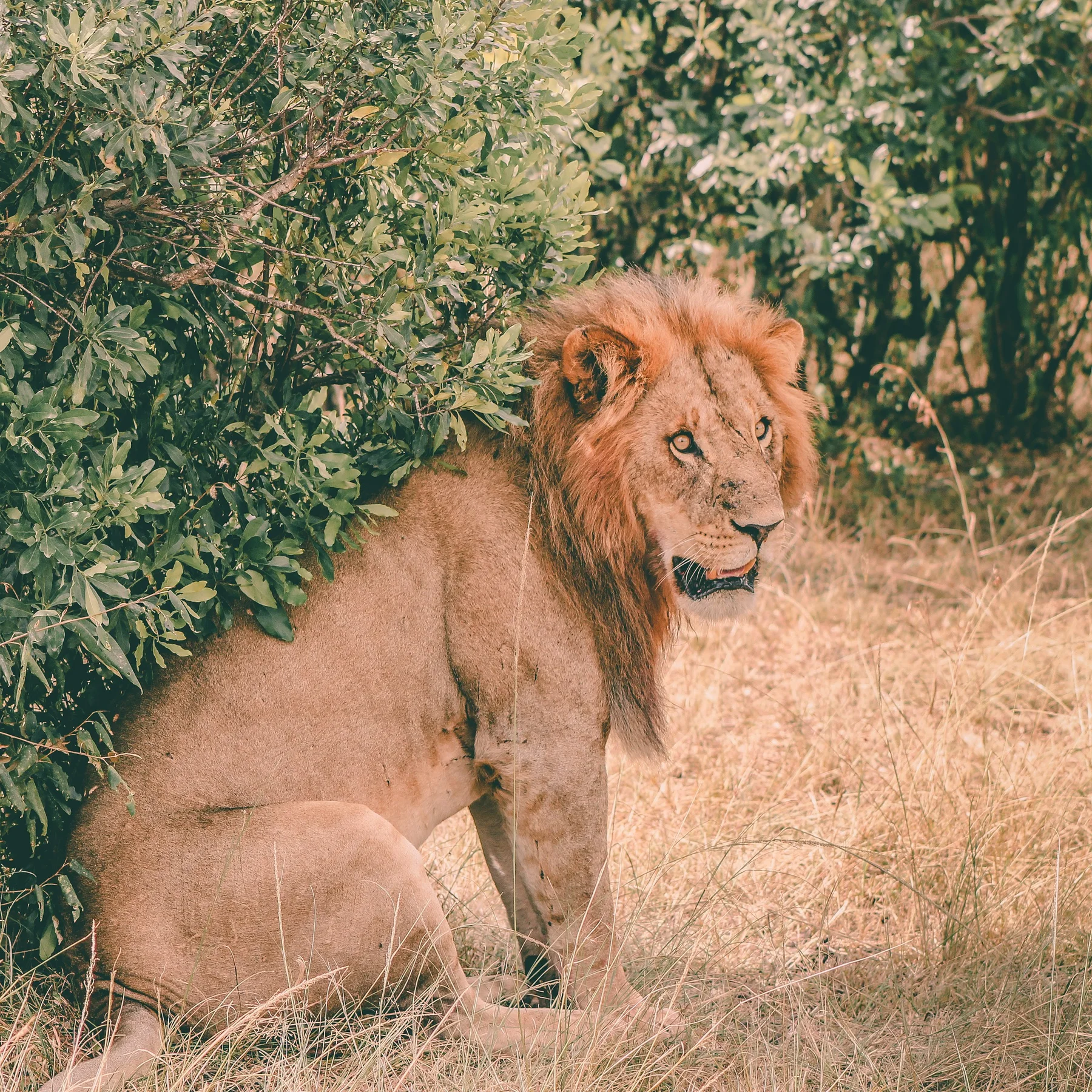
A lion lifts his head beside a croton bush. The face is new to you, but your guide pauses. He studies the whisker spots, a notch in one ear and the shape of the mane. This is not “a lion” to him. It is an individual with a territory, relatives and a history that may stretch across years of sightings.
That is how Mara animals become famous. Film crews introduce some to the world. Researchers identify others so their movements and survival can be followed. Guides remember a hunt, injury or litter. Travellers carry the story home.
The famous animals of the Masai Mara include historical individuals such as Scarface, well-known groups such as the Marsh Pride and Tano Bora, and entire species that define the ecosystem. This guide explains who they were, why names matter, what is still uncertain and how to enjoy a sighting without turning a wild animal into a celebrity appointment.
Two meanings of famous
One meaning is an individual animal recognised by a name. The other is a species people cross the world to see.
| Type of fame | Examples | What the name tells you | What it cannot promise |
|---|---|---|---|
| Identified individual | Scarface, Malaika | A recorded life story | That the animal is alive or near your camp |
| Coalition | Four Musketeers, Tano Bora | Males travelling or holding range together | A fixed membership forever |
| Pride | Marsh Pride | Related lionesses, cubs and changing males | One permanent family roster |
| Documentary character | Half-Tail, Amber | A filmed chapter in Mara history | A current sighting |
| Famous species | Lion, cheetah, elephant | The Mara supports important habitat | Guaranteed close views |
| Seasonal spectacle | Wildebeest herds | Large-scale movement through the ecosystem | A river crossing on demand |
A name is not a pet name
Researchers use markings, whisker-spot patterns, scars and photographs to distinguish animals. Guides often use the same names because they help share accurate field observations.
The animal remains wild. A familiar name does not make it tame, approachable or owned by the person who first posted it online.
Why identification matters
An individual record can reveal survival, dispersal, reproduction, territory and conflict. A coalition that splits or a lioness that moves outside protected land becomes conservation information.
The Mara Predator Conservation Programme publishes reports rather than relying on social-media legend. That is the stronger source when an old name and a current claim disagree.
Why stories matter
People protect what they recognise. A film about one pride can open a conversation about habitat loss, livestock conflict, snares and responsible tourism.
Stories become dangerous when a dramatic number or invented battle travels further than the research.
Scarface
Scarface was a male lion named for the unmistakable injury around his right eye. He belonged to a coalition remembered as the Four Musketeers with Morani, Sikio and Hunter.
He is historical. The Mara Predator Conservation Programme recorded that he died on 11 June 2021 after researchers watched his final days.
Why Scarface became famous
His damaged face made him visually recognisable, while his long life, coalition history and tolerance around cubs gave guides and photographers a continuing story.
The official MPCP tribute to Scarface connects the coalition with the Marsh, Mara River, Mugoro, Serena North, Rekero and Lookout prides. It describes a lion whose influence came through territory and offspring, not internet combat statistics.
The Four Musketeers
Coalitions help male lions compete for territory and pride access. The Four Musketeers were not four characters frozen in one permanent scene. Their range, condition and membership changed with injury, disappearance and death.
Hunter vanished in 2019, Sikio died after territorial injuries in 2020, and Scarface died in 2021. Historical context prevents an old photograph from becoming a false current sighting.
The myth of impossible kill counts
Posts sometimes credit Scarface with hundreds of dead hyenas and rival lions. Those claims do not match the careful MPCP account and are often repeated without field records.
Do not use an exact number simply because it appears in a dramatic caption. Scarface needs no invented scorecard to be remarkable.
What Scarface teaches a traveller
Look beyond the scar. Ask how guides know an individual, when it was last recorded and whether the information comes from a research programme.
If a guide explains that the famous lion is dead, that honesty is a reason to trust them.
The Marsh Pride
The Marsh Pride is one of the Mara’s longest-followed lion stories. Jonathan and Angela Scott say they have followed it since 1977, and television carried its changing generations far beyond Kenya.
“Marsh Pride” describes a lineage and territory through time, not a fixed cast. Lionesses age, cubs disperse, males take over and the pride may split.
Big Cat Diary
The BBC programme archive for 1998 described the Marsh lions alongside Amber the cheetah and Half-Tail the leopard. Those animals belong to documentary history.
The archive is useful because it shows how long named Mara stories have shaped wildlife television. It is not a field guide for finding the same individuals now.
Why the Marsh Pride changes
Lion society is dynamic. Related females form the core, while males may hold tenure for a shorter period. Food, competition, cub survival and human pressure influence group size and movement.
A current guide should describe today’s pride composition cautiously and date the observation.
Where the Marsh Pride name comes from
The pride became associated with the Musiara Marsh area in the northern Reserve. Habitat names are often more reliable for trip planning than celebrity names.
Choose the Musiara sector for marsh, plains and northern access, not because one historical lion appeared there on television.
Notch and the Notch coalition
Notch was another famous Mara male linked in popular storytelling with a large coalition that included his sons. Films, guide accounts and online posts turned the group into legend.
The safe way to tell the story is to acknowledge the unusual coalition and its historical importance without repeating unsourced claims about exact territories, kills or pride takeovers.
How internet lore changes a lion
One caption copies another, a possible event becomes certain, and a rounded estimate becomes a precise total. The animal is eventually described like a warrior king rather than a lion responding to ecology.
When a claim sounds designed for a movie trailer, look for a dated field report.

Tano Bora
Tano Bora became famous as a coalition of five male cheetahs. Large male cheetah coalitions are unusual, and five animals hunting and moving together created striking behaviour and photographs.
The Mara-Meru Cheetah Project 2021 report mapped their range around Tipilikwani, Talek, Olare Motorogi and Naboisho. It also documented separation and a reduction in membership. That change is part of the story.
What the name means
Tano Bora is commonly translated as the magnificent five or best five. It describes the coalition at its famous peak, not a guarantee that five remain together today.
Use current Mara-Meru or MPCP reports for surviving individuals and recent movements.
Why male cheetahs form coalitions
Brothers often stay together after leaving their mother, although unrelated males can also cooperate. A coalition may defend access to a range and tackle prey that one male might avoid.
Five did not turn cheetahs into lions. They remained coursing predators with cheetah vulnerabilities, including competition from lions and hyenas.
What Tano Bora changed for visitors
The coalition showed that patient observation can reveal social behaviour more interesting than a sprint. Resting, scent-marking, sharing, separation and reunion all mattered.
Do not pressure a guide to follow a hunt. Crowding can change a cheetah’s decisions.
Malaika
Malaika was a well-known female cheetah associated with a large litter and a strong documentary following. Historical films introduced viewers to the difficulty of raising cubs among lions, hyenas and other risks.
Like every named cheetah from an earlier documentary period, her story must be dated. A modern “Malaika sighting” needs verification because names can be reused or confused.
Amber
Amber appears in the BBC’s older Big Cat Diary record. She belongs to the programme’s historical cheetah stories.
The value of remembering Amber is not the possibility of seeing her. It is recognising that long-term individual observation made cheetah survival understandable to a wide audience.
Half-Tail
Half-Tail was a leopard known through Big Cat Diary. Her name came from a visible feature that helped people recognise her.
Leopards are solitary and elusive. One famous individual never made the species easy to find.
Current named predators
The Mara still has named lions, cheetahs and leopards in active research and guide records. Those names change faster than an evergreen guide should pretend.
Ask the guide what has been seen this week, then check a current research report. Never build a timeless page around a living animal’s assumed location.
| Name | Animal or group | Status in this guide | Best source |
|---|---|---|---|
| Scarface | Male lion | Historical, died in 2021 | MPCP tribute |
| Four Musketeers | Male lion coalition | Historical coalition | MPCP tribute and reports |
| Marsh Pride | Lion pride lineage | Continuing name, changing membership | Current MPCP and guide records |
| Notch coalition | Male lion coalition | Historical, internet claims need caution | Dated field and documentary records |
| Tano Bora | Male cheetah coalition | Historical famous five, membership changed | Mara-Meru reports |
| Malaika | Female cheetah | Historical documentary individual | Dated cheetah-project records |
| Amber | Female cheetah | Historical television individual | BBC programme archive |
| Half-Tail | Female leopard | Historical television individual | BBC programme archive |
Lions
Lions are the Mara’s most socially visible big cats. Females form prides, cubs play near resting adults and male coalitions patrol large ranges.
They can be active at dawn, dusk and through cool weather, but many midday sightings are sleeping cats in shade.
How to recognise a male lion
Look at mane colour and shape, ear notches, scars, whisker spots and facial structure. Light changes mane appearance, so one feature is not enough.
Photograph both sides when possible. Researchers identify from combinations, not resemblance to an online portrait.
How to recognise a lioness
Lionesses lack the obvious mane but show whisker patterns, ear damage, scars and facial proportions. Pride context and cub association also help.
Do not assume every female near a pride belongs permanently to it.
Lion behaviour worth waiting for
Greeting, grooming, cub nursing, play, scent marking and group movement reveal social life. A sleeping lion may wake, stretch and greet another without hunting.
Quiet patience often produces a better story than leaving for another checklist animal.
Cheetahs
Cheetahs favour open sightlines where they can scan for prey and danger. They may use termite mounds, fallen trunks or vehicles as viewpoints.
Females are usually solitary except with cubs. Males may be solitary or form coalitions.
Cheetah versus leopard
| Feature | Cheetah | Leopard |
|---|---|---|
| Body | Light, long-legged and narrow | Heavier and muscular |
| Face | Dark tear lines | No tear lines |
| Coat | Solid round spots | Rosettes |
| Claws | Less retractile, visible in tracks | Retractile |
| Hunting | Daylight pursuit common | Stalk and ambush |
| Habitat view | Often open plains | Woodland, riverine cover and thickets |
| Social pattern | Females alone, males may coalition | Mostly solitary |
Cheetah hunts
A hunt may begin with twenty minutes of stillness and end in seconds. Keep distance and silence. Do not place the vehicle in the approach line.
If the cheetah abandons the stalk because of vehicles, the sighting was poorly managed.
Cheetah cubs
Cubs face predation, food shortages and difficult dispersal. A large litter is exciting but not a promise of recruitment into adulthood.
Give the mother space to scan and move. Never surround a family.
Leopards
Leopards use riverine forest, drainage lines and woodland edges. Their rosettes and secretive movement make each clear sighting memorable.
They may rest in trees, but many remain hidden on the ground.
Finding a leopard
Guides listen for baboon, vervet and antelope alarm calls. They check favourite branches, rocky drainage and dense edges without crashing through vegetation.
The correct expectation is possibility, not certainty.
Spotted hyenas
Hyenas are intelligent social hunters, not comic scavengers. Clans defend territories, raise cubs at communal dens and compete with lions for food.
Watch their greetings, cub curiosity and coordinated movement rather than waiting only for conflict.
Hyena versus lion stories
Online captions often frame every encounter as war. In reality, both species hunt and scavenge, avoid unnecessary injury and respond to numbers and context.
Do not assign a human villain to either animal.
African wild dogs
Wild dogs are possible in the Greater Mara but far less predictable than lions or hyenas. Their wide-ranging packs may appear and disappear across conservancies and community land.
Treat a sighting as exceptional. Never sell it as part of a Big Five guarantee.
Black-backed jackals
Jackals are elegant, alert and often ignored beside larger predators. Pairs hunt small prey, follow opportunities and defend territories.
Their interactions can fill the quiet time between big-cat sightings.
Serval
Tall ears, long legs and a spotted coat help servals hunt rodents and birds in grass. They can be active in cool daylight but are never easy to promise.
Slow drives through suitable grassland give a better chance than racing between lions.
Aardwolf
The aardwolf is a termite specialist related to hyenas. It is smaller, striped and mainly nocturnal.
Conservancy night drives may improve the chance, but rarity remains part of the experience.
African elephants
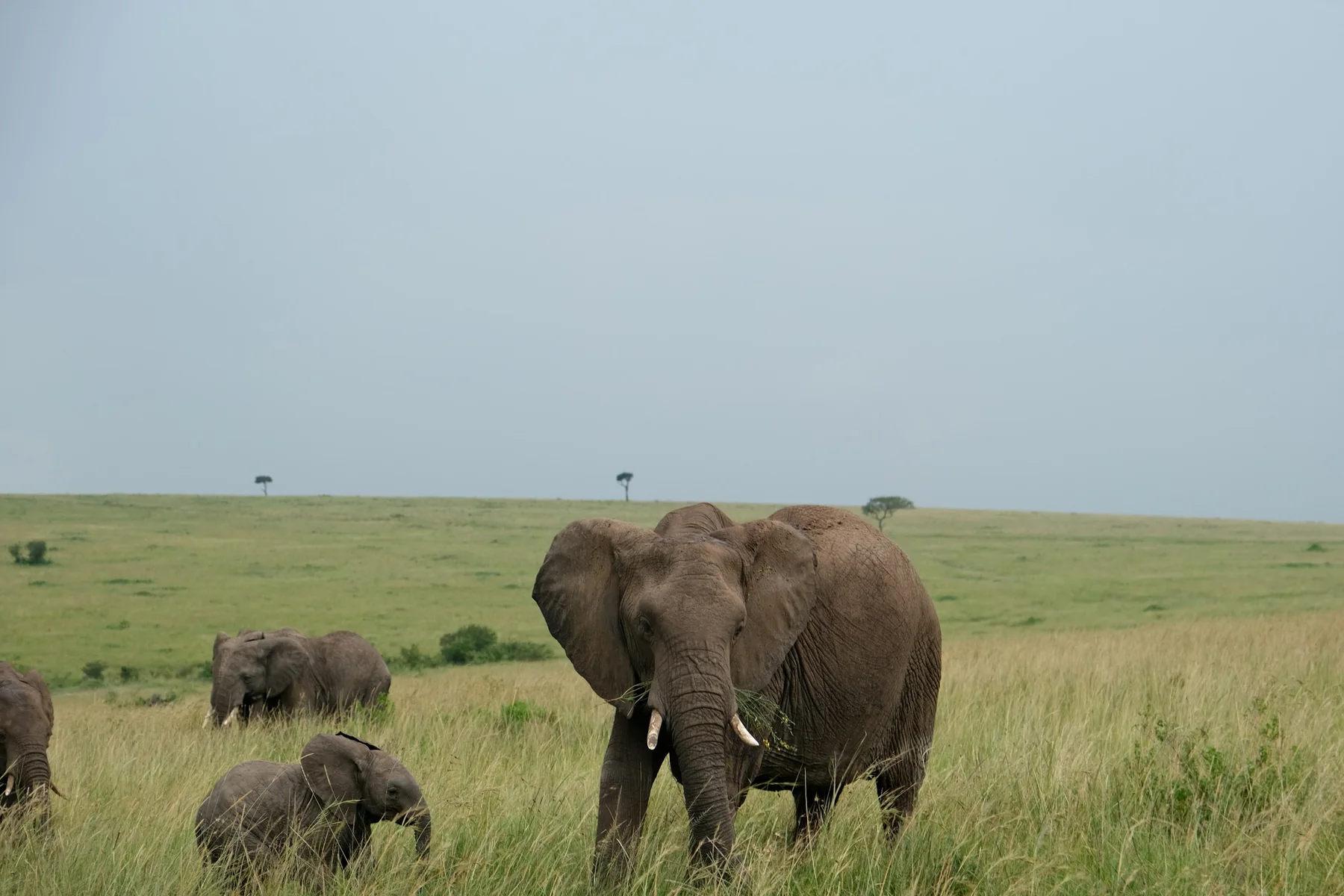
Elephants move through family networks led by experienced females. Bulls may travel alone or in loose association.
The Mara’s open landscape can reveal feeding, play, dust bathing, social touch and long-distance movement.
Reading an elephant family
Calves stay close to mothers and allomothers. Adults may form a protective wall when uncertain.
Give the family a clear route and never separate individuals with the vehicle.
Elephant body language
Relaxed ears, feeding and unhurried movement differ from a raised head, focused stare, dust toss or rapid approach. A guide reads the whole sequence.
Reverse early and slowly when space is needed.
Black rhinos
Black rhinos occur in the Mara but sightings are uncommon and sensitive. Exact locations should not be broadcast casually.
Dense cover, wide range and conservation security make a rhino a chance rather than an itinerary line.
White rhinos
Do not assume that every Kenya rhino destination has both species. The Mara’s celebrated rhino story centres on black rhinos.
For more dependable rhino-focused viewing, compare Ol Pejeta Conservancy and Solio.
Cape buffalo
Buffalo gather in large herds and also form smaller bachelor groups. Old bulls may rest in thickets or wallows.
They deserve distance. A buffalo hidden near a riverbank is a strong reason not to alight.
Wildebeest
Wildebeest define the migration story, yet resident animals remain in the ecosystem outside the famous crossing months. They graze, calve, form lines and respond collectively to water and grass.
The herd is not background decoration for a crocodile scene.
The Great Migration
The migration is a circular regional movement through Serengeti and the Mara ecosystem, shaped by rain and forage. Calendar months describe patterns, not contracts.
Read the Great Migration river crossings guide before choosing a camp from one viral video.
Why river crossings are unpredictable
A herd can gather, turn away, move downstream or cross after visitors leave. Pressure from vehicles can make the approach worse.
Plan enough Mara days to enjoy resident wildlife if no crossing occurs.
Plains zebras
Zebras travel with wildebeest because the species use grass differently and benefit from shared vigilance. Individual stripe patterns are unique.
Watch social grooming, foal behaviour and stallion interactions rather than treating them as migration extras.
Masai giraffes
Masai giraffes carry irregular vine-like patches rather than the cleaner polygon pattern of a reticulated giraffe. Their long stride makes movement across the plains appear slow until distance reveals the speed.
They browse trees and shrubs, shape vegetation and watch predators from above the grass.
Topi
Topi stand on termite mounds to scan the plains. Their dark facial masks and sloping backs make them distinctive.
During breeding periods, males defend small territories and females move among them.
Thomson’s and Grant’s gazelles
Thomson’s gazelles are smaller with a strong dark flank stripe. Grant’s are larger and paler, with white extending above the tail.
Learning that difference turns a field of “antelope” into separate lives and strategies.
Eland
Eland are the world’s largest antelope, yet they can jump surprisingly well. Their size, throat dewlap and subtle vertical stripes help identification.
They may appear in loose herds on open plains or bush edge.
Impala
Impala thrive around woodland and edge habitat. Males carry lyre-shaped horns, while females form herds that can become large around food and safety.
Watch the black “M” markings on the rump and the explosive alarm leaps.
Waterbuck
Waterbuck favour grass near permanent water and riverine habitat. The common waterbuck’s white rump ring is visible from a distance.
They are not aquatic, but their ecology stays close to water.
Warthogs
Warthogs kneel on their front wrists to graze and run with tails held upright. Piglets often follow the adult tail like a flag.
They reverse into burrows so tusks face the entrance.
Hippopotamuses
Hippos rest in rivers and pools by day, then graze on land. Their apparent stillness hides territorial behaviour and enormous strength.
Use authorised viewpoints and never stand between a hippo and water.
Nile crocodiles
Crocodiles concentrate attention during migration crossings, but they live in the river all year. Many crossing deaths come from panic, injury or drowning rather than predation.
Do not reduce the river to a hunt scene.
Baboons and vervet monkeys
Baboons forage socially and can become bold around food. Vervets give useful alarm calls and move through riverine trees.
Keep windows controlled at camp and never feed either species.
Ostriches
Ostriches stride across open plains, with males showing black-and-white plumage and females greyer brown. Their courtship and chick care are worth patient observation.
They are not merely the largest bird on a checklist.
Secretarybirds
Secretarybirds walk grassland hunting insects, snakes and small vertebrates. Long legs, black flight feathers and a crest make them unmistakable.
They need open habitat and tall nesting trees.
Vultures
The Mara supports several vulture species, including lappet-faced, white-backed, Rüppell’s and hooded vultures. They provide rapid carcass clean-up and disease control.
Poisoning and habitat threats make every identification meaningful.
Lilac-breasted rollers
Brilliant colour makes the roller a favourite first bird. It hunts from exposed perches and often returns to a branch after dropping to the ground.
Do not call it Kenya’s official national bird. That popular statement is not established in law.
Grey crowned cranes
Tall crowns, red throat pouches and graceful courtship make cranes memorable around wetlands and grassland. They face pressure from habitat loss and illegal trade.
Give feeding pairs and families space.
The Big Five
Lion, leopard, elephant, buffalo and rhino form the old hunting-era Big Five label. Today the phrase is a viewing shorthand, not a measure of ecological importance.
| Big Five animal | Mara expectation | Main habitat clue | Honest caveat |
|---|---|---|---|
| Lion | Strong possibility | Plains, marsh edge and prey | Resting cats can be hidden in grass |
| Leopard | Possible | Riverine cover and woodland | Solitary and elusive |
| Elephant | Strong possibility | Plains, woodland and water | Families move widely |
| Buffalo | Strong possibility | Grassland, marsh and thicket | Dangerous at close range |
| Black rhino | Rare possibility | Sensitive and variable | Never guaranteed or geotagged |
The animals outside the Big Five
A serval hunt, hyena greeting, topi lookout or vulture gathering can reveal more behaviour than a distant rhino found to complete a list.
Tell the guide which behaviour interests you, not only which names are missing.
| Look beyond | Watch for | Why it matters |
|---|---|---|
| Hyena | Clan greetings and den care | Complex social life |
| Topi | Lookout posture and territorial males | Plains behaviour |
| Vulture | Species order at a carcass | Scavenger ecology |
| Jackal | Pair cooperation | Small-predator strategy |
| Giraffe | Browsing and vigilance | Habitat and predator awareness |
| Zebra | Grooming and foal defence | Herd relationships |
| Warthog | Kneeling graze and alarm run | Adaptation in ordinary moments |
| Secretarybird | Long grassland hunt | Bird behaviour at ground level |
What can you reasonably see in three days?
Three nights with well-placed accommodation give a strong chance of lions, elephants, buffalo, giraffes, zebras, wildebeest, hippos, hyenas and many antelope. Cheetah and leopard remain less certain. Rhino is a bonus.
Weather, sector, drive length and luck still matter.
What can you reasonably see in five days?
Five nights allow repeated dawns, more habitats and time to stay with behaviour. The extra days improve chances without guaranteeing a rare animal.
They also reduce pressure to crowd one famous cat.
Animal, habitat and time
| Animal | Useful habitat | Productive time | Do not promise |
|---|---|---|---|
| Lion | Open plains, marsh and prey corridors | Dawn, dusk, cool weather | A hunt |
| Cheetah | Open plains and lookout mounds | Morning and late afternoon | A sprint |
| Leopard | Riverine forest and drainage | Early, late and patient searches | A tree pose |
| Elephant | Mixed grassland and woodland | Any time near movement routes | A close approach |
| Rhino | Sensitive cover and open patches | Variable | Exact location |
| Hyena | Den areas and open plains | Dawn, dusk and night in permitted areas | Lion conflict |
| Serval | Grassland and wet margins | Cool hours | A sighting |
| Birds | Every habitat | Morning often strongest | One complete list |
Where you stay changes the story
A Musiara camp gives different daily access from Talek, Sekenani, the Triangle or Naboisho. Famous animals roam, but drive times remain real.
Start with the Masai Mara safari guide to understand the Reserve, Triangle and conservancy map before choosing a camp from an animal name.
The Mara Triangle vs Talek vs Sekenani guide helps match habitat and crowd preference to a sector.
Musiara and the marsh
Musiara is associated with marsh habitat, plains and the historical Marsh Pride story. Choose it for the whole northern ecosystem.
Do not book on the assumption that a specific named lion will be beside the marsh.
Mara Triangle
The Triangle combines escarpment, river, plains and important migration routes. It can offer strong wildlife density and clear landscape variety.
Crossing activity remains seasonal and unpredictable.
Talek and central plains
Talek provides access to busy central wildlife areas and accommodation across a broad price range. It can also experience vehicle concentrations around predators.
Ask how the guide handles crowds and which quieter loops are available.
Sekenani and eastern areas
Sekenani is a principal road gate and suits camps on the eastern side. Drive time to the Mara River can be long.
Choose the east for its own plains and access logic, not as a cheap room beside every famous sighting.
Naboisho
Naboisho controls visitor numbers and is known for predator habitat, walking and night-drive possibilities through its camps. Independent access is restricted.
Read the Naboisho Conservancy guide for camp, landowner and activity context.
Mara North
Mara North spans varied northern habitat and supports camp-managed viewing with lower density than the busiest Reserve sectors.
The Mara North Conservancy guide explains access and camp positioning.
Olare Motorogi and Ol Kinyei
These conservancies are important predator landscapes with controlled tourism. Tano Bora’s historical range included Olare Motorogi and Naboisho, but that fact does not guarantee a coalition today.
Book for current habitat, guiding and conservation model.
Time of day
Dawn brings cool air, tracks and renewed movement. Late afternoon brings lengthening shadows and animals rising from rest. Midday can reveal elephants at water, raptors in thermals and cats using shade.
There is no hour when wildlife becomes a scheduled performance.
Full-day versus split drives
A full day reaches distant habitats and lets you stay with one story. Split drives protect rest and concentrate on dawn and evening activity.
Our Masai Mara game drives guide compares the trade-offs.
Night drives
Night drives in authorised conservancies can reveal aardwolf, serval, genets, hares and nocturnal behaviour. They are not allowed as normal visitor activity inside the National Reserve.
Read the Masai Mara night game drives guide before choosing a camp for that experience.
Migration season versus green season
Migration months bring large herds and more visitors. Green season brings dramatic skies, young animals, birds and quieter roads, with rain affecting access.
The migration season versus green season guide helps choose the kind of wildlife day you prefer.
April and May
Long-rain months can create tall grass, soft tracks and beautiful light. Predators do not vanish, but viewing and access change.
Use the Masai Mara in April and May guide for realistic planning.
What travellers remember
One visitor wrote that a lion yawn showed “teeth the size of my fingers”. Another remembered a cheetah hunt as “fast, tense, and over in seconds”.
Those short moments explain the emotion. They do not make the same scene repeatable.
Another traveller said “It really feels like you are in a documentary”. A recent couple ended more simply: “Breathtakingly beautiful, there are no words for it”.
Abundance and its cost
A traveller said “it wasn't boring for a second”. Another found the experience “somewhat ruined by vehicles overcrowding” around popular cats.
Both reviews belong in an honest guide. Wildlife density attracts people, and poor crowd behaviour can damage the very encounter they came for.
A conservancy perspective
One Olare Orok visitor valued “no queues of safari vehicles”. A Mara Triangle review described “landscapes of infinite beauty”.
The right sector depends on whether species density, solitude, migration access or special activities matter most.
Reviews are not sighting forecasts
A reviewer’s leopard, rhino or hunt happened on a particular drive. Use the account to understand feeling and conditions, not to predict your day.
Recent guide knowledge is more useful than an old species list.
Ethical viewing
The Reserve management plan calls for distance, limits around key predators and waiting when a sighting is full. It also prohibits chasing and harassment.
Rules matter most when the animal is famous and every vehicle wants the same photograph.
The 25-metre principle
Keep roughly 25 metres from animals whenever possible. Greater distance may be necessary for elephants, hunting predators, nervous individuals and families with young.
If an animal approaches a stationary vehicle, remain quiet and let it choose.
Five vehicles around key predators
When five vehicles are already around lions, rhinos, leopards or cheetahs, wait at least 100 metres away. Move on after the permitted viewing time when others wait.
Fame does not suspend the rule.
Do not geotag rhinos
Avoid posting precise rhino locations in real time. Share a broad sector later if management permits.
Conservation security is more important than proving the sighting.
Do not name a den online
Cheetah cubs, lion cubs, hyena dens and leopard hideouts attract repeated pressure. Exact locations can change behaviour and concentrate vehicles.
Follow guide and researcher advice about sensitive information.
Do not call an animal
Clapping, whistling, playback, revving and food are not acceptable ways to make a face turn toward the camera.
Photograph the behaviour the animal chooses.
A famous animal is not a trophy
The sighting does not become more valuable because everyone else wants it. Stay for ecology, not proof.
The quiet unknown lion may give the richest hour of the trip.
Photography and identification
Photograph faces, flanks, ears and tails without blocking movement. A wide habitat frame can be more useful than another tight portrait.
The Masai Mara photography guide covers lenses, dust, beanbags and light.
Whisker spots
Lion researchers use the pattern of whisker spots above the upper lip, often with scars and ear marks. A clear side view helps.
Do not publish your own identification as certain until an experienced guide or project confirms it.
Cheetah spot patterns
Cheetah coats also allow individual recognition, especially through clear flank photographs. Cubs change size and appearance quickly, so date and location matter.
Share images with a research project when it requests citizen observations.
Leopard rosettes
Leopard rosettes form distinctive patterns. Left and right sides differ, making a full photo set valuable.
A partial face behind grass may not support a confident name.
Elephant ears and tusks
Ear tears, vein patterns, tusk shape and family association can help experienced observers identify elephants.
Age, dust and viewing angle can mislead a casual comparison.
Ask before sharing a name
Guide names, research IDs and social-media nicknames may differ. Ask which project uses the name and when the animal was last confirmed.
Use “possibly” when evidence is incomplete.
What a good guide tells you
| Weak statement | Stronger explanation |
|---|---|
| “This is the famous lion” | Name, identifying marks, pride and date of recent confirmation |
| “There are always cheetahs here” | Habitat, recent movement and why today may differ |
| “This leopard owns the tree” | Range, behaviour and how identification was made |
| “The migration arrives in July” | Rain-driven pattern and current herd reports |
| “Rhino is guaranteed” | Sensitive, rare and never promised |
| “Hyenas only steal” | Clan hunting, scavenging and ecological role |
Questions to ask your guide
Ask which animals are current, how they are identified, what research project follows them, whether a sighting is sensitive and how the guide responds to crowding.
Curiosity improves the drive without demanding a closer view.
Questions to ask a camp
Ask which habitats are reached on normal drives, how many vehicles gather at sightings, whether the camp follows reserve or conservancy rules, and whether guides contribute to monitoring.
Do not ask for a guarantee of a named predator.
Famous animals and children
Named stories help children follow family, survival and habitat. Keep the explanation truthful when cubs die, coalitions split or an animal is no longer alive.
The Kenya safari with children guide helps match drive length and expectations to age.
Famous animals on a honeymoon
A private vehicle lets a couple stay with one quiet encounter instead of chasing a checklist. Build rest into the day so the search remains enjoyable.
The best honeymoon story may be elephants crossing beside breakfast, not a celebrity lion.
Limited mobility
Tell the planner about transfer height, back support and how long you can remain seated. Close sightings cannot be promised, so optical reach and vehicle comfort matter.
Our accessible Kenya safaris guide provides a practical planning checklist.
A wildlife-first three-night plan
Use one well-positioned camp and a private vehicle. Spend the first afternoon learning the immediate habitat, the next day on one longer loop, and the third day following a promising story without crossing the Reserve for a rumour.
Keep the departure morning short and local.
A wildlife-first five-night plan
Five nights allow two sectors or one conservancy plus Reserve access. It gives a guide time to build on tracks, calls and previous sightings.
Do not change camps every night. Familiarity is part of identification.
A big-cat itinerary
Choose open cheetah habitat, riverine leopard cover and established lion range, then allow dawn and late drives. A conservancy adds lower density and night-drive possibilities.
Balance predators with the prey and landscape that sustain them.
An elephant itinerary
The Mara can provide beautiful elephant viewing, but travellers whose main priority is long-term elephant family study may also compare Amboseli National Park.
A multi-park trip shows how habitat changes behaviour.
A rhino itinerary
Keep the Mara for its full ecosystem, then add Ol Pejeta or Solio for stronger rhino chances. One destination should not carry every expectation.
Never trade ethical distance for a complete Big Five photograph.
A migration itinerary
Allow several nights and choose the river sector carefully. Enjoy predators, plains and herds even when no crossing happens.
The migration is a landscape event before it is a dramatic moment.
How many days are enough?
| Priority | Minimum | Better | Why |
|---|---|---|---|
| General wildlife | 3 nights | 4 to 5 nights | More dawns and habitats |
| Big cats | 4 nights | 5 to 7 nights | Time for patient stories |
| Migration crossings | 4 nights | 6 or more nights | Crossings are unpredictable |
| Photography | 5 nights | 7 nights | Light, repetition and behaviour |
| Family safari | 3 nights | 4 nights | Shorter drives and rest |
| Research interest | 5 nights | 7 or more nights | More context and guide continuity |
Common planning mistakes
| Mistake | Better approach |
|---|---|
| Asking where Scarface is now | Learn his historical story |
| Booking a camp for one old documentary animal | Choose current habitat and guiding |
| Treating a name as proof of identity | Ask for marks and research confirmation |
| Promising children the Big Five | Build a discovery list |
| Following a vehicle race | Keep speed and choose another sighting |
| Posting a rhino pin | Protect sensitive location |
| Ignoring birds and prey | Read the whole ecosystem |
| Expecting a crossing in two days | Allow time and alternative value |
| Believing viral kill totals | Use field reports |
| Demanding a close photo | Let the animal choose distance |
A better wildlife wish list
List behaviours instead of names: a lion greeting, cheetah scanning, elephant family feeding, hyena cub at a den, giraffe browsing, vulture hierarchy and wildebeest movement.
This list can succeed in any season without turning a guide into a promise-maker.
Conservation behind the stories
KWT describes the Mara Predator Conservation Programme as science-led research combined with community work. Monitoring alone cannot protect a lion that moves onto livestock land.
Coexistence, secure bomas, compensation discussions, habitat and responsible tourism belong to the same story.
Predators cross boundaries
Reserve and conservancy lines organise people. Lions, cheetahs, leopards and hyenas follow prey, water, territory and dispersal.
An animal famous inside the Reserve may face its greatest risk outside it.
Livestock conflict
Predators can kill livestock, threatening household livelihoods and triggering retaliation. Conservation must respond to both loss and wildlife survival.
Romanticising a lion without understanding neighbouring families leaves half the story out.
Tourism pressure
Tourism funds jobs, fees and conservation, but too many vehicles can disrupt hunting, resting and movement. Better guiding protects the product that supports those benefits.
Choose operators willing to leave a crowded sighting.
Research tourism
Some camps host talks or support monitoring projects. Ask whether the activity contributes directly and whether researcher time is respected.
Never expect access to a den, collaring event or sensitive location.
Independent videos
An independent wildlife filmmaker’s dated trip video can show vehicle density, habitat and real sighting pace. A conservation project video can explain an individual’s verified history.
Check the date, location and creator. Do not use a tour operator’s montage as evidence that every drive delivers the same animals.
The Scarface tribute video
The MPCP tribute page includes a video alongside its field account. It is a responsible way to remember Scarface because the story is anchored in the programme that monitored him.
Historical footage should be labelled as remembrance, not current safari advertising.
What not to promise in a quote
Do not promise a named lion, all Big Five, a cheetah hunt, a leopard in a tree, a river crossing or a private sighting. Promise the planned sector, vehicle, guiding, drive times and honest flexibility.
Wildlife remains the part no operator owns.
What a clear safari proposal names
| Line | Detail that belongs there |
|---|---|
| Accommodation | Property, sector, room and nights |
| Vehicle | Private or shared, seat and roof arrangement |
| Guide | Qualification, language and continuity |
| Drives | Full day or split, conservancy or Reserve |
| Fees | Named protected areas and ticket assumptions |
| Special interests | Cats, birds, photography, family or mobility |
| Ethics | Crowd, off-road and sensitive-sighting policy |
| Transfers | Road or air, gate or airstrip and timing |
Final perspective
Scarface is gone. The Marsh Pride has changed across generations. Tano Bora’s famous five did not remain five forever. Those facts do not weaken the stories. They are the stories.
Wild lives unfold through birth, dispersal, injury, cooperation, competition and death. Naming an individual can help us follow that truth, as long as we resist turning it into mythology.
Use this guide to the famous animals of the Masai Mara as an invitation to recognise more, wait longer and ask better questions. Arrive hoping for lions and cheetahs. Leave remembering the topi on a mound, the hyena cub at dawn and the elephant that chose its own road.
Frequently asked questions
Is Scarface the lion still alive?
No. The Mara Predator Conservation Programme recorded that Scarface died on 11 June 2021.
Who were the Four Musketeers?
Scarface, Morani, Sikio and Hunter were a famous male lion coalition associated with several Mara prides.
Can I see the Marsh Pride?
The pride name continues through changing generations, but composition and location change. Ask a current guide rather than expecting documentary animals.
What was Tano Bora?
Tano Bora was a famous coalition of five male cheetahs whose membership and movements changed over time.
Are famous Mara animals tagged?
Some research animals may be collared or formally identified, while many are recognised from natural markings and photographs.
Can a guide guarantee a named lion?
No. Wild animals move, and historical individuals may have died or dispersed.
Which Mara animal is easiest to see?
Zebras, wildebeest, giraffes, impalas and other plains animals are often easier than leopards, rhinos or wild dogs.
Are lions guaranteed?
No wild species is guaranteed, although the Mara offers a strong chance with enough time and good guiding.
Where are leopards found?
They favour riverine cover, drainage lines, woodland and other habitats that support concealment.
Is the Big Five the best wildlife goal?
It is a familiar list, but behaviour, birds, prey and smaller predators often create richer sightings.
How many nights should a wildlife enthusiast stay?
Five nights are strong. Seven allow more patient photography, habitats and weather flexibility.
How can I view famous animals responsibly?
Keep distance, follow vehicle limits, avoid calls and food, protect sensitive locations and choose guides who leave crowded sightings.
Tell us which wildlife stories matter to you
Share dates, number of nights, species interests, photography goals, children, mobility and crowd preferences. We will choose the sector and guiding style while keeping wild-animal expectations honest.