
Nairobi to Laikipia: Should You Drive or Fly?
Ol Pejeta, Lewa, Loisaba and western Laikipia are not one transfer. Name the conservancy first, then compare the complete road and flight journey.
- Nairobi to Laikipia at a glance
- Laikipia is a region, not a single park gate
- Name the conservancy before comparing the clock
- The eastern road through Thika, Karatina and Nanyuki
- The western approach through Nyahururu and Rumuruti
- Realistic driving time by Laikipia sector
- Why map distance can mislead you
- Use a proper safari 4×4 for the final road
- Private driver-guide or self-drive
- Conservancy vehicle rules are not all the same
- Road stops that add something to the journey
- Flying from Wilson Airport
- JKIA to Wilson is a separate transfer
- Nanyuki Airstrip for Ol Pejeta and the Mount Kenya side
- Lewa Downs Airstrip for Lewa and Borana
- Loisaba Airstrip for northern Laikipia
- Mugie and other private airstrips
- The airstrip-to-lodge drive is part of the safari
- Small-aircraft baggage needs an honest plan
- Compare door to door, not road time with flight time
- When flying clearly wins
- When driving clearly wins
- Road one way and fly the other
- Nairobi to Ol Pejeta
- Nairobi to Lewa and Borana
- Nairobi to Loisaba
- Connecting Aberdare and Laikipia
- Connecting Solio and Laikipia
- Connecting Laikipia and Samburu
- Connecting Laikipia and the Masai Mara
- Connecting Laikipia and the Kenya coast
- Families with children
- Honeymoon travel
- Travellers with limited mobility
- Photographers and heavy equipment
- Rain changes the last part of the journey
- Public transport reaches towns, not the safari experience
- What road and flight really cost
- A three-night Laikipia plan
- A five-night northern circuit
- A seven-night slow Laikipia journey
- What travellers say about the region
- The decision in one table
- Questions to settle before booking
- Plan the journey around the stay you actually want
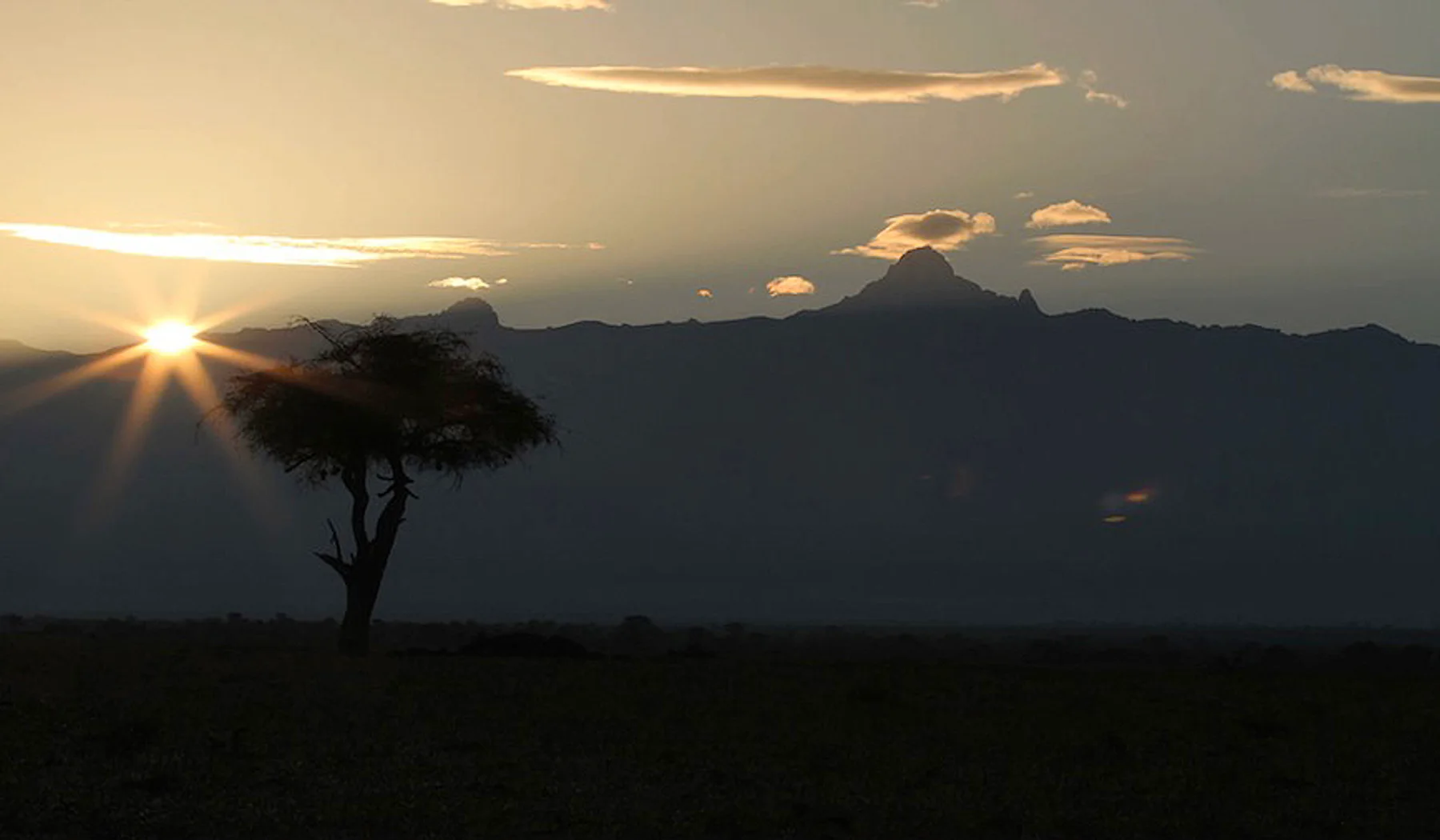
The road out of Nairobi tells the story slowly. Buildings loosen into farmland, the air cools as the highlands rise, and Mount Kenya may appear above the traffic on a clear morning. A flight tells the same story from another angle. The city falls away, cultivated ridges become a patchwork below the wing, and the dry northern country opens out in less than an hour.
Both journeys can be excellent. The wrong choice is usually made before either one begins, when somebody asks how long it takes to get from Nairobi to Laikipia without first saying where in Laikipia they are going.
Laikipia is a broad safari region of ranches, community lands, private conservancies, towns and mountain foothills. Ol Pejeta near Nanyuki is a different transfer from Loisaba in northern Laikipia. Lewa and Borana sit toward the Mount Kenya side. Mugie, Sosian and other remote properties have their own road approaches and airstrips. A single Nairobi to Laikipia distance hides all of that.
Nairobi to Laikipia at a glance
These are planning ranges. Traffic, rain, stops, the final conservancy road and the exact air service can change the day.
| Question | Practical answer | What changes it |
|---|---|---|
| Is Laikipia one destination? | No. Name the conservancy, lodge or town before choosing transport | Ol Pejeta, Lewa, Loisaba and western Laikipia use different approaches |
| Drive or fly? | Both work, but the complete itinerary should decide | Nights available, group size, luggage, onward route and lodge location |
| Road time | Roughly 3.5 hours to the Nanyuki side, with much longer drives to remote sectors | Nairobi starting point, traffic, stops and final dirt road |
| Scheduled flights | Usually leave Wilson Airport for a named Laikipia airstrip | Airline, day, season, routing and property transfer |
| Closest practical flight for Ol Pejeta | Nanyuki, followed by a road transfer of about 45 minutes | Gate, property and road conditions |
| Direct lodge access | Some remote properties have their own or nearby airstrips | Confirm the strip and transfer before booking |
| Best road vehicle | A comfortable safari 4×4 for conservancy roads | Wet season, luggage, group size and self-drive rules |
| Best compromise | Road one way and fly the other | Works especially well in a multi-stop northern circuit |
The most useful first sentence you can put in an enquiry is not “We want to visit Laikipia.” It is “We want to stay at this property or in this conservancy.” That one detail turns a vague transfer into a real plan.
Laikipia is a region, not a single park gate
Laikipia County stretches across a varied landscape north and northwest of Mount Kenya. Its official planning documents describe wildlife conservancies, wilderness, Maasai culture and ecological areas as part of the county's tourism identity. The county map also shows how widely conservancies and airfields are spread. There is no central Laikipia gate where every safari begins.
| Laikipia area | What travellers often mean | Access character |
|---|---|---|
| Nanyuki and Ol Pejeta | Rhino conservation, chimpanzees, Big Five viewing and an easy northern circuit | Straightforward road approach and Nanyuki flights |
| Lewa and Borana | Conservancy safari, rhinos, Mount Kenya views and intimate camps | Road via Nanyuki or flight to Lewa Downs |
| Loisaba | Remote northern landscapes, cats, conservation and lodge activities | Long road finish or flight to Loisaba airstrip |
| Mugie and northern Laikipia | Quiet private conservancy experience and wide country | Remote road access or property-linked airstrip |
| Sosian and western Laikipia | Ranch country, riding, wild dogs and low-density safari | Longer road journey, charter or lodge-arranged flight |
| Nanyuki town and Mount Kenya foothills | Hotels, supplies, mountain access and a circuit base | Easiest sector to reach by road |
Our forthcoming Laikipia safari guide explores the region as a whole. For transport, think of Laikipia as several safari neighbourhoods connected by roads and small airstrips.
Name the conservancy before comparing the clock
A flight to Nanyuki followed by a long road north may not be quicker than driving directly to a closer property. A flight to Loisaba, by contrast, can remove hours of remote road from a short stay. The destination name changes both the calculation and the mood of the travel day.
| If you are staying near | First comparison to make | Common mistake to avoid |
|---|---|---|
| Ol Pejeta | Nairobi road transfer versus Wilson to Nanyuki plus vehicle transfer | Treating Nanyuki Airstrip as the lodge entrance |
| Lewa or Borana | Direct road via Nanyuki versus Wilson to Lewa Downs | Booking Nanyuki when Lewa is the useful strip |
| Loisaba | Full road journey versus Wilson to Loisaba | Comparing flight time only and forgetting Wilson access |
| Mugie | Property-approved road and airstrip plan | Assuming every scheduled airline serves it every day |
| Sosian or western Laikipia | Long road, charter or lodge-linked flight | Using an eastern Laikipia estimate |
| Nanyuki hotel | Direct drive versus Nanyuki flight | Paying to fly when the broader itinerary already needs a road vehicle |
Before paying for any transport, put the lodge name, airstrip, pickup arrangement and final road time on the same page.
The eastern road through Thika, Karatina and Nanyuki
For Nanyuki, Ol Pejeta, Lewa and many Mount Kenya side properties, the usual road leaves Nairobi on Thika Road and continues through the central highlands toward Karatina and Nanyuki. It is a rewarding introduction to Kenya beyond the capital. Fruit stalls, farms, towns and distant peaks replace the city in stages.
| Road section | What the journey feels like | Useful planning note |
|---|---|---|
| Nairobi to Thika | Urban motorway and commuter traffic | Leaving early protects the rest of the day |
| Thika to Karatina | Faster highland road through productive farmland | Keep stops deliberate rather than accidental |
| Karatina to Nanyuki | Cooler air, busier towns and possible Mount Kenya views | Nanyuki is a useful meal and supply point |
| Nanyuki to Ol Pejeta | Regional road followed by the correct conservancy approach | Confirm the gate and property, not just “Ol Pejeta” |
| Nanyuki to Lewa or Borana | Continue around the mountain side to the named entrance | Allow for the final conservancy road |
| Nanyuki onward to northern Laikipia | Landscape becomes drier and roads more local | Time expands quickly beyond the town |
The tarmac section is only part of a safari transfer. A three-and-a-half-hour arrival in Nanyuki does not mean a three-and-a-half-hour arrival at every Laikipia bed.
The western approach through Nyahururu and Rumuruti
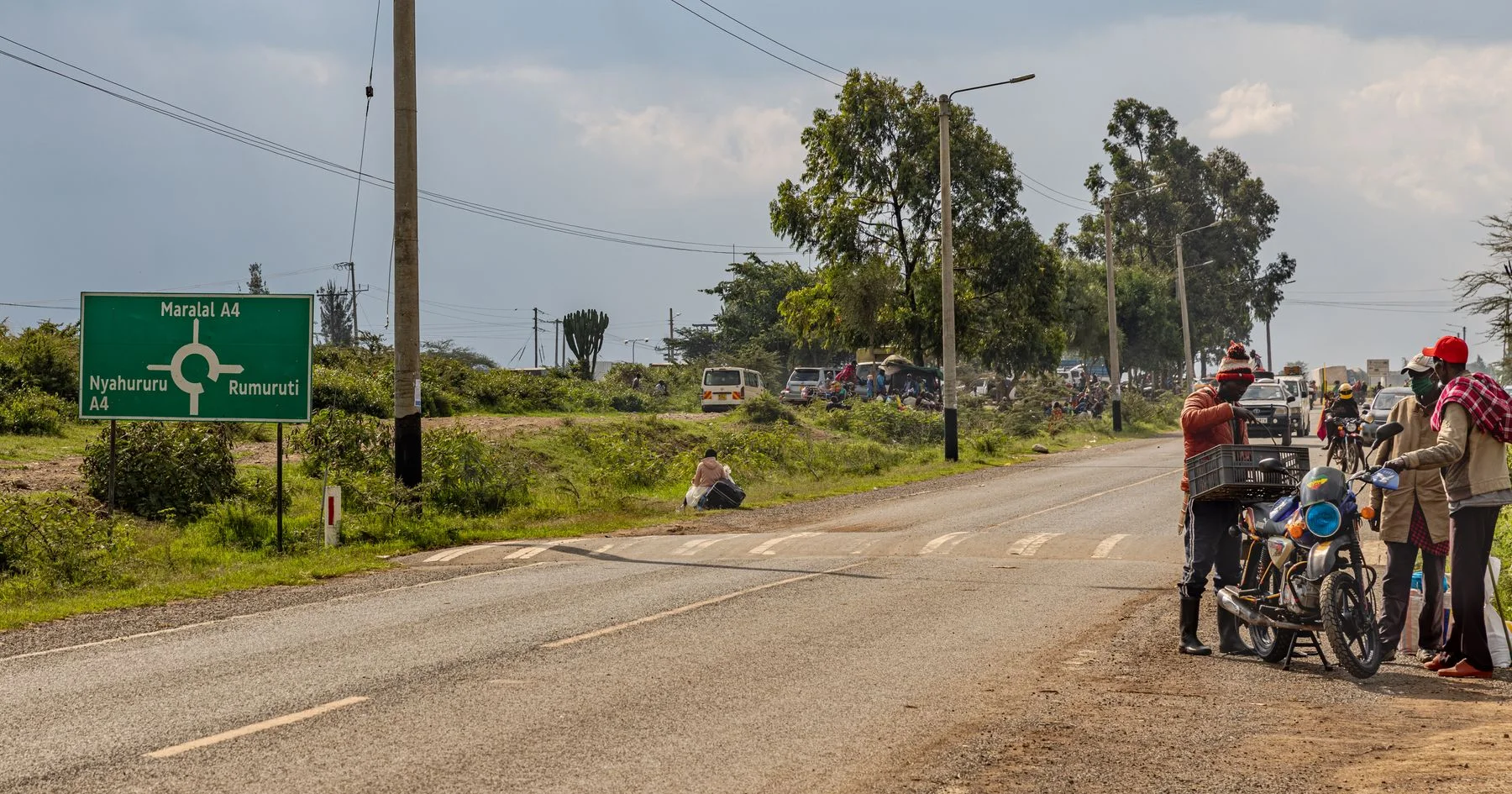
Some western and northern properties are better approached through the Rift Valley side, Nyahururu or Rumuruti. This route can also fit a journey coming from Lake Nakuru, Lake Naivasha or the Aberdare west side. It should be chosen around the property, not because it looks straighter on a map.
| Western-route factor | Why it matters |
|---|---|
| Starting point | A Naivasha or Nakuru departure changes the sensible route completely |
| Property entrance | A ranch may have a specific gate far from the public-road pin |
| Rain | Laterite and earth sections can slow sharply when wet |
| Fuel and supplies | Fill up before committing to a remote final leg |
| Mobile coverage | Download directions and carry the host's contact details |
| Daylight | The last section is easier and more enjoyable before dark |
For a multi-stop trip, routing from Nairobi through Aberdare National Park or Solio and exiting toward western Laikipia can prevent a large backtrack.
Realistic driving time by Laikipia sector
Road times are best treated as bands. Nairobi departure traffic can add an hour before the countryside begins, while a final conservancy road may cover relatively few kilometres very slowly.
| Destination area | Sensible road-planning band from central Nairobi | Why the range is wide |
|---|---|---|
| Nanyuki town | About 3.5 to 4.5 hours | Nairobi traffic, town approaches and stops |
| Ol Pejeta area | About 4 to 5 hours | Gate, property and final conservancy road |
| Lewa or Borana area | About 4.5 to 6 hours | Exact entrance, stops and road condition |
| Loisaba area | Often 6 to 8 hours or more | Long final approach and remote-road pace |
| Mugie or northern Laikipia | Often 6 to 8 hours or more | Property location and route choice |
| Sosian or western Laikipia | Often a full travel day | Western approach, weather and final ranch roads |
These bands are for itinerary design, not live promises. Ask for a same-week road report and a same-day traffic check. If the first afternoon contains an activity you would hate to miss, build more margin than the table suggests.
Why map distance can mislead you
A phone map is useful on the public road. It does not know every conservancy rule, lodge gate, river crossing, wet-season diversion or wildlife-related slowdown. It may route a private road as if it were open to through traffic.
| What the map shows | What the safari journey adds |
|---|---|
| Distance to a pin | Distance to the correct gate, reception or lodge |
| Public-road speed | Slow viewing roads and wildlife right of way |
| Shortest line | Property-approved access and permitted vehicle route |
| Estimated arrival | Gate formalities, bathroom stops and a meal |
| A road through a conservancy | Permission, opening hours and lodge instructions |
| Dry-weather geometry | Mud, dust, washboard, livestock and seasonal water |
Loisaba's own access guidance tells visitors to use the correct approach and notes vehicle requirements inside the conservancy. That is a useful warning for all of Laikipia: follow the host's arrival instructions, even when a navigation app prefers another line.
Use a proper safari 4×4 for the final road
The highway to Nanyuki can be travelled in an ordinary road car. The final access to a remote conservancy is a different question. A safari 4×4 gives clearance, stronger tyres, better visibility and enough cabin space for a full travel day.
| Vehicle feature | Reader benefit |
|---|---|
| Four-wheel drive | Better traction on wet, loose or eroded sections |
| Useful ground clearance | Less risk on ruts, stones and drainage crossings |
| All-terrain tyres | More confidence on mixed surfaces |
| Pop-up roof or wide windows | The transfer can become a first wildlife drive |
| Individual seat space | A six-hour day remains comfortable |
| Charging points | Cameras and phones arrive ready for the first evening |
| Sound spare and recovery kit | Remote roads leave little room for improvisation |
Ask how many travellers will share the vehicle and where the luggage will go. “4×4 included” says nothing about elbow room, window access or a roof piled with hard cases.
Private driver-guide or self-drive
Laikipia can be a wonderful self-drive region for experienced Kenya travellers. It is not a good place to discover after sunset that a pin led to the wrong gate. A private driver-guide removes that pressure and can remain with you for a wider circuit.
| Factor | Private driver-guide | Self-drive |
|---|---|---|
| Nairobi departure | Driver handles city traffic | You begin the holiday at the wheel |
| Navigation | Local team confirms the property approach | You carry the responsibility |
| Wildlife sightings en route | Guide can scan while driving safely | Driver must keep attention on the road |
| Vehicle permissions | Operator and lodge can align arrangements | You must confirm every conservancy rule |
| Flexibility | Easy to change stops with one team | High freedom if access is permitted |
| Recovery | Professional vehicle and contacts | Depends on rental support and preparation |
Self-drive is best when it is part of the enjoyment. It should not be selected only because the public-road distance looks manageable.
Conservancy vehicle rules are not all the same
Private conservancies manage access differently. Some allow a guest's transfer vehicle to reach the lodge but conduct game drives in their own vehicles. Some accept outside safari vehicles by arrangement. Others have specific colour, clearance, guide or route expectations. Loisaba, for example, states that only green or brown 4×4 vehicles are permitted inside.
| Ask the property before driving | Why it matters |
|---|---|
| May our vehicle enter the conservancy? | A public road arrival is not automatic safari access |
| May it conduct game drives? | Transfer permission and game-drive permission may differ |
| Is a conservancy vehicle included? | Avoid paying twice or arriving without a seat |
| Which gate and GPS point should we use? | Properties may have several possible approaches |
| What is the latest arrival time? | Remote gates and reception teams plan around daylight |
| Is a vehicle colour or specification required? | Some conservancies protect the visual and environmental setting |
The Laikipia conservancies comparison will help match the safari style. Access still needs confirmation from the chosen property.
Road stops that add something to the journey
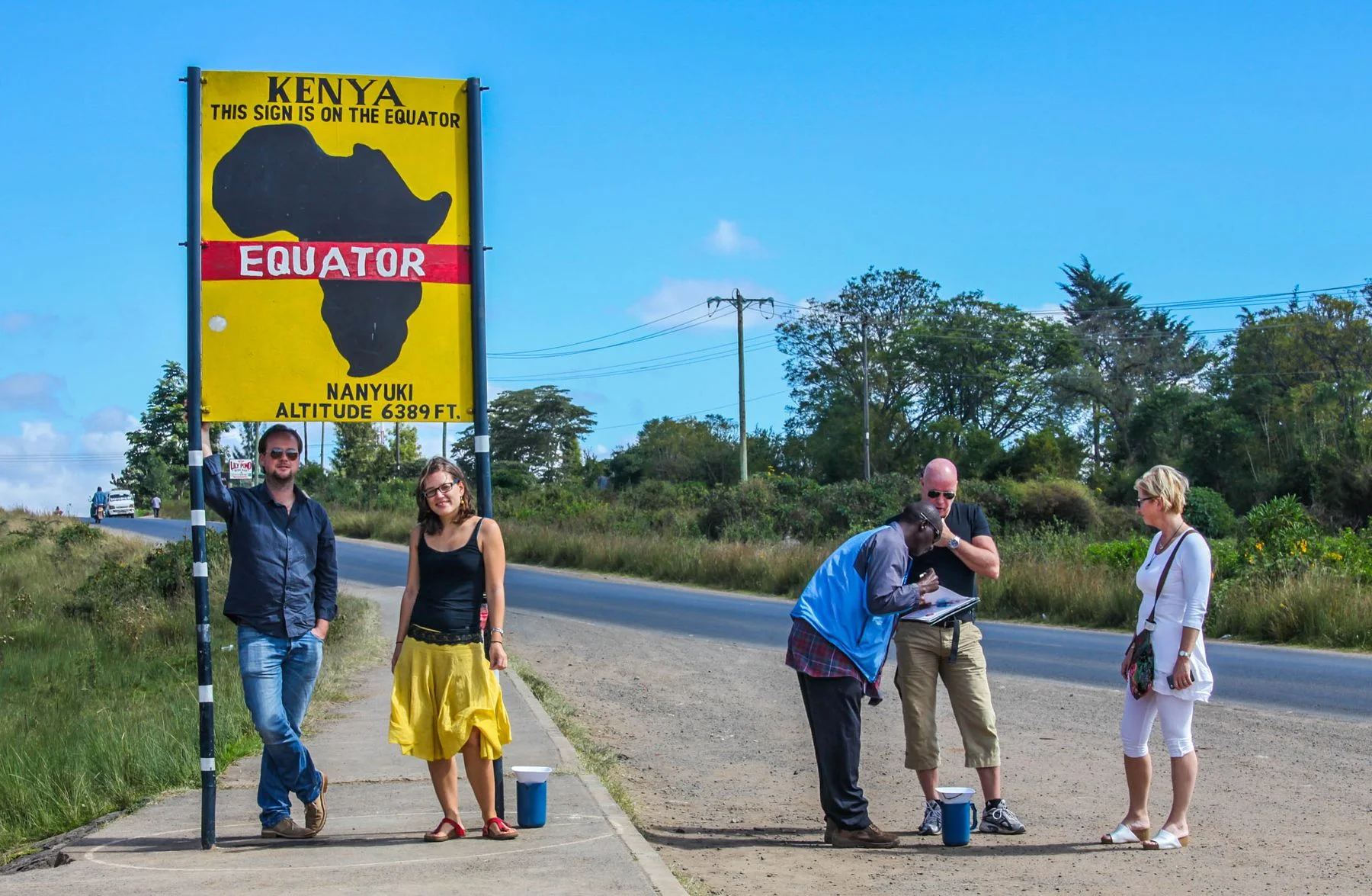
A road day does not need to be a race. The central highlands can support a coffee stop, a market pause, a meal in Nanyuki or a conservation stop on a longer route. The trick is to choose one or two, not collect a list that destroys the first afternoon.
| Possible pause | When it works | When to skip it |
|---|---|---|
| Breakfast north of Nairobi | Very early departure from the hotel | Late start or important lunch arrival |
| Equator stop near Nanyuki | First visit and relaxed itinerary | You have already done it or the lodge drive is long |
| Nanyuki lunch | Continuing to remote northern Laikipia | Flight arrival or early Ol Pejeta activity |
| Solio visit | Two-night highland circuit with a separate game-drive block | Attempted as a quick roadside stop |
| Aberdare overnight | Slow journey into a northern circuit | Three-night trip with one main Laikipia focus |
| Mount Kenya foothill stay | Climbers, walkers or travellers wanting contrast | A short pure-safari itinerary |
Road travel earns its place when the journey has texture without becoming cluttered.
Flying from Wilson Airport
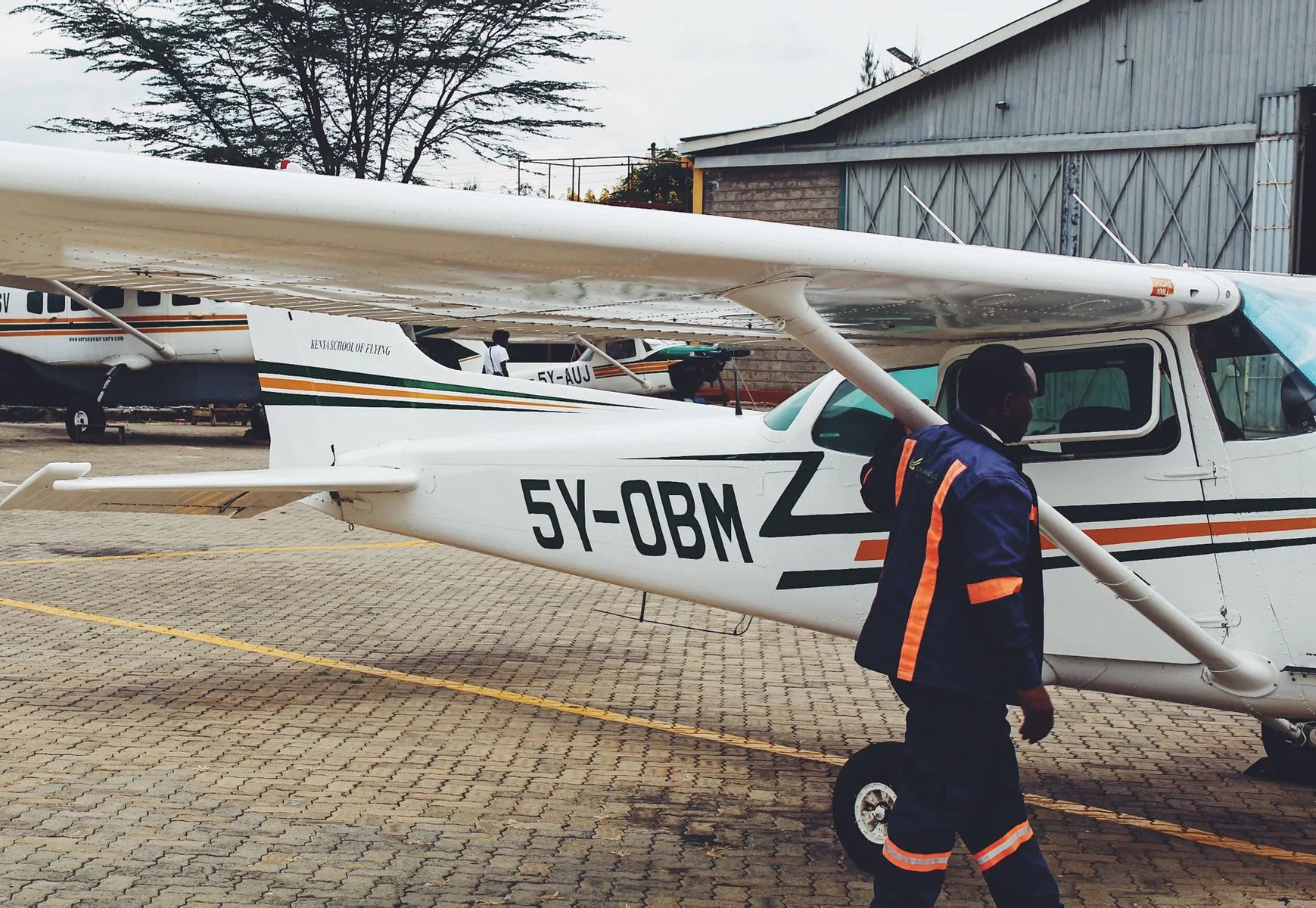
Scheduled safari flights to Laikipia normally use Wilson Airport, Nairobi's smaller domestic airport. AirKenya lists Nanyuki, Lewa Downs and Loisaba among its Laikipia access points. Safarilink also serves parts of the region. Exact days, times and routings change, so choose the lodge first and confirm the flight that serves its useful airstrip.
| Flight-day element | Time to allow |
|---|---|
| Nairobi hotel to Wilson | Depends heavily on neighbourhood and traffic |
| Check-in | Follow the airline's stated deadline, not a city-airport habit |
| Possible intermediate stop | Some safari flights touch another airstrip |
| Flying time | Often around an hour, depending on strip and routing |
| Airstrip welcome | Bags, briefing and vehicle loading take time |
| Airstrip to lodge | May be a short transfer or a first game drive of several hours |
The flight is short. The travel day still has several moving pieces.
JKIA to Wilson is a separate transfer
International flights arrive at Jomo Kenyatta International Airport. Most Laikipia safari flights leave Wilson. Those airports are on different sides of Nairobi traffic and do not share a protected connection.
| International-arrival situation | Sensible response |
|---|---|
| Overnight flight lands early | Allow immigration, bags, airport change and a wide delay margin |
| Separate tickets | Treat a missed safari flight as your financial risk unless covered |
| Family with children | Add breakfast, bathroom and repacking time |
| Many camera cases | Confirm baggage before leaving home, not at Wilson |
| Afternoon arrival | Use a Nairobi night rather than force an impossible connection |
| Tight same-day connection | Compare a private road departure instead |
A night in Nairobi can turn a fragile connection into an enjoyable start. It also lets travellers sleep before a small aircraft and a game drive.
Nanyuki Airstrip for Ol Pejeta and the Mount Kenya side
Ol Pejeta's official access information places Nanyuki Airstrip about a 45-minute drive from the conservancy and names scheduled services from Wilson. The airstrip also serves Nanyuki hotels and some Mount Kenya side itineraries.
| Nanyuki flight suits | Check before booking |
|---|---|
| Short Ol Pejeta stay | Which gate and vehicle will meet you |
| Mount Kenya foothill hotel | Exact road transfer to the property |
| Circuit beginning in Nanyuki | Whether the onward guide meets the flight |
| Travellers avoiding a long highway day | Complete door-to-door time from the Nairobi hotel |
| Fly-in, road-out itinerary | Luggage capacity in both aircraft and safari vehicle |
Do not describe the flight as direct to Ol Pejeta. The conservancy has an airstrip for charter arrangements, while scheduled access is commonly through Nanyuki.
Lewa Downs Airstrip for Lewa and Borana
For a stay in Lewa Wildlife Conservancy or neighbouring Borana, Lewa Downs can be more useful than Nanyuki. The airstrip-to-lodge transfer becomes part of the safari, with the possibility of wildlife from the first drive.
| Question | Why to ask it |
|---|---|
| Does the chosen flight land at Lewa Downs? | Not every service operates every day |
| How long is the transfer to our lodge? | Conservancies are large and drives are unhurried |
| Is the transfer included? | Avoid a surprise line in the final account |
| Is it a shared game drive? | Arrival time and privacy can affect the afternoon |
| Can we continue by road after the stay? | Useful for Samburu, Ol Pejeta or Aberdare circuits |
Flying here makes most sense when the stay itself is the priority. If several neighbouring stops follow, a road vehicle may create more freedom.
Loisaba Airstrip for northern Laikipia
Loisaba is where the value of flying becomes easiest to feel. The conservancy lies in northern Laikipia, and its official access page describes scheduled Wilson services as well as charter possibilities. Landing within the landscape removes a long final road and can protect a short stay.
| Fly to Loisaba when | Consider driving when |
|---|---|
| You have two or three nights and want them inside the conservancy | Laikipia is one chapter of a longer northern road circuit |
| The flight fits the lodge's transfer plan | You are travelling as a larger family group |
| Light luggage is manageable | You have substantial photographic or family luggage |
| You value time over road flexibility | Stops at Ol Pejeta, Solio or Mount Kenya matter |
| You are connecting onward by air | A private guide and vehicle will continue elsewhere |
The airstrip arrival is not dead time. In a wildlife conservancy, the transfer to camp can be the first game drive.
Mugie and other private airstrips
Remote conservancies may use their own strips, nearby strips or charters. Service can vary by day and season. A lodge name is therefore more useful than a general request for a Laikipia flight.
| Confirm in writing | Reason |
|---|---|
| Airstrip name | Similar regional names can produce the wrong booking |
| Airline and flight number | Makes the lodge pickup precise |
| Arrival and departure time | Determines the first and final activity |
| Intermediate stops | Affects total time and motion-sensitive travellers |
| Transfer duration | The strip may not sit beside the lodge |
| Private or shared transfer | Changes comfort, pace and cost |
| Charter alternative | Useful for families, unusual timings or heavy equipment |
Never book a flight to the nearest-sounding strip and hope the lodge can collect you. Ask the property or safari planner which strip belongs to the itinerary.
The airstrip-to-lodge drive is part of the safari
People sometimes describe an airstrip transfer as an inconvenience after the flight. In Laikipia it can be one of the loveliest parts of arrival. The vehicle is already in wildlife country. A twenty-minute route may become an hour because elephants block the road or a guide finds wild dogs.
| Arrival choice | What it creates |
|---|---|
| Straight transfer | Faster shower, lunch or rest |
| Game-drive transfer | First sightings without adding a separate activity |
| Private vehicle | Stops shaped around your interests |
| Shared vehicle | Sociable and often included, but slower to coordinate |
| Late arrival | Less light and a more direct drive |
If you are arriving with young children, limited mobility or after a long international journey, tell the lodge. A beautiful transfer still needs to suit the traveller.
Small-aircraft baggage needs an honest plan
Safari aircraft have strict weight and bag-shape limits because storage is small. The exact allowance belongs to the airline and fare, and it may change. Soft bags are usually easier than rigid cases.
| Baggage issue | Plan before travel |
|---|---|
| Hard-shell suitcase | Store it in Nairobi and repack into a soft safari bag |
| Camera equipment | Declare weight and dimensions before ticketing |
| Medical device | Ask the airline how it can be accommodated safely |
| Child equipment | Confirm stroller, car seat and cot arrangements |
| More luggage than allowed | Buy approved extra capacity or choose a road transfer |
| Road out after flying in | Make sure every bag fits the onward safari vehicle too |
Do not hide heavy camera gear in a “personal item.” Aircraft loading is a safety calculation, not an airline game.
Compare door to door, not road time with flight time
An hour in the air is not a one-hour journey. A four-hour drive is not always a four-hour burden. The useful comparison starts at the hotel door and ends at the lodge.
| Road journey | Flight journey |
|---|---|
| Hotel pickup | Hotel pickup to Wilson |
| City departure | Airport check-in |
| Highway drive | Waiting and possible intermediate stop |
| Meal or bathroom stop | Flight |
| Final conservancy road | Airstrip unloading |
| Arrival at lodge | Airstrip-to-lodge game drive |
For Ol Pejeta, the door-to-door difference can be modest once Wilson access and the Nanyuki transfer are added. For remote northern Laikipia, flying can still save a substantial part of the day.
When flying clearly wins
Flying is not only a luxury upgrade. Sometimes it is the itinerary that makes sense.
| Flying is usually stronger when | Why |
|---|---|
| You have two or three nights in a remote conservancy | More daylight remains for the experience you paid for |
| The trip connects Mara and Laikipia | Air can avoid returning through Nairobi by road |
| One traveller finds long roads painful | Less sitting on tarmac, though small-aircraft access must be considered |
| The lodge sits near its airstrip | Transfer time remains short or scenic |
| The party travels light | Baggage constraints are easy to meet |
| You are celebrating a honeymoon | The arrival feels immediate and unhurried |
The best flight is the one that improves the stay, not simply the one with the shortest advertised duration.
When driving clearly wins
Road travel is often the more intelligent choice for a northern Kenya circuit. One vehicle can collect you in Nairobi, stop in the highlands, continue through several conservancies and finish in Samburu or back in the city.
| Driving is usually stronger when | Why |
|---|---|
| You are combining Aberdare, Solio, Ol Pejeta and Laikipia | The route becomes the holiday rather than repeated airport transfers |
| Four or more people travel together | The private vehicle can compare favourably with several air tickets |
| Luggage is generous | Fewer weight and bag-shape restrictions |
| Children need flexible stops | Meals, bathrooms and pacing remain under your control |
| A private guide matters | The same person learns your interests across the circuit |
| You want photography equipment close at hand | No aircraft loading limits beyond vehicle capacity |
Road travel also reveals the change from fertile highlands to dry northern country. That transition is part of understanding Laikipia.
Road one way and fly the other
The mixed plan often gives the best of both. Drive north through Aberdare, Solio or Ol Pejeta, continue into deeper Laikipia, then fly from the final conservancy to Nairobi or the Masai Mara.
| Mixed itinerary | What it solves |
|---|---|
| Road Nairobi to Ol Pejeta, fly out of Loisaba | Includes highland stops without repeating the long return |
| Fly to Lewa, road through Laikipia to Samburu | Protects the first day and keeps northern flexibility |
| Road through Aberdare and Solio, fly Loisaba to Mara | Connects three distinct landscapes efficiently |
| Fly to Nanyuki, road back via Aberdare | Useful after an international arrival when later days are flexible |
| Road to Laikipia, fly to the coast | Avoids a full return to Nairobi before beach time |
Nairobi to Ol Pejeta
Ol Pejeta is one of the easiest Laikipia experiences to reach from Nairobi. Drive through the central highlands for a door-to-gate journey, or fly from Wilson to Nanyuki and continue by vehicle for roughly 45 minutes.
| Choose road when | Choose flight when |
|---|---|
| Ol Pejeta follows Aberdare or Solio | You have a short two-night stay |
| A private guide continues north | A lodge vehicle will handle all activities |
| The family carries more luggage | The group is small and light |
| You want Nanyuki or Mount Kenya stops | You want to begin the afternoon in the conservancy |
Read the detailed Ol Pejeta Conservancy guide and Ol Pejeta entry fees and activities before deciding how much of the day belongs to the transfer.
Nairobi to Lewa and Borana
Lewa and Borana suit both approaches. The road journey fits an Ol Pejeta or Mount Kenya circuit. A flight to Lewa Downs is elegant for a focused conservancy stay.
| Itinerary shape | Better starting point |
|---|---|
| Three nights only at Lewa or Borana | Compare direct flight first |
| Lewa plus Ol Pejeta | Private road vehicle often adds flexibility |
| Lewa plus Samburu | Fly in, then continue by road if the sequence and vehicle work |
| Family of five or six | Price the whole vehicle against all air seats |
| Photography trip with heavy cases | Road may remove the baggage problem |
The planned Ol Pejeta versus Lewa guide will help distinguish their safari character before transport drives the decision.
Nairobi to Loisaba
Loisaba is far enough north for transport to shape the stay. Driving can consume most of a day, but it joins beautifully with stops farther south. Flying can put a traveller into the conservancy in time for lunch and an afternoon activity.
| Your wider trip | Strong option |
|---|---|
| Nairobi, Loisaba, Nairobi in three nights | Fly both ways if schedules fit |
| Aberdare, Ol Pejeta, Loisaba | Drive north, then consider flying out |
| Loisaba, Samburu | Compare road connection with an air routing |
| Loisaba, Masai Mara | Ask about through or connecting safari flights |
| Large family with flexible time | Private road vehicle may offer better total value |
The conservancy is worth reaching in a way that leaves energy for it.
Connecting Aberdare and Laikipia
Aberdare's wet mountain forest makes a powerful contrast with Laikipia's open ranch country. By road, the two belong naturally in the same northern circuit.
| Sequence | Good for |
|---|---|
| Nairobi, Aberdare, Ol Pejeta | First northern safari with rhinos and forest |
| Nairobi, Aberdare, Solio, Laikipia | Rhino-focused journey with landscape variety |
| Naivasha, Aberdare west, Laikipia | Travellers already in the Rift Valley |
| Laikipia, Aberdare, Nairobi | Slower final night before the city |
Our Nairobi to Aberdare route guide explains the gate and 4×4 choices. Do not try to treat Aberdare as a quick roadside attraction between breakfast and a northern lodge lunch.
Connecting Solio and Laikipia
Solio's rhino viewing sits neatly between the Aberdare and Mount Kenya sides of a northern trip. It deserves its own drive, not a hurried detour. A stay near Solio can shorten the next morning's journey into Ol Pejeta or deeper Laikipia.
| Plan | Why it works |
|---|---|
| Nairobi to Solio, then Ol Pejeta | Separates two rhino experiences rather than rushing both |
| Aberdare to Solio to Lewa | Moves north with little repeated road |
| Solio day, Nanyuki night, fly onward | Uses both road and air without a tight same-day transfer |
| Laikipia to Solio to Nairobi | Adds a final wildlife chapter on the way south |
Use the forthcoming Nairobi to Solio Ranch guide and Solio Ranch visitor guide to give the visit enough time.
Connecting Laikipia and Samburu
Laikipia and Samburu share a northern geography but feel distinct. Laikipia is shaped by varied conservancies and ranch histories. Samburu brings the Ewaso Nyiro, dry-country species and classic reserve drives.
| Connection | Planning thought |
|---|---|
| Lewa to Samburu | Natural road pairing with a private vehicle |
| Loisaba to Samburu | Ask about the exact road and realistic transfer time |
| Ol Pejeta to Samburu | Full but manageable northern road day with an early start |
| Fly between regions | Useful only if schedules, strips and transfers truly align |
Our Samburu safari guide helps decide how many nights the second region needs.
Connecting Laikipia and the Masai Mara
On a map, both are west of Mount Kenya and east of Lake Victoria only in the broadest sense. By road, the journey is long and usually returns through or around Nairobi. Safari flights can turn the pairing into an excellent contrast between private conservancy country and the Mara ecosystem.
| Option | Strength | Limitation |
|---|---|---|
| Fly Laikipia to Mara | Protects a full day and avoids a very long road | May involve stops or a connection |
| Road via Nairobi | Keeps luggage simple and may suit a private circuit | Usually consumes a full travel day |
| Nairobi overnight between | Gives rest and separates transport risks | Adds a night outside the safari areas |
| Charter | Tailored timing for a group | Higher cost and aircraft constraints |
Use our Masai Mara safari guide to select the correct Mara sector before booking the onward airstrip.
Connecting Laikipia and the Kenya coast
After dust, early game drives and cool nights, the coast feels wonderfully soft. The transport normally works through Nairobi, although seasonal or connecting air options may reduce the interruption.
| Route idea | What to check |
|---|---|
| Laikipia airstrip to Wilson, then coast flight | Airport, connection time and baggage rules |
| Road to Nairobi, fly next morning | Hotel, traffic and which airport the coast flight uses |
| Private charter | Exact coastal airport and luggage capacity |
| Road all the way to the coast | Usually too long for a holiday transfer |
Do not assume two flights shown on separate websites connect safely. Put the airports, baggage collection and delay margin into one itinerary.
Families with children
Families often prefer the road because snacks, bathroom stops and bags remain under their control. Children who become carsick may prefer the shorter flight, although small aircraft can also be warm and bumpy.
| Family question | Road response | Flight response |
|---|---|---|
| How long can the child sit comfortably? | Break the journey or add an overnight | Choose a nearby airstrip and short transfer |
| Is a car seat needed? | Confirm the exact seat and installation | Confirm both aircraft and lodge vehicle arrangements |
| How much luggage is essential? | Private vehicle gives more capacity | Repack and store non-safari cases in Nairobi |
| Does the lodge accept the child's age? | Check before transport | Check before transport |
| Can the first activity be skipped? | Private itinerary makes this easy | Tell the lodge not to build pressure into arrival |
The best family transfer is the one that leaves everyone curious when they arrive.
Honeymoon travel
A honeymoon does not automatically require a flight. Privacy, pace and the sequence of experiences matter more. A private road trip through the highlands can be romantic. A fly-in arrival at a remote camp can feel beautifully cinematic.
| Honeymoon priority | Transport choice to explore |
|---|---|
| Maximum lodge time | Direct flight to the useful airstrip |
| Private journey with scenic stops | Chauffeured 4×4 from Nairobi |
| Several distinct safari areas | Road north and fly onward |
| Plenty of luggage after a wedding | Road or pre-arranged storage and repacking |
| Quiet final day | Fly back rather than repeat a long road |
Tell the planner what would make the journey feel special. “Luxury” is too vague to decide between a private car, a charter or a scheduled flight.
Travellers with limited mobility
Neither flying nor driving is automatically more accessible. Safari aircraft may have narrow doors and steps. A long road can be painful without proper support and stops. The correct choice depends on the individual and the exact vehicle or aircraft.
| Ask in advance | Why it matters |
|---|---|
| Aircraft door dimensions and boarding steps | Small planes differ from commercial jets |
| Ability to walk on uneven airstrip ground | Aprons may be gravel or earth |
| Vehicle step height | Safari 4x4s can be high |
| Transfer duration without a toilet | Remote roads need planning |
| Wheelchair storage | Space may be limited in aircraft and game vehicles |
| Room-to-vehicle route | Accessibility continues after arrival |
Our accessible Kenya safaris guide provides a fuller planning framework. Describe the traveller's actual needs rather than relying on an “accessible” label.
Photographers and heavy equipment
Road travel gives photographers more control over hard cases, tripods and charging equipment. Flying can still work with early disclosure and paid extra capacity.
| Photography need | Better question |
|---|---|
| Large lens case | Will it fit the aircraft hold opening? |
| Multiple bodies and batteries | What must remain in the cabin and what can be checked? |
| Private vehicle | Is one full row available for gear? |
| Sunrise arrival | Does the transport reach camp before the first full morning? |
| Dust protection | Can equipment be stored inside rather than on the roof? |
| Charging | Are vehicle inverters and lodge charging hours suitable? |
Photographers should compare the price of extra aircraft capacity with a private road vehicle, not risk turning up overweight.
Rain changes the last part of the journey
The central highway remains broadly usable through the year, but rain can slow conservancy roads, deepen ruts and make river crossings more serious. Dry periods bring dust and corrugation instead.
| Condition | Road implication | Flight implication |
|---|---|---|
| Heavy rain | Slower final access and possible route change | Airstrip condition and local visibility can matter |
| Morning mist | Reduced road visibility in highlands | Possible operational delay |
| Dry dust | More following distance and cabin dust | Usually limited effect on schedule |
| Washed road | Property may give a different gate | Pickup vehicle may use a different route |
| Storm forecast | Leave margin and keep contact | Protect onward connections |
Ask for the latest property access advice within the week of travel, then confirm again if strong rain falls overnight.
Public transport reaches towns, not the safari experience
Buses and shared vehicles can reach Nanyuki, Nyahururu and other regional towns. They do not solve the final conservancy transfer, game-drive vehicle, gate permission or luggage security.
| Budget idea | Hidden second step |
|---|---|
| Bus to Nanyuki | Private pickup to the lodge or conservancy |
| Shared taxi toward a gate | Permission and safe final access |
| Town hotel then day visit | Dedicated safari vehicle and entry arrangements |
| Ride-hailing app | Coverage, return availability and suitable vehicle |
Independent travellers can use public transport successfully, but the final leg should be booked before leaving Nairobi. Do not arrive in Nanyuki late in the day expecting an ordinary taxi to create a conservancy safari.
What road and flight really cost
There is no single Laikipia transfer price. Road quotes may be per vehicle and include a driver-guide for several days. Flight prices are per person, then may need hotel transfers and airstrip pickups. Conservancy vehicles can add another line.
| Cost line | Road | Flight |
|---|---|---|
| Main transport | Private vehicle, driver and fuel | Seat per traveller or charter aircraft |
| Nairobi pickup | Usually part of the vehicle day | Separate hotel-to-Wilson transfer |
| Final access | Same vehicle if permitted | Lodge airstrip transfer |
| Game drives | May use the same vehicle or lodge vehicle | Usually lodge vehicle |
| Extra luggage | Vehicle capacity | Airline fee or charter requirement |
| Driver accommodation | May apply on a multi-day private trip | Not applicable to the flight |
| Group size effect | More people can reduce per-person vehicle cost | Every scheduled seat adds cost |
The Laikipia safari cost guide will separate accommodation, conservation and activity costs. For transport, ask for one total that reaches the lodge and supports the planned game drives.
A three-night Laikipia plan
With only three nights, choose one conservancy and protect the first afternoon. Remote properties often justify flying. Ol Pejeta can work well by either road or Nanyuki flight.
| Day | Road-focused version | Flight-focused version |
|---|---|---|
| Day 1 | Early Nairobi departure, one chosen stop, afternoon arrival | Morning Wilson flight, game-drive transfer, afternoon activity |
| Day 2 | Full conservancy day | Full conservancy day |
| Day 3 | Full conservancy day | Full conservancy day |
| Day 4 | Drive to Nairobi or onward stop | Morning activity and flight onward |
Do not divide three nights between two distant Laikipia properties unless the move itself adds something important.
A five-night northern circuit
Five nights allow the road to earn its place. A night in the Aberdare or Solio area, two nights at Ol Pejeta and two nights deeper in Laikipia create real contrast.
| Day | Example rhythm |
|---|---|
| Day 1 | Nairobi to Aberdare or Solio, afternoon activity |
| Day 2 | Morning experience, continue to Ol Pejeta |
| Day 3 | Full Ol Pejeta day |
| Day 4 | Drive to Lewa, Loisaba or another chosen conservancy |
| Day 5 | Full conservancy day |
| Day 6 | Fly to Nairobi, Mara or coast connection |
This is a framework, not a package template. A rhino enthusiast, rider, family and birder would each fill the days differently.
A seven-night slow Laikipia journey
Seven nights can support two or three contrasting bases without turning every other morning into luggage time.
| Stay | Possible focus |
|---|---|
| Two nights Ol Pejeta | Rhinos, chimpanzee sanctuary and broad wildlife viewing |
| Two nights Lewa or Borana | Conservancy drives, landscapes and conservation story |
| Three nights Loisaba, Mugie or Sosian | Remote activities, slower pace and a deeper sense of place |
Drive between the first bases, then fly out of the most remote property. That sequence gives context on the way north and avoids repeating the longest road.
What travellers say about the region
Individual reviews cannot promise what another visitor will see, but they reveal why travellers accept the extra planning. On SafariBookings, one Laikipia reviewer wrote, “I loved the feeling of being the only visitors in an area ruled by animals.” That sense of space is a strong reason to choose a remote conservancy rather than the easiest road pin.
Another Laikipia reviewer described the region simply as “best wildlife viewing in central kenya.” The lowercase wording is theirs, and the opinion is personal. It does capture the surprise some visitors feel when Laikipia delivers serious wildlife without the density of better-known reserves.
At Ol Pejeta, a Tripadvisor contributor wrote, “We saw all the Big 5, plus a cheetah in one morning.” Treat that as one lucky morning, not an itinerary promise. Wildlife remains wild. The useful point is that an accessible sector can still produce a full safari experience.
| Review insight | Planning lesson |
|---|---|
| Space and low vehicle density matter | A remote road or flight may be worthwhile for quiet |
| Wildlife can be excellent outside the famous southern circuit | Do not treat Laikipia as merely a transfer region |
| One visitor's sightings are not guaranteed | Choose habitat, guides and time, not a checklist promise |
| Airstrip transfers can already be game drives | Do not measure every minute only as transport |
Sources: Laikipia visitor reviews on SafariBookings and Ol Pejeta traveller reviews on Tripadvisor.
The decision in one table
| Your trip | Strong first choice | Why |
|---|---|---|
| Two nights at remote Loisaba | Fly | Protects scarce lodge time |
| Three nights at Ol Pejeta from Nairobi | Compare both | Door-to-door difference may be smaller than expected |
| Family northern circuit | Drive | Space, stops and luggage flexibility |
| Honeymoon at one remote lodge | Fly | Immediate arrival and more time together |
| Aberdare, Solio, Ol Pejeta and Lewa | Drive | One coherent route with a private guide |
| Laikipia followed by Mara | Fly onward | Avoids a very long road day |
| Heavy photography equipment | Drive or pre-book extra air capacity | Prevents a baggage crisis |
| Limited mobility | Individual assessment | Aircraft steps and road duration both matter |
| Large private group | Compare charter with safari vehicle | Per-person arithmetic changes quickly |
| First Kenya safari with seven or more nights | Road north, fly onward | Shows the landscape and removes repetition |
Questions to settle before booking
| Question | A complete answer should contain |
|---|---|
| Where exactly are we staying? | Property, conservancy and gate |
| Which airstrip serves it? | Exact strip, airline and transfer time |
| What is the road time? | Starting address, stops, final road and realistic range |
| Which vehicle will we use? | Model, seats, luggage space and conservancy permission |
| Who meets us? | Named lodge, guide or transfer company |
| Are game drives included? | Private or shared vehicle, activity limits and fees |
| What are the baggage rules? | Weight, dimensions and special equipment agreement |
| What happens if weather delays us? | Contact, rebooking and missed-night terms |
| Where do we go next? | Correct exit route or onward airstrip |
When those answers are clear, the transport stops being a vague add-on and becomes part of the safari.
Plan the journey around the stay you actually want
There is no prize for choosing the fastest-looking route. A road journey can be the best first chapter, especially when it climbs through the highlands and connects several northern landscapes. A flight can be the kinder choice when time is short or the lodge sits deep in the conservancy country.
Start with the experience. Name the property. Count the nights. Look at the luggage, travellers and next destination. Then compare the whole road and flight journey from door to door.
If you share your Nairobi hotel or arrival flight, Laikipia lodge, dates, group size, luggage and onward route, we can build the transfer around the safari rather than forcing the safari around a transport assumption.
Plan your Laikipia journey
Share the Nairobi start, exact lodge or conservancy, travellers, luggage, dates and next stop. We will compare the complete road and air options.