
Lake Nakuru Rhino Safari Guide
Learn how to identify Lake Nakuru’s rhinos, read their behaviour and plan an ethical safari that remains rewarding even when sightings take time.

- Why Lake Nakuru matters for rhinos
- What the census can and cannot tell you
- Black rhino and white rhino are not colour labels
- The mouth gives the best first clue
- Habitat narrows the search
- Start early, but keep the whole day useful
- A sighting begins before the animal appears
- The guide should refuse a chase
- Keep at least 20 metres away
- Mothers and calves need extra room
- White rhinos can be social
- Black rhinos can disappear in plain sight
- Oxpeckers are more than decoration
- Rhino posture tells you when to stop
- Stay inside the vehicle
- Choose a vehicle for sightlines and patience
- Shared versus private rhino drive
- Photograph shape, habitat and behaviour
- Never publish live location details
- Children can learn to identify without a checklist
- Plan mobility around the vehicle, not a walking promise
- Rain changes roads and search strategy
- Dust changes comfort and image quality
- A full day gives uncertainty room
- Overnight inside or outside the park
- Calculate the cost without buying a guarantee
- Do not pay extra for a false rhino promise
- Lake Nakuru versus Ol Pejeta
- Lake Nakuru versus Solio Ranch
- Lake Nakuru versus Nairobi National Park
- Lake Nakuru versus Tsavo West rhino searching
- Rhino and flamingo expectations belong on separate lines
- Other wildlife prevents tunnel vision
- Use traveller reviews as evidence, not instructions
- Red flags at a rhino sighting
- What to pack for a rhino-focused drive
- Send a complete rhino-safari brief
- Measure value by the day, not the closest horn
- Let the driver-guide turn a shape into a story
- Frequently asked questions
- Let the rhino choose the encounter
The shape appears first: a broad back moving between shrubs, then two ears turning independently and a horn catching the morning light. Lake Nakuru is compact enough to make rhino searching feel possible, yet wild enough that nothing arrives on command. The guide cuts the engine, leaves the animal a clear path and waits.
This Lake Nakuru rhino safari guide explains how to plan that encounter well. It covers black and white rhino identification, sanctuary history, habitat, timing, vehicle choice, mothers and calves, oxpeckers, tracks, photography, safety, children, accessibility, cost and honest comparisons with other Kenyan rhino destinations.
| Quick decision | Practical answer |
|---|---|
| Black and white rhinos? | Both occur |
| Guaranteed sighting? | No |
| Best general start | 6:00 am when gates open |
| Species clue | Mouth and feeding style, not skin colour |
| Viewing distance | KWS states a minimum of 20 metres |
| Off-road approach | Prohibited |
| Best vehicle | Comfortable roof viewing with a guide who knows the park |
| Strong combination | Rhinos, Rothschild's giraffe, birds and viewpoints |
Why Lake Nakuru matters for rhinos
KWS designated Lake Nakuru Kenya's first government-managed rhino sanctuary in 1987. The fenced park combines grassland, woodland, shore and escarpment habitat within 188 square kilometres.
| Conservation milestone | Meaning |
|---|---|
| 1986 perimeter fence | Strengthened park boundary management |
| 1987 rhino sanctuary designation | Created focused protection for black and white rhinos |
| Black and white rhino populations | Offers a chance to compare two African species |
| Ongoing monitoring | Supports individual and population management |
| National-park protection | Connects rhinos with a wider ecosystem |
The complete Lake Nakuru National Park guide covers gates, viewpoints and the rest of the wildlife.
What the census can and cannot tell you
The 2021 National Wildlife Census recorded 51 rhinos, black and white combined, in the Lake Nakuru ecosystem. That is a dated count, not today's total and not a promise about what sits beside the road.
| Census statement | Correct use |
|---|---|
| 51 combined rhinos in 2021 | Historical population evidence |
| No species split in the summary | Do not invent one |
| Park supports both species | Plan identification learning |
| Count covers an ecosystem | Do not convert it into sighting odds |
Rhino numbers and locations are security-sensitive. A responsible guide discusses habitat, not live operational detail.
Black rhino and white rhino are not colour labels
Both can look grey, brown or mud-stained. “White” is not a reliable field colour. Start with mouth shape, head posture, habitat and feeding.
| Feature | Black rhino | White rhino |
|---|---|---|
| Mouth | Pointed, hooked upper lip | Broad, square lip |
| Feeding | Browser taking leaves and twigs | Grazer cropping grass |
| Head at rest | Often held higher | Often carried lower |
| Build | Generally more compact | Generally larger and longer-bodied |
| Social tendency | Often solitary | More often seen in loose groups |
| Habitat clue | Thickets and browse | Open grassland |
Use several clues together. Angle, age and vegetation can hide the mouth.
The mouth gives the best first clue
A black rhino's prehensile upper lip can grasp leaves. A white rhino's wide mouth sweeps grass close to the ground.
| What you observe | Likely interpretation |
|---|---|
| Head deep in shrub | Black-rhino browsing behaviour |
| Broad muzzle moving across lawn | White-rhino grazing behaviour |
| Animal walking with head raised | Look for more clues |
| Mud covers face | Ignore colour and watch feeding |
Do not pressure the guide to move for a face-on view. Behaviour may identify the species without disturbing it.
Habitat narrows the search
Rhinos move, so habitat is a probability, not a pin. White rhinos often use open grassland; black rhinos often favour woody browse and broken cover.
| Habitat | What to scan |
|---|---|
| Short grass | Low head, broad body and grazing line |
| Shrub edge | Ears or horn emerging before the body |
| Woodland opening | Travel route between cover and feeding |
| Mud or water | Tracks, wallowing and drinking signs |
| Lakeshore grass | Rhinos with buffalo, waterbuck or birds |
The park's variety allows a guide to change the search when one habitat is quiet.
Start early, but keep the whole day useful
KWS lists 6:00 am to 6:00 pm for day visitors. Early air can be cool and animals may be active, but there is no rhino appointment.
| Time | Strength | Limitation |
|---|---|---|
| Early morning | Cool, soft light and long search margin | Low light in woodland |
| Late morning | Better light and active grazing possible | Heat and traffic can build |
| Midday | Quiet roads and open-grass visibility | Harsh light |
| Late afternoon | Warm light and movement | Gate-time margin |
Give the guide permission to enjoy other wildlife rather than racing between rumours.
A sighting begins before the animal appears
Experienced guides read fresh dung, tracks, feeding signs, alarm calls and reports from colleagues without broadcasting exact locations publicly.
| Sign | What it suggests |
|---|---|
| Broad three-toed track | A rhino passed, freshness still matters |
| Browsed twig ends | Possible black-rhino feeding among other browsers |
| Cropped grass path | Possible grazer movement |
| Dung midden | Repeated territorial communication site |
| Oxpecker activity | Large mammal nearby, not proof of rhino |
Never leave the vehicle to inspect a track except at a designated area and under park rules.
The guide should refuse a chase
When a radio report arrives, several vehicles may converge. A strong guide slows before the sighting, finds a legal position and leaves an exit.
| Poor practice | Responsible practice |
|---|---|
| Speeding to beat another vehicle | Approach below the park limit |
| Blocking the rhino's path | Keep road and habitat exit clear |
| Surrounding the animal | View from one side and move on |
| Hooting for attention | Stay quiet |
| Driving off road | Remain on established roads |
| Following a retreating rhino | Let it disappear |
KWS limits vehicle speed to 40 km/h and prohibits off-road driving.
Keep at least 20 metres away
KWS tells visitors to view wildlife from a minimum distance of 20 metres. Behaviour can require much more.
| Rhino response | Vehicle response |
|---|---|
| Feeding calmly | Hold distance and keep voices low |
| Head rises towards vehicle | Stop advancing |
| Ears lock on vehicle | Give more space |
| Animal turns away | Do not follow closely |
| Mother positions between calf and vehicle | Withdraw calmly |
| Rhino approaches | Stay inside and follow guide instructions |
Distance is measured for the animal's comfort, not the lens in your hand.

Mothers and calves need extra room
A calf invites attention, but the adult's protective choices govern the encounter.
| Situation | Best response |
|---|---|
| Calf resting | Keep quiet and brief |
| Calf crosses road | Wait for mother and any second animal |
| Mother faces vehicle | Increase distance |
| Calf wanders towards car | Do not move between them |
| Several vehicles arrive | Leave before pressure builds |
Never use the vehicle to separate, flank or hold a family for a photograph.
White rhinos can be social
White rhinos may appear in pairs or loose groups, sometimes called crashes. A group does not mean every animal is relaxed with vehicles.
| Group behaviour | What to watch |
|---|---|
| Parallel grazing | Calm feeding rhythm |
| Young animal following adult | Family relationship |
| Sudden bunching | Increased attention or uncertainty |
| One animal moving away | Give the whole group space |
| Play or horn contact | Observe without interpreting every movement as aggression |
Count carefully, then stop counting and watch behaviour.
Black rhinos can disappear in plain sight
A black rhino can step behind a shrub and vanish. Their browsing habitat makes patience more useful than speed.
| Search habit | Why it helps |
|---|---|
| Scan gaps, not only open ground | Body parts appear between branches |
| Watch ears | They move above cover |
| Stop engine where permitted | Reveals feeding sounds and movement |
| Recheck an edge after minutes | Animal may emerge naturally |
| Use binoculars | Prevents pressure for closer access |
The difficulty is part of a black-rhino encounter's character.
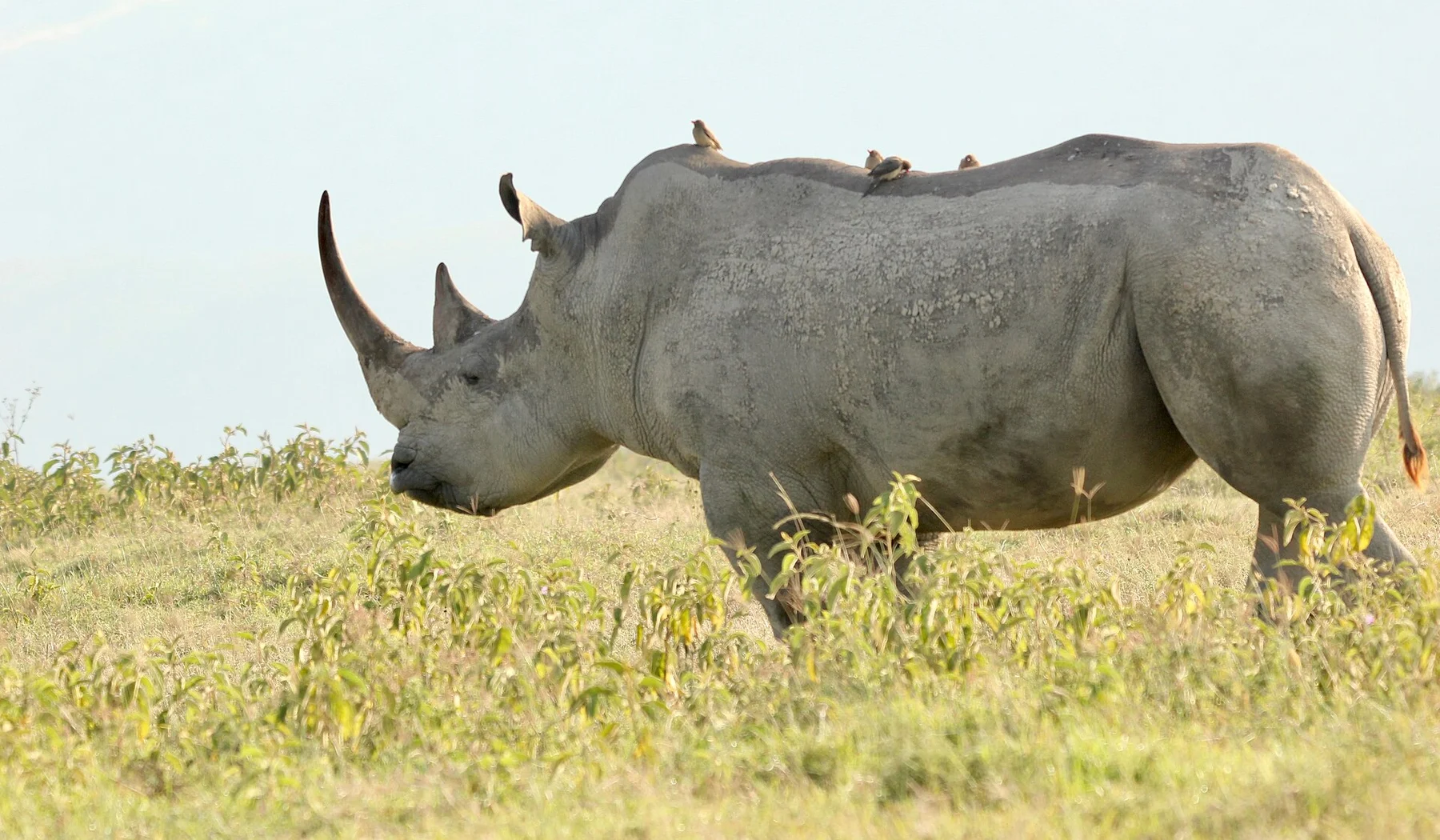
Oxpeckers are more than decoration
Red-billed oxpeckers may perch on rhinos and other large mammals, taking ticks and other material. Their calls and movement can alert a host.
| Observation | Interpretation |
|---|---|
| Birds feeding along folds | Foraging relationship |
| Sudden alarm and flight | Something changed nearby |
| Rhino flicks ears or tail | Responding to irritation |
| Birds absent | Says nothing about rhino health |
Photograph the relationship without asking the vehicle to crowd the host.
Rhino posture tells you when to stop
Guides read the whole animal, not one horn movement.
| Signal | Cautious response |
|---|---|
| Relaxed feeding | Remain still |
| Repeated head lift | Reduce noise and distance pressure |
| Snorting or abrupt turn | Prepare to withdraw |
| Pawing or short rush | Follow guide immediately |
| Blocking road ahead | Wait, never squeeze past |
No photograph is worth testing whether a warning becomes a charge.
Stay inside the vehicle
KWS requires visitors to remain in vehicles except at designated areas. A rhino's bulk can disguise its speed.
| Passenger rule | Reason |
|---|---|
| Keep doors closed | Prevents sudden exit and noise |
| Do not sit on roof edge | Maintains secure position |
| Keep limbs inside | Avoids exposure |
| Move slowly under pop-up roof | Reduces startling movement |
| Follow one guide voice | Prevents conflicting action |
Designated viewpoints are for scenery, not approaching wildlife on foot.
Choose a vehicle for sightlines and patience
Both a pop-up-roof van and 4×4 can work. Fit, road conditions, group size and guide quality matter more than branding.
| Vehicle factor | Why it matters |
|---|---|
| Window for each traveller | Avoids everyone leaning to one side |
| Pop-up roof space | Allows stable viewing |
| Low-speed control | Helps a gentle approach |
| Tyres and clearance | Supports current road conditions |
| Seat comfort | Makes patient waiting possible |
| Private use | Lets the group remain or move without compromise |
The Kenya safari vehicle guide explains the deeper trade-offs.
Shared versus private rhino drive
| Decision | Shared vehicle | Private vehicle |
|---|---|---|
| Cost | Divided among more guests | Higher for a small party |
| Waiting | Group compromise | Matches your interest |
| Photography | Positions shared | Easier seat planning |
| Children | Fixed pace | Flexible breaks |
| Route | General safari | Rhino-focused without guarantee |
Private does not permit closer distance or off-road access.
Photograph shape, habitat and behaviour
A tight horn portrait is only one picture. Include the hooked lip browsing, square mouth grazing, oxpeckers, calf position and woodland context.
| Photograph | Story |
|---|---|
| Rhino small beneath escarpment | Habitat scale |
| Mouth on food | Species identification |
| Oxpeckers on back | Ecological relationship |
| Pair walking | Social behaviour |
| Track beside road | Evidence before sighting |
| Rhino with lake | Lake Nakuru identity |
Use the Kenya wildlife photography safari guide for lens, dust and ethical positioning.
Never publish live location details
Share wonder, not a map that could weaken protection.
| Safe to share | Avoid sharing |
|---|---|
| Lake Nakuru National Park | Exact live coordinates |
| Species and general habitat | Ranger routes or patrol gaps |
| Photograph after leaving | Real-time location tags |
| Conservation history | Identifying security procedures |
Disable precise geotags before public posting when guidance requests it.
Children can learn to identify without a checklist
| Activity | Lesson |
|---|---|
| Draw mouth shapes | Browser versus grazer |
| Watch head posture | Feeding adaptation |
| Compare tracks from vehicle | Field signs |
| Count oxpeckers | Species relationships |
| Record calm behaviours | Observation before excitement |
The Kenya safari with children guide helps plan seats, breaks and realistic drive length.
Plan mobility around the vehicle, not a walking promise
Rhino viewing at Lake Nakuru is primarily from a vehicle. That can work well for travellers with limited mobility when the step, seat and viewing position are chosen in advance.
| Access detail | Confirm before booking |
|---|---|
| Entry step | Height and availability of a stable stool |
| Door width | Whether the traveller can turn and transfer safely |
| Seat | Back support, leg room and proximity to door |
| Roof viewing | Whether a window view is the better option |
| Toilet stops | Location and route timing |
| Wheelchair storage | Space without blocking doors or aisles |
| Drive duration | Breaks and maximum comfortable sitting time |
Nobody needs to stand through the roof to have a meaningful sighting. A lower window can create an excellent eye-level photograph when the driver positions legally and the animal chooses to remain nearby. The accessible Kenya safaris guide covers vehicle transfers, rooms and activity choices in more detail.
Rain changes roads and search strategy
Rain can soften light and freshen vegetation, but it can also make secondary roads difficult. One recent visitor described the roads as “pretty rugged at times”.
| Condition | Rhino-safari adjustment |
|---|---|
| Recent heavy rain | Use a capable vehicle and current route advice |
| Tall green grass | Scan ears, horns and movement rather than full bodies |
| Cool cloud | Animals may remain active longer |
| Strong sun | Check shade and mud areas without crowding |
| Flooded road | Accept the legal alternative route |
| Dusty dry road | Leave space behind other vehicles |
The best time to visit Lake Nakuru guide connects weather with roads, wildlife and photography.
Dust changes comfort and image quality
Dry weather can create a fine layer on binoculars, camera controls and faces. Keep equipment covered between sightings and never ask a driver to tail another vehicle through its dust.
| Item | Useful habit |
|---|---|
| Binoculars | Use a soft blower and lens cloth |
| Camera | Keep one lens mounted where practical |
| Phone | Store in a sealed pouch between stops |
| Eyes | Carry sunglasses and clean water |
| Sensitive airway | Discuss masks and medical needs before travel |
| Vehicle | Close a window temporarily in a dust plume |
Dust is part of an open-road safari, not a reason for dangerous overtaking.
A full day gives uncertainty room
A short loop can find a rhino and a full day can miss one. Time does not guarantee success, but it lets the guide search more habitats without turning every report into a race.
| Park time | What it permits |
|---|---|
| Two hours | One focused circuit with little recovery from delays |
| Half day | Several habitat checks and other wildlife |
| Full day | Patient sightings, viewpoints and a proper break |
| Overnight | Evening and morning search windows |
One traveller reported that they “saw 2 black and 1 white Rhino” during their visit. Treat that as one dated experience, not the inventory awaiting every car.
Overnight inside or outside the park
Staying inside can simplify an early start. Staying outside can offer more price and dining choices. The best location depends on gate, route and whether a second game drive matters.
| Choice | Main strength | Question |
|---|---|---|
| Lodge inside | Less transfer before first search | Which game-drive areas are practical from it? |
| Camp inside | Immersive park setting | What facilities and security rules apply? |
| Hotel near a gate | Wider room choice | How long is the gate journey? |
| Nakuru City hotel | Convenience and city services | Does traffic reduce early park time? |
The planned where to stay at Lake Nakuru guide compares actual areas, not only property names.
Calculate the cost without buying a guarantee
The conservation fee opens the park. It does not purchase a rhino sighting. Vehicle, guide, road transfer, room and meals form the rest of the cost.
| Cost line | Confirm |
|---|---|
| Conservation fee | Correct citizenship or residency category |
| Park vehicle fee | Charge for the actual seating capacity |
| Safari vehicle | Private or shared, van or 4×4 |
| Driver-guide | Included hours and language |
| Nairobi or route transfer | Start, finish and fuel |
| Accommodation | Exact room and board basis |
| Meals and water | Included or separate |
Use the Lake Nakuru entry fees and safari cost guide for official rates and worked examples.
If you prefer to compare ready-made route shapes before changing the details, the Lake Nakuru safari packages page groups practical day, overnight and multi-park options.
Do not pay extra for a false rhino promise
A credible operator can offer a rhino-focused route and experienced guide. It cannot guarantee black rhinos, white rhinos or a mother and calf.
| Credible wording | Warning wording |
|---|---|
| Focus on known rhino habitats | Guaranteed both species |
| Use recent ranger guidance | Secret off-road location |
| Allow a full game-drive window | Touching-distance photograph |
| Build alternative wildlife value | Refund only if no rhino appears, unless formally contracted |
| Follow KWS distance rules | We get closer than other operators |
Pay for time, skill, vehicle quality and route design. Leave the animal outside the contract.
Lake Nakuru versus Ol Pejeta
Both are strong rhino destinations, but the experience differs.
| Decision | Lake Nakuru | Ol Pejeta |
|---|---|---|
| Setting | National park around a Rift Valley lake | Private conservancy in Laikipia |
| Rhino species | Black and white | Black, southern white and managed northern-white conservation context |
| Core activity | Game drive | Game drives plus booked conservancy experiences |
| Route fit | Naivasha, Nakuru and Mara circuits | Mount Kenya and Laikipia circuits |
| Other identity | Birds, giraffe, escarpment | Chimpanzee sanctuary and plains wildlife |
The Ol Pejeta Conservancy guide will compare activities, zones, fees and accommodation in depth.
Lake Nakuru versus Solio Ranch
Solio is celebrated for rhino viewing in a private-conservancy landscape. Lake Nakuru adds a national-park lake, birdlife and a different route.
| Priority | Stronger fit |
|---|---|
| Rift Valley stop | Lake Nakuru |
| Dedicated Laikipia rhino time | Solio |
| Flamingos and waterbirds too | Lake Nakuru |
| Private conservancy atmosphere | Solio |
| Combine with Mount Kenya | Solio |
| Combine with Naivasha | Lake Nakuru |
Neither offers a wildlife guarantee. The planned Solio Ranch rhino safari guide will explain access, accommodation geography and route design.
Travellers deciding whether the Rift Valley needs one stop or two can also use the Lake Nakuru versus Lake Naivasha guide to compare wildlife, boat time, landscapes and overnight value.
Lake Nakuru versus Nairobi National Park
Nairobi National Park is easier for a short city stay and can offer black-rhino viewing. Lake Nakuru is a distinct destination with both black and white rhinos.
| Factor | Lake Nakuru | Nairobi National Park |
|---|---|---|
| Travel context | Rift Valley circuit | Nairobi stopover |
| Rhino interest | Both species possible | Strong black-rhino interest |
| Landscape | Lake, forest, grassland and escarpment | Plains with city skyline |
| Time commitment | Half day, full day or overnight | Half-day city safari possible |
| Wider combination | Naivasha and Mara | Giraffe Centre and city activities |
Use the future Nairobi National Park rhino guide when time in Kenya is short.
Lake Nakuru versus Tsavo West rhino searching
Tsavo West's immense landscape and sanctuary history create a very different search. Lake Nakuru is more compact, while Tsavo gives wilderness scale and red-earth scenery.
| Traveller | Better starting choice |
|---|---|
| Wants a compact rhino-focused day | Lake Nakuru |
| Already travelling to the coast through Tsavo | Tsavo West |
| Wants both black and white rhino possibilities | Lake Nakuru |
| Values volcanic scenery and springs | Tsavo West |
| Needs a Naivasha or Mara link | Lake Nakuru |
Do not assume a named sanctuary means easier sightings. Habitat density and visibility differ.
Rhino and flamingo expectations belong on separate lines
Lake Nakuru's flamingo numbers have changed greatly, while rhino conservation became another defining part of the park. One does not guarantee the other.
| Interest | Plan |
|---|---|
| Rhinos first | Search suitable land habitats patiently |
| Flamingos first | Obtain a current dated bird report |
| Both | Accept that either can move out of view |
| General wildlife | Enjoy giraffe, buffalo, birds and viewpoints too |
Read Lake Nakuru flamingos: are they still there? before expecting an historic pink shoreline.

Other wildlife prevents tunnel vision
Rothschild's giraffe, buffalo, waterbuck, zebra, baboons, lions and hundreds of bird species can carry the day when rhinos remain in cover.
| Encounter | What it adds |
|---|---|
| Rothschild's giraffe | Endangered-subspecies conservation story |
| Buffalo | Herd behaviour and oxpecker interactions |
| Waterbuck | Wetland-edge ecology |
| Baboon | Social behaviour in woodland |
| Pelican and eagle | Lake food web |
| Lion | Predator context without a promise |
One visitor called the park “one of the best stops of my trip”. A wide interest usually creates that result.
Use traveller reviews as evidence, not instructions
Independent accounts show what happened on specific days. One person wrote, “We saw so many rhinos in Nakuru!”, while another considered the “game drives in Lake Nakuru were much more superior” to a different stop.
| Review detail | How to use it |
|---|---|
| Visit month and year | Connect to road and habitat conditions |
| Species and number | Treat as that day's observation |
| Guide behaviour | Look for patterns across reviews |
| Road comment | Confirm current conditions |
| “Worth it” | Understand the reviewer's priorities |
Never copy a stranger's sighting into a promise for your date.
Red flags at a rhino sighting
| Red flag | Better response |
|---|---|
| Driver exceeds 40 km/h | Ask to slow and obey KWS rules |
| Vehicle leaves established road | Refuse the approach |
| Guide shares live coordinates publicly | Protect location privacy |
| Several cars block the animal | Leave space or move on |
| Passengers shout or stand outside | Remain quiet and inside |
| Rhino shows sustained attention | Increase distance |
| Mother and calf are separated by cars | Clear the route immediately |
The guide's restraint is part of the product you paid for.
What to pack for a rhino-focused drive
| Item | Use |
|---|---|
| Binoculars | Identify mouth and behaviour at distance |
| Long lens | Photograph without approach |
| Beanbag | Stabilise camera on window edge where safe |
| Neutral layers | Handle cool morning and midday warmth |
| Water | Stay comfortable during patient waits |
| Dust cover | Protect camera and phone |
| Field notebook | Record species clues and behaviour |
Avoid loose equipment on the roof. It can fall, create noise or distract the driver.
Send a complete rhino-safari brief
| Include | Detail |
|---|---|
| Date | Exact park day |
| Start and finish | Nairobi, Naivasha, Nakuru, Mara or another point |
| Main goal | Black, white, both or general conservation learning |
| Time | Half day, full day or overnight |
| Party | Adults, children and mobility needs |
| Vehicle | Private, shared, van or 4×4 preference |
| Photography | Lens size and seating needs |
| Accommodation | Inside or outside park |
| Alternative interests | Giraffe, birds, scenery or predators |
Measure value by the day, not the closest horn
The most dramatic rhino photograph is not always the sign of the best safari. A close animal may have approached a stationary vehicle of its own accord. It may also be the result of a poor driver blocking its path. The image alone cannot tell you which story occurred.
| Better measure of value | What it reveals |
|---|---|
| Guide explained black and white rhino differences | Learning beyond a sighting checklist |
| Vehicle stayed on the road | Respect for habitat and rules |
| Rhino continued feeding normally | Low-pressure observation |
| Group watched several behaviours | Patience rather than pursuit |
| Children could see from secure seats | Thoughtful vehicle planning |
| Other wildlife remained interesting | A resilient safari day |
| Driver left before crowding escalated | Professional judgement |
A visitor wrote that “the drive was totally worth it”. That phrase is more useful when we ask why. Perhaps it was rhinos, the lake, a patient guide, varied wildlife or simply enough time to let the park unfold. Your own value should be built the same way.
Decide in advance what a strong day contains if rhinos remain distant. A viewpoint can show the scale of the flooded lake. A Rothschild's giraffe can open a conversation about another threatened animal. Buffalo with oxpeckers can reveal the same large-mammal relationship you hoped to photograph on a rhino. This is not a consolation itinerary. It is a fuller reading of the park.
If a rhino does appear, resist turning the sighting into a transaction. Watch which plants a black rhino selects, how a white rhino sweeps grass with its broad mouth, whether ears follow distant sounds and how a calf chooses its position beside an adult. Ten calm minutes can teach more than a rushed close pass.
At the end of the drive, the guide should be able to explain what was searched, what signs were read and why a route changed. That makes the day valuable even when the final count is lower than another traveller's review. Quiet observation, clear interpretation and ethical choices are part of the safari you will remember.
Let the driver-guide turn a shape into a story
A rhino sighting becomes richer when the guide explains what the animal is doing instead of only naming it. A broad mouth held low over short grass supports a white-rhino identification. A pointed lip working through woody leaves suggests black rhino. Dung, rubbed branches and a well-used path can reveal presence before the animal appears. Oxpeckers, ear position, wind direction and the attention of nearby buffalo or giraffe can all add context.
The best interpretation is also honest about uncertainty. Dense bush may hide the mouth. A distant animal may offer only its back. Light can flatten shape and make photographs misleading. In those moments, “rhino” may be the only responsible identification until the vehicle reaches another legal viewpoint. There is no shame in waiting for a better angle or leaving the species unconfirmed.
| What you notice | What a thoughtful guide may explain | What should remain uncertain |
|---|---|---|
| Head held low in open grass | Grazing behaviour supports white rhino | Sex and age without a clear view |
| Pointed lip selecting leaves | Browsing supports black rhino | Species if the mouth remains hidden |
| Calf close to an adult | A dependent young animal needs extra space | Exact age from a distant glimpse |
| Repeated head lift or turn | The rhino may be monitoring the vehicle | A claim that the animal is charging |
| Oxpeckers moving over the hide | A chance to discuss parasites and mutual benefit | A promise that birds always reveal rhinos |
| Fresh tracks near a road | Rhinos have used the area recently | Where an animal is at that moment |
Ask questions while keeping voices low. Which clue matters most? Is the animal feeding, resting or travelling? Why did the guide stop at this angle? What would make the vehicle move away? Those questions create a safari that is about understanding wildlife, not merely collecting proof that it was seen.
Good guiding continues after the rhino disappears. The guide can connect the sighting to habitat management, explain why exact locations should not be shared and help children record clues in a notebook. A photograph may last for years, but the explanation often becomes the part travellers retell.
Frequently asked questions
Are rhinos guaranteed at Lake Nakuru?
No. The park is a major sanctuary for both species, but vegetation, weather, movement and road access affect every sighting.
Does Lake Nakuru have black and white rhinos?
Yes. KWS identifies the park as a sanctuary for both black and white rhinos.
How do I tell them apart?
Use mouth and feeding style. Black rhinos have a pointed, hooked lip for browsing; white rhinos have a wide, square mouth for grazing.
Are white rhinos white?
No. Both species appear grey or mud-coloured. Colour is not a useful identification feature.
How close can a vehicle go?
KWS states a minimum wildlife-viewing distance of 20 metres. Increase it whenever behaviour or conditions require more room.
Can a vehicle drive off road for a rhino?
No. KWS prohibits off-road driving. Stay on established roads and trails.
What time should I start?
The park opens at 6:00 am for day visitors. Early starts provide cool conditions and more search time, but no hour guarantees a rhino.
Is one day enough?
A full day can cover several habitats. An overnight creates morning and afternoon windows, useful for keen photographers and slower travellers.
Is Lake Nakuru better than Ol Pejeta for rhinos?
They offer different experiences. Nakuru fits a Rift Valley national-park route; Ol Pejeta is a Laikipia conservancy with additional managed experiences.
Can children enjoy a rhino safari?
Yes, with a private or appropriately paced drive, secure seating, breaks and clear rules about quiet movement inside the vehicle.
Let the rhino choose the encounter
The best Lake Nakuru rhino safari guide cannot place an animal beside your vehicle. It can help you choose enough time, the right guide, a comfortable vehicle and a respectful search. Share your dates, route, party and priorities, and we will build a day that values the sanctuary whether the final photograph is a black rhino in browse, a white rhino grazing beneath oxpeckers or the track that reminds you a wild animal passed before you arrived.
Plan your Lake Nakuru rhino safari
Share your date, party, route, vehicle preference, mobility needs, photography equipment and the wildlife experiences that would make the day worthwhile.