
Lake Nakuru National Park Guide: Rhinos, Flamingos, Gates and Where to Stay
Plan around rhinos, birds, woodland and viewpoints, then choose the operating gate and lodge that fit the route instead of promising a permanent pink shore.

- Is Lake Nakuru National Park worth visiting?
- Lake Nakuru is both a national park and a Ramsar wetland
- Where is Lake Nakuru National Park?
- The gates and why your entrance matters
- Do not use an old ring-road map blindly
- How many nights do you need?
- The truth about Lake Nakuru’s flamingos
- Greater and lesser flamingos
- Pelicans and the birds beyond pink
- Lake-level change is part of the park’s present story
- Why Lake Nakuru is a rhino park
- Black rhino and white rhino differences
- What travellers say about the rhinos
- Rothschild’s giraffes in the woodland
- Buffalo, waterbuck and plains wildlife
- Lions, leopards and the predator question
- Baboons, vervet monkeys and colobus monkeys
- The fever-tree forest
- Baboon Cliff
- Lion Hill and Out of Africa viewpoint
- Makalia Falls
- A full-day game-drive circuit
- A half-day visit
- Can you visit Lake Nakuru from Nairobi in one day?
- Where to stay inside the park
- Where to stay outside the park
- Compare accommodation by position
- Lake Nakuru with children
- Accessibility and limited mobility
- The best time to visit
- Vehicle choice and self-driving
- Photography in Lake Nakuru
- Responsible wildlife viewing
- What does a Lake Nakuru safari cost?
- What to pack
- Lake Nakuru and Lake Naivasha are not interchangeable
- Nakuru, Naivasha and Elementaita compared
- Lake Nakuru and Hell’s Gate
- Lake Nakuru and the Aberdares
- Lake Nakuru and the Masai Mara
- A strong two-night itinerary
- A day-visit itinerary from Naivasha
- Common planning mistakes
- Questions that improve the booking
- Frequently asked questions
- Plan the park that exists now
The first view from Baboon Cliff explains why Lake Nakuru deserves more than its old nickname. Below the escarpment, forest gives way to grassland, the road follows a changing shore and a shallow Rift Valley lake holds whatever the season has brought. Flamingos may gather in a pink line. Pelicans may be more numerous. Buffalo can darken the green edge, and somewhere between the fever trees a rhino may step into view.
Lake Nakuru became famous through photographs of immense flamingo flocks. Those photographs are real, but they are not a daily timetable. Water levels, salinity, algae, rainfall and movements among Rift Valley wetlands determine where the birds feed. The park's dependable value is broader: black and white rhinos, Rothschild's giraffes, woodland, viewpoints, waterbirds, buffalo, lions, leopards and a compact circuit that can work within a short Kenya itinerary.
This Lake Nakuru National Park guide helps you plan that park rather than chase an old postcard. It compares the gates and accommodation areas, explains realistic wildlife expectations, shows when a day visit is enough and connects Nakuru with Naivasha, the Aberdares and the Masai Mara.
Is Lake Nakuru National Park worth visiting?
Yes, especially for a first Kenya safari, a shorter route or a traveller keen to see rhinos. The park is more compact than the Masai Mara and can reveal several habitats in one drive. You may begin among baboons and colobus monkeys, cross open grassland with buffalo and giraffes, watch pelicans at the shore, climb to a viewpoint and finish near Makalia Falls.
Its limitations are just as important. A fence surrounds the park, Nakuru city is close, and the circuit can feel less expansive than Tsavo, Samburu or the Mara. Lake levels can cover former roads and change where birds concentrate. One disappointed traveller may have expected an endless pink shore. Another may remember a first wild rhino for the rest of their life.
| Your priority | Lake Nakuru can offer | Important expectation |
|---|---|---|
| Black and white rhinos | One of Kenya's best-known rhino parks | Sightings are likely, never guaranteed |
| Flamingos | Lesser and greater flamingos when conditions suit | Numbers move and can be modest |
| Broader birding | Pelicans, raptors, waterbirds, woodland and grassland species | Bring binoculars and slow the drive |
| Short safari | A varied circuit within one full day | Gate choice and road conditions still matter |
| Scenery | Lake, cliffs, fever-tree forest and waterfalls | Viewpoint access may change with weather or wildlife |
| Big predators | Lions and leopards occur | Do not choose the park for a guaranteed cat sighting |
Lake Nakuru is both a national park and a Ramsar wetland
Unlike Lake Naivasha, Lake Nakuru sits within a gazetted national park managed by Kenya Wildlife Service. It is also a Ramsar wetland of international importance. Park rules, gates, entry fees and game-drive restrictions apply across the protected area.
The national park includes far more than open water. Yellow-barked acacia woodland, euphorbia forest, rocky escarpment, grassland, riverine areas and the southern waterfall country create a compressed ecological journey. The lake is central, but it is not the only reason to enter.
Where is Lake Nakuru National Park?
The park lies beside Nakuru city in Kenya's central Rift Valley, northwest of Nairobi. It fits naturally between Nairobi or Lake Naivasha and destinations farther west, including the Masai Mara. The Aberdare highlands lie to the east, while Lake Elementaita is southeast along the Rift Valley corridor.
If the available time is only one capital-city day, compare the longer Nakuru road journey with our planned Nairobi National Park guide. Nairobi offers a shorter transfer, while Nakuru adds the Rift Valley lake, rhino focus and viewpoints.
“Nakuru” can mean the city, the lake or the park. A hotel in Nakuru city is not automatically beside a park gate. Ask for the map pin, intended entrance and driving time at the hour you will travel.
The gates and why your entrance matters
Main Gate, Lanet Gate and Nderit Gate are the names most visitors encounter. Their usefulness depends on where you sleep, which roads are open and how lake levels or maintenance have affected the circuit. Main Gate has faced serious high-water disruption in recent years, so an old route description may be wrong on your travel date.
Confirm the operating gate with Kenya Wildlife Service and the lodge shortly before arrival. A property on one side of the park may require a much longer internal or external drive from another gate.
| Gate | General relationship | Often useful for | Confirm now |
|---|---|---|---|
| Main Gate | City-facing traditional entrance | Nakuru town approaches when operational | Opening, access road and high-water impact |
| Lanet Gate | Eastern side near Lanet | Nairobi, Naivasha and eastern accommodation approaches | Road condition and lodge transfer time |
| Nderit Gate | Southern approach | Southern properties and through routes | Hours, road surface and correct map pin |
Do not use an old ring-road map blindly
Rising lake levels have submerged sections of former shoreline road and changed circulation. New alignments and temporary restrictions can appear. A route once described as a complete drive around the lake may no longer operate in the same way.
The practical solution is simple. Name the gate, lodge and next destination, then ask for the current route. Keep enough fuel and drinking water for a longer drive than the straight-line map suggests.
How many nights do you need?
One full day can reveal the park well. Two nights give an evening and morning drive, softer light and protection against a late road arrival. Three nights suit birders, photographers or anyone who wants a slow day rather than using Nakuru only as a link in a chain.
| Time | What fits | Verdict |
|---|---|---|
| Half day | One sector, lake edge and perhaps a viewpoint | Too short after a long transfer |
| Full day | Broad wildlife circuit and selected viewpoints | Strong day visit |
| 1 night | Afternoon and morning drive if timing works | Good route break |
| 2 nights | One complete day plus two favourable light periods | Best first stay |
| 3 nights | Birding, photography and road flexibility | Excellent for specialists |

The truth about Lake Nakuru’s flamingos
Lake Nakuru once held spectacular concentrations of lesser flamingos feeding on algae in suitable alkaline conditions. The lake remains important to flamingos and other waterbirds, but numbers vary dramatically. Birds move between Nakuru, Bogoria, Elementaita and other wetlands as food and water conditions change.
High water can dilute salinity, alter algae and flood feeding margins. A recent photograph cannot promise the same flock months later. Ask what has been seen this week, then build a day that remains worthwhile with ten flamingos, ten thousand or none.
Greater and lesser flamingos
Both greater and lesser flamingos may occur. Lesser flamingos are smaller, darker pink and closely associated with microscopic blue-green algae. Greater flamingos are larger, paler and have a different feeding range. At distance, light and flock density can make identification difficult.
A guide with a spotting scope or strong binoculars adds more than a rushed drive to the nearest pink patch. Look at bill colour, leg colour, size and feeding style rather than asking only for a total.
Pelicans and the birds beyond pink
Some visitors arrive expecting flamingos and leave talking about pelicans, fish eagles, storks, herons or cranes. One traveller wrote, “we actually saw way more pelicans” than flamingos, then described the many other waterbirds as a highlight rather than a consolation.
That is the healthier way to bird Nakuru. Scan the mud, open water, drowned trees, grassland and woodland. The species list changes as the road moves away from the shore.
Lake-level change is part of the park’s present story
The water has expanded and contracted across different periods, drowning trees, covering roads and reshaping feeding edges. It is tempting to treat the change as a single permanent state, but the lake remains dynamic. Rainfall, catchment flow, evaporation, groundwater and human land use all matter.
Do not repeat a fixed water-level measurement from an old article as if it describes the day of travel. Use current gate advice and recent ecological observations while keeping the guide's core message durable: shorelines move.
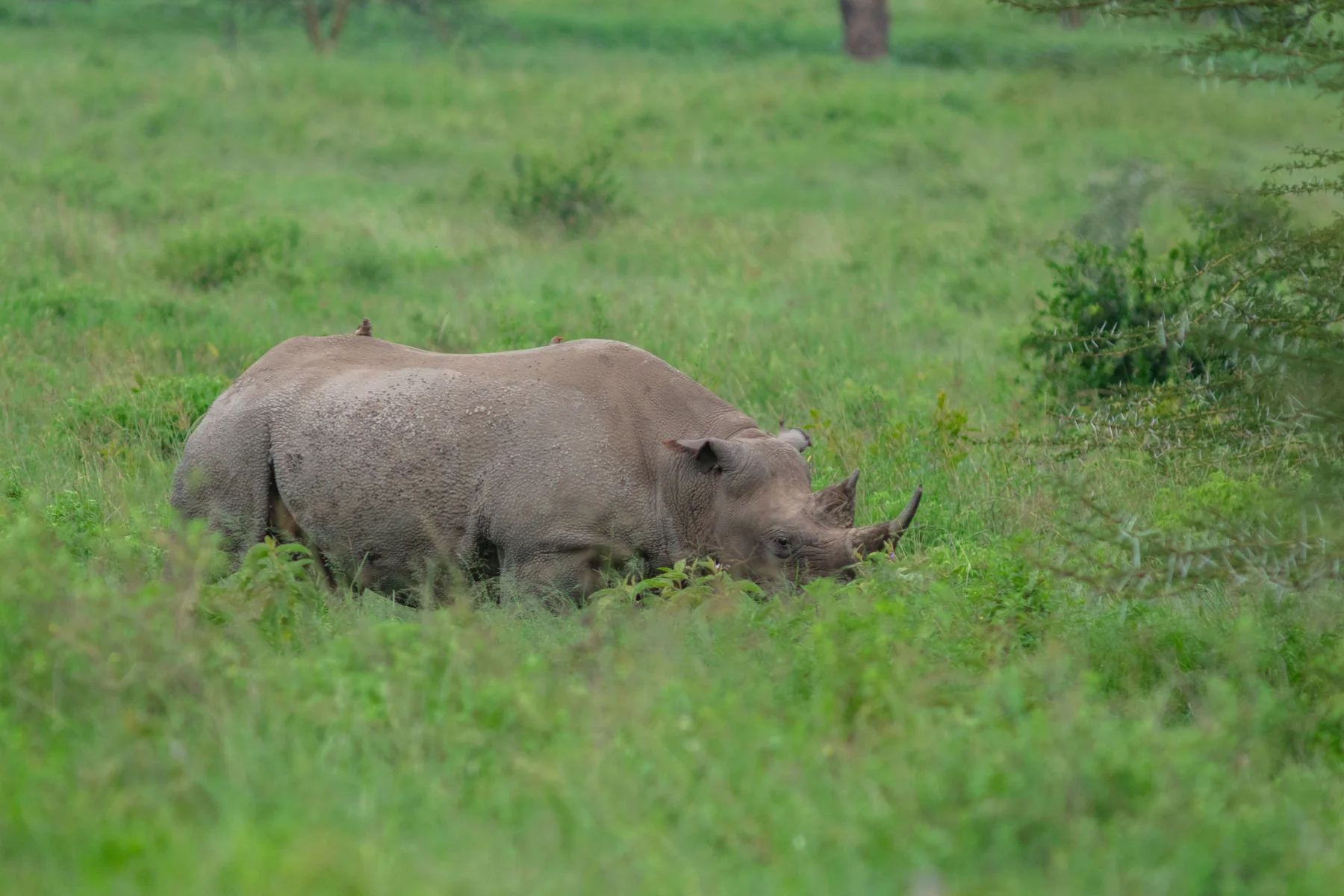
Why Lake Nakuru is a rhino park
Kenya Wildlife Service identifies Lake Nakuru as the country's first rhino sanctuary and an important area for black rhinos, with white rhinos also introduced. The fence, ranger presence and habitat have made rhino conservation central to the park's identity.
White rhinos often graze in more open country and may be easier to observe. Black rhinos browse and can remain within thicker cover. Those are tendencies, not appointment times. Never pressure a driver to leave the road or crowd an animal for a clearer photograph.
Black rhino and white rhino differences
| Feature | Black rhino | White rhino | What not to assume |
|---|---|---|---|
| Feeding | Browser, often taking leaves and shoots | Grazer, feeding mainly on grass | Habitat never guarantees identity |
| Mouth | More pointed, prehensile upper lip | Broad, square lip | Do not approach for a close mouth photograph |
| Social pattern | Often solitary | May be seen in small groups | Every individual behaves differently |
| Nakuru habitat | Woodland edges and dense cover can suit browsing | Open grassland often suits grazing | Either species can move across varied terrain |
What travellers say about the rhinos
Recent visitors repeatedly mention rhinos as the park's defining moment. One family said they “needed the height to see above the grass” from their self-drive vehicle. That small observation matters when grass is tall. A low saloon car may be legal on some dry roads but still give children a poor view.
Another solo traveller wrote that “the scenery will stay with me forever” after seeing a first wild rhino and flamingos. The park is strongest when the landscape and animal carry equal weight.
Rothschild’s giraffes in the woodland
Lake Nakuru is associated with the conservation of Rothschild's giraffes, which were introduced to the protected area. They can appear beautifully against fever trees and open grassland. Their pale lower legs and coat pattern help identification, but distant views and hybridisation questions make casual certainty unwise.
Ask the guide to explain the population's history and habitat rather than treating the giraffe as another tick after the rhino.
Buffalo, waterbuck and plains wildlife
Large buffalo herds often use the lake-edge grassland. Defassa waterbuck, impala, zebra, warthog and eland may also occur, with sightings varying by sector and season. These animals create the park's sense of abundance even on a day when cats remain hidden.
Buffalo need space. Do not stop between a herd and the water, and avoid surrounding animals with several vehicles. A broad view of buffalo and pelicans can say more about Nakuru than a close portrait.
Lions, leopards and the predator question
Lions live in the park and sometimes rest in trees or along open ground. Leopards occur but are elusive in woodland and rocky areas. Spotted hyenas, jackals and smaller carnivores add interest.
Do not choose Lake Nakuru because a lodge gallery shows one tree-climbing lion or a recent leopard. Choose it for rhinos, wetland and habitat variety, then let a predator sighting be an exceptional addition.
Baboons, vervet monkeys and colobus monkeys
Baboons and vervet monkeys are conspicuous around roads, picnic areas and lodge grounds. Black-and-white colobus monkeys can be seen in mature woodland. Never feed primates or leave food visible in an open vehicle.
At viewpoints, close windows and secure bags before stepping away. Baboons learn quickly from careless visitors. A traveller who called them “friendly baboons” also repeated lodge advice to keep doors and windows closed. Familiarity is not safety.
The fever-tree forest
Yellow-barked acacias create one of Nakuru's most recognisable habitats. Their pale trunks glow in low light, while giraffes, monkeys and birds move through the canopy. Flooding has killed or stressed trees in some areas, and the drowned trunks along the shore have become part of the contemporary landscape.
Drive slowly. The forest can hide a black rhino at short range, and branches make hurried photography difficult.
Baboon Cliff
Baboon Cliff provides the classic high view across the lake, shoreline, road and surrounding escarpment. It is a place to understand the park's scale and changing waterline. One visitor described “Superb views” for panoramic photographs.
Whether visitors may leave the vehicle, use picnic facilities or approach every viewpoint depends on current park instructions and wildlife. Secure food, follow ranger guidance and never walk beyond the permitted area.
Lion Hill and Out of Africa viewpoint
Kenya Wildlife Service also highlights Lion Hill and Out of Africa Hill among the park's viewpoints. Each changes the angle on the lake and surrounding habitats. The road to a viewpoint may be rough, wet or temporarily restricted.
Do not insist on collecting every named hill. Ask which is open, safe and best for the day's light. One well-timed panorama is better than three hurried climbs.
Makalia Falls
Makalia Falls lies in the southern part of the park and changes with rainfall. After wet weather the flow can be dramatic. In drier periods it may be modest, while the surrounding cliffs and picnic setting still offer a useful break.
Confirm the road, permitted stopping area and wildlife conditions. Do not climb wet rock or leave the designated visitor zone for a cleaner photograph.
A full-day game-drive circuit
Begin at the gate serving your route and check current road access. Use the first hours for open grassland and rhino country, then follow the lake edge slowly for birds and buffalo. Add one viewpoint before the middle of the day and use a designated picnic area for lunch. Continue through woodland or towards Makalia if the road and timing support it.
The circuit should flex around sightings. A black rhino browsing at the forest edge deserves time. A distant flamingo patch does not justify speeding past everything between.
| Time | Strong focus | Flex point |
|---|---|---|
| Early morning | Rhinos, cats, soft light and woodland | Enter through the most useful open gate |
| Mid-morning | Lake edge, birds and buffalo | Slow down when flocks are distant |
| Midday | Viewpoint and designated picnic | Secure all food from primates |
| Afternoon | Makalia, southern grassland or second rhino area | Use road and weather advice |
| Late afternoon | Return through productive habitat | Leave enough time for the correct gate |
A half-day visit
A half day works best when sleeping near or inside the park and continuing a short onward route. Concentrate on one wildlife-rich sector, the lake edge and one viewpoint. Do not promise a complete circuit or both waterfall and rhino areas.
If driving from Nairobi and back in one day, the park deserves most of the daylight. Adding Lake Naivasha turns a compact safari into a road marathon.
Can you visit Lake Nakuru from Nairobi in one day?
Yes, with an early start, a capable vehicle and realistic traffic allowance. The drive crosses the Rift Valley corridor, and congestion entering Nairobi can lengthen the return. A day visit should include several hours inside the park, not only lunch and a short shore drive.
For many travellers, one night near Nakuru produces better value by opening an evening or morning drive. The saving is time, not only money.
Where to stay inside the park
Lake Nakuru Lodge and Sarova Lion Hill Game Lodge are established full-service properties inside the park. Flamingo Hill Tented Camp offers a tented style within the protected area. The Cliff occupies a dramatic elevated position with a small luxury-camp feel and wide lake views.
Inside accommodation reduces gate formalities between drives and keeps you within the park's rhythm. It can cost more, and the exact lodge position still matters. Ask how far the property is from the active entry gate, key wildlife sectors and next day's exit.
Where to stay outside the park
Nakuru city contains hotels across many budgets. Properties near Lanet or southern approaches may serve a particular gate more efficiently than a city-centre room. Mbweha Camp sits outside the park in the wider Soysambu area and should not be described as an inside-Lake-Nakuru lodge.
Outside accommodation can suit late arrivals, business facilities, restaurants and lower budgets. Calculate the gate drive, entry queue and time lost between morning and afternoon activities.
Compare accommodation by position
| Property or area | Position and style | Often suits | Confirm before paying |
|---|---|---|---|
| Lake Nakuru Lodge | Inside the park, full-service lodge | Families, groups and classic safari stays | Room category, gate route and drive sectors |
| Sarova Lion Hill | Inside near Lion Hill sector | Travellers wanting established service | Renovation status, view and game-drive arrangement |
| Flamingo Hill Tented Camp | Inside, tented accommodation | Couples and a smaller camp atmosphere | Current operation, tent location and meal plan |
| The Cliff | Inside, elevated luxury tents | Honeymoons, views and short luxury stays | Gate access, transfer distance and child policy |
| Nakuru city hotels | Outside across broad price levels | Late arrivals, budgets and practical stops | Exact gate time and secure vehicle parking |
| Lanet or southern approach stays | Outside near specific routes | Road itineraries using eastern or southern gates | Actual map pin and current gate operation |
| Soysambu or Elementaita area | Separate conservancy and lake landscape | Travellers combining two ecosystems | Entry, road time and which game drives are included |
Lake Nakuru with children
The compact park can work well for families because sightings may come without eight hours of continuous driving. Viewpoints and a designated picnic break change the day. The fence and nearby city do not remove wildlife risk, so children remain supervised whenever leaving the vehicle is permitted.
Use a vehicle with good viewing height and a pop-up roof. Bring familiar snacks but keep food hidden from baboons. Our Kenya safari with children guide helps plan car seats, rooms, meals and game-drive length across the full route.
Accessibility and limited mobility
Most wildlife viewing happens from a vehicle, which can make Lake Nakuru a good option for travellers who cannot walk far. The challenge is transferring into a high-roof safari vehicle and accessing toilets, rooms or viewpoints. Ask about step height, portable steps, grab handles and whether a lower vehicle still provides enough visibility over grass.
Viewpoint surfaces may be rocky or uneven. An excellent panorama can often be seen from near the vehicle, but confirm the current setup. Our accessible Kenya safari guide turns general accessibility claims into measurements and practical arrangements.
The best time to visit
Lake Nakuru is a year-round park, but every season changes visibility, roads, grass and water. Drier months may produce easier roads and more open sightlines. Rain makes the forest vivid and can improve waterfall flow, while mud and tall grass complicate driving.
Flamingo numbers do not follow a simple tourist-season calendar. Current lake chemistry and regional bird movements matter. Ask for recent observations instead of choosing a month from an old “best flamingo season” claim.
| Condition | Likely effect | Planning response |
|---|---|---|
| Dry road period | Easier circuits and dust | Protect cameras and eyes from dust |
| Recent rain | Green scenery and possible Makalia flow | Use a capable vehicle and flexible route |
| Tall grass | Harder views from low vehicles | Use good viewing height and binoculars |
| High lake level | Flooded margins and route changes | Confirm gate and road status |
| Large bird movement | Spectacular shore concentrations | Keep distance and avoid crowding |
| Fewer flamingos | More attention to pelicans and woodland birds | Treat the whole park as the destination |
Vehicle choice and self-driving
Self-driving is possible when the vehicle, road conditions, maps and driver experience are suitable. A high-clearance four-wheel-drive gives better visibility and resilience after rain. Carry a spare tyre, water, fuel margin and offline navigation, then follow current KWS directions rather than unofficial tracks.
One family reported that “roads were a bit rough in some places”. Conditions change, but the lesson lasts. A small car that completes the circuit on a dry day does not become the right recommendation for every month.
Photography in Lake Nakuru
Carry a long lens for rhinos, birds and distant cats, plus a wide lens for Baboon Cliff and fever-tree woodland. Early and late light adds shape to the escarpment. Beanbags work well on vehicle windows, while a pop-up roof helps track birds in flight.
Do not position a vehicle between a rhino and its direction of travel. Keep shore birds from being repeatedly flushed, and never ask a driver to leave authorised roads.
Responsible wildlife viewing
Observe KWS speed limits and viewing rules. Do not feed primates, sound calls, play loud music or discard food. Give rhinos, buffalo, lions and nesting birds space. If several vehicles gather, take a wider position or leave after a reasonable view.
At viewpoints and picnic sites, check that leaving the vehicle is currently permitted. Wildlife can enter any unfenced stopping area, even when other visitors are walking around.
What does a Lake Nakuru safari cost?
The total can include park entry by residency category, vehicle entry, guide, private transport, accommodation, meals and a separate conservancy or lake visit. Kenya Wildlife Service fees can change, so use the official tariff for your travel date rather than an old amount copied across websites.
| Cost line | What changes it | What should be named |
|---|---|---|
| Park entry | Residency, age and tariff date | Adult and child category, date and payment method |
| Safari vehicle | Private or shared use, origin and duration | Vehicle type, seats, roof and hours |
| Guide | Driver-guide or separate KWS guide | Language, private service and inclusions |
| Accommodation | Inside or outside, season and room | Exact property, room, meals, taxes and gate transfer |
| Route transfer | Nairobi, Naivasha, Mara or Aberdare origin | Pickup, gate, luggage and final destination |
| Extra destination | Naivasha, Elementaita or Soysambu | Separate entry and activity fee |
Use our Kenya safari cost guide to compare complete route value rather than one attractive room rate.
What to pack
Bring binoculars, neutral layers, sun protection, a light waterproof jacket and a warm layer for early drives. Protect cameras from dust and rain. Closed shoes suit viewpoints and waterfall stops, even when most of the day remains in the vehicle.
Families should carry water and quiet activities for transfer hours, but food must stay secured around baboons. Our Kenya safari packing guide covers luggage, chargers, medication and clothing for the rest of Kenya.
Lake Nakuru and Lake Naivasha are not interchangeable
Lake Nakuru is a fenced national park built around vehicle-based wildlife viewing. Lake Naivasha is a freshwater Ramsar wetland surrounded largely by private land, where visitors arrange boat trips, shore access and Crescent Island separately. Naivasha offers hippos, waterbirds, boating and nearby active parks. Nakuru offers rhinos, game-drive circuits, woodland and viewpoints.
Combining both works when each has a clear purpose. Read the Lake Naivasha guide before deciding whether one or both belongs in the route.
Nakuru, Naivasha and Elementaita compared
These Rift Valley lakes sit close enough to share an itinerary and far enough apart to reward clear naming. Lake Elementaita is another Ramsar wetland and part of the Kenya Lake System World Heritage landscape, with private conservancy and accommodation access around it. It is not an entrance to Lake Nakuru National Park.
| Destination | Main experience | Wildlife style | Typical time |
|---|---|---|---|
| Lake Nakuru National Park | Rhino-focused game drives, birds and viewpoints | Fenced national park with road circuits | Full day or two nights |
| Lake Naivasha | Boats, hippos, Crescent Island and nearby active parks | Private shore access plus separate attractions | Two nights |
| Lake Elementaita and Soysambu | Wetland views, birds and private-conservancy activities | Property-specific access | One or two nights |
Choose the lake for the experience, not because all three appear under the same “Rift Valley” heading.
Lake Nakuru and Hell’s Gate
Hell's Gate National Park adds cycling, walking, cliffs and geothermal landscapes. Nakuru adds conventional game drives and rhinos. Two nights around Naivasha and one or two around Nakuru create a varied Rift Valley chapter.
The Hell's Gate National Park guide explains current gorge-access safety, cycling distance and how not to overcrowd the day.
Lake Nakuru and the Aberdares
The Aberdares replace open lake and grassland with mountain forest, waterfalls and lodge waterholes. The road connection can create a strong contrast, particularly for travellers continuing towards Mount Kenya or Laikipia.
Use the Aberdare National Park guide to choose between a forest lodge chapter, an active waterfall route and a simple transit night.
Lake Nakuru and the Masai Mara
The Mara is larger, more open and usually earns at least three nights. Nakuru can add rhinos and Rift Valley birding before the route reaches the Mara. Do not spend only one night in each place to create a longer destination list.
The Masai Mara, Lake Nakuru and Lake Naivasha safari gives each landscape its own role. The Samburu, Lake Nakuru and Masai Mara safari uses Nakuru as a meaningful rhino and wetland bridge between northern and southern ecosystems.
A strong two-night itinerary
Arrive through the gate that serves your lodge by mid-afternoon. Use the first drive for nearby woodland or grassland without racing around the lake. On the full day, start early in rhino habitat, follow the lake edge for birds and buffalo, take one viewpoint around mid-morning and continue to Makalia only when road time makes sense.
The following morning can revisit the best habitat before breakfast or departure. This structure protects the sighting that needs patience.
A day-visit itinerary from Naivasha
Leave Naivasha early, enter through the most efficient operating gate and spend the morning on rhinos and lakeshore birds. Use a designated picnic place or lodge lunch, then add one viewpoint and a different habitat in the afternoon. Exit towards the next accommodation before dark.
Do not add a Naivasha boat trip on the same morning unless the park drive is intentionally short. The lake and national park both deserve daylight.
Common planning mistakes
| Mistake | Why it fails | Better choice |
|---|---|---|
| Promising millions of flamingos | Flocks move with ecological conditions | Sell a wetland and rhino park |
| Using the nearest gate on an old map | Flooding and closures change access | Confirm the operating gate shortly before travel |
| Booking a city hotel as “park side” | The morning drive may be long | Check the map pin and gate time |
| Expecting a complete ring road | Former shoreline roads may be submerged | Use the current KWS circuit |
| Chasing every viewpoint | Road time replaces wildlife time | Choose one good panorama |
| Driving a low car in tall grass | Children and seated adults lose visibility | Use appropriate viewing height |
| Feeding baboons at picnic sites | It creates aggressive behaviour | Lock food inside the vehicle |
| Adding Naivasha and Nakuru in half a day | Both become transfer stops | Give each a clear role |
Questions that improve the booking
Name the intended gate, lodge, room and current road circuit. Confirm park fees for each traveller's residency category and date. Ask whether the vehicle is private, how high the seats are and how many people share each row. Find out whether lunch is packed, at a lodge or at a designated picnic site.
For flamingos, ask what has been seen recently without turning the answer into a guarantee. For rhinos, ask where the guide will begin and how much time the schedule allows.
Frequently asked questions
Are there still flamingos at Lake Nakuru?
Yes, greater and lesser flamingos can occur, but numbers change with water, food and regional movements. Huge flocks are never guaranteed.
Can I see rhinos?
Black and white rhinos live in the park, and Nakuru is one of Kenya's strongest rhino destinations. Every sighting remains wild and uncertain.
Which gate should I use?
Choose the operating gate that serves the lodge and road route. Confirm Main, Lanet or Nderit access shortly before travel because conditions can change.
How long do I need?
One full game-drive day is a strong minimum. Two nights provide better light and flexibility.
Is Lake Nakuru good for children?
Yes. It is compact and varied, but children need good viewing height, safe picnic behaviour and realistic drive lengths.
Can I self-drive?
Yes when current roads, vehicle clearance, navigation and driver confidence are suitable. A high-clearance four-wheel-drive is the safest broad recommendation.
Where should I stay?
Stay inside for immediate park access or outside for a wider budget and facility range. The actual gate time matters more than the town name.
Is Baboon Cliff open?
Viewpoint access can change with road, wildlife and safety conditions. Confirm current KWS guidance on the day.
Can I combine Nakuru and Naivasha?
Yes. Use Nakuru for rhinos and park game drives, then Naivasha for boating, hippos and walking. Avoid squeezing both into one short stop.
What animals live in the park?
Wildlife can include black and white rhinos, Rothschild's giraffes, buffalo, waterbuck, zebra, lions, leopards, baboons, colobus monkeys and many birds.
Plan the park that exists now
Lake Nakuru does not need an outdated promise of an unbroken pink shoreline. A black rhino in green woodland, pelicans beneath a stormy sky and the lake opening below Baboon Cliff already make a distinctive safari.
Use this Lake Nakuru National Park guide to choose the right gate, enough time and an honest wildlife focus. Tell us your dates, travellers, room style and wider Kenya route, and we will build the park around what matters now.
Tell us what Nakuru should add
Share the dates, travellers, wildlife priorities, accommodation style, vehicle preference and onward route. We will plan around current access and honest sightings.