
Lake Nakuru Flamingos: Are They Still There?
Understand what changed, where the birds move and how to plan a rewarding Lake Nakuru safari without an outdated promise.
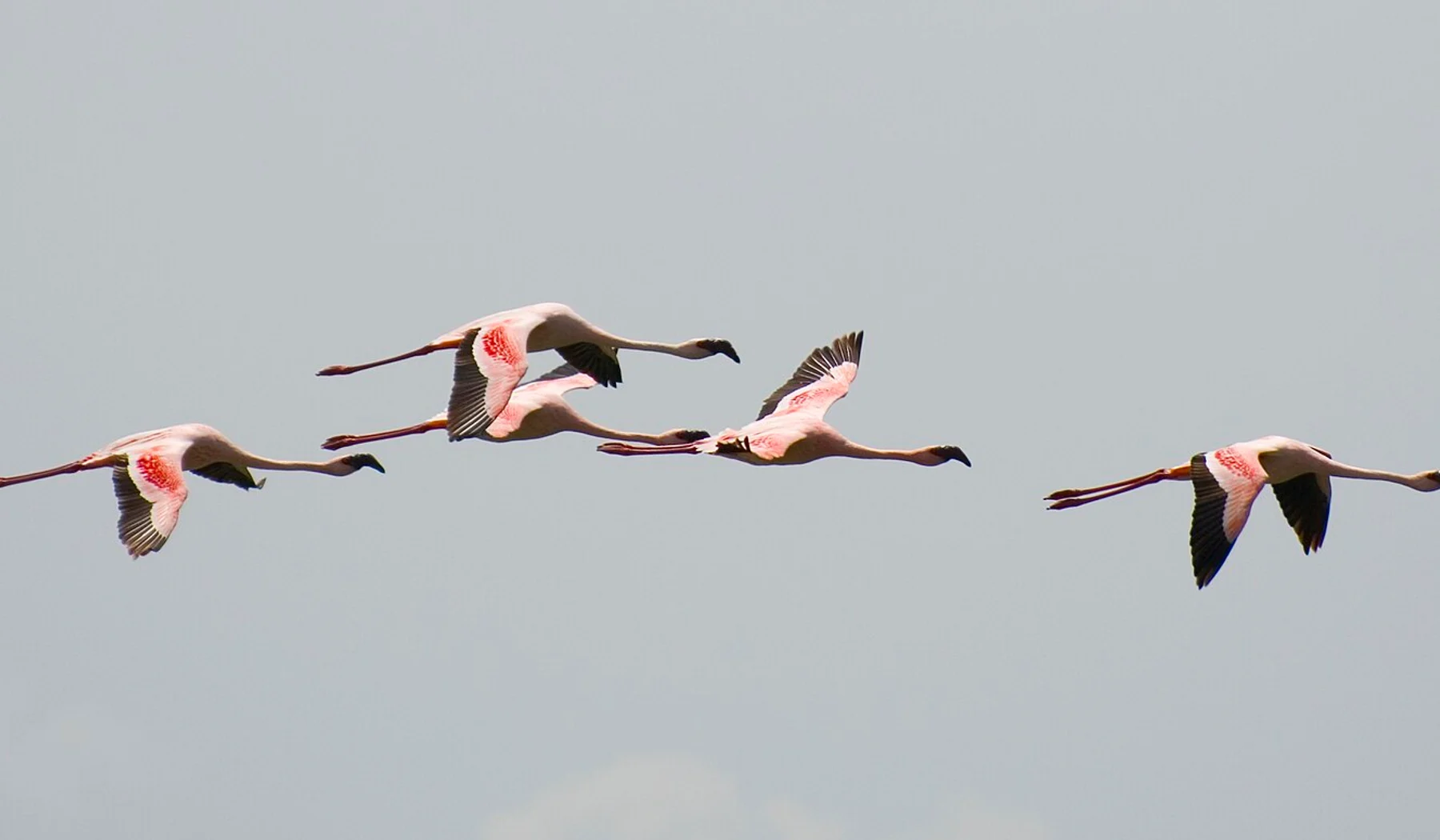
- The newest official evidence
- What the July 2026 census adds
- Flamingos move because they can
- Rising water changed the chemistry
- Lesser flamingos need the right food
- Greater and lesser flamingos are different
- A flock in a photograph is not a live report
- How to obtain a useful current report
- Same-week does not mean guaranteed
- Do not chase birds off the shore
- Drones are not a casual solution
- Morning light helps more than proximity
- Historic mass flocks were real
- Why “they have returned” headlines need care
- Visitor reviews reveal expectation gaps
- Flamingos may still be visible in small groups
- The park holds many other waterbirds
- Rhinos give Lake Nakuru another identity
- Rothschild’s giraffe and woodland matter too
- Is Lake Nakuru worth visiting without mass flamingos?
- Lake Bogoria is not a guaranteed substitute
- Lake Elementaita also belongs to the network
- Lake Naivasha is a different ecosystem
- There is no guaranteed flamingo month
- Overnight or day trip
- Cost still deserves a clear calculation
- A good guide changes the day
- Photograph the ecological story
- Children can enjoy the science
- What not to promise in an itinerary
- Send a useful planning brief
- How a flamingo census is actually made
- Why one low count is not extinction
- What could make conditions improve
- What could make numbers fall again
- Choose the trip by your tolerance for uncertainty
- A two-lake plan still needs live evidence
- Viewpoints tell the water story
- Separate a flamingo excursion from a flamingo guarantee
- Frequently asked questions
- Plan for truth and leave room for surprise
There was a time when the first view from Lake Nakuru's escarpment seemed almost impossible. The shoreline was pink, not in a narrow band but in a moving, feeding mass. Those photographs still sell Kenya today. They are beautiful, historically real and a poor promise of what any visitor will see now.
So, Lake Nakuru flamingos: are they still there? Yes, flamingos can still occur at Lake Nakuru, but numbers fluctuate sharply and the famous million-bird spectacle is not dependable. Kenya Wildlife Service reported about 500 lesser flamingos in its January 2025 count, compared with 1,347,063 in January 2006. Birds move among a network of East African lakes as water chemistry and food change.
The honest answer: Visit Lake Nakuru for a complete national-park safari, including rhinos, Rothschild's giraffe, woodland, scenery and diverse birds. Treat flamingos as a possible highlight, never a guaranteed pink carpet. Ask for a same-week field report before making them the reason for the trip.
| Quick question | Useful answer |
|---|---|
| Are flamingos extinct at Nakuru? | No |
| Are they always present? | No |
| Is a huge flock guaranteed? | Absolutely not |
| Why did numbers fall? | Rising water altered salinity and reduced lesser-flamingo food |
| Where did birds go? | They move among Rift Valley and wider regional lakes |
| Can numbers change quickly? | Yes, even within weeks |
| Is Nakuru still worth visiting? | Yes, when planned for the whole ecosystem |
The newest official evidence
Kenya Wildlife Service's latest flamingo-census account gives the clearest answer. It compares Lake Nakuru's January counts and explains the movement rather than pretending that an old tourism image remains constant.
| KWS census point | Lesser flamingos at Lake Nakuru |
|---|---|
| January 2006 | 1,347,063 |
| January 2025 | About 500 |
Those figures do not say that exactly 500 birds are there today. They show the scale of ecological change and why a current sighting cannot be inferred from Nakuru's reputation.
What the July 2026 census adds
On 18 July 2026, KWS, National Museums of Kenya, Nature Kenya and partners counted lesser flamingos across several Kenyan lake systems at the same time. Nature Kenya's field account explains that high water at Nakuru, Elmenteita and Bogoria has made conditions fresher and reduced suitable food.
| Why simultaneous counts matter | What they prevent |
|---|---|
| Count several lakes on one date | Mistaking movement for population loss |
| Compare habitat conditions | Blaming one park without context |
| Record where birds concentrate | Treating a famous lake as the only habitat |
| Repeat over time | Turning one unusual day into a trend |
A single shoreline photograph can answer “what was here this morning?” It cannot answer “where is the regional population?”
Flamingos move because they can
KWS notes that lesser flamingos can move hundreds of kilometres between lakes in a short time. A food-rich lake can gather a vast flock; a change in chemistry can disperse it.
| Movement trigger | Likely response |
|---|---|
| Food declines | Birds search other lakes |
| Water deepens | Feeding habitat can become less suitable |
| Salinity changes | Preferred microorganisms may decline |
| Disturbance | Flocks may shift position or leave |
| Conditions improve elsewhere | Birds exploit the better site |
They do not respect a tour brochure's borders.
Rising water changed the chemistry
Lake Nakuru is a closed-basin soda lake. Rain, catchment inflow, evaporation and human pressures influence its depth and chemistry. KWS estimates that its surface area increased by about 70 percent relative to the 1984 to 2009 average.
| More water can mean | Flamingo consequence |
|---|---|
| Lower salinity and alkalinity | Less suitable food production |
| Flooded former shore | Different feeding depth and access |
| Changed nutrient balance | Different plankton community |
| Submerged roads and gates | Changed visitor routes |
“More water” is not automatically “more habitat” for a specialised feeder.
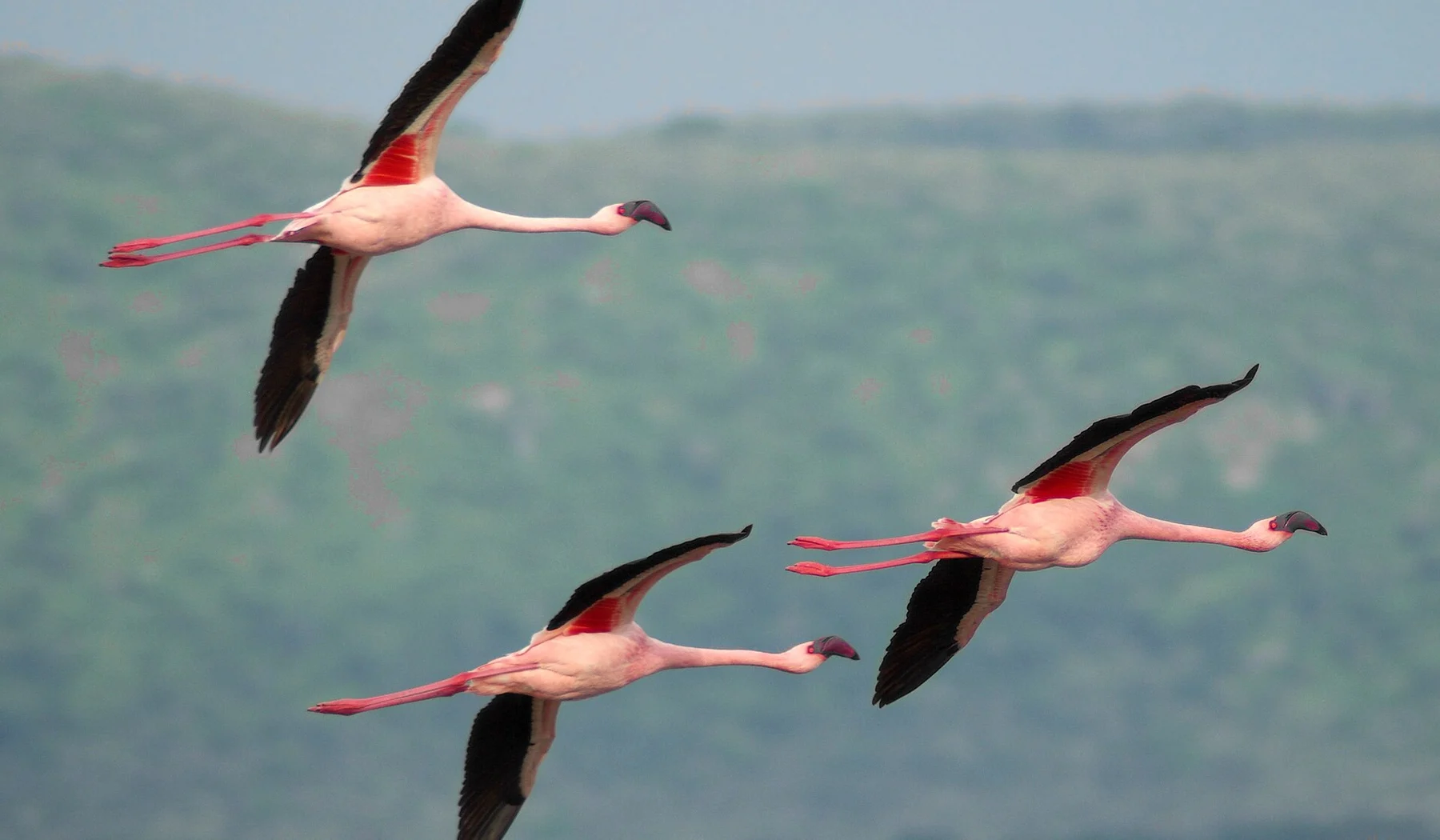
Lesser flamingos need the right food
Lesser flamingos are strongly associated with microscopic food, especially the cyanobacterium Arthrospira fusiformis, often called spirulina. The ISME Journal Lake Nakuru study documented linked changes in Arthrospira biomass and lesser-flamingo abundance.
| Lake condition | Food effect |
|---|---|
| Suitable alkalinity and nutrients | Arthrospira can thrive |
| Freshwater dilution | Competitive conditions change |
| Rapid ecological shift | Food biomass can fall |
| Food recovery | Birds may return if other conditions suit |
This is a food map, not a fixed migration timetable.
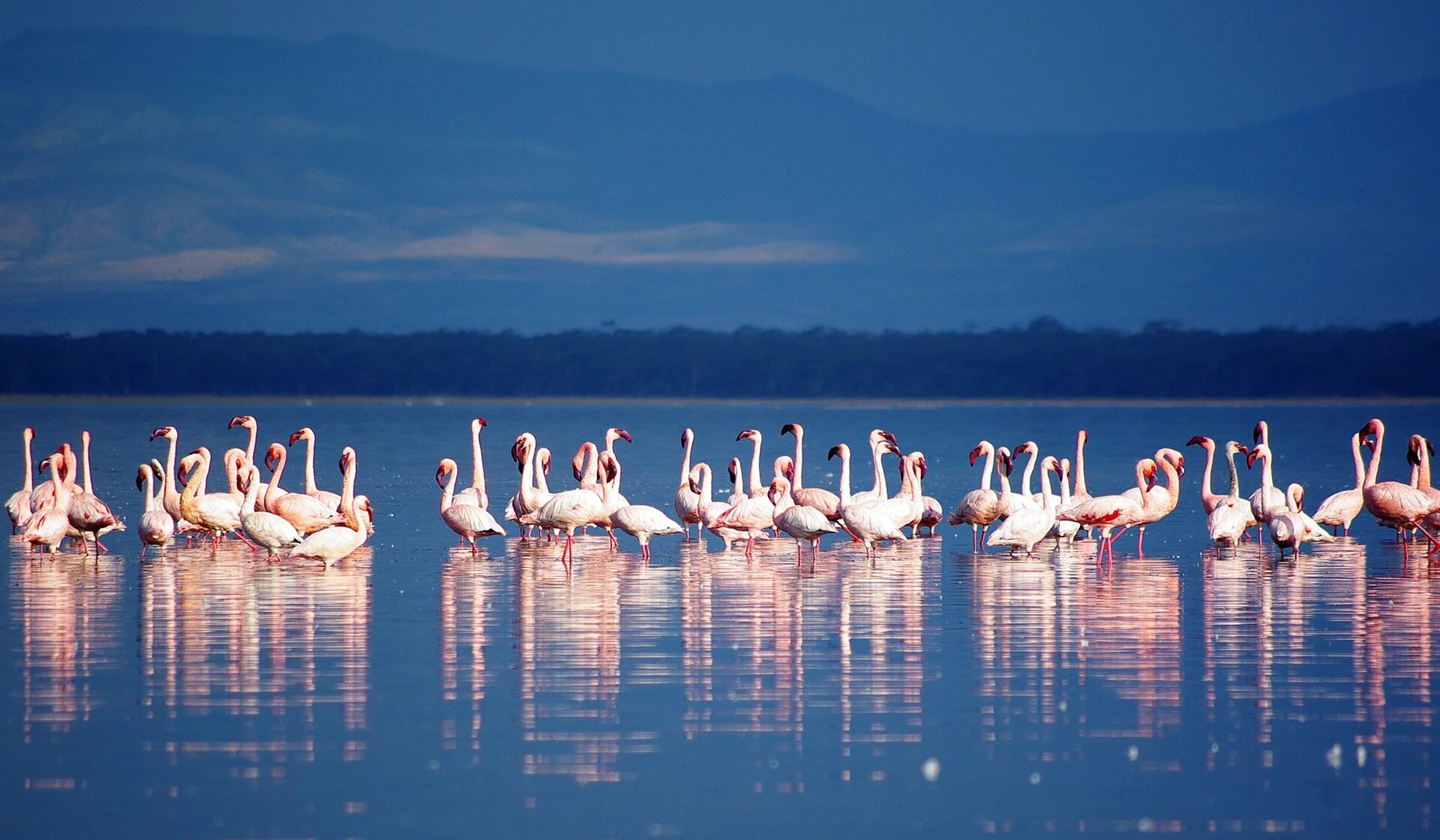
Greater and lesser flamingos are different
Both species can occur, but the lesser flamingo made Nakuru's historic mass spectacle.
| Feature | Lesser flamingo | Greater flamingo |
|---|---|---|
| Size | Smaller | Taller and heavier |
| General colour | Often deeper pink overall | Paler body with pink areas |
| Bill | Darker, deep carmine appearance | Pinkish with a black tip |
| Feeding emphasis | Microscopic algae and cyanobacteria | Broader small aquatic prey and organisms |
| Historic Nakuru numbers | Dominant mass flocks | Usually fewer |
Use binoculars and guide interpretation rather than judging only by colour in harsh light.
A flock in a photograph is not a live report
Stock images are frequently reused without the capture date. Even a recently uploaded photograph may have been taken years earlier.
| Evidence | Trust level for today's sighting |
|---|---|
| Ranger or guide report from this week | High |
| Geotagged visitor photograph with capture date | Useful |
| Hotel social post with date but no capture detail | Ask |
| Undated gallery image | Low |
| Historic aerial “pink lake” photograph | Historical only |
| Search-result snippet | Not enough |
Every image on this page is credited and used to explain species or history, not to claim the same flock is present today.
How to obtain a useful current report
Ask a question that can be answered precisely.
| Weak question | Better question |
|---|---|
| Are flamingos there? | Which species and approximate group size were seen this week? |
| Will I see thousands? | What was observed on the last two game drives? |
| Which month is guaranteed? | How have water and bird positions changed recently? |
| Can you promise a photo? | Which open route currently gives a lawful distant view? |
Request the observation date and location. Do not demand certainty from a moving species.
Same-week does not mean guaranteed
Yesterday's flock can move overnight. A useful report improves probability, not certainty.
| Report age | How to use it |
|---|---|
| Same morning | Best available indicator |
| One to three days | Useful, still uncertain |
| One week | Context only |
| One month | Seasonal background |
| Previous year | Historical comparison |
Build a park day that remains rewarding if the birds relocate.
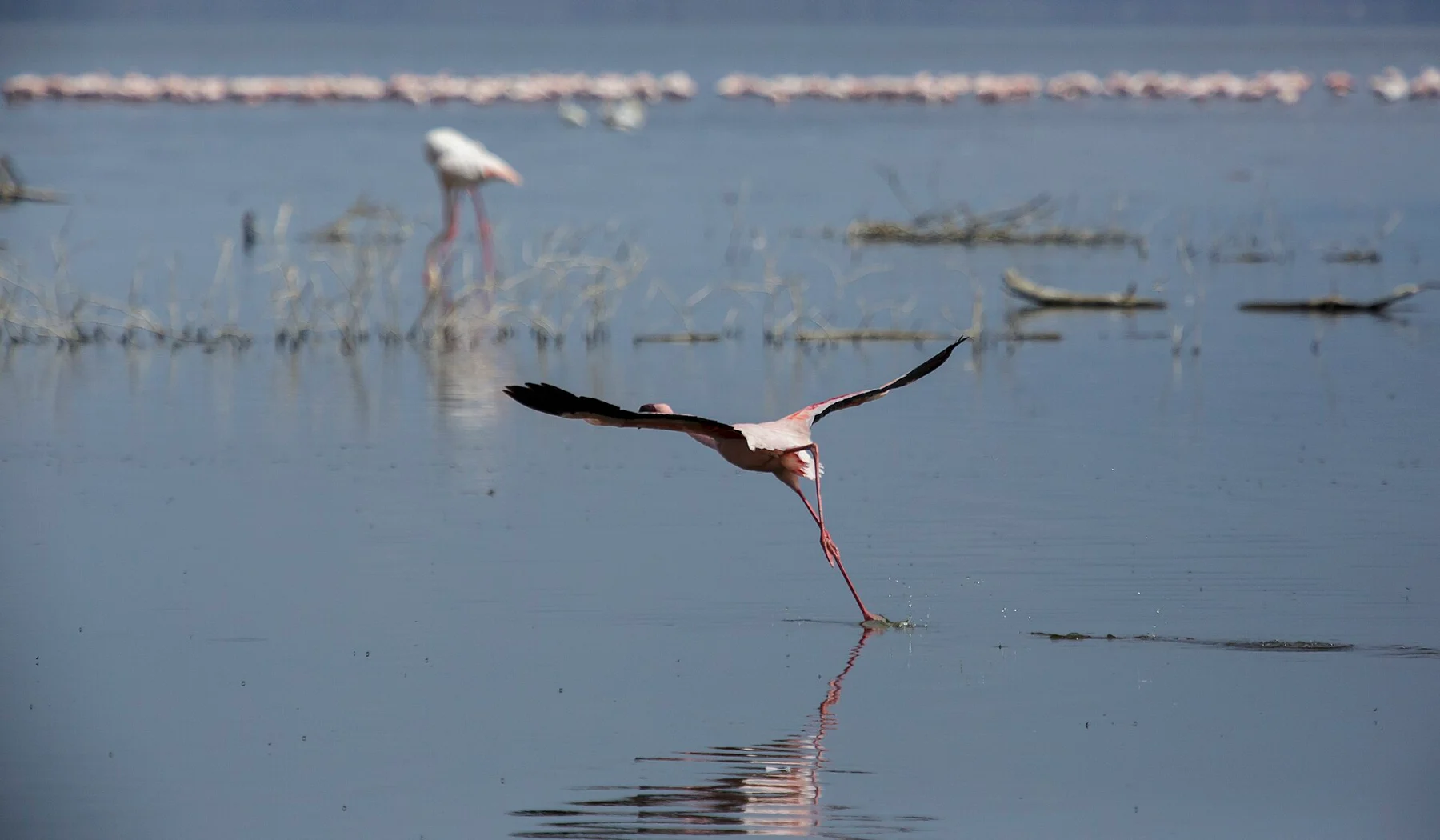
Do not chase birds off the shore
Flamingos feed and rest with limited energy margins. Vehicles, people and aircraft should not push them into repeated flight for photographs.
| Ethical choice | Benefit |
|---|---|
| Stay on permitted roads | Protects shore habitat |
| Keep distance | Allows feeding and resting |
| Stop before birds become alert | Prevents forced movement |
| Use a long lens | Creates scale without approach |
| Avoid shouting or horn use | Reduces disturbance |
| Follow ranger instructions | Responds to live conditions |
Flying birds are beautiful, but a vehicle should not be the reason they took off.
Drones are not a casual solution
The official fee schedule requires Kenya Civil Aviation Authority licensing and park charges for authorised drone use. Wildlife disturbance and park permission remain separate concerns.
| Assumption | Reality |
|---|---|
| Small drone means harmless | Noise and approach can disturb flocks |
| Paying a fee grants permission | Aviation and park approvals still apply |
| High flight is always safe | Regulations and wildlife response govern |
| Social-media use is personal | Filming rules may still apply |
Plan ground-based photography unless every authority has approved the operation.
Morning light helps more than proximity
Early light can reduce glare, reveal feather colour and create reflections. Wind is often gentler, though no time guarantees birds.
| Photography condition | Adjustment |
|---|---|
| Strong backlight | Use silhouettes or change legal viewpoint |
| White water glare | Lower exposure carefully |
| Distant flock | Show landscape scale |
| Small group | Photograph behaviour and reflections |
| Birds in flight | Use fast shutter and leave movement space |
The Kenya wildlife photography safari guide covers ethical positioning and equipment.
Historic mass flocks were real
Honesty about today does not erase Nakuru's past. Formal protection began with a bird sanctuary in 1961, expanded around the lake in 1964 and became a national park in 1968, according to KWS park history.
| Historic truth | Present-day caution |
|---|---|
| Million-bird counts occurred | They are not a present guarantee |
| Nakuru became globally famous | Fame can outlive current ecology |
| Flamingos remain part of its identity | The park now offers much more |
| Old photographs are valuable records | They need capture dates |
The right story is change, not disappearance.
Why “they have returned” headlines need care
A temporary increase may be real without signalling a permanent return. Check who counted, when, how and whether another lake was counted simultaneously.
| Claim | Verification question |
|---|---|
| Record numbers | Which agency and census date? |
| Permanent return | Over how many seasons? |
| One million birds | Was it a formal count or visual estimate? |
| Best lake now | Compared on the same date? |
| Flamingos vanished | From one lake or the regional population? |
When a commercial article contradicts current KWS evidence without a primary dataset, do not build a trip around it.
Visitor reviews reveal expectation gaps
One recent traveller wrote that “Lake Nakuru flooded and there’s no more flamingos there which I wish we knew ahead of time”. The wording is personal and absolute, not a census conclusion, but the disappointment is instructive. They arrived with an outdated promise.
| Review lesson | Planning response |
|---|---|
| No mass flock seen | Set ecological expectations before travel |
| Some flamingos seen | Record date and approximate number |
| Great wildlife day | Value the whole park |
| Poor road experience | Check current route conditions |
| One visit | Do not generalise to every month |
Reviews add human texture, while official counts explain the population.
Flamingos may still be visible in small groups
“About 500 in January 2025” is not zero. Small groups can still create lovely viewing, especially when the expectation is behaviour rather than a pink horizon.
| Small-group moment | Why it matters |
|---|---|
| Feeding line | Shows specialised bill action |
| Courtship movement | Reveals social behaviour |
| Flight | Exposes black wing feathers |
| Greater and lesser together | Allows identification comparison |
| Reflection | Rewards calm water and distance |
A good birding day is not measured only in thousands.
The park holds many other waterbirds
Pelicans, storks, cormorants, herons, egrets, ducks, waders and raptors can all contribute, depending on season and conditions.
| Birding interest | Habitat to scan |
|---|---|
| Pelicans and cormorants | Open water and feeding areas |
| Herons and egrets | Margins and shallows |
| Waders | Exposed shore and mud |
| Raptors | Thermals, trees and open ground |
| Woodland birds | Acacia and euphorbia forest |
The planned Kenya birdwatching safari guide will connect Nakuru with other habitats.
Rhinos give Lake Nakuru another identity
KWS designated the park Kenya's first government-managed rhino sanctuary in 1987. Black and white rhinos are a major reason to visit, although sightings remain wild and unguaranteed.
| Rhino plan | Practical choice |
|---|---|
| First-time visitor | Allow a full game-drive window |
| Photographer | Use a private vehicle and patient guide |
| Family | Ask for age-appropriate conservation context |
| Short stop | Avoid promising both species |
A traveller reported, “We saw so many rhinos in Nakuru!”. Use the Lake Nakuru rhino safari guide to plan around habitat rather than luck alone.
Rothschild’s giraffe and woodland matter too
The drive through fever-tree and acacia woodland can feel entirely different from the lakeshore. Rothschild's giraffe, buffalo, waterbuck, baboons and sometimes lions broaden the day.
| Park zone | Experience |
|---|---|
| Lakeshore | Waterbirds and open views |
| Woodland | Giraffe, primates and shade |
| Grassland | Grazers and rhino habitat |
| Viewpoints | Landscape and lake-level context |
| Waterfall area | Scenic contrast where routes are open |
The complete Lake Nakuru National Park guide helps route the whole park.
Is Lake Nakuru worth visiting without mass flamingos?
Yes, for travellers who value rhinos, varied habitat, birds and a compact Rift Valley safari. No destination is compulsory, so reconsider if the only acceptable outcome is an enormous flock.
| Go when | Reconsider when |
|---|---|
| Rhino viewing matters | Flamingos are the sole interest |
| It fits the route naturally | The detour consumes a needed Mara day |
| You enjoy varied birds | You expect a guaranteed photograph |
| You can give the park time | You have only a rushed circuit |
One visitor “enjoyed the magical nature of the flamingos”, while another called Nakuru “one of the best stops of my trip”. Different dates can produce different bird experiences and the same broad park value.
Lake Bogoria is not a guaranteed substitute
Bogoria has often held large flamingo concentrations, but it is part of the same mobile network and has also experienced rising water. Ask for current reports there too.
| Comparison | Nakuru | Bogoria |
|---|---|---|
| Park emphasis | Full game drive and rhino sanctuary | Soda-lake scenery and flamingo potential |
| Flamingo certainty | Variable | Variable |
| Other wildlife | Broad national-park mix | Different reserve experience |
| Route | Common on Nairobi, Naivasha and Mara circuits | Requires its own routing decision |
The Lake Bogoria National Reserve guide will cover road, heat, facilities and viewing.
Lake Elementaita also belongs to the network
Elementaita can hold flamingos and is part of the Kenya Lake System World Heritage landscape. It should not be sold as an automatic backup without a current observation.
| Network principle | Meaning |
|---|---|
| Birds choose food | Fame does not hold them |
| Lakes change together and differently | One rainfall story is not enough |
| Counts must align in time | Separate dates can mislead |
| Protection must cover multiple sites | No single lake can secure the population |
Use the future Lake Elementaita guide for a separate visit decision.
Lake Naivasha is a different ecosystem
Naivasha is freshwater and best known for boating, fish eagles, hippos and shore activities. It is not a replacement for a soda-lake flamingo spectacle.
| Priority | Better fit |
|---|---|
| Rhino game drive | Lake Nakuru |
| Boat safari | Lake Naivasha |
| Flamingo possibility | Nakuru, Elementaita or Bogoria with live reports |
| Walking near plains game | Selected Naivasha sanctuaries |
Compare them with the Lake Nakuru versus Lake Naivasha guide and Lake Naivasha guide.
There is no guaranteed flamingo month
Seasonal rain and evaporation matter, but regional movement can override a simple month chart.
| Planning factor | Better than a fixed month claim |
|---|---|
| Current water level | Ask local conservation staff |
| Recent bird position | Seek date-stamped report |
| Regional lake conditions | Check several sites |
| Road access | Confirm routes after rain |
| Photography light | Choose morning where possible |
The best time to visit Lake Nakuru guide treats wildlife, weather and roads together.
Overnight or day trip
An overnight creates two viewing windows and room for a last-minute route change. A day trip works when Nakuru fits the road plan and the park receives enough time.
| Choice | Flamingo advantage | Wider trade-off |
|---|---|---|
| Nairobi day trip | One current viewing window | Long road day |
| Nakuru overnight | Morning and afternoon possibilities | Adds room cost |
| Naivasha plus Nakuru | Flexible Rift Valley sequence | Needs two distinct activity plans |
| Nakuru en route to Mara | Efficient when properly timed | Do not rush both parks |
Use the where to stay at Lake Nakuru guide when choosing gate and game-drive access.
Cost still deserves a clear calculation
Do not pay a premium based on a guaranteed flamingo claim. Pay for the actual vehicle, park access, guide, accommodation and route.
| Cost line | Confirm |
|---|---|
| Conservation fee | Correct visitor category |
| Vehicle entry | Capacity band |
| Safari vehicle | Private or shared |
| Guide | Included expertise |
| Room and meals | Exact property and board |
| Extra detour | Time and fuel |
The Lake Nakuru entry fees and safari cost guide uses current official rates. One review said the “Park entry fees were reasonable and justified” by the overall experience.
A good guide changes the day
The guide should know recent bird locations, alternative habitats and when a report is too old to trust.
| Ask the guide | Strong answer |
|---|---|
| When were flamingos last seen? | Gives date and approximate location |
| Which species? | Distinguishes greater and lesser |
| How many? | Uses a cautious range, not fantasy |
| What if they moved? | Offers rhino, woodland, bird and viewpoint plan |
| Can we drive closer? | Keeps to roads and distance rules |
One traveller noted that “roads are pretty rugged at times”, another reason local route judgement matters.
Photograph the ecological story
If only a few flamingos are present, widen the frame. Flooded trees, distant escarpment, new shorelines and mixed waterbirds explain a changing lake better than a forced close-up.
| Story frame | What it communicates |
|---|---|
| Flamingos small in landscape | Scale and habitat |
| Mixed species feeding | Ecological community |
| Flooded former road or trees | Rising water |
| Guide viewing from distance | Responsible tourism |
| Rhino with lake backdrop | Wider park identity |
Photography can document change without pretending it is loss alone.
Children can enjoy the science
Turn the question into observation rather than disappointment.
| Child activity | Learning |
|---|---|
| Compare bills | Feeding adaptation |
| Count a small group | Field-survey practice |
| Map nearby lakes | Movement and habitat network |
| Watch feeding | Behaviour and food |
| Record water level signs | Environmental change |
Do not teach children that wildlife owes them a performance.
What not to promise in an itinerary
| Avoid | Write instead |
|---|---|
| See millions of flamingos | Search for current flamingo groups and varied waterbirds |
| Guaranteed pink lake | Visit the historic flamingo lake with live expectations |
| Best flamingos all year | Numbers change across the Rift Valley network |
| Flamingos have permanently returned | Recent observations show birds may be present |
| No flamingos remain | Counts vary and some birds can occur |
Precise uncertainty builds more trust than a spectacular false promise.
Send a useful planning brief
| Include | Why |
|---|---|
| Travel date | Allows a current report |
| Main priority | Flamingos, rhinos, birds or full park |
| Acceptable alternative | Protects the day if birds move |
| Photography equipment | Shapes vehicle and timing |
| Adults and children | Sets pace and cost |
| Start and finish | Determines useful park time |
| Overnight preference | Creates one or two windows |
| Wider route | Connects Naivasha, Mara or Nairobi |
How a flamingo census is actually made
A census is more disciplined than looking across the water and guessing how pink it appears. Teams work from shore positions, elevated viewpoints or aircraft, divide large concentrations into countable units and coordinate sites so that moving birds are less likely to be missed or counted twice. The method, coverage, weather and observer visibility belong beside the number.
| Census detail | Why readers need it |
|---|---|
| Count date and time | Flocks can move after the survey |
| Lakes covered simultaneously | Shows regional distribution |
| Shore, aerial or mixed method | Affects visibility and scale |
| Percentage of site covered | Reveals possible gaps |
| Species separated | Prevents mixing greater and lesser flamingos |
| Estimate or direct count | Communicates uncertainty |
| Juveniles recorded | Adds breeding and recruitment evidence |
Large flocks are commonly estimated in blocks rather than by naming every individual bird. That does not make the result meaningless. It means the reported precision should match the method. “About 500” is more honest than a spurious exact number when observers are estimating a moving group.
The July 2026 coordinated exercise is especially useful because teams visited several lake systems within one programme. If Nakuru has few birds while another lake holds many, the comparison supports movement. If every lake shows a fall, researchers must consider wider population or survey explanations.
Why one low count is not extinction
The lesser flamingo is a mobile regional species. A low Lake Nakuru count describes one location at one time, not the total living population.
| Wrong conclusion | Better interpretation |
|---|---|
| Nakuru has 500, so only 500 remain | Other lakes may hold the population |
| Birds left Kenya permanently | Counts show concentrations can shift within Kenya and across borders |
| No flock today means no recovery | Food and chemistry may change again |
| One high count means the problem is solved | Habitat stability matters across years |
| Movement makes protection unnecessary | A network of safe lakes becomes more important |
KWS highlighted Lake Logipi after a December 2024 aerial estimate of roughly 737,000 lesser flamingos there. By March 2026, a Logipi count was about 50,000. The sharp difference is not a contradiction. It is an example of the mobility that makes a single-lake headline incomplete.
This is also why conservation cannot follow tourists' familiarity alone. Nakuru, Bogoria and Elementaita have formal protection, while an emerging refuge may have different safeguards. Protecting flamingos means protecting feeding and potential breeding sites across the network.
What could make conditions improve
Flamingos do not return because a calendar reaches a famous month. Conditions have to support food, appropriate depth and safe use.
| Improvement factor | What scientists would watch |
|---|---|
| Suitable salinity and alkalinity | Recovery of the preferred food base |
| Stable shallow feeding areas | Accessible feeding depth |
| Healthy catchment | Water quality and sediment load |
| Reduced disturbance | Longer feeding and resting periods |
| Regional habitat availability | Alternatives during local change |
| Repeated census growth | A pattern, not one visiting flock |
No responsible operator can control rainfall, catchment change or lake chemistry. What tourism can influence is disturbance, honest communication and support for protected areas. Visitors who accept distant viewing and refuse off-road pursuit help make a temporary feeding stop less costly for the birds.
An increase should be celebrated cautiously. First ask whether it lasts through more than one count, whether food conditions have improved and whether birds are feeding rather than simply resting briefly before moving again.
What could make numbers fall again
The same flock that delights visitors can disappear when food conditions change, even if no visible disaster occurs.
| Pressure | Possible effect |
|---|---|
| Freshwater dilution | Reduces the specialised food environment |
| Catchment pollution | Alters water quality and ecological processes |
| Sediment and land-use change | Affects depth, inflow and chemistry |
| Repeated disturbance | Costs feeding and resting time |
| Disease or food collapse | Can cause rapid local decline |
| Better conditions elsewhere | Draws mobile birds away |
The Nature Africa synthesis describes research linking dilution at East African salt lakes with reduced phytoplankton food. The 2025 Lake Nakuru ecological review goes further into the shift from historically hypersaline conditions towards fresher water.
These mechanisms are more useful than a story that blames one rainy season. Lake change results from interacting rainfall, evaporation, catchment processes and human influence.
Choose the trip by your tolerance for uncertainty
Two travellers can read the same evidence and make different good decisions. A lifelong flamingo specialist may reroute towards the freshest multi-lake report. A first-time safari family may keep Lake Nakuru because rhinos and giraffe make the day worthwhile even if the shoreline is quiet.
| Traveller | Sensible decision |
|---|---|
| Flamingos are the only goal | Obtain current reports from several lakes before routing |
| Flamingos plus rhinos | Keep Nakuru with honest expectations |
| General first safari | Judge Nakuru by the whole wildlife day |
| Bird photographer | Stay flexible and carry a long lens |
| Short Nairobi visit | Avoid a long detour based only on historic fame |
| Repeat Kenya visitor | Use current ecology as part of the interest |
Set an acceptable outcome before paying. “I will value rhinos, woodland and waterbirds even if only a few flamingos appear” is a robust Nakuru plan. “The trip is successful only if the lake turns pink” is not.
A two-lake plan still needs live evidence
Adding Bogoria or Elementaita can improve habitat variety, but it does not create a guarantee. It also adds road time, entry costs and accommodation decisions.
| Plan | Strength | Cost |
|---|---|---|
| Nakuru only | Strong full-park safari | One lake report |
| Nakuru plus Elementaita | Easy regional contrast on some routes | More stops and access arrangements |
| Nakuru plus Bogoria | Wider soda-lake search | Longer route and heat exposure |
| Nakuru plus Naivasha | Rhino game drive plus boat or walking | Naivasha is not a flamingo substitute |
| Flexible three-lake birding | Best response to current movement | More days and specialist guiding |
Decide the evening before which site has the strongest recent evidence, then keep accommodation and transfer terms flexible enough to respond. A route that cannot change should be sold as a varied Rift Valley safari, not a flamingo expedition.
Viewpoints tell the water story
Elevated viewpoints are useful even when the nearest birds are small. They reveal how much of the former shore is underwater, where open water meets woodland and how the city, escarpment and park share one basin.
| Viewpoint observation | Question it answers |
|---|---|
| Submerged trees or infrastructure | How far water has expanded |
| Narrow or absent mudflat | Whether shallow feeding edge is available |
| Bird bands in distant water | Where flocks are concentrating |
| Vehicle routes around shore | How access has changed |
| Mixed habitat beyond lake | Why the park remains diverse |
Carry binoculars rather than asking a driver to leave the road. A distant flock seen in context can be more informative than a close portrait that hides the ecological change.
Separate a flamingo excursion from a flamingo guarantee
A tour may reasonably make a dedicated effort to find flamingos. It cannot responsibly promise that the birds will cooperate.
| A credible product includes | It does not claim |
|---|---|
| Recent reports from guides or rangers | A fixed number on your date |
| Flexible route within permitted roads | Off-road access to a moving flock |
| Time for bird identification | Guaranteed mass spectacle |
| Alternative rhino and habitat plan | Refund because wild birds moved, unless explicitly contracted |
| Long-lens and binocular advice | Touching-distance photography |
Ask what work the operator will do, not what nature is ordered to deliver. That distinction lets a guide be accountable for research, timing, route and ethics while leaving wildlife wild.
Frequently asked questions
Are there flamingos at Lake Nakuru now?
Flamingos can be present, but numbers move quickly. Ask for a dated observation from the same week and never assume a mass flock.
Why did the flamingos leave Lake Nakuru?
Rising water diluted the soda lake's chemistry and reduced the Arthrospira food preferred by lesser flamingos, encouraging movement to more suitable lakes.
How many flamingos were counted recently?
KWS reports about 500 lesser flamingos at Lake Nakuru in January 2025, compared with 1,347,063 in January 2006. That is a dated census comparison, not today's exact number.
Will the million flamingos return?
Nobody can responsibly promise that. Lake conditions and the regional habitat network will determine future concentrations.
Which flamingo species occur?
Both lesser and greater flamingos can occur. Lesser flamingos historically formed the largest concentrations.
Is Lake Bogoria guaranteed to have flamingos?
No. It can hold major flocks, but birds move and Bogoria's water conditions also change.
Is Lake Nakuru still worth visiting?
Yes for rhinos, giraffe, woodland, scenery and diverse birds. Reconsider only if an enormous flamingo flock is the sole acceptable outcome.
What is the best month for flamingos?
There is no guaranteed month. Same-week observations and current regional conditions are more useful than a fixed calendar.
Can I use a drone to find the flock?
Not casually. Aviation approval, park permission, fees and wildlife-disturbance rules apply.
How should I photograph distant birds?
Use binoculars or a long lens, stay on permitted roads and show the landscape rather than pressuring the guide to approach.
Plan for truth and leave room for surprise
The best answer to Lake Nakuru flamingos: are they still there? is neither a tourism slogan nor a gloomy obituary. They are mobile wild birds responding to a changing network of lakes. Plan with the newest field information, respect whatever number is present and give Lake Nakuru enough time to reveal its rhinos, giraffe, woodland, viewpoints and other birds too.
Plan your Lake Nakuru safari
Share your date, flamingo priority, alternative wildlife interests, route, adults, children, photography equipment and overnight preference.