
Nairobi to Meru National Park: Routes, Gates and Real Travel Time
Meru town, Murera Gate and Ura Gate are three different destinations. Choose the lodge and gate first, then build the road or flight journey around the part of the park you actually need.
- Nairobi to Meru National Park at a glance
- Meru town and Meru National Park are not the same destination
- First choose Murera or Ura Gate
- Route one: Nairobi through Embu and Meru
- Route two: Nairobi through Nyeri, Nanyuki and Meru
- Route three: Nairobi to Ura Gate through Embu
- How long does the drive really take?
- Leave Nairobi before breakfast traffic
- An arrival-day game drive needs restraint
- JKIA arrival days need a safety margin
- Murera Gate and the western tourism area
- Ura Gate and the southern approach
- A proper 4×4 earns its place after the tarmac
- Driver-guide or self-drive
- Fuel is an itinerary decision
- What to carry on the road
- Food and rest stops
- Flying to Meru National Park
- Wilson Airport and the complete flight day
- Small-aircraft baggage
- Door-to-door road versus flight
- When road is the stronger choice
- When flying is the stronger choice
- Road in and fly out
- Two nights in Meru
- Three nights in Meru
- Four nights for a deeper Meru safari
- The rhino sanctuary affects routing
- River crossings and wet-season roads
- Heat changes the travel day
- Families with children
- Honeymoon travel
- Travellers with limited mobility
- Photographers and birders
- Connecting Meru and Samburu
- Connecting Meru and Laikipia
- Connecting Meru and the Masai Mara
- Connecting Meru and the coast
- Can Meru be a day trip from Nairobi?
- What travellers say about Meru
- The decision table
- Questions to answer before paying
- Give Meru enough time to feel remote
The first hours of the journey feel like a passage through Kenya's cultivated heartland. Depending on the route, the road threads past rice country, climbs toward the Mount Kenya foothills or bends through Embu and the eastern highlands. Later, the landscape dries, the settlements thin and the broad Meru wilderness begins to feel close.
That last word can be deceptive. Nairobi to Meru National Park is not simply Nairobi to Meru town. The park lies beyond the town and covers 870 square kilometres. Murera Gate, Ura Gate, a lodge outside the boundary and a fly-in camp each create a different travel day. Kenya Wildlife Service gives 348 kilometres as the standard Nairobi distance and also describes a 290-kilometre approach to Ura Gate through Embu. Neither number tells you which gate belongs to your bed.
Nairobi to Meru National Park at a glance
| Decision | Practical starting point | Why it matters |
|---|---|---|
| Standard road distance | KWS gives 348 km from Nairobi | Gate, route and lodge change the actual distance |
| Shorter southern figure | KWS gives 290 km from Nairobi to Ura Gate via Embu | The final road and location inside the park can erase the apparent saving |
| Road time | Plan roughly 6 to 8 hours to the useful park side | Nairobi traffic, meal stops, gate and last road create a wide band |
| Common western entry | Murera Gate through Meru and Maua | Useful for many western lodges and the main tourism area |
| Southern entry | Ura Gate through Embu | Useful only when the intended lodge and current access align |
| Vehicle | Proper safari 4×4 | Park roads, river country and wet-season sections demand clearance and traction |
| Air access | Kinna, Mulika and Mughwango airstrips | The correct strip belongs to the property, not to a generic Meru ticket |
| Sensible stay | Three nights is comfortable, two nights is the minimum worth considering | The road is too long for a rushed single night |
| Gate hours | 06:00 to 18:00 for ordinary day entry and exit | A late Nairobi departure can end at the wrong side of a closed gate |
The journey becomes easy to understand once the lodge, gate and first activity are placed on the same map.
Meru town and Meru National Park are not the same destination
Meru town is a busy regional centre on the Mount Kenya side. Meru National Park lies farther east, with western access commonly approached through Maua and Murera Gate. Reaching Meru town does not mean the safari transfer is over.
| Pin entered into a map | What it really represents | What is still missing |
|---|---|---|
| Meru town | Regional city, supplies and road junctions | Maua, gate and lodge transfer |
| Maua | Town closer to Murera Gate | About 35 km to the gate according to KWS, plus internal driving |
| Murera Gate | Western park entry | Exact lodge and internal road |
| Ura Gate | Southern entry from the Embu side | Final park route and property location |
| Elsa's Kopje | Lodge served by nearby Mughwango Airstrip | Road or flight arrival arrangement |
| Kinna | Eastern park area and main airstrip | Lodge vehicle or camp transfer |
Our Meru National Park safari guide explains the habitats and attractions. For this road guide, begin with the exact night stop.
First choose Murera or Ura Gate
The gate decision controls the route. Murera is generally the practical western entry for travellers staying near the western boundary, Rhino Sanctuary or lodges using the main tourism area. Ura serves the southern side and can fit travellers approaching through Embu.
| Choose Murera when | Choose Ura when |
|---|---|
| The lodge sends western-gate instructions | The lodge explicitly confirms southern entry |
| You are routing through Meru town and Maua | You are coming through Embu and the southern road is suitable |
| The rhino sanctuary or western circuits matter first | The first night or activity lies toward the southern sector |
| You need final supplies in Meru or Maua | Fuel, food and road checks are settled before the last section |
| Current road advice favours the west | Current access advice favours Ura |
Do not choose Ura only because 290 kilometres looks smaller than 348. A shorter road to the gate can create a longer internal drive to the bed.
Route one: Nairobi through Embu and Meru
The eastern highland route leaves Nairobi toward Thika and the Embu side, then continues north toward Meru before turning to Maua and Murera Gate. KWS describes Nairobi access through Embu on all-weather roads.
| Segment | What to expect | Planning note |
|---|---|---|
| Nairobi to Thika side | Urban motorway and commuter traffic | Leave before the morning peak owns the first hour |
| Thika to Mwea and Embu | Fast sections, market towns and rice-country views | Keep one planned stop rather than several accidental ones |
| Embu to Meru | Highland road around the eastern side of Mount Kenya | Curves, local traffic and weather affect pace |
| Meru to Maua | Busy regional road and final useful supplies | Refill fuel and confirm the gate call |
| Maua to Murera Gate | KWS gives about 35 km | Treat this as a real transfer, not a five-minute finish |
| Inside the park | Wildlife roads, river crossings and slow viewing | Arrival time is later than gate time |
This route is straightforward when Murera is the intended entry. It is still a full travel day, especially from Karen, Lang'ata or JKIA.
Route two: Nairobi through Nyeri, Nanyuki and Meru
KWS also names the Nyeri, Nanyuki and Meru route. It is especially attractive when the safari already includes Aberdare, Solio, Ol Pejeta, Mount Kenya or Laikipia. From Nairobi alone it may be longer than the eastern approach, but it can make a multi-stop circuit far more coherent.
| This route works when | It adds unnecessary distance when |
|---|---|
| You sleep in Aberdare or Nanyuki first | Meru is the only destination after Nairobi |
| Ol Pejeta or Solio belongs in the itinerary | The group has only two nights in Meru |
| The guide and vehicle continue across northern Kenya | You plan to return to Nairobi immediately |
| Mount Kenya foothill scenery matters | The route is chosen only because Nanyuki is familiar |
| You continue from Meru to Samburu or Laikipia | The first lodge specifically directs you through Embu |
Read our Nairobi to Aberdare guide and Nairobi to Laikipia guide if Meru is part of a longer northern story.
Route three: Nairobi to Ura Gate through Embu
KWS lists Ura Gate at about 161 kilometres from Embu and 290 kilometres from Nairobi. The route looks tempting because the headline distance is shorter. It should be used when the property, road report and internal park route all support it.
| Ura-route question | Why the answer matters |
|---|---|
| Is Ura Gate open for the intended arrival? | Gate availability belongs to the day, not an old map |
| What is the final road condition? | Rain can change the slower rural section |
| How far is the lodge from Ura inside the park? | The apparent road saving may become an internal drive |
| Is fuel available before the remote section? | The park is large and detours consume fuel |
| Is the vehicle allowed and equipped? | Clearance, tyres and recovery preparation matter |
| What is the latest safe departure from Embu? | Darkness removes options on an unfamiliar road |
Ura can be a beautiful entrance. It is not a shortcut to every Meru safari.
How long does the drive really take?
Six hours is possible from a favourable Nairobi starting point with smooth traffic and a direct plan. Eight hours is not unusual when the trip starts across the city, includes a meal, meets town traffic or continues beyond the gate. Build the itinerary with a range.
| Nairobi starting point | Sensible planning band to the useful park side | Main uncertainty |
|---|---|---|
| Hotel near Thika Road | About 6 to 7 hours | Stops, Meru or Embu traffic and final road |
| Nairobi CBD or Westlands | About 6.5 to 7.5 hours | City departure and gate choice |
| Karen or Lang'ata | About 7 to 8 hours or more | Crossing Nairobi before the northbound road |
| JKIA after an early arrival | Full-day transfer with recovery margin | Immigration, bags, fatigue and city traffic |
| Nanyuki | Often 4 to 5 hours to Murera side | Mount Kenya road, Meru traffic and Maua finish |
| Embu | Several hours to Ura or the western approach | Exact gate and rural-road condition |
These are itinerary bands, not promises. A same-day navigation estimate does not include every stop, gate conversation or wildlife delay.
Leave Nairobi before breakfast traffic
An early departure protects the afternoon. It also lets the group stop for breakfast after leaving the city instead of watching the first hour disappear between junctions.
| Goal for arrival day | Useful departure logic |
|---|---|
| Lodge lunch | Leave near first light and keep stops short |
| Afternoon game drive | Protect at least several hours after check-in |
| Murera-area outside lodge | Arrival before lunch may be realistic with a very early start |
| Inside-park lodge | Add gate and internal-drive time |
| Ura entry | Reach the final rural section with generous daylight |
| Children in the vehicle | Leave early but schedule breakfast and bathroom stops |
A 06:00 departure can feel demanding in Nairobi. At Meru, it can be the difference between a calm first drive and a late dash to the gate.
An arrival-day game drive needs restraint
Meru is not a park to attack with a checklist after seven hours on the road. Choose a gentle first drive near the lodge, a rhino-sanctuary visit if location and time work, or a slow sunset route. Save distant rivers and full circuits for the next morning.
| Arrival time | Sensible first plan |
|---|---|
| Before lunch | Check in, rest, then take a proper afternoon drive |
| Early afternoon | Short lodge break and one nearby habitat |
| Late afternoon | Direct transfer, brief orientation and sunset only if permitted |
| Near gate closing | Go to the lodge without detours |
| After an international flight | Let rest win over a forced sighting list |
The first evening should make travellers want to wake early, not wish they had stayed in Nairobi.
JKIA arrival days need a safety margin
An international flight can land before dawn and still deliver bags late. Immigration, breakfast, traffic and fatigue all sit before the 300-plus-kilometre road.
| Flight situation | Better plan |
|---|---|
| Lands before 06:00 | Road transfer can work with a private vehicle and a flexible first afternoon |
| Lands mid-morning | Consider a Nairobi or Embu-area night instead of chasing the gate |
| Lands after midday | Do not attempt ordinary park entry that evening |
| Travellers slept poorly | Add a Nairobi night or fly if an appropriate service exists |
| Bags are delayed | Keep the first night flexible and carry essentials in hand luggage |
Separate tickets and a long road magnify risk. One calm night can improve the entire safari.
Murera Gate and the western tourism area
Murera is the gate many visitors use because it serves the western park side and nearby accommodation. KWS places it about 35 kilometres from Maua. Ikweta Safari Camp describes itself near the main gate, while Rhino River Camp sits outside the park opposite the rhino-sanctuary and management gate area.
| Western-side stay | Access implication |
|---|---|
| Lodge outside Murera Gate | Road transfer may end before park entry, then game drives enter separately |
| Elsa's Kopje | Continue inside the park or use Mughwango Airstrip arrangement |
| KWS Murera cottages | Confirm reception, keys, food and exact arrival procedure |
| Rhino sanctuary focus | Use the gate and internal route confirmed for that day |
| Camping | Carry supplies and reach the correct campsite before dark |
Our planned where to stay in Meru National Park guide will compare inside and outside options. The transfer should be built around the actual category.
Ura Gate and the southern approach
Ura sits on a quieter side of the conservation area. The approach can feel more adventurous and may suit travellers coming from Embu or a southern circuit. Remote access also means fewer easy corrections if the route is wrong.
| Before choosing Ura | Confirm |
|---|---|
| Gate operation | Opening, payment and latest arrival |
| Property instructions | Whether Ura is the recommended entry |
| Road condition | Recent rain, diversions and vehicle need |
| Fuel | Last reliable refill point |
| Food and water | Enough for the final road and delays |
| Internal route | Distance from gate to lodge or campsite |
| Communication | Warden, lodge and driver contact numbers |
The reward is a quieter arrival. The price is preparation.
A proper 4×4 earns its place after the tarmac
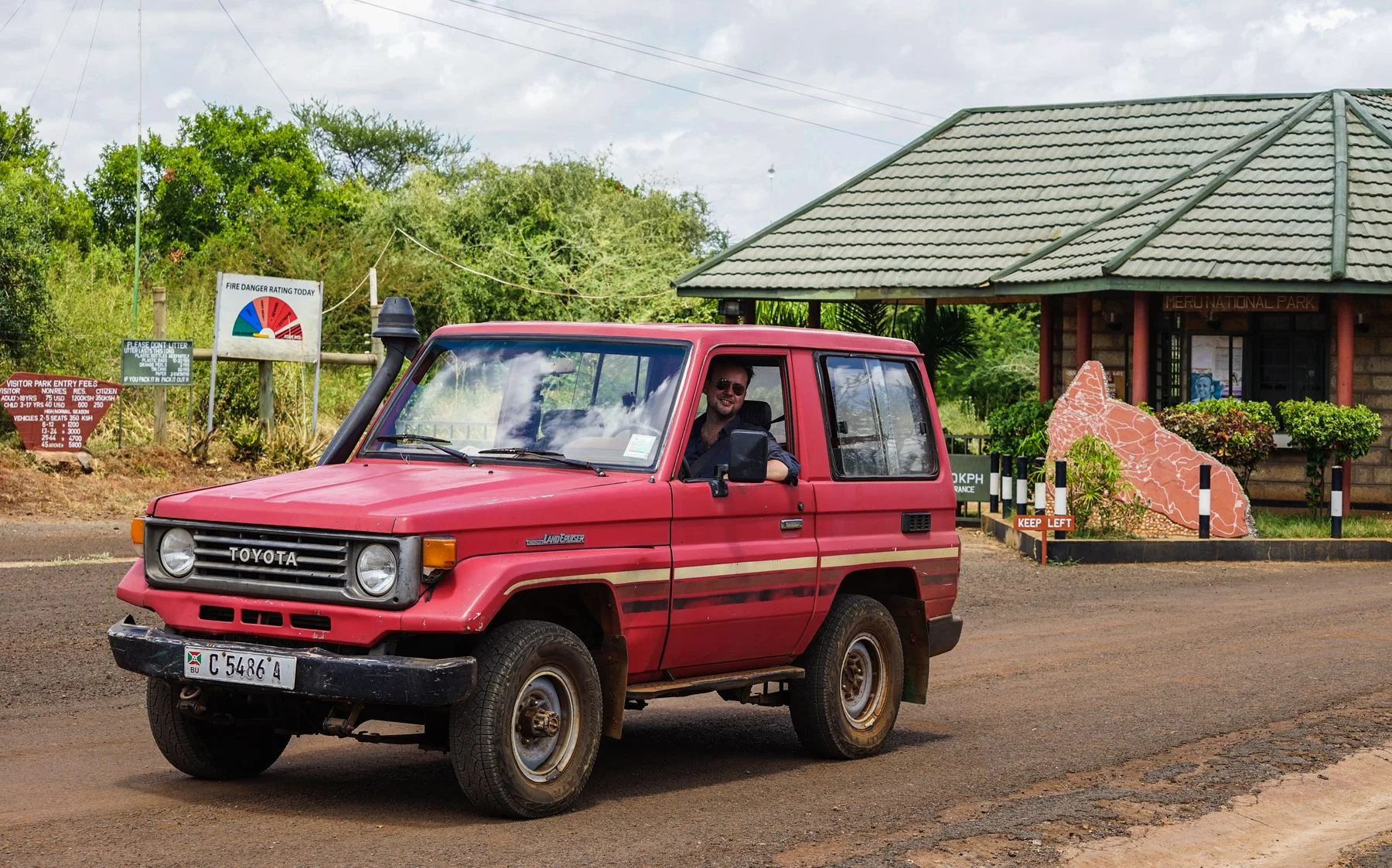
The highway section can make the journey look easy. Meru's internal roads cross a landscape cut by rivers, seasonal channels, black-cotton soils and dry tracks. A proper 4×4 protects the itinerary when the road stops behaving like a highway.
| Vehicle feature | Why it matters |
|---|---|
| Four-wheel drive | Traction on mud, sand and loose approaches |
| Ground clearance | Ruts, drainage channels and rough park sections |
| All-terrain tyres | Better control on mixed surfaces |
| Strong spare and tools | Help can be distant |
| Recovery points | Safe assistance if a vehicle becomes stuck |
| Pop-up roof or large windows | The transfer becomes a wildlife drive inside the park |
| Reliable cooling | Lower Meru can be hot even when Nairobi was cool |
Ask how many people share the vehicle. A long journey is very different with one window per person than with a cramped third row.
Driver-guide or self-drive
Experienced Kenya self-drivers can reach Meru, but the park demands more preparation than a short visit to Nairobi National Park. A private driver-guide handles city traffic, route changes, gate questions and wildlife scanning.
| Factor | Private driver-guide | Self-drive |
|---|---|---|
| Nairobi traffic | Passenger can rest | Driver begins with a demanding city exit |
| Gate selection | Local team confirms current advice | Traveller must verify independently |
| Final rural road | Driver has regional contacts and judgement | Rental support may be far away |
| Wildlife inside park | Guide watches tracks and habitat | Driver divides attention |
| Route changes | Easier to reorganise | Requires navigation and recovery confidence |
| Freedom | Private itinerary remains flexible | Maximum independence when prepared |
Self-drive should be chosen because the traveller enjoys the responsibility, not because Meru looks like one straight road.
Fuel is an itinerary decision
Meru National Park is large. Fuel used reaching the gate is not the fuel needed for two days of game drives. Fill the main tank before the remote section and ask whether the vehicle carries a legal, safe reserve.
| Fuel question | Why it matters |
|---|---|
| Where is the final dependable station? | Small-town availability can change |
| How many park kilometres are planned? | Distant rivers and circuits add quickly |
| Does the lodge supply fuel? | Do not assume |
| Is a reserve carried safely? | Improvised containers are dangerous |
| Where does the trip go after Meru? | Samburu, Kora or Nairobi require different margins |
A full tank gives freedom to stop for wildlife. A nearly empty tank turns every detour into anxiety.
What to carry on the road
| Carry | Reason |
|---|---|
| Drinking water | Heat and delays make it essential |
| Light meal or snacks | The final road may have no suitable stop |
| Offline map and written gate directions | Mobile coverage is not a route plan |
| Warm layer and sun protection | Nairobi morning and Meru afternoon feel different |
| Insect repellent | Riverine and evening areas can be active |
| Camera battery and power bank | The first wildlife may appear before check-in |
| First-aid kit | Remote travel deserves basic preparation |
| Park and lodge contacts | One phone call can prevent a wrong gate |
KWS also advises visitors to carry personal effects, clean water, food, camera, binoculars, sunscreen, repellent, first aid and reserve car fuel.
Food and rest stops
The journey is long enough for one proper stop. Choose it according to the route and arrival target.
| Route | Useful stop logic |
|---|---|
| Through Embu | Breakfast or early lunch before the final northern section |
| Through Nyeri and Nanyuki | Breakfast near the highlands, then keep Meru onward moving |
| JKIA start | Eat before the city exit or after clearing Nairobi, depending on landing time |
| Family trip | Add predictable bathroom breaks rather than emergency stops |
| Ura route | Finish food, water and fuel before the remote approach |
Avoid a long restaurant lunch when an inside-park lodge still lies beyond the gate.
Flying to Meru National Park
KWS identifies Kinna as the main airstrip, Mulika beside the Meru Mulika Lodge area and Mughwango beside Elsa's Kopje. Flights may be scheduled, chartered or arranged around a property, so the lodge should identify the correct strip before a ticket is purchased.
| Airstrip | Broad use | Confirm |
|---|---|---|
| Kinna | Main park airstrip and eastern-area access | Flight operation, lodge transfer and drive time |
| Mulika | Property-linked access near the former Mulika lodge area | Current use and receiving vehicle |
| Mughwango | Access beside Elsa's Kopje | Lodge pickup and baggage limit |
| Other operational strips | Management or special use | Do not assume visitor service |
The older Meru Conservation Area plan counted several airstrips but noted that only a subset served tourists. A pin labelled “airstrip” is not a bookable arrival.
Wilson Airport and the complete flight day
Safari aircraft generally use Wilson Airport rather than JKIA. A short flight therefore begins with a Nairobi road transfer and check-in.
| Flight-day step | Planning need |
|---|---|
| Hotel to Wilson | Traffic margin based on the neighbourhood |
| Check-in | Airline deadline and identification |
| Baggage | Soft bags, weight and equipment approval |
| Possible stops | Total journey may be longer than direct air time |
| Airstrip arrival | Lodge vehicle and named driver |
| Transfer to lodge | Short drive or a first game drive |
Compare the whole chain against the road. For two people, a private vehicle may still be valuable because it remains for game drives. For a short luxury stay, flying can protect a large part of the first day.
Small-aircraft baggage
| Item | Plan |
|---|---|
| Hard suitcase | Store it in Nairobi and use a soft safari bag |
| Large lens case | Give dimensions and weight before ticketing |
| Medical device | Obtain written carriage confirmation |
| Child seat or stroller | Confirm aircraft and lodge-vehicle capacity |
| Excess luggage | Buy approved extra capacity or travel by road |
| Road onward after flying | Make sure the next vehicle also has space |
Do not let a baggage rule appear for the first time at Wilson. The alternative road journey may be better than abandoning equipment or paying for an urgent charter.
Door-to-door road versus flight
| Road | Flight |
|---|---|
| Nairobi hotel pickup | Nairobi hotel pickup to Wilson |
| City exit | Check-in and waiting |
| Highland road | Flight and possible stop |
| Meal and bathroom stop | Airstrip unloading |
| Final gate approach | Lodge vehicle pickup |
| Same vehicle into park if permitted | Airstrip-to-lodge drive |
Flying can save several hours, but only when the strip belongs to the lodge and the service fits the dates. Road can take longer, but the vehicle, guide and luggage move as one unit.
When road is the stronger choice
| Road wins when | Why |
|---|---|
| Meru follows Aberdare, Solio or Laikipia | The route connects naturally |
| The group has substantial luggage | No small-aircraft weight problem |
| A private guide is wanted for several days | The same team stays with the safari |
| Four or more travellers share cost | Vehicle economics improve |
| The trip continues to Samburu | Road avoids returning to Nairobi |
| The family needs flexible stops | Pace remains private |
The road also reveals why Meru feels different. The park is reached through changing highlands and drier country rather than dropped into as an isolated product.
When flying is the stronger choice
| Flying wins when | Why |
|---|---|
| Only two or three nights are available | More of the stay remains inside the park |
| The lodge sits by a useful airstrip | Ground transfer is short and simple |
| A honeymoon prioritises privacy and time | Arrival feels immediate |
| Long roads are painful for a traveller | Sitting time can be reduced after accessibility checks |
| Meru connects by air to another safari region | A full road day may disappear |
| The group can travel light | Baggage rules are easy to meet |
The best flight improves the experience. It is not simply the most expensive transport line.
Road in and fly out
Driving to Meru through the highlands and flying out can be an excellent compromise. The road provides context and circuit stops. The flight removes the repeated return.
| Mixed route | Benefit |
|---|---|
| Nairobi, Aberdare, Ol Pejeta, Meru, fly out | Builds a complete northern story |
| Nairobi road to Meru, fly to Mara | Avoids a long return through Nairobi |
| Fly to Meru, road to Samburu | Protects the first day and keeps northern flexibility |
| Road to Meru, fly to coast connection | Reduces the final transfer burden |
Two nights in Meru
Two nights produce one full day. They can work if transport is efficient and the lodge location is well chosen.
| Day | Road version | Fly-in version |
|---|---|---|
| Day 1 | Very early Nairobi departure, late-afternoon short drive | Morning flight, game-drive transfer, afternoon drive |
| Day 2 | Full park day | Full park day |
| Day 3 | Early drive and long road onward | Morning activity and flight onward |
Do not divide two nights between lodges. Choose one base and one coherent full-day circuit.
Three nights in Meru
Three nights give two full mornings and two full afternoons without forcing every distant attraction into one day.
| Day | Rhythm |
|---|---|
| Day 1 | Travel, settle and explore near the lodge |
| Day 2 | Full wildlife circuit with river and rhino focus |
| Day 3 | Different habitat, Born Free history, birding or slower drive |
| Day 4 | Morning activity, then road or air departure |
Three nights are especially valuable after a long road. The first evening becomes an arrival rather than half the holiday.
Four nights for a deeper Meru safari
Four nights suit photographers, repeat safari travellers, birders and anyone who values space over a rapid Big Five count.
| Extra night allows | Reader benefit |
|---|---|
| A distant river circuit | No race back through the park |
| A second rhino-sanctuary visit | Different light and animal movement |
| Walking or night-drive arrangement | Another way to read the landscape |
| A slow lodge afternoon | Rest without sacrificing the only game drive |
| Weather flexibility | Rain does not erase a key plan |
Meru rewards time because its habitats are spread across a large, low-traffic park.
The rhino sanctuary affects routing
KWS describes black and white rhinos under 24-hour surveillance and identifies the sanctuary as a major viewing experience. If rhinos are a priority, place the sanctuary on the correct day and choose the gate and lodge accordingly.
| Rhino-focused question | Planning effect |
|---|---|
| Which entrance is practical? | Western-side routing may reduce repeated kilometres |
| What time is best? | Morning and afternoon light support slower viewing |
| Is the sanctuary open and accessible? | Confirm with the park or lodge |
| Is Solio or Ol Pejeta also included? | Give each conservation setting its own purpose |
Our Meru versus Laikipia guide and Meru versus Samburu guide help decide whether Meru belongs alone or in a broader northern itinerary.
River crossings and wet-season roads
Meru is crossed by numerous rivers and streams descending from the highlands. That water creates its green, varied character. It also makes road condition important after rain.
| Condition | Response |
|---|---|
| Heavy rain before arrival | Ask which gate and internal roads remain practical |
| Rising river or damaged crossing | Accept a reroute rather than force the planned circuit |
| Black-cotton mud | Use proper tyres and avoid wheel spin |
| Dry corrugation | Slow down and protect tyres and suspension |
| Tall wet grass | Check visibility and avoid hidden road edges |
A route closed by weather is not a failed safari. The park has enough habitat to build another day.
Heat changes the travel day
Nairobi may be cool at dawn while lower Meru is hot by afternoon. Hydration, vehicle ventilation and a shaded rest matter.
| Traveller | Heat plan |
|---|---|
| Young child | Water, shade, light clothing and shorter afternoon drive |
| Older traveller | Easy vehicle access and a proper lunch rest |
| Photographer | Protect batteries and equipment from direct sun |
| Self-driver | Swap drivers and avoid fatigue on the final road |
| Camper | Carry more water than the expected daily use |
The most productive wildlife time is often early and late. Let midday belong to shade when the season is hot.
Families with children
| Family need | Road option | Flight option |
|---|---|---|
| Bathroom stops | Fully controlled | Limited until the airstrip transfer ends |
| Luggage | Generous in a private vehicle | Strict aircraft allowance |
| Car seat | Confirm vehicle fit | Confirm aircraft and lodge vehicles |
| Motion sensitivity | Long winding road can be difficult | Small aircraft can also be bumpy |
| First afternoon | Flexible if arrival is late | Usually protects more lodge time |
| Privacy | Private vehicle supports family pace | Lodge transfer may be shared |
For families driving from Nairobi, an overnight in the highlands can turn one very long day into two interesting ones.
Honeymoon travel
Meru's low vehicle density and secluded lodges suit a honeymoon beautifully. Transport should preserve that calm.
| Honeymoon style | Journey to consider |
|---|---|
| One remote lodge for three nights | Fly to the property-linked strip |
| Slow northern Kenya journey | Private 4×4 through Aberdare or Laikipia |
| Meru followed by Mara | Fly between safari regions |
| Plenty of wedding luggage | Road or Nairobi luggage storage |
| Private guide throughout | Road circuit with one guide and vehicle |
Do not let “luxury” decide by itself. Some couples love a private road story. Others want to land within the wilderness and be at lunch within the hour.
Travellers with limited mobility
| Check | Road implication | Flight implication |
|---|---|---|
| Sitting tolerance | Long transfer needs breaks and support | Shorter total sitting may help |
| Vehicle step | Safari 4×4 can be high | Lodge transfer vehicle still matters |
| Aircraft door and steps | Not applicable | Small aircraft can be difficult to board |
| Wheelchair storage | Private vehicle may have room | Aircraft hold dimensions may not |
| Uneven ground | Gate and lodge paths | Airstrip surface and apron |
| Bathroom access | Planned road stops | Limited during the flight chain |
Use our accessible Kenya safaris guide to describe the traveller's exact requirements. A label is not enough.
Photographers and birders
Meru holds more than 400 recorded bird species according to KWS and offers low-traffic roads that reward patience. The transport choice should support equipment and dawn access.
| Priority | Plan |
|---|---|
| Heavy lenses | Drive or reserve approved aircraft capacity |
| One window per person | Use a private vehicle with a confirmed seating plan |
| Dawn inside park | Stay inside or just outside the correct gate |
| Multiple habitats | Allow three or four nights |
| Charging | Confirm lodge supply and vehicle inverter |
| Dust and rain | Carry covers and keep equipment inside the vehicle |
Do not sacrifice two mornings to transport on a two-night photography trip.
Connecting Meru and Samburu
Meru and Samburu create a strong contrast. Meru is greener, river-crossed and secluded. Samburu is drier, more open and shaped by the Ewaso Nyiro.
| Sequence | Planning thought |
|---|---|
| Meru to Samburu by road | Natural northern continuation with an early start |
| Fly into Meru, road to Samburu | Protects first day and keeps the second region flexible |
| Samburu to Meru | Confirm the best gate for the chosen Meru lodge |
| Two nights in each | Fast but possible with efficient transfers |
| Three nights in each | Better for distinct habitats and rest |
Read the Samburu safari guide before deciding which region receives the extra night.
Connecting Meru and Laikipia
Laikipia can sit between Nairobi and Meru or follow Meru on the way west. The road is more useful when the exact conservancy is named.
| Pairing | Transport logic |
|---|---|
| Ol Pejeta and Meru | Road via Nanyuki and Meru town |
| Lewa and Meru | Shorter northern connection than a Nairobi return |
| Loisaba and Meru | Full road plan or flight arrangement depending on lodge |
| Solio, Ol Pejeta and Meru | Sequential road circuit with no city backtrack |
Our Nairobi to Laikipia transport guide explains why the conservancy name matters.
Connecting Meru and the Masai Mara
Road travel between Meru and the Mara usually consumes a full day and crosses the Nairobi region. Air can preserve time, though routings may include stops or connections.
| Option | Strength | Limitation |
|---|---|---|
| Safari flight | Keeps two distant ecosystems in one itinerary | Schedule and baggage must align |
| Road via Nairobi | Simple with one private vehicle | Very long day |
| Nairobi overnight | Separates risk and allows rest | Adds a city night |
| Private charter | Tailored timing for a group | Higher cost |
Use the Masai Mara safari guide to choose the correct Mara airstrip before the Meru flight is booked.
Connecting Meru and the coast
Meru lies closer to Kenya's eastern side than many safari parks, but the coast is still a serious road journey. Air through Nairobi or a charter can be kinder.
| Plan | Check |
|---|---|
| Meru airstrip to Nairobi, onward coast | Airport, connection margin and baggage |
| Road to Nairobi, fly next day | Hotel and which airport serves the coast flight |
| Private charter | Coastal airport and total luggage |
| Road toward Tsavo and coast | Break the journey with a real overnight |
Do not turn the last safari day into an exhausting race to the beach.
Can Meru be a day trip from Nairobi?
No sensible safari plan treats Meru National Park as a day trip from Nairobi. Even the shorter KWS distance to Ura Gate requires several hours each way, leaving little or no safe wildlife time before the 18:00 gate closure.
| Better alternative | Why |
|---|---|
| Two-night minimum | Creates one full park day |
| Three-night stay | Justifies the road and allows varied habitats |
| Fly-in two-night stay | Protects more safari time |
| Highland overnight en route | Makes the road part of a circuit |
If only one day is available from Nairobi, choose a nearer park rather than asking Meru to fit an impossible clock.
What travellers say about Meru
Low traffic is the recurring theme. A SafariBookings reviewer described Meru as “So far off the beaten track it’s relatively undisturbed and the wildlife are thriving.” That is one person's view, but it explains why the long road appeals to repeat safari travellers.
A guest reviewing a stay near Murera Gate wrote of “glorious wide open spaces and very few other cars.” The same review mentioned birds and animals, but the sense of space is the part transport planning can either protect or waste.
Another park visitor used the short headline “Quiet, but a lot of animals.” No one can promise a particular sighting day. The useful expectation is that Meru trades the concentrated traffic of a famous reserve for a more exploratory drive.
| Review theme | Planning lesson |
|---|---|
| Few other vehicles | Allow time to search rather than follow a crowd |
| Wide open spaces | Choose a comfortable vehicle and enough nights |
| Wildlife thriving | Keep expectations about wild sightings realistic |
| Quiet | Avoid arriving exhausted after an impossible schedule |
Sources: Meru user reviews on SafariBookings, Ikweta guest reviews on Tripadvisor and Meru National Park visitor reviews on Tripadvisor.
The decision table
| Your trip | Strong first choice | Why |
|---|---|---|
| Two nights at Elsa's Kopje | Fly to the lodge-linked strip | Protects limited park time |
| Three nights, first Kenya visit | Road or fly depending on wider itinerary | Both can work with a clear gate plan |
| Aberdare, Ol Pejeta and Meru | Road | One coherent northern circuit |
| Meru followed by Mara | Fly onward | Avoids a full road day |
| Family with generous luggage | Private road vehicle | Space and stop flexibility |
| Honeymoon at one lodge | Fly | Immediate arrival and more lodge time |
| Heavy photography gear | Road or pre-booked aircraft capacity | Prevents baggage surprises |
| Self-drive adventure | Road with current gate advice | Maximum independence with responsibility |
| Mobility limitations | Individual comparison | Long road and small aircraft create different barriers |
| Meru and Samburu | Road between parks | Keeps the northern sequence intact |
Questions to answer before paying
| Question | Complete answer |
|---|---|
| Where are we sleeping? | Property name and inside or outside park |
| Which gate? | Murera, Ura or another confirmed entry |
| Which route? | Embu, Nyeri-Nanyuki or a mixed circuit |
| How long door to door? | Nairobi address, stops, gate and internal drive |
| Which vehicle? | 4×4 type, seats, luggage and game-drive use |
| Which airstrip? | Kinna, Mulika, Mughwango or another approved strip |
| Who meets the flight? | Named lodge vehicle and contact |
| What are the baggage rules? | Weight, dimensions and special equipment |
| What if it rains? | Alternative gate or internal route |
| What comes next? | Exit gate, road sequence or onward flight |
Give Meru enough time to feel remote
Meru's distance is not a flaw to hide. It is one reason the park remains quiet. The road can be a beautiful highland journey, especially when Aberdare, Solio, Ol Pejeta or Mount Kenya belongs before it. A flight can carry a short-stay traveller straight into the wilderness and leave more hours for rivers, rhinos and empty tracks.
Name the lodge. Choose the gate. Compare the full road and flight chain. Then allow enough nights for the landscape to replace the journey in your memory.
Plan your journey to Meru
Share the Nairobi start, exact Meru property, dates, travellers, luggage and next destination. We will compare the complete road and flight options.