
Meru National Park Guide: Wildlife, Lodges, Roads and the Rhino Sanctuary
Plan Meru around its rivers, rhino sanctuary, real road conditions, named gates, accommodation position and the wildlife priorities that matter to you.

- Is Meru National Park worth visiting?
- What makes Meru different?
- Understanding the park’s habitats
- The rivers are the park’s map
- How many nights do you need?
- Wildlife at a glance
- The Meru rhino sanctuary
- Black rhino or white rhino?
- Elephants and buffalo
- Lions in Meru
- Leopards and cheetahs
- Reticulated giraffes
- Grevy’s zebras, plains zebras and northern specialists
- Hippos, crocodiles and water-dependent wildlife
- Birding in Meru
- Elsa, George Adamson and the Born Free story
- Elsa’s Grave
- Pippa’s Grave
- Adamson’s Falls
- The equator marker
- Mwariama’s baobab hideout
- Murera Gate
- Ura Gate
- Other gates and park access
- Flying to Meru
- Driving from Nairobi
- Flying or driving compared
- Roads inside the park
- The rainy seasons
- Dry-season travel
- Best time to visit Meru
- Daily safari rhythm
- Night drives and astro-tourism
- Where to stay inside and near Meru
- Elsa’s Kopje
- Rhino River Camp
- Ikweta Safari Camp
- KWS guest houses and cottages
- Bwatherongi public campsite
- Special campsites
- Compare Meru accommodation styles
- Meru for families
- Meru for a honeymoon
- Accessibility and limited mobility
- Photography in Meru
- Self-drive safaris
- Park rules that protect the experience
- What a Meru safari costs
- What to pack
- Meru and Lewa
- Meru and Samburu
- Meru and Shaba
- Meru and Ol Pejeta
- Meru and the Aberdares
- Meru and the Masai Mara
- A strong three-night itinerary
- A deeper four-night itinerary
- A northern Kenya route
- What travellers notice
- Common planning mistakes
- Frequently asked questions
- Let Meru remain wild
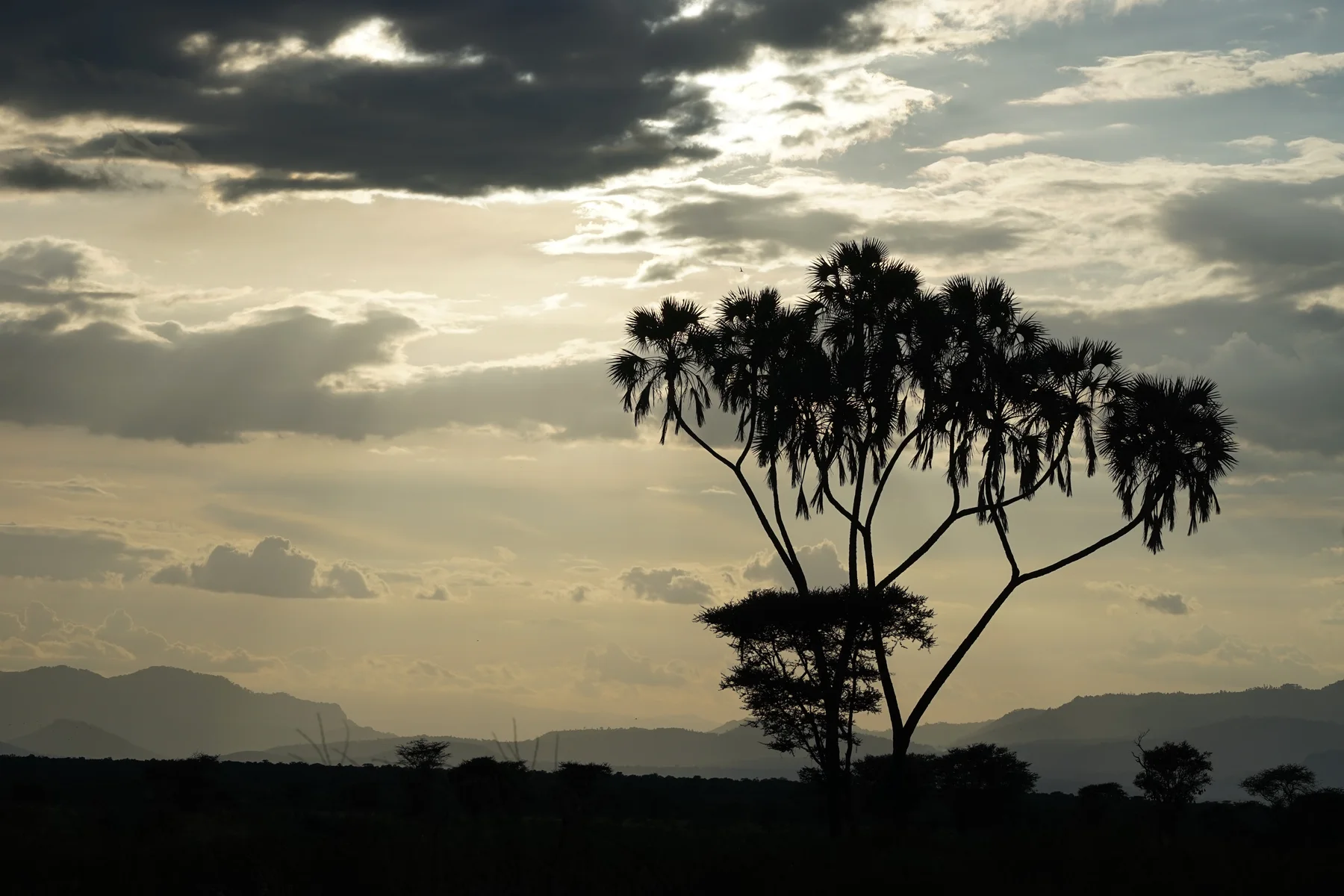
Meru does not reveal itself in one grand panorama. It arrives in chapters. Open grass gives way to combretum thickets, doum palms gather beside water, a red-earth track crosses another river, and a waterbuck watches from the green edge before melting back into cover. On a quiet morning, the only tyre marks ahead may be your own from the previous drive.
That solitude is Meru's greatest pleasure and its central planning challenge. The park is large, the vegetation can be dense, and wildlife is not arranged around a famous circuit. A short, hurried visit can feel empty. Three or four nights with a guide who understands the rivers, recent rain and animal movement can feel wonderfully private.
This Meru National Park guide explains the habitats, gates, roads, wildlife, rhino sanctuary, lodges, camps, seasons and route combinations that shape a good visit. It also separates the real park from the shorthand description of “Born Free country.” Elsa's story belongs here, but Meru is much bigger than one lioness and one grave.
Is Meru National Park worth visiting?
Yes, for travellers who value space and discovery more than a rapid Big Five checklist. Meru protects a broad eastern landscape of rivers, grassland, wooded bush, rocky outcrops and palm-fringed drainage lines. Elephants, buffalo, lions, leopards, cheetahs, reticulated giraffes, Grevy's zebras, gerenuk, waterbuck and many birds occur here. A fenced rhino sanctuary supports both black and white rhinos.
The park is not the easiest first safari for someone with only two nights and a fixed expectation of constant sightings. Animals can disappear into thick vegetation, distances are significant, and roads respond quickly to rain. Meru rewards patience, local guiding and a willingness to enjoy landscapes, tracks and smaller encounters between headline animals.
| Choose Meru when you want | Think carefully when you need |
|---|---|
| Quiet drives with few other vehicles | Maximum large-cat density on a short stay |
| Green river corridors and varied scenery | A simple day trip from Nairobi |
| Rhino viewing in a dedicated sanctuary | Predictable road conditions in heavy rain |
| Northern species alongside classic safari wildlife | A large choice of luxury lodges inside the park |
| Birding and unhurried photography | Night drives without prior authorised arrangements |
| A route linking Mount Kenya, Lewa or Samburu | A guaranteed species checklist |
What makes Meru different?
Water shapes Meru. Thirteen permanent rivers and numerous seasonal watercourses cross the wider landscape from the Nyambene Hills towards the Tana River system. Their green banks break up drier bush and open ground, creating a sequence of habitats rather than one uniform plain.
The result is beautiful and sometimes difficult. Thick cover gives browsers and predators places to disappear. River crossings slow a drive and make road choice important. During wet periods, the park can become lush enough that an elephant stands surprisingly close without being obvious.
Meru is also quieter than Kenya's best-known reserves. One traveller described it as an “awesome park for game viewing and landscapes”, while another reported that they “only saw one other vehicle over the three days”. Those comments capture the attraction, but low traffic also means fewer vehicles sharing live sighting information.
Understanding the park’s habitats
Meru's western side receives more rainfall and rises towards the Nyambene foothills. Woodland and bush can be thick. Moving east, the country generally becomes lower, hotter and more open, with acacia, grassland and doum palms along rivers. The southern and eastern edges connect visually and ecologically with the Tana River landscape and the wider Meru Conservation Area.
Do not ask which single sector is “best” without adding the month, recent rainfall and wildlife priority. Rhinos draw visitors to the western sanctuary. Elephants and buffalo may use watercourses. Northern species favour suitable drier country. Lions follow prey and can shift their patterns.
| Habitat | What it looks like | What to watch for | Planning implication |
|---|---|---|---|
| Riverine woodland | Tall green vegetation beside water | Elephants, waterbuck, monkeys, birds, leopard signs | Drive slowly and listen before moving on |
| Doum palm country | Fan palms along drainage lines | Elephants, birds and strong landscape photographs | Best light often comes early or late |
| Open grassland | Wider views and lower cover | Grazers, giraffes, cheetah possibilities, raptors | Scan far ahead before approaching |
| Combretum and acacia bush | Dense shrubs and broken woodland | Browsers, kudu, gerenuk, lions in shade | Sightings can be close and brief |
| Rhino sanctuary | Fenced western sector with mixed cover | Black and white rhinos, buffalo and other wildlife | Give the sanctuary a proper half day |
| Rocky features and falls | Stone, rapids and viewpoint country | Scenery, geology, birds and history | Leave the vehicle only where permitted |
The rivers are the park’s map
Road maps show named tracks, but local guiding often begins with water. Rivers and seasonal streams influence grazing, shade, drinking and movement. The Rojewero, Ura, Bwatherongi and other watercourses help a guide decide where to spend the morning after listening to the night's rain and checking tracks.
A river crossing is not merely a landmark. Fresh elephant prints, buffalo tracks, alarm calls or a change in bird activity may turn it into the most productive twenty minutes of the drive. In wet conditions, the same crossing can become a reason to change route.
How many nights do you need?
Three nights provide two full days and are the sensible minimum for a first visit. Four nights are better when rhinos, birds, northern species and Adamson sites all matter. Five suit photographers, repeat safari travellers and anyone combining game drives with slower lodge time.
| Stay | Realistic experience | Verdict |
|---|---|---|
| 1 night | Arrival, sleep and a short drive | Too rushed for the size of the park |
| 2 nights | One full day, usually sanctuary plus a limited circuit | Possible, but highly weather dependent |
| 3 nights | Two full days with sanctuary and wider exploration | Strong minimum |
| 4 nights | Three full days, better habitat coverage and flexibility | Best first visit |
| 5 or more | Slow photography, birding and deeper east-west exploration | Excellent for specialists |
The quietest parks need more time, not less. In a busy reserve, several vehicles may locate a pride and share the position. In Meru, the guide may be reading a track with no other car nearby. That is part of the experience.

Wildlife at a glance
Meru supports classic East African wildlife and species associated with Kenya's north. Elephants and buffalo can be impressive. Reticulated giraffes, Grevy's zebras, gerenuk and Beisa oryx add a different character from a Mara safari. Lions, leopards and cheetahs occur, but vegetation and low traffic make every predator sighting earned.
The rhino sanctuary is a major draw. Birders also benefit from the meeting of wetter western habitats, drier eastern country, rivers and open grassland.
The Meru rhino sanctuary
The sanctuary lies in the western part of the park and protects black and white rhinos within a fenced area. It is large enough to feel like habitat rather than an enclosure at a zoo. Rhinos still choose cover, rest behind vegetation and move away from vehicles.
White rhinos graze and are often easier to find in open ground. Black rhinos browse and can disappear into shrubs. Ask the guide to explain mouth shape, feeding style and body posture instead of relying on the misleading colour names.
One visitor recalled seeing “many rhino, elephant and Buffalo in one sighting”. Treat that as a memorable experience, not a promise. The sanctuary should receive enough time for patient searching rather than a hurried pass on the way to lunch.
Black rhino or white rhino?
| Feature | Black rhino | White rhino |
|---|---|---|
| Feeding | Browser | Grazer |
| Mouth | Hooked upper lip | Broad, square lip |
| Typical habitat use | Shrub and thicker cover | More open grassland |
| Head position while feeding | Often higher | Usually low to the ground |
| Sighting style | May be brief and partly hidden | Can remain visible while grazing |
Keep a generous distance, especially around mothers and calves. Never ask a driver to block a rhino's path for a photograph. Location details connected to security or monitoring should remain private.
Elephants and buffalo
Elephants move through riverine cover, open country and palm landscapes. They may appear as a family crossing a road, a bull feeding alone or a herd gathering near water. Dense bush can make a close elephant encounter feel sudden, which is why speed and listening matter.
Buffalo can form substantial herds and also occur as older bulls near water and shade. Give both species room. A quiet engine and an open escape route produce calmer, longer sightings than edging forward for one more photograph.
Lions in Meru
Meru is part of the landscape made famous by George and Joy Adamson, but present-day lion viewing should be judged as wildlife, not as a sequel to Born Free. Lions live in the park, follow prey and use shade, river lines and open areas according to conditions.
Finding them may involve tracks, calls, vultures, prey behaviour and recent guide knowledge. A pride can offer an intimate sighting with no queue. It can also remain invisible through an entire short stay. Book enough nights for the park to work on its own terms.
Leopards and cheetahs
Leopards favour cover and may move along wooded drainage lines or rocky ground. They are present but elusive. Cheetahs need more open terrain and can range widely. Neither should be sold as guaranteed.
If cats dominate the wish list, pair Meru with the Masai Mara rather than demanding that Meru perform like it. The contrast works well: open predator country in the Mara, then riverine exploration and quieter northern wildlife in Meru.
Reticulated giraffes
Reticulated giraffes carry large chestnut patches divided by clean pale lines. Their pattern differs from the irregular markings of Masai giraffes found farther south. Meru sits within the range of northern Kenyan wildlife, and these giraffes are among its most elegant residents.
Watch how the habitat shapes the photograph. A giraffe between doum palms or against a storm front says far more about Meru than a tight portrait with no landscape.
Grevy’s zebras, plains zebras and northern specialists
Grevy's zebras have narrow stripes, large rounded ears and a mostly white belly. Plains zebras have broader stripes and more stable family groups. Both may occur in the wider region, so identification deserves care.
Gerenuk stand on their hind legs to browse, Beisa oryx carry long straight horns, and Somali ostriches can be recognised by adult males' blue-grey necks and legs. Distribution changes across habitat and season. A guide should never turn a probable glimpse into a certain species merely to complete a list.
Hippos, crocodiles and water-dependent wildlife
The park's rivers support hippos, crocodiles and a rich community of water-associated birds and mammals. Visibility depends on the water level, bank and safe stopping points. Do not approach a river edge on foot unless it is a designated area and a qualified guide confirms that it is safe.
Waterbuck are especially at home near green drainage lines. Their presence, tracks and alarm behaviour can reveal more than a quick species tick.
Birding in Meru
Meru's habitat range makes it one of Kenya's rewarding birding parks. Riverine forest, bush, grassland, palms and wetlands support raptors, hornbills, kingfishers, bee-eaters, storks, bustards, weavers, sunbirds and northern dry-country species.
One visitor wrote, “I'd definitely recommend this to avid bird watchers”. A good birding drive should move more slowly than a general game drive. Tell the guide before arrival, bring binoculars and leave space for calls, behaviour and habitat rather than chasing only a long list.
Elsa, George Adamson and the Born Free story
Joy and George Adamson raised Elsa, an orphaned lioness, and eventually returned her to a wild life. Joy's book Born Free and the later film carried that story around the world. Elsa's Grave remains one of Meru's recognised historic sites.
The story helped shape public ideas about lions, but it should be told with context. Wildlife rehabilitation has evolved, individual animals do not represent an entire ecosystem, and today's park depends on rangers, scientists, surrounding communities and daily management. Visit the grave as one layer of Meru, not the reason to race past living wildlife.
Elsa’s Grave
Elsa was buried near the Ura River. Reaching the site can take time depending on the starting lodge, road conditions and gate used. Ask whether it fits naturally into a full eastern circuit. A rushed return across the park can erase the quiet that makes the place meaningful.
Keep the visit reflective. It is a grave in a wildlife landscape, not a film set. Stay within the permitted area and follow the guide's instructions.
Pippa’s Grave
Pippa was a cheetah rehabilitated by Joy Adamson. Her grave is another official park attraction and extends the history beyond Elsa. It is especially interesting for travellers who have read Adamson's work and want to understand the experimental nature of early rehabilitation efforts.
Ask the guide to verify access and current road conditions. Not every historic point belongs in the same day's circuit.
Adamson’s Falls
Adamson's Falls lies on the Tana River and adds geological force to a park often described through animals. Water moves through dark rock in a rugged setting, creating a powerful landscape stop.
The site is distant from some western accommodation. It should be planned as part of an eastern or southern day, subject to roads and safe access. Water, heat and the return drive matter more than squeezing another pin onto a map.
The equator marker
The equator crosses the park and is marked as a visitor attraction. It is a simple geographical stop rather than a wildlife event. Combine it with a route that already makes sense instead of driving a long distance solely for a photograph.
Mwariama’s baobab hideout
KWS identifies a large baobab associated with Field Marshal Musa Mwariama and Kenya's Mau Mau history. The tree broadens Meru's story beyond wildlife and colonial-era conservation narratives.
The most useful visit includes informed context about Mwariama and the independence struggle. Avoid reducing the site to an unusual hollow tree. Confirm current access with the park or guide.
Murera Gate
Murera is the principal western gate for many visitors approaching from Meru town and Maua. It suits stays near the park's western accommodation and gives practical access to the rhino sanctuary. The final road, weather and gate time should be confirmed before departure.
Most first itineraries should begin here unless the chosen accommodation or previous stop makes another gate clearly better.
Ura Gate
Ura Gate serves the south-western side and can be useful from Embu or for a route designed around the Ura River and Adamson history. It is not automatically the scenic shortcut shown by a mapping app. Surface, bridges, rain and onward distance require local confirmation.
Never choose Ura solely because a digital map shows fewer kilometres. Ask for current driving time from someone who has used the road recently.
Other gates and park access
Meru has several access points serving a large conservation landscape. Gate usefulness changes with lodge position, road maintenance and rain. The itinerary should name the intended gate, not simply say “drive to Meru National Park.”
| Arrival direction | Likely access logic | Confirm before travel |
|---|---|---|
| Meru town or Maua | Murera Gate commonly suits western stays | Final road, gate time and lodge meeting point |
| Embu and south | Ura Gate may reduce backtracking | Current surface, bridge and river conditions |
| Northern Kenya | Route may approach via Isiolo and Meru/Maua | Real driving time and refuelling |
| Nairobi by road | Nyeri, Nanyuki and Meru or Embu route | Lunch stop, traffic and after-rain conditions |
| Flight arrival | Kinna, Mulika or Mughwongo airstrip as arranged | Airstrip, transfer time and baggage limit |
Flying to Meru
KWS lists Kinna, Mulika and Mughwongo airstrips. Charter or scheduled availability changes, so the itinerary must name the actual airstrip, airline or charter, baggage allowance and lodge transfer. “Fly to Meru” is not enough.
Flying saves road time, particularly when connecting Nairobi or a distant safari region. It can also create a long transfer if the chosen airstrip and lodge are poorly matched. Ask for wheels-up time, intermediate stops and the expected transfer after landing.
Driving from Nairobi
The road journey can run north through Nyeri, Nanyuki and Meru or east through Embu, depending on gate, vehicle and current conditions. It is a substantial travel day rather than a casual half-day transfer. Nairobi traffic and the final approach introduce uncertainty.
A private 4×4 allows food, camera gear and a broader overland route, but the value comes from sensible sequencing. Breaking the journey near Mount Kenya, the Aberdares, Lewa or Ol Pejeta can turn transit into a coherent safari.
Flying or driving compared
| Question | Fly | Drive |
|---|---|---|
| Time | Usually shorter in the air | Full travel day from Nairobi |
| Luggage | Strict weight and soft-bag rules | More flexible within vehicle capacity |
| Scenic continuity | Landscape changes quickly | See highlands and changing vegetation |
| Vehicle | Lodge transfer and game-drive vehicle required | Same private vehicle may continue if permitted |
| Weather effect | Airstrip and visibility can disrupt | Rain can affect final roads and park tracks |
| Best for | Shorter premium itineraries | Multi-stop Mount Kenya and northern circuits |
Roads inside the park
Meru's internal tracks are part of the adventure and a real operational consideration. Dry-season roads can be dusty and corrugated. Rain can turn black-cotton soil and river approaches slippery. A track that worked yesterday may be unsuitable after a storm.
Use a proper safari 4×4, carry recovery equipment and respect closures. Do not ask a guide to force a flooded crossing to preserve a planned checklist. KWS sets a 40 km/h speed limit, and slow driving is also better for animals, birds and unexpected washouts.
The rainy seasons
Rain often arrives around March to May and again in shorter bursts around October to December, but weather does not follow a perfect calendar. Meru's western and eastern sectors may experience different conditions. A wet spell produces colour, dramatic skies and fewer dusty roads, while also making vegetation thicker and access less predictable.
Ask about actual conditions during the week before arrival. Seasonal labels alone do not reveal whether a bridge is passable or grass has recently grown high.
Dry-season travel
The drier months generally simplify road access and draw animals towards reliable water. Vegetation may thin, improving visibility. Dust increases, afternoons can feel hot in lower sectors, and popular water points become more important.
Dry does not mean brown everywhere. Permanent rivers keep green lines through the landscape. Morning and late-afternoon temperatures still vary, especially around the higher west.
Best time to visit Meru
There is no single best month for every priority.
| Priority | Often favoured conditions | Trade-off |
|---|---|---|
| Easier road travel | Drier periods | Dust and hotter lower sectors |
| Open wildlife visibility | Later in a dry spell | Paler landscapes and stronger midday contrast |
| Green scenery and storm light | Wet and shoulder periods | Thick cover and possible road disruption |
| Birding | Green season and migrant periods | Insects, rain and slower travel |
| Low visitor numbers | Much of the year | Fewer vehicles sharing sightings |
| Rhino sanctuary | Year-round with enough time | Cover and heat still affect viewing |
Daily safari rhythm
Leave early. The first hours bring softer light, tracks from the night and cooler conditions. Return for breakfast or remain out with a packed meal when the chosen circuit is long. Rest through the hottest hours when practical, then drive again in late afternoon.
A full-day excursion works when moving between distant sectors or visiting Adamson's Falls. It should include shade, water, food, toilet planning and an honest return time. A full day is not an excuse to drive continuously without observing anything properly.
Night drives and astro-tourism
KWS currently promotes guided night wildlife viewing and astro-tourism among possible Meru experiences. That does not create permission for independent night driving. Ordinary park access remains governed by gate hours and authorised arrangements.
If a night activity matters, request the named operator, vehicle, guide, route, duration, child policy and current KWS approval in writing. If it cannot be confirmed, build the trip around excellent daylight drives and dark skies at the lodge.
Where to stay inside and near Meru
Meru has a small accommodation collection compared with the Mara. The choice includes distinctive private camps, KWS guest houses and cottages, and campsites. Position is crucial. A beautiful room can still be the wrong base if every priority requires a long cross-park drive.
KWS currently names Elsa's Kopje, Rhino River Camp, Ikweta Safari Camp and Spring Wells Hotel among private options connected with the park. It also lists Meru Guest House, Kinna Guest House, Kinna Cottages and Murera Cottages. Verify whether a property is inside the boundary, at the gate or farther away, because listings and casual descriptions sometimes blur that distinction.
Elsa’s Kopje
Elsa's Kopje sits on Mughwango Hill within the park. Its cottages are built among rocks with wide views, and the position gives a strong sense of being inside Meru rather than commuting from outside. It suits couples, honeymooners and travellers who value architecture, landscape and a full-service lodge.
Ask for the exact cottage, steps, walking distance to common areas, plunge-pool details, vehicle arrangement and airstrip transfer. A hill property can be visually magnificent while requiring careful room selection for limited mobility.
Rhino River Camp
Rhino River Camp is in forested country outside or beside the park rather than a central lodge deep inside Meru. Its appeal lies in a leafy riverside atmosphere, which creates a different experience from an open savannah camp. One guest praised the “breathtaking forest pictures”, while another enjoyed being “very peaceful with no crowds around the animals”.
Confirm the precise entrance route, daily gate process, game-drive vehicle, travel time to the sanctuary and whether meals or activities take place outside the park. The forest setting is the point, not something to hide behind a generic “Meru lodge” label.
Ikweta Safari Camp
Ikweta Safari Camp is near Murera Gate and works as a practical base for entering the western park. Its position can suit travellers who want a lower-cost camp experience without giving up guided game drives. It should not be described as equivalent in setting to a hill lodge inside the park.
Ask whether the quote includes park entry for every date, transport through the gate, game-drive duration, meals, drinks and a private or shared vehicle. Proximity to the gate is useful only when the programme leaves early enough.
KWS guest houses and cottages
KWS lists Meru Guest House, Kinna Guest House, Kinna Cottages A and B, and Murera Cottages A and B. These self-contained or self-catering options can suit independent travellers, families and groups who value park location over lodge service.
Facilities, power, cooking equipment, linen, staffing and water should be checked directly for the chosen unit. Bring provisions before entering if self-catering. Do not assume a nearby shop, restaurant or card terminal will solve a missing dinner.
Bwatherongi public campsite
Bwatherongi is the named public campsite. Public camping usually means shared facilities and a less exclusive setting than a special campsite, although Meru's low visitor volume may keep it quiet. Campers need a capable vehicle, water, food, fuel planning, lighting and a clear wildlife safety routine.
Confirm current booking, ranger requirements, ablutions, fire rules and whether the route remains usable after rain. Food must be secured and no scraps left for animals.
Special campsites
KWS lists several special campsites, generally intended for more private, low-infrastructure camping. A name on a list does not prove that the site is accessible, prepared or safe on a particular date.
The booking should identify the exact site, ranger or guide arrangement, toilet method, water, waste removal, catering team and emergency communication. Special camping is rewarding when it is properly supported, not when guests arrive with an ordinary road car and hope for the best.
Compare Meru accommodation styles
| Stay style | Position and feeling | Best for | Check carefully |
|---|---|---|---|
| Elsa's Kopje | Hill setting inside the park | Couples, scenery, full-service comfort | Cottage, steps, vehicle and transfer |
| Rhino River Camp | Forested setting outside or adjacent | Riverside atmosphere and camp character | Gate time and sanctuary distance |
| Ikweta Safari Camp | Near Murera Gate | Practical value and western access | Included drives, fees and vehicle use |
| KWS guest house or cottage | Functional park accommodation | Families, groups and self-catering | Supplies, facilities and staffing |
| Bwatherongi public campsite | Shared public camping | Equipped overlanders | Facilities, safety and rain access |
| Special campsite | Remote low-infrastructure site | Fully supported private camping | Exact site, ranger, water and waste plan |
Meru for families
Meru can be excellent for families who enjoy exploration and can manage longer drives. Quiet roads reduce sighting congestion, rivers create varied learning, and the equator, tracks, birds and Adamson history give children more than a large-animal checklist.
Match the room before the park. Ask about family-unit layout, steps, open camp boundaries, pool safety, meal times, child-minding and private vehicle use. A private vehicle is especially valuable for flexible departures, bathroom breaks and shorter afternoon drives.
Meru for a honeymoon
The park suits couples who want privacy, landscape and a sense of discovering somewhere together. Elsa's Kopje can provide a particularly strong setting, while a carefully supported special campsite offers a different kind of seclusion.
Honeymoon value should come from the room, private vehicle, meals and unhurried time, not rose petals added to a generic safari. Confirm the exact cottage, whether meals can be private, how much road time the itinerary contains and which days remain deliberately slow.
Accessibility and limited mobility
Accessibility varies sharply by property and vehicle. Hill cottages may involve steps and uneven paths. Camps can have gravel, roots, raised thresholds and long distances between tents and common areas. Safari vehicles require a climb unless a step, transfer aid or adapted setup is arranged.
Request photographs and measurements for the exact room, shower, toilet, paths and vehicle. Name walking tolerance, transfer method, wheelchair dimensions and assistance needs. Our accessible Kenya safari guide explains the details to settle before payment.
Photography in Meru
Meru offers atmosphere more readily than predictable close portraits. Storm fronts, palms, red roads, green rivers and solitary animals in habitat are the signature. Carry one body or lens combination that can handle wider scenes, not only a long telephoto.
Request a private vehicle for serious photography, remove the middle seat where possible and carry beanbags rather than relying on a tripod. Dense vegetation rewards quick autofocus and the discipline to wait for a clean gap. Rain covers and dust protection belong in the same bag.
Self-drive safaris
Experienced Kenya drivers can self-drive, but Meru is not the place to learn recovery skills. Use a high-clearance 4×4, obtain the latest KWS map, enter with enough fuel and water, and report the intended route when conditions are uncertain. Downloaded map directions cannot assess a flooded crossing.
Stay on authorised tracks. Do not leave the vehicle except at designated places. KWS gate hours are normally 6:00 to 18:00 for visitors without an authorised overnight activity, and arrival after closing should never be assumed.
Park rules that protect the experience
KWS requires low speeds, responsible waste handling and respect for designated areas. The park is plastic-free for prohibited single-use items. Drones require explicit national and park permissions and should never be assumed acceptable.
| Rule | Why it matters |
|---|---|
| Keep below 40 km/h | Protects wildlife and allows reaction to washouts |
| Stay in the vehicle except designated areas | Dangerous animals and hidden terrain remain present |
| Do not feed animals | Prevents dependence and conflict |
| Keep noise low | Protects behaviour and improves sightings |
| Remove all waste | Stops ingestion, pollution and campsite habituation |
| Do not reveal sensitive rhino locations | Supports security |
| Follow gate and authorised activity times | Prevents unmanaged night movement |
What a Meru safari costs
The total combines accommodation, park entry, vehicle and guide, road or air transfer, meals, drinks, activities and any private arrangements. Season, residency, child age, room occupancy and number of park-entry dates all matter.
Do not compare a self-catering KWS cottage with a fully inclusive hill lodge on room price alone. Ask for one total that names every component for the same dates and number of travellers.
| Cost line | What should be named |
|---|---|
| Accommodation | Property, room, occupancy and board basis |
| Park entry | Adult and child category, residency and entry dates |
| Vehicle | Private or shared, guide, seats and drive duration |
| Road transfer | Start point, gate, vehicle and meal stops |
| Flight | Airline or charter, airstrip, baggage and transfers |
| Activities | Sanctuary, guided walk, historic sites or night activity |
| Drinks and laundry | What the rate includes and excludes |
| Camping | Site, ranger, equipment, catering, water and waste removal |
Read our Kenya safari cost guide before comparing different routes.
What to pack
Bring neutral layers, a warm early-morning layer, sun protection, closed shoes, binoculars, camera protection, reusable water bottle and personal medication. In wetter months, add a light waterproof jacket and dry bags. For camping, the equipment list becomes far more substantial.
Soft bags simplify small-aircraft travel. Confirm baggage weight before packing. Our complete Kenya safari packing guide covers cameras, clothing, medication and flight restrictions.
Meru and Lewa
Lewa Wildlife Conservancy offers controlled access, resident lodges, highly organised rhino conservation and a broad private-conservancy activity menu. Meru is a much larger national park with wilder road circuits, more riverine habitat and fewer accommodation choices.
Together they make a strong four to seven-night northern section. Lewa provides focused guiding and lodge activities. Meru adds scale, palms, history and the pleasure of an empty road.
Meru and Samburu
Samburu National Reserve centres on the Ewaso Nyiro River and a dry northern wildlife landscape. Meru is greener, larger and more broken by rivers and dense vegetation. Both can feature reticulated giraffe, Grevy's zebra and gerenuk.
The pair works because the scenery changes. Allow a proper transfer day and confirm the route rather than assuming two northern names sit beside each other.
Meru and Shaba
Shaba National Reserve has volcanic scenery, springs and a drier character east of Samburu and Buffalo Springs. It connects with Joy Adamson's later work, while Meru carries the better-known Elsa history.
Choose the combination for landscape and story, not simply to repeat northern species. Road time, reserve fees and the chosen Shaba lodge need to be explicit.
Meru and Ol Pejeta
Ol Pejeta Conservancy offers structured conservation visits, a large accommodation range and very strong rhino context. Meru provides a less programmed national-park experience and a different rhino sanctuary.
Ol Pejeta is easier to fit around Nanyuki. Meru needs more time and a well-chosen gate. Combining both suits travellers who want to compare conservation models without turning the trip into a race.
Meru and the Aberdares
The Aberdare National Park guide covers misty forest, high moorland, waterfalls and mountain roads. Meru brings warmer low country, rivers and palms. The habitat contrast is one of the strongest in a central Kenya circuit.
Use a night near Nanyuki, Nyeri or Mount Kenya when it makes the transfer safer and more enjoyable.
Meru and the Masai Mara
The Mara offers open plains, dense resident wildlife and a broad lodge choice. Meru offers privacy, northern species and landscape discovery. Flying between regions can protect safari time, while an overland combination needs intermediate stops.
Do not remove nights from Meru to make room for a long transfer. Three nights in Meru and three or four in the Mara create a more satisfying contrast than two rushed nights in each.
A strong three-night itinerary
Arrive through Murera Gate or the arranged airstrip and settle before a short afternoon drive. Spend the first full day across the western habitats and rhino sanctuary, allowing wildlife rather than distance to set the pace. Use the second full day for a longer river and palm circuit, birding and any historic stop that fits naturally. Depart after a final morning drive.
This plan works only when accommodation position and arrival time are sensible. A late road arrival should not be dressed up as a safari day.
A deeper four-night itinerary
Use the first afternoon for orientation. Give the first full day to the sanctuary and western sector. Spend the second exploring rivers, open country and northern species. Keep the third for a full-day eastern or southern circuit, possibly including Elsa's Grave or Adamson's Falls when roads permit.
Four nights create a weather buffer. If rain closes one route or cats remain hidden, the entire visit does not collapse.
A northern Kenya route
A coherent route can run Nairobi, Ol Pejeta or Lewa, Meru, Samburu or Shaba, then fly south to the Mara or coast. The exact order depends on flight days, lodge position and gate access.
Avoid alternating long drives with one-night stays. Build clusters of at least three nights in the places that deserve exploration.
Meru can also sit within a broader Laikipia safari when the trip is designed around contrasting conservation areas rather than repeated one-night stops. Travellers landing late in Kenya may begin with the Nairobi National Park guide and spend a first night in the city before driving north. Families should also read our Kenya safari with children guide before choosing room layouts and daily drive lengths.
What travellers notice
Visitors repeatedly mention scenery, quiet and the feeling of having sightings to themselves. One wrote that they were “mostly alone throughout the game drives”. Another called it “a beautiful place to drive around”.
Not every report is glowing. Recent visitors have also described sparse daytime wildlife and long drives. That criticism is useful. Meru's low vehicle density and thick cover can make a short visit feel slow. A good plan responds with enough nights, an experienced guide and realistic priorities, not with inflated promises.
Common planning mistakes
| Mistake | Why it weakens the visit | Better choice |
|---|---|---|
| Staying one night | Most time goes to arrival and departure | Book three or four nights |
| Choosing accommodation by photograph alone | Position controls daily driving | Match the base to the sanctuary and wider circuit |
| Expecting Mara-style cat density | Habitat and sighting network differ | Value tracks, birds, scenery and northern species |
| Naming no gate | The road plan remains incomplete | Put the gate and current access in the itinerary |
| Treating every lodge as inside the park | Daily gate time may be hidden | Confirm boundary position and transfer |
| Driving after heavy rain without local advice | Crossings and soil can become unsafe | Recheck roads before every long circuit |
| Promising an independent night drive | Park rules and approvals apply | Confirm an authorised guided activity |
| Visiting only for Elsa's Grave | Meru becomes a history stop, not a safari | Give living habitats and wildlife two full days |
Frequently asked questions
Is Meru National Park safe?
Visit with an established guide or a properly prepared self-drive plan, follow KWS instructions, stay in the vehicle outside designated places and respect wildlife distance. Road and weather safety require as much attention as animals.
Does Meru have the Big Five?
Lion, leopard, elephant, buffalo and rhino occur, but a short visit should not be sold as a guaranteed Big Five circuit. Rhino viewing is strengthened by the sanctuary, while leopards remain particularly elusive.
Is Meru crowded?
Usually no. Low vehicle pressure is one of its strongest attractions. It also means fewer guides sharing sightings across a large park.
How long should I stay?
Three nights are the minimum we recommend. Four are better for the sanctuary, broader habitats, birding and a historic site.
Can I see Elsa’s Grave?
Yes when the route and roads allow. It lies near the Ura River and may require a substantial drive from western accommodation.
Can I fly to Meru?
Yes by an arranged service or charter using the airstrip named in the booking. KWS lists Kinna, Mulika and Mughwongo. Confirm the operating flight and lodge transfer.
Can I self-drive?
Yes if you have a capable 4×4, current road information, sufficient fuel and water, offline navigation and recovery experience. Wet-season conditions require extra caution.
Are there rhinos?
Yes. The western sanctuary protects black and white rhinos. Sightings remain wild and require time.
Is Rhino River Camp inside the park?
It is outside or adjacent to the park in a forested setting. Confirm the exact gate process and daily drive time in the itinerary.
Can children visit?
Yes. Choose a suitable family room, private vehicle and realistic drive length. Confirm camp boundaries, pool safety and activity ages.
Is Meru good for birding?
Yes. Rivers, woodland, bush, grassland and northern habitats create excellent variety. Request a guide who enjoys birding and plan slower drives.
Are night drives available?
Only through current authorised arrangements. KWS promotes guided night wildlife and astro-tourism, but independent night driving should never be assumed.
Let Meru remain wild
Meru is at its best when nobody tries to turn it into a quieter copy of the Mara. Its appeal lies in moving between rivers, reading tracks on an empty road, finding rhinos in a sanctuary large enough to hide them, and watching a storm darken the palms before the first drops reach the vehicle.
Use this Meru National Park guide to choose the right gate, the right base and enough nights. Leave room for a day that produces more birds and landscapes than lions. The reward is not a checklist completed faster. It is the feeling that a very large park has begun, slowly, to make sense.
Tell us how you want to experience Meru
Share the dates, travellers, wildlife priorities, accommodation style, vehicle preference and next destination. We will build enough time for Meru’s scale.