
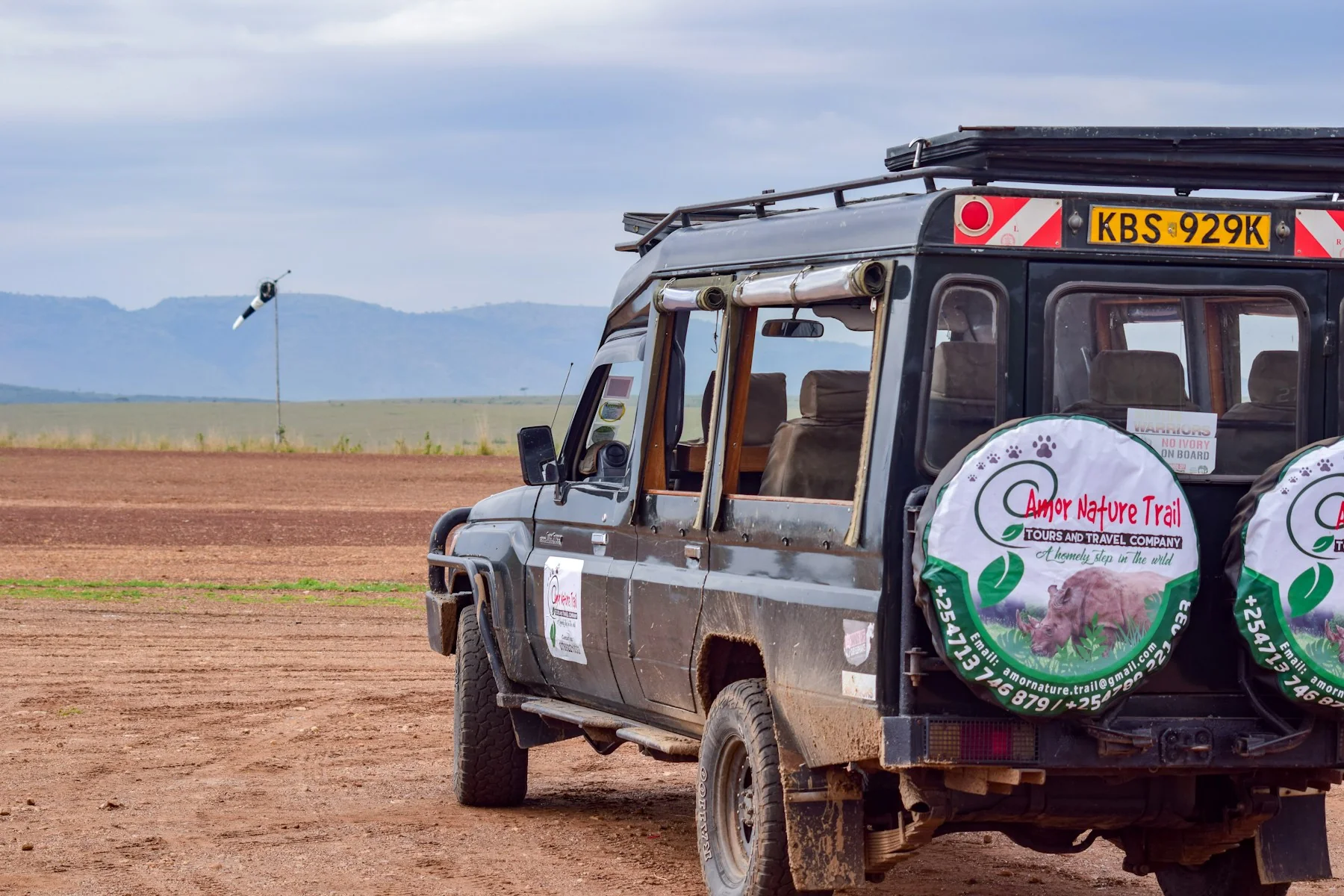
At sunrise, driving out of Nairobi feels like the safari has already begun. The city loosens its grip, the road drops towards the Rift Valley and the landscape opens on the way to Narok. Flying is a different pleasure. You leave Wilson Airport in a small aircraft, look down across the escarpment and can be on Mara grass before lunch. The better choice is not simply the faster one. It is the one that gives your particular trip the best days.
- How long does Nairobi to Masai Mara take?
- Road and flight routes at a glance
- What driving to the Mara is really like
- Nairobi to Masai Mara flights explained
- Cost, comfort and usable safari hours
- Drive one way and fly the other
- Connections that need breathing room
- Traveller experiences
- Watch the road journey
- Frequently asked questions
Six ways the choice changes your trip
How many nights?
The shorter the stay, the more valuable a flight becomes.
How much luggage?
Light aircraft use stricter limits and usually require soft-sided bags.
Private or camp vehicle?
Road trips often keep one guide; fly-ins normally transfer to a camp vehicle.
Which airstrip?
The nearest-looking airstrip is not always the stop used by the chosen camp.
What follows the Mara?
Lake Nakuru favours road; some safari regions or the coast may favour flight links.
Where is your Nairobi arrival?
Wilson Airport is separate from JKIA, so transfer time matters.
How long does Nairobi to Masai Mara take?
Most road safaris need about five and a half to six and a half hours from a Nairobi hotel to an eastern Mara gate, including a viewpoint or comfort stop. A western camp can take longer. The distance is often quoted as roughly 230 to 270 kilometres, but the final location matters more than the headline number. A camp near Sekenani is not the same journey as a lodge beyond Oloololo Gate or a conservancy camp reached from Aitong.
AirKenya’s 2026 timetable shows Wilson departures reaching the first Mara stop in 30 to 45 minutes. That is flying time, not hotel-to-camp time. Add the drive to Wilson, one-hour check-in, possible stops at other airstrips and the lodge transfer on arrival. For most guests, a fly-in journey occupies roughly two and a half to three hours door to door. It still saves a substantial part of the day.
| Stage | Private road safari | Scheduled flight |
|---|---|---|
| Nairobi start | Hotel pickup, normally early morning | Transfer to Wilson Airport and check in |
| Main journey | Highway, Rift Valley, Narok and the chosen gate road | About 30 to 45 minutes to the first Mara stop |
| Final leg | The same 4×4 continues to the lodge or camp | Camp vehicle collects you from the assigned airstrip |
| Typical door-to-door range | About 5.5 to 6.5 hours for many eastern locations, longer for some western areas | Often 2.5 to 3 hours once transfers and check-in are counted |
| What can add time | Nairobi traffic, rain, comfort stops and the final tracks | Nairobi traffic, aircraft routing, extra airstrip stops and camp distance |
| Vehicle for game drives | Usually the same private vehicle and guide | Usually a camp vehicle, shared unless private use is booked |
There is one detail worth remembering when reading an airline timetable. The listed Mara arrival can be the first stop. AirKenya says its Mara services use multiple airstrips and that arrival and departure times can vary with the day’s routing. Your useful time begins when you reach the correct camp, not when the first aircraft wheel touches grass.
Nairobi to Masai Mara road and flight routes
The road runs west from Nairobi, descends the Rift Valley escarpment and passes Narok before dividing towards the Mara’s eastern gates or the western route through Aitong. Scheduled flights leave Wilson Airport and fan out to airstrips serving the reserve, Mara Triangle and private conservancies.
What driving to the Mara is really like
The drive has chapters. Nairobi wakes around you, the escarpment opens into a wide Rift Valley view, and Narok makes a natural fuel and comfort stop. After Narok, the route depends on where you are sleeping. Mara Conservancy advises using the tarmacked Narok to Sekenani road for Mara Serena, while properties on the western side such as Angama, Kichwa Tembo, Bateleur, Olonana and Mara West are normally better approached through Aitong.
This is why “the road to the Mara” can sound wonderful to one traveller and exhausting to another. The highway is not the whole journey. Rain can slow the last tracks, dust rises in dry weather, and a camp deep inside the ecosystem adds time after the gate. The same private 4×4 and guide usually stay with you, which is a real advantage for families and photographers. You can stop for a child, carry more camera gear and keep the daily rhythm you agreed together.
| Road section | What it feels like | Planning note |
|---|---|---|
| Nairobi to the escarpment | Urban traffic gives way to the Rift Valley descent | Leave early to clear the city |
| Rift Valley to Narok | Main road through towns and farmland | Use Narok for fuel, food and bathrooms |
| Narok to Sekenani | Tarmac towards the eastern reserve entrance | Useful for Sekenani, Talek and some central camps |
| Narok through Aitong | Western approach towards the escarpment side | Useful for several western lodges and conservancies |
| Gate or local road to camp | Wildlife country, tracks and slower speeds | The lodge location decides the true arrival time |
If anyone in the group has a sensitive back, is prone to motion sickness or dislikes long drives, do not dismiss that as a minor comfort issue. Game drives themselves are bumpy. Flying removes one long stretch of vehicle time before the safari has even begun.
Nairobi to Masai Mara flights explained
Scheduled Mara flights normally leave from Wilson Airport, not Jomo Kenyatta International Airport. Safarilink places Wilson about 18 kilometres from JKIA and says the road transfer can take around 25 minutes in light traffic but at least an hour in the morning or evening rush. An international arrival also needs immigration and baggage collection before that journey begins, so a tight self-made connection is a poor start to a safari.
AirKenya lists three daily 2026 departures from Wilson to the Mara, at 7:30 am, 10:30 am and 2:15 pm, with arrival at the first Mara stop between 8:00 am and 3:00 pm. Schedules and routing can change, but those times show why flying can rescue both the first and last safari day. AirKenya requires check-in 60 minutes before departure at Wilson and closes check-in 30 minutes before the flight.
The Mara is not served by one central airport. Airstrips include Serena, Keekorok, Ol Kiombo, Musiara, Kichwa Tembo, Mara North, Olare Orok and others. The correct strip follows the lodge location. A short pickup can turn into a first game drive; the wrong strip can create an unnecessary cross-Mara transfer. Let the camp or safari planner match the booking to the airstrip rather than choosing the name that looks closest on a map.
Cost, comfort and usable safari hours
Road transport is priced mainly around a vehicle, guide and operating day, while scheduled flights are priced per seat. That makes the road increasingly attractive as a private group fills the vehicle. A solo traveller or couple pays a larger share of the road cost; a family of five or six spreads it widely. Flying reverses the pattern because every traveller needs a seat.
Airfare is only one line. Add Wilson transfers, airstrip pickup if it is not included, and a private camp vehicle supplement if you do not want shared game drives. For the road, count the transfer day, guide, vehicle and fuel as part of the safari rather than comparing the vehicle with an airline ticket in isolation.
| Cost question | Road answer | Flight answer |
|---|---|---|
| How is transport priced? | Mostly per vehicle and day | Per passenger and sector |
| What changes with group size? | Per-person cost falls as the group grows | Each additional traveller needs another seat |
| What vehicle is used in the Mara? | Usually the same private 4×4 | Camp vehicle, often shared unless upgraded |
| What luggage cost can appear? | Usually none within the vehicle’s safe capacity | Storage, excess baggage or an extra freight seat |
| What time is bought? | None, but the journey can form part of a road circuit | Often an afternoon on arrival and a morning on departure |
| Traveller | Likely best option | Reason |
|---|---|---|
| 2-night Mara visit | Fly | Protects the only full safari day |
| Family with luggage | Drive | Space, stops and one vehicle |
| Honeymoon | Fly | Comfort and time |
| Mara + Lake Nakuru | Drive | Natural overland sequence |
| Photographer with heavy kit | Private drive or pre-cleared flight | Baggage and seat access |
| Limited mobility | Fly with assisted transfers | Avoids prolonged rough road |
Drive one way and fly the other
A one-way flight and one-way drive is often the most satisfying compromise. Drive in if you want the Rift Valley story and an easy stop in Narok, then fly out after an early game drive instead of watching the highway through the window for most of the final day. Reversing it also works: fly in fresh and road-transfer onward to Lake Nakuru or Naivasha, where the overland route has a purpose.
The hybrid is not automatically half the price of flying return. A private safari vehicle and guide may still need to return to Nairobi, or the operator may arrange a different transfer vehicle. The flight leg also brings the 15 kg baggage rule. Price the complete itinerary, store excess luggage in Nairobi if necessary and decide whether the saved hours are worth the one-way supplement.
Connections that need breathing room
International arrivals usually use JKIA while safari flights use Wilson. Safarilink’s own guidance says the airports are roughly 18 kilometres apart and recommends at least an hour for the road transfer during rush hour. That hour begins only after you have cleared immigration and collected bags. A Nairobi night is often the calmest answer after an evening international arrival.
On the homeward journey, leave enough space for a bush-flight delay, several airstrip stops and the transfer back across Nairobi. Separately booked airlines do not automatically protect one another. If the international flight is important enough to end the holiday, reaching Nairobi the previous day may be worth the hotel night.
Road returns have a different uncertainty. A 7:00 am departure from the Mara does not create a guaranteed early-afternoon arrival at JKIA. Traffic, rain and stops can stretch the day. Build the international departure around a realistic Nairobi arrival, not the best drive time anyone has ever achieved.
Door to door, the routes tell different stories
The right transport choice depends on total door-to-door time, not the flight or road segment in isolation.
What the extra hours are worth
Road travel adds context and route flexibility. The Rift Valley, Lake Naivasha or Lake Nakuru can turn the journey into part of the safari, and a private vehicle remains with the party. The cost is fatigue and uncertainty on the final roads. A late arrival may leave no meaningful afternoon drive, while the return can occupy most of a departure day.
Flying is not a magic one-hour door-to-door transfer. Wilson is separate from JKIA, light aircraft have baggage limits, and scheduled services may land at several airstrips. The gain is still substantial on a two- or three-night Mara stay. Ask for the camp-specific airstrip, the baggage allowance, the transfer vehicle and the realistic wildlife time on each day.
Three route patterns
| Pattern | Use it when | Watch for |
|---|---|---|
| Road both ways | You want Rift Valley context, one continuous vehicle and a multi-park route. | Long transfer days and late arrival into camp. |
| Fly both ways | The Mara is the main purpose and the stay is short or premium. | Wilson/JKIA connection, soft-bag limits and shared camp vehicles. |
| Drive in, fly out | You want overland scenery but want to protect the final day. | Vehicle return logistics and one-way supplements. |
The Kenya safari routes from Nairobi make more sense once transport is treated as part of the holiday. Compare the Masai Mara safari packages by usable wildlife time, vehicle arrangement and camp location, not only by the number of calendar days.
What a realistic travel day feels like
A road departure from Nairobi can include hotel pickup, traffic leaving the city, a Rift Valley stop, meal or bathroom breaks and a final unpaved approach. The transfer may be part of the adventure, but it is not a full wildlife day simply because the vehicle passes through attractive scenery. If the lodge is far inside a sector, the final approach can continue after the gate.
A fly-in day still begins with a Nairobi transfer to Wilson, check-in, a possible stop at another airstrip and a camp pickup. The benefit is that the long intercity road is removed, which is especially valuable on a two- or three-night stay. Confirm whether the arrival transfer is a game drive, a direct camp transfer or a mixture, and whether the return flight leaves enough margin for an international connection.
Who should strongly consider flying?
- Travellers with only two or three nights in the Mara.
- Families with car-sickness or limited tolerance for rough roads.
- Photographers carrying equipment but willing to use soft bags.
- Honeymooners who value time and a quieter pace over overland scenery.
Driving remains compelling when the route includes Nakuru, Naivasha, Amboseli or another stop, when the group wants one continuous private guide, or when the budget is more important than speed.
Connection planning is part of the fly-versus-drive decision
International arrivals normally use JKIA, while scheduled safari flights use Wilson. A traveller who lands at JKIA and has a same-day bush flight must allow for baggage, immigration, traffic and the transfer across Nairobi. On the way home, never schedule an international departure as though the bush flight were a guaranteed taxi ride. Weather, routing and several airstrip stops can change the arrival time.
Road travel has a different risk profile. Traffic leaving Nairobi, a slow truck, a meal stop, a puncture or a rough final road can extend the day. A private vehicle gives the guide more control, but it cannot make the road shorter. Families should carry snacks, water, motion-sickness medication if appropriate and a realistic expectation of sitting in the vehicle.
The best answer is often hybrid: drive when the route itself is part of the holiday, then fly a long return leg to protect the final day. Price the vehicle return, one-way supplement and baggage before assuming the hybrid is cheaper.
The small details that change the journey
Ask the operator for the exact pickup point, expected departure time, road route, stop plan, lodge location and realistic arrival time. For flights, ask which Wilson terminal, airline, airstrip, baggage allowance and transfer vehicle apply. Also ask whether the same guide and vehicle remain with you, whether the first drive is shared, and how a delayed flight is handled.
These questions matter because the advertised “one-hour flight” and “six-hour drive” are only segments. The traveller experiences the complete chain. A family with limited time may value the flight even when it costs more; a photographer with heavy equipment may prefer the road; a couple may combine both to protect the return day.
Connection airport
International arrivals normally use JKIA; safari flights use Wilson. Allow the Nairobi transfer between them.
Luggage reality
Light aircraft have stricter soft-bag weight limits. Road travel is more forgiving for families and camera equipment.
Usable game time
Compare actual arrival and departure drive opportunities, not only the number of nights.
Vehicle continuity
Road trips usually keep one vehicle and guide; fly-ins require a camp vehicle and may be shared.
Route value
Driving makes sense with Naivasha, Nakuru or another overland park. Flying suits a Mara-first short stay.
Hybrid option
Drive one way and fly back when the itinerary and vehicle logistics make the extra coordination worthwhile.

What travellers say after the trip
These public comments are personal experiences, not guarantees. They are useful because they reveal the details that glossy descriptions often leave out.
“yes, the drive time does take up a large chunk of two days. But it was still amazing”
This traveller had taken two three-day road safaris and later enjoyed the contrast of flying into a riverside lodge.
“I opted for a flight from Nairobi to Masai Mara because its more comfortable.”
The same traveller described the road as cheaper but rougher, showing how comfort and group size can outweigh a simple price comparison.
“if I could change one thing about my Kenya trip is splurging on a flight to Mara.”
After driving, this visitor felt that arriving less tired would have improved the trip. That matters most when the stay is short or a back problem makes long rough journeys difficult.
Watch an independent Nairobi to Masai Mara road trip
Manisha Tajne’s travel vlog follows the road in a safari van, including the Rift Valley viewpoint, the smoother highway and the rougher final kilometres. It is useful because the camera shows the journey as a traveller experiences it.
Watch directly on YouTube. The video follows Manisha’s own journey in a safari van.
Nairobi to Masai Mara FAQs
How long is the flight from Nairobi to Masai Mara?
AirKenya’s 2026 schedule allows 30 to 45 minutes from Wilson to the first Mara stop. Multiple airstrip stops and the camp transfer can make the complete journey longer.
How long is the drive from Nairobi to Masai Mara?
Allow about five and a half to six and a half hours for many eastern camps, including short stops. Western locations and wet-weather roads can take longer.
Which Nairobi airport flies to the Mara?
Scheduled safari flights normally use Wilson Airport. JKIA handles most international arrivals and is roughly 18 kilometres away.
Can I take a hard suitcase?
A soft-sided bag is the safe choice. AirKenya allows 15 kg in soft bags, including hand luggage, and Safarilink also uses a 15 kg total allowance.
Is driving to the Masai Mara safe?
A professional driver-guide in a well-maintained 4×4 makes this a standard safari route. The main concerns are fatigue, traffic, weather and the condition of the final tracks.
Can I drive one way and fly back?
Yes. It lets you see the Rift Valley in one direction and preserve wildlife time in the other. The quote should include the one-way vehicle logistics and flight baggage plan.
Will the airstrip transfer be a game drive?
It often feels like one because the camp vehicle crosses wildlife country. Its length and focus depend on the airstrip, camp and arrival time.
How early should I arrive at Wilson Airport?
AirKenya requires check-in 60 minutes before departure at Wilson and closes check-in 30 minutes before the flight. Follow the booked airline’s instructions.
Can I arrive at one Mara airstrip and leave from another?
Often yes on a split stay, as long as the camps, airline routing and transfer plan fit together. Each camp should confirm its preferred airstrip.
Is the road from Nairobi scenic?
Yes. The Rift Valley escarpment, farms and changing landscape add context to the safari. The final section can still feel long and rough.