
Safari Airstrips in Kenya: What First-Time Flyers Should Expect
The flight is the easy part when the right strip, luggage, pickup and onward connection are already joined together.
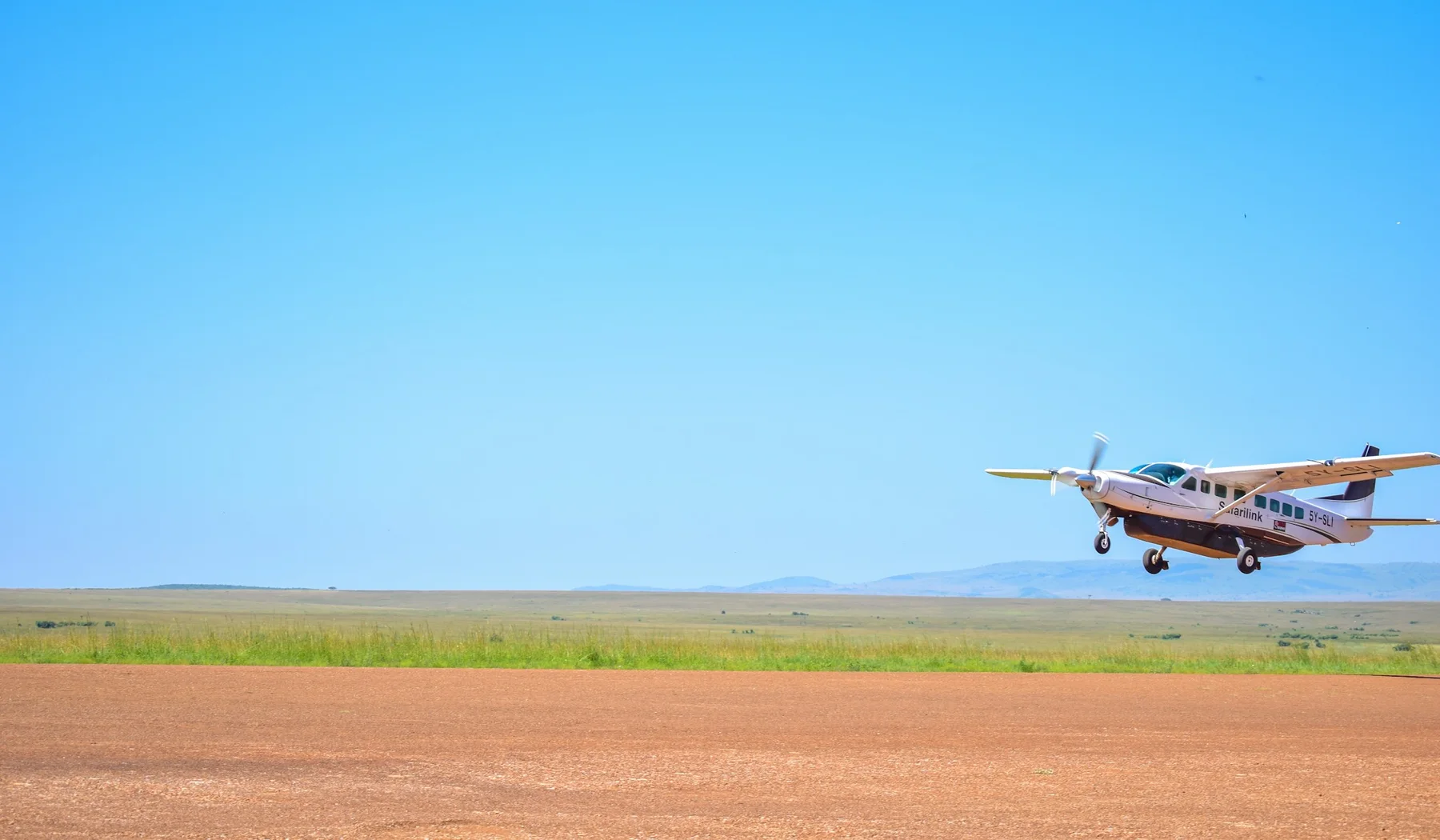
The plane slows over grass. A guide waits beside a vehicle, and suddenly the airport part of the journey is gone. No baggage carousel, no long terminal walk. You step down with a soft bag and see an enormous sky. Then someone says the camp is another forty minutes away. The airstrip was an arrival point, not the destination.
That distinction is the heart of planning safari airstrips in Kenya. The flight ticket names a strip; the safari happens at a particular lodge, reserve sector or conservancy. Match those two before paying. The Safarilink FAQ explicitly tells travellers who are unsure of the Mara strip to consult its camp mapping or ask the airline. The AirKenya timetable warns that Mara services use multiple airstrips and the published arrival time may refer to the first stop. The name “Masai Mara” on a booking search is not enough.
What a bush-airstrip arrival actually involves
A safari aircraft may land on a compact dirt, grass or surfaced strip, depending on the destination. After the crew says it is safe, passengers leave the aircraft, collect luggage as directed and meet the driver or camp team at the designated point. Some strips have a modest shelter or basic facilities; others feel much closer to a clearing beside the landscape. Do not count on a terminal shop, cash machine, Wi-Fi or a long wait in shade.
Keep your hat, water, any medicine and the booking details easy to reach, while following the airline’s instructions for what stays stowed during flight. Let staff handle luggage near the aircraft; propellers, moving vehicles and wildlife areas are not places to wander for a photograph. At many strips the camp vehicle is waiting and the drive to accommodation begins almost at once. It can feel like the first game drive, but it may also be a straightforward transfer with a tired group and a meal waiting. If arrival time matters for a promised afternoon activity, ask for the honest transfer time.
What if the driver is not immediately visible? Stay at the safe passenger area, ask the airline or airstrip staff for help and call the contact in your itinerary. Do not hire a random vehicle on the assumption that every nearby lodge is close. The camp should know your flight number, operating airline, strip and passenger names before takeoff.
The Kenya airstrip network is a set of local gateways
The official Safarilink destination list includes the Mara, Amboseli, Samburu, Lewa Downs, Loisaba, Nanyuki and Tsavo West, among other places. AirKenya’s published network also names Meru, Nanyuki or Kamok, Lewa, Loisaba and Samburu’s Buffalo or Kalama strips. This does not mean every flight serves every strip every day. Routes, minimum passenger numbers, seasons and operating conditions determine the actual service. Treat this table as an orientation, not a bookable timetable.
| Safari region | Strip or gateway names you may encounter | The question that saves time |
|---|---|---|
| Greater Masai Mara | Many reserve and conservancy strips, including Serena, Keekorok, Ol Kiombo, Musiara, Mara North and Ol Seki or Naboisho | Which strip does the exact camp use, and what is the drive from that strip? |
| Amboseli ecosystem | Amboseli and property-specific alternatives | Is the lodge inside the park, beside a gate or in a neighbouring sanctuary? |
| Samburu area | Buffalo and Kalama appear in AirKenya’s service notes | Which side of the river or reserve is the camp, and who meets the aircraft? |
| Central Kenya and Laikipia | Nanyuki Civil, Kamok, Lewa Downs and Loisaba are distinct names | Is the strip serving the conservancy, the town or a different property? |
| Meru | Meru appears in AirKenya’s published network | Does the scheduled service actually operate for the travel date and camp? |
| Tsavo and coast | Tsavo West and coastal airports or airstrips such as Diani | Is there a direct connection, a Wilson change or a road leg? |
The Mara is the most confusing because it is an ecosystem with many landing points. Our dedicated Mara airstrip guide maps the main reserve and conservancy strips in far more detail. For a first-time flyer, the rule is simpler: give the airline or safari planner the exact camp name and have the camp confirm its preferred strip and pickup. A strip that looks closest on a map may be separated by a river, reserve gate, road condition or access arrangement.
The northern circuit deserves the same care. Lewa Downs, Loisaba, Nanyuki and Kamok are not interchangeable labels for “Laikipia.” A flight into a town gateway may work perfectly for a nearby property, while a conservancy strip may shorten a particular camp transfer. Samburu’s Buffalo and Kalama options likewise point to different ground arrangements. Our Ol Pejeta, Lewa and Samburu guides help with the destinations after the aircraft stops.
Wilson Airport is not Jomo Kenyatta International Airport
Most scheduled safari light-aircraft services start at Nairobi’s Wilson Airport. International flights commonly arrive at or depart from Jomo Kenyatta International Airport, usually called JKIA. They are different airports on different sides of the city. If an itinerary says “Nairobi connection,” it should name the airport on both tickets and the road transfer between them. A protected connection on one airline booking and two unrelated tickets are also different arrangements.
After an international arrival, you may need immigration, luggage collection, road transport, another check-in and baggage weighing at Wilson. Nairobi traffic can change the road time sharply. For a short connection, a delay at any one of those stages matters. An overnight in Nairobi may be more pleasant than starting a family safari with a frantic cross-city transfer. On the return, a same-day international flight needs enough margin for both the bush service and the Wilson-to-JKIA road leg. The Kenya safari airlines and baggage guide covers the carrier side in greater detail.
At Wilson, go to the operating airline’s stated check-in building, not just an airport pin. Safarilink lists Phoenix House at Wilson on its official site; AirKenya describes an exclusive terminal in its baggage policy. Confirm the exact reporting point on your ticket. A driver told only “Wilson” may still drop you at the wrong entrance.
Checking in and boarding a small safari aircraft
Expect booking and identification checks, luggage weighing and a wait before boarding. The process is more compact than a major international terminal, but that is not permission to arrive at the last moment. AirKenya’s published timetable says check-in at Wilson is 60 minutes before departure and at bush strips 30 minutes before departure; another carrier’s rule may differ. Use the operating airline’s instructions for your own flight. If the names on the booking and identification do not match, resolve it before travel day.
Small aircraft make the crew’s seating and loading decisions important. Follow the seat assignment or direction you are given, keep walkways clear and do not assume the front seat is a bookable sightseeing perch. Tell the airline ahead of time about mobility support, a child restraint, medical equipment or an unusual amount of camera gear. A small aircraft can be perfectly suitable, but its steps, doorway and storage will not feel like those on a large jet.
For nervous flyers, it helps to know what is normal: the cabin may feel closer to the engine, you may see more of the landscape and a stop at another strip may involve passengers getting off and on. Weather can be felt more directly in a smaller aircraft. None of that tells you how a specific flight will operate; it is simply why planning the ground side well makes the whole journey calmer.
The flight may make several airstrip stops
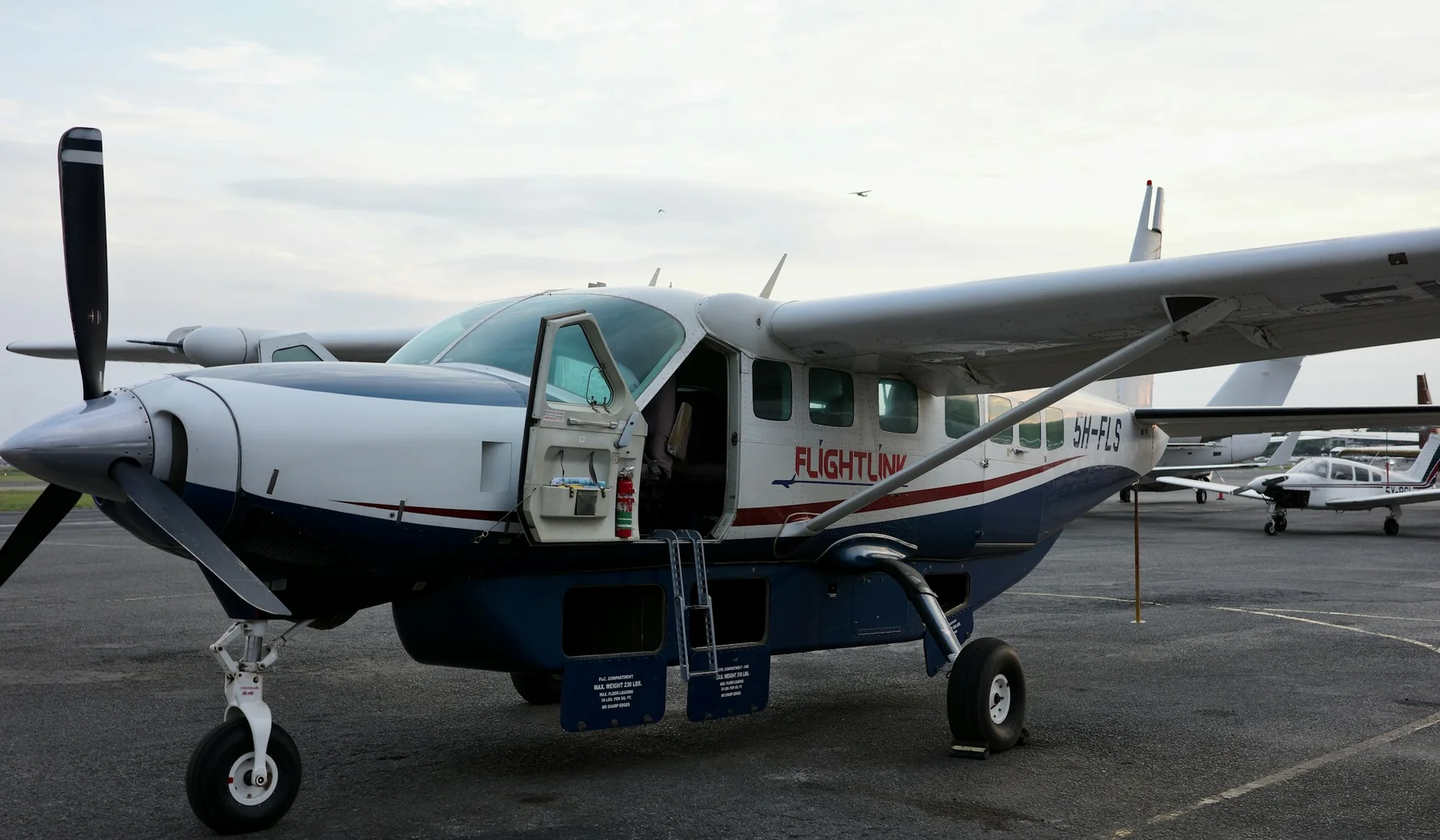
A ticket showing Wilson to Masai Mara does not necessarily mean one takeoff and one landing. The aircraft can drop or collect passengers at several Mara strips. AirKenya states that its Mara timings can vary by routing and that its displayed arrival can be the first stop. Safarilink likewise advises checking the operating time near departure because some routings vary. The same principle can affect flights linking Laikipia and the Mara.
Listen for your strip name and let the crew direct disembarkation. If you are unsure whether this is your stop, ask before leaving the aircraft. On the way back, your camp will usually tell you when to be ready for the transfer to the strip. Be there with all bags and essential paperwork, rather than planning a last-minute wildlife drive that cannot end on time.
Do not promise yourself a precise lunch or afternoon drive based only on a headline flight duration. A scheduled aircraft’s route can be efficient, but its order of stops and the transfer afterwards determine the actual camp arrival. If your whole safari is two nights, those hours are important. A private charter can sometimes solve an awkward route, but its cost and landing permissions need a separate comparison. Our fly-in Mara safari guide shows how the choices affect a short stay.
The pickup is part of the safari, not a footnote
The camp vehicle and guide are the bridge between airstrip and bed. Ask who provides that transfer, whether it is included and how long it normally takes. Some camps collect guests with other arriving travellers and make a gentle wildlife drive toward the property. Others need a longer or more direct road leg. A private transfer may be possible for a supplement, but it should be arranged before the aircraft lands.
Send the camp the flight number, airline, destination strip, passenger count and any child or mobility needs. The flight can change its estimated time or a strip can change for operational reasons; make sure the airline and camp know how to reach one another. You should also have the camp’s contact saved offline. A phone may not find immediate data coverage just because an aircraft found a runway.
If the camp is in a reserve or conservancy, ask whether entry formalities happen at a gate on the way from the strip. That is especially important where the strip, lodge and game-drive area sit in different management zones. A nearby-looking camp across a river may be a much longer drive than a farther-looking camp on the same track. The park, reserve and conservancy guide explains why those boundaries matter.
Soft bags, camera gear and the suitcase that cannot come
Small-aircraft baggage rules are real space and weight constraints, not a suggestion about style. AirKenya’s published policy gives a 15-kilogram total allowance in soft-sided bags, including hand luggage. It also sets a hand-baggage limit within that total. Other carriers have their own rules. Check the actual operating airline and the smallest aircraft on your route before packing. A long-haul allowance does not carry across automatically.
One soft duffel per person is often easier than a hard suitcase. Keep medicine, documents and items needed on arrival accessible, within the carrier’s cabin rules. Camera bodies, long lenses, binoculars, chargers and batteries count toward what you are carrying, even when they feel too precious to check. If your equipment exceeds the allowance, contact the airline well ahead of time about permitted additional baggage or an appropriate arrangement. Do not hope that the last passenger’s bag will make the weight problem disappear.
For a safari-and-beach journey, ask whether a hotel or other trusted arrangement can hold the larger case while you fly with a light safari bag. Agree who labels, stores and later returns it. One independent traveller described doing exactly that at Wilson. It worked for that itinerary, but storage is not a universal airline entitlement. Keep valuables and essential medicine under your control.
Flying between safari regions is not always a straight line
On a map, the Mara and Samburu appear connected by a simple diagonal. The scheduled aircraft network may instead run through Wilson or several northern strips. The current AirKenya timetable describes direct and via-Wilson possibilities that vary with season and passenger routing. Safarilink’s FAQ also notes seasonal variations for Laikipia-to-Mara services. A flight that looks short geographically can still consume much of a day once you include transfer to the first strip, check-in, stops and transfer from the second.
Compare the full movement: last game drive at Camp A, airstrip departure, any stop or Nairobi change, ground arrival at Camp B and the first usable game drive there. When a move costs most of the day, another night at one place may produce more wildlife time than adding a new destination. Our road-time guide helps compare a vehicle transfer, while the tailor-made safari page is useful when the route needs both road and air.
For the coast, Diani, Mombasa, Malindi and Lamu are different arrival points, not one “beach airport.” Match the beach accommodation and its road or boat transfer to the actual flight. A fly-in Mara trip followed by Diani can be smooth, but a connection that runs through Wilson and another airport still needs time. A photograph of white sand does not show the movement between two terminals.
If weather, a strip or the schedule changes
Bush aviation works within weather, daylight, aircraft and airstrip conditions. A service can run late, change its order of stops or use an alternative landing point. AirKenya’s timetable itself says the carrier may change departure times or equipment for operational and weather reasons. Build a little resilience into the itinerary: avoid an unprotected, tight international departure after the bush flight and do not treat the first afternoon’s premium activity as guaranteed if it starts immediately after landing.
Make a practical plan for communication. Who tells the camp if the flight changes? Who meets you at the alternative strip? Is a longer transfer included or billed separately? If the operator cancels, how are alternatives, refunds and missed lodge nights handled under the booking terms and travel insurance? Those questions are best settled with the actual carrier and camp before departure. Our cancellation and payment guide helps with the wider terms.
Do not panic if the aircraft makes an unexpected stop. Ask the crew for the next destination and follow the revised instructions. If you need assistance on the ground, the airline and camp contacts are more useful than a generic airport search. Calm, named handoffs are what make a flexible flight network feel easy to use.
Three traveller experiences worth hearing
Airstrip accounts often focus on the moment a large-airport traveller realises how different the bush arrival feels. These are independent travellers describing their own journeys, not promises about every service.
airstrips w/o permanent buildings was even more mind blowing!
A first-time Kenya safari traveller had already expected small planes to feel unfamiliar. What stayed with them was the absence of a conventional terminal at some strips. That is part of the charm, but it is also why you should arrive knowing who meets you.
We flew on SafariLink which was very convenient (look into baggage weight limits).
A traveller comparing lodge transfers found flying helpful after rough road journeys. The baggage warning comes from experience, not a marketing checklist.
Left on time and landed on time, even though we had to drop some others off at a different airstrip first.
A passenger describing a recent Wilson-to-Mara trip found that an intermediate stop was simply part of a smooth day. That is a useful counterpoint to the assumption that a multi-stop flight must feel disruptive.
The common thread is simple: flying can remove hours of hard road travel, but it rewards preparation. What matters is the match between flight, baggage, arrival strip and the vehicle waiting there.
The six details your booking should show
| Detail | Why it matters | What should be written down |
|---|---|---|
| Operating airline and flight | Terminal, baggage and contact rules differ | Carrier, flight number, departure airport and reporting point |
| Arrival strip | A region can have several | Exact strip name agreed with the camp |
| Camp pickup | The flight is not the end of the journey | Who meets you, vehicle basis and normal transfer time |
| Baggage | Small aircraft have firm limits | Total kilograms, dimensions, bag type and any approved extra |
| Connections | Wilson and JKIA are separate airports | Ground transfer, buffer and what happens if a leg changes |
| Access and fees | A strip, reserve and lodge may cross boundaries | Entry days, conservancy fees and any extra gate or activity charge |
Use this as a conversation with the person designing the journey. It is not a demand for a longer document; it is how the details that make a fly-in safari feel effortless are made visible. For a honeymoon, family trip or photographic safari, add the room, vehicle and guide arrangements that matter to you. A shared camp drive after a private flight may be exactly what you want, but it should be an intentional choice.
Frequently asked questions
What are safari airstrips in Kenya?
They are local landing areas used by light aircraft serving parks, reserves, conservancies and camps. Facilities and surfaces vary, and the camp vehicle usually completes the journey.
Do Kenya safari flights use Wilson or Jomo Kenyatta airport?
Most scheduled light-aircraft safari services depart from Nairobi Wilson Airport. International services usually use Jomo Kenyatta International Airport. Check both tickets because they are separate airports.
How do I choose the right Masai Mara airstrip?
Give the exact camp name to the airline or safari planner, then confirm the preferred strip and transfer time with the camp. The Greater Mara has multiple landing points.
Does a flight to the Masai Mara land only once?
Not necessarily. A scheduled aircraft may stop at several Mara strips to drop and collect passengers. Confirm your named landing point and listen to the crew.
How much luggage can I take on a bush flight?
Allowances depend on the operating carrier and aircraft. AirKenya publishes a 15-kilogram total allowance in soft bags, including hand luggage. Check your actual airline before packing.
Will the lodge meet us at the airstrip?
Many camps arrange an airstrip pickup, but the booking must name who provides it, whether it is included and which strip and flight they will meet.
Can I connect a safari flight to an international flight the same day?
It may be possible, but allow for the bush-flight schedule, a road transfer between Wilson and JKIA, check-in and disruption. An overnight buffer may be safer for a tight or important departure.
What happens if weather changes the flight or airstrip?
Follow the operating airline’s instructions and contact the camp or safari planner. Ask in advance who arranges an alternative pickup and how any extra transfer or missed service is handled.
Are there scheduled flights to Lewa, Samburu, Meru and Amboseli?
These places appear in published safari airline networks, but operating dates, minimum passenger conditions and specific strips vary. Confirm service for the travel date and camp before booking.
More help before you fly
Airstrips, operating routings, check-in points and luggage rules are set by the actual carrier and camp for your flight. Confirm the named service and pickup when booking.
Tell us where you want to land
Share dates, camps and onward plans. We can talk through flights, ground transfers and safari time.