
Where to Stay on a Kenya Safari: Lodges, Tented Camps and Conservancies
Compare lodges, tents, houses, bandas and campsites by location, wildlife access, room, vehicle and the people travelling.
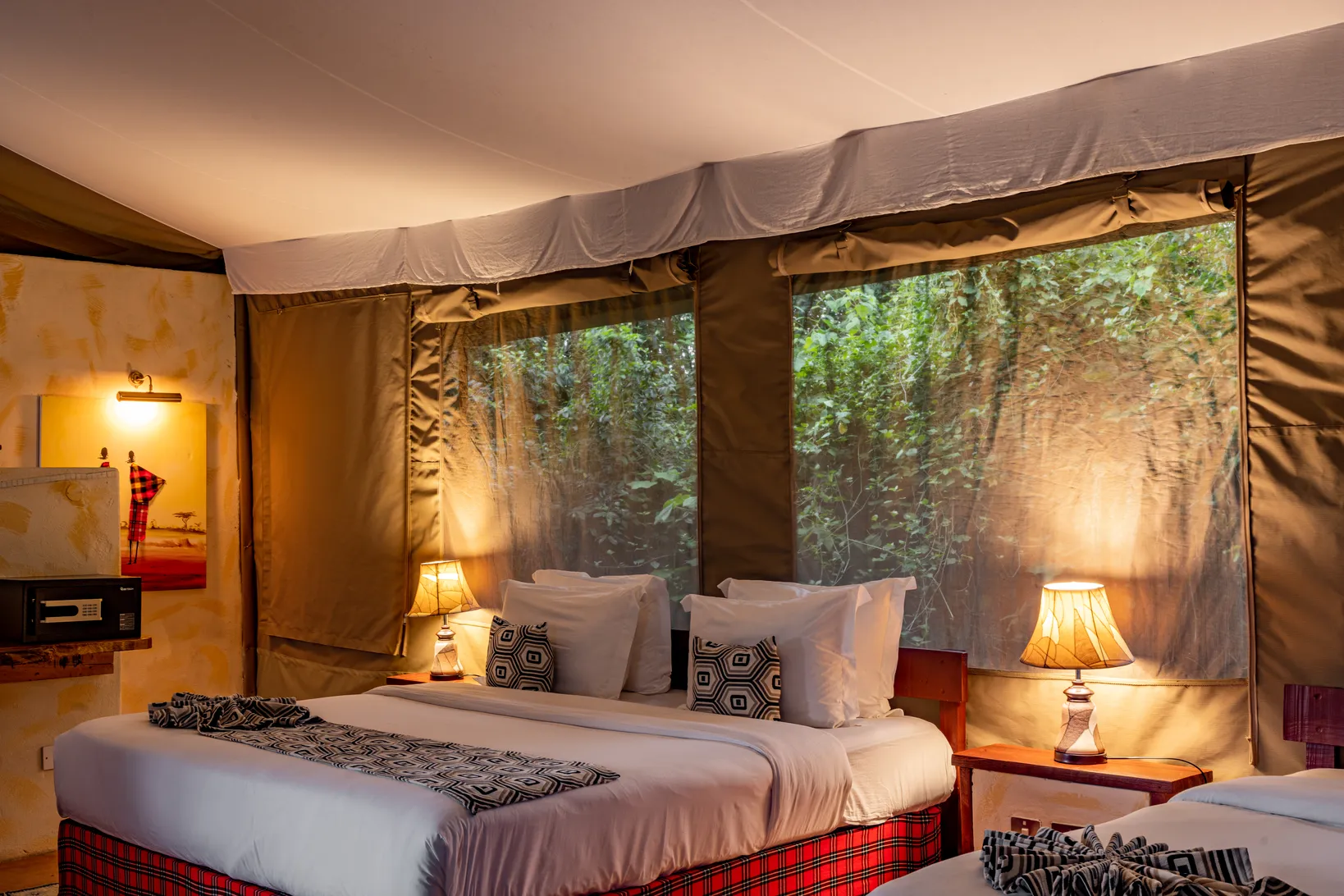
- Kenya safari accommodation is a family of different products
- A tented camp is not the same as camping
- Permanent lodge or tented camp
- Inside a park, outside a gate or in a conservancy
- Location inside a destination matters too
- Property size changes the stay
- Room configuration is more important than the room name
- Bathrooms, water and power
- Fencing and wildlife in camp
- Meals and dining style
- Game drives may belong to the lodge, not the package vehicle
- Activities depend on land access
- Bush houses and private villas
- Bandas, KWS homes and self-catering stays
- Public and special campsites
- Seasonal and mobile camps
- Nairobi, gateway towns and airport hotels
- Coast accommodation after safari
- Read photographs like evidence
- Named accommodation examples by region
- Match the property to the traveller
- Cost and inclusions
- What travellers say about camps and lodges
- Red flags when choosing accommodation
- A step-by-step accommodation shortlist
- Frequently asked questions about where to stay on safari
- Sources and further reading
The best safari room is not always the most beautiful room. It is the room that puts you in the right landscape, gives you the sleep and facilities you need, and supports the way you want to spend each day. A tent beside a productive wildlife area may deliver more than a grand lodge reached after a long gate drive. A large lodge with level paths and a reliable kitchen may be exactly right for a family or a traveller with limited mobility.
Choosing where to stay on a Kenya safari is therefore a geography and operations decision before it is a décor decision. You need to know whether the property sits inside a national park, in a private or community conservancy, on the edge of a reserve, or in a town used for access. You also need the exact room, meal plan, game-drive arrangement and transfer.
Kenya safari accommodation is a family of different products
The words lodge and camp are used so freely that they can mislead. A tented camp may have permanent floors, a full bathroom, electricity and a large suite. A lodge may be small and intimate or hold many rooms. A campsite may offer basic shared facilities or require the group to bring everything.
| Accommodation type | What it usually means | What it does not tell you |
|---|---|---|
| Permanent safari lodge | Solid rooms or cottages, restaurant and established common facilities | Property size, wildlife access, room quality or whether drives are included |
| Permanent tented camp | Canvas walls or roof on a fixed platform, often with an en-suite bathroom | Whether it is rustic, mid-range or highly luxurious |
| Seasonal or mobile camp | Camp that moves or operates for part of the year | Bathroom style, vehicle access, luggage support or privacy |
| Bush house or private villa | Exclusive-use house with several bedrooms and shared living space | Whether private guide, vehicle, chef and all activities are included |
| Bandas or self-catering home | Simple fixed accommodation, sometimes managed by KWS | Catering, bedding, utensils, power and housekeeping arrangements |
| Public campsite | Shared camping area with basic facilities where available | Tent, food, staff, security and equipment provision |
| Special campsite | Site reserved exclusively for one group | Infrastructure, water, toilets or camp setup |
| City or gateway hotel | Conventional hotel used before a park, flight or road sector | Wildlife access and safari guiding |
| Beach resort or boutique hotel | Coast accommodation after safari | Meal plan, tide, beach access and transfer from the final park |
Kenya Wildlife Service itself lists private lodges, tented camps, Mbugani Homes, public campsites and special campsites across its protected areas. The category is only the beginning of the comparison.
Help me choose the right accommodation style
Share your route, travellers, room needs, comfort priorities and preferred activity style. We will compare named properties by real location and daily access.
A tented camp is not the same as camping
This is the most common misunderstanding. In a permanent tented camp, canvas forms part of the structure, but the room can have a proper bed, furniture, electricity, a flush toilet, indoor or outdoor shower and private deck. Some tents have pools and large bathrooms. Others use bucket showers or restricted power.
Camping means the group uses a tent and campsite. A supported mobile camp may still provide beds, staff, meals and private wash facilities. Independent camping may require the guest or operator to bring tents, food, cooking equipment, water and sanitation.
Ask six questions:
- Is the tent permanent, seasonal or moved during the itinerary?
- Does it have a private bathroom inside the unit?
- Is the toilet flush, chemical or another system?
- Is hot water continuous, scheduled or requested?
- When is electricity available and what can be charged?
- Are the floor, walls and doors secure enough for the traveller's needs?
Canvas changes sound and temperature. You hear wind, rain, birds and animals more clearly. That can feel wonderfully immersive or disturb a light sleeper. Earplugs help with ordinary camp noise, but guests must still hear safety instructions.
Permanent lodge or tented camp
| Decision | Permanent lodge often suits | Tented camp often suits |
|---|---|---|
| Mobility | Travellers who need level paths, nearby rooms and established common facilities | Travellers whose chosen camp has verified accessible paths and bathrooms |
| Families | Pools, connecting rooms, flexible buffets and more indoor space | Smaller families wanting immersion, subject to age and room rules |
| Sound and weather | Guests who prefer solid walls and stronger insulation | Guests who enjoy bush sounds and canvas atmosphere |
| Social style | Larger guest mix and several common areas | More hosted, intimate rhythm in a small camp |
| Activities | Strong game-drive base | Camp-specific walks, night drives or conservancy activities where permitted |
| Budget | Broad range from practical to luxury | Broad range from simple to ultra-luxury |
The words do not decide quality. A Reddit contributor put it plainly: "tented camps can be equally luxurious to a lodge." Read the full lodge versus tented camp discussion for differing preferences.
Inside a park, outside a gate or in a conservancy
This choice changes what happens after wake-up.
An inside-park property can protect early and late game-drive time because the vehicle does not wait for a gate to open or travel from town. It may also have strict activity limits set by park rules.
An outside-gate property may cost less, offer larger grounds or support local activity on private land. The weakness is repeated gate travel. "Five minutes from the park" should name the gate and the road condition.
A conservancy camp may provide lower vehicle density, night drives, guided walks or off-road access under its own rules. It may also charge a separate conservation fee and restrict drives to guests of member properties. Reserve visits can require an additional fee and a long drive from some conservancies.
In Mara North, tourism partners lease land from Maasai landowners and conservancy fees support those lease payments and land management. The accommodation is part of a land-use model, not simply a hotel outside the reserve.
Location inside a destination matters too
The Masai Mara is not one small viewing area. The eastern reserve, central plains, Musiara sector, Mara Triangle and surrounding conservancies create different access. A camp close to one river section may be several hours from another.
Amboseli properties sit inside the park, near gates and across the wider ecosystem. The right choice depends on wetland access, Kilimanjaro views, private-land activities and the next road sector.
Tsavo East and Tsavo West are separate parks with long internal roads. A lodge beside Aruba Dam, near Voi, near Mzima Springs or toward Ngulia supports a different itinerary.
In Samburu, Buffalo Springs and Shaba, the river, bridges, gates and reserve side affect game-drive time. In Laikipia, each conservancy has its own lodge access, activities and airstrip arrangements.
This national pillar links into the detailed all Masai Mara lodges and camps directory and all Amboseli lodges and camps directory.
Compare park, gate and conservancy locations
Share your route, travellers, room needs, comfort priorities and preferred activity style. We will compare named properties by real location and daily access.
Property size changes the stay
A six-tent camp and an eighty-room lodge can both be excellent, but they create different mornings.
Small camps often know each guest quickly, host meals and keep the atmosphere quiet. They may have fewer room configurations, less separation between staff roles and no spa or large pool. A full camp can feel more social than its room count suggests.
Large lodges can offer pools, buffets, family rooms, accessible rooms, shops and several common spaces. They may host groups and conferences, and vehicles can leave together at peak times. A large property does not automatically mean crowded game drives if the vehicle plan is good.
Ask for the number of rooms or tents, maximum guests, dining style and number of safari vehicles. Then decide whether you want intimacy, anonymity, facilities or a balance.
Room configuration is more important than the room name
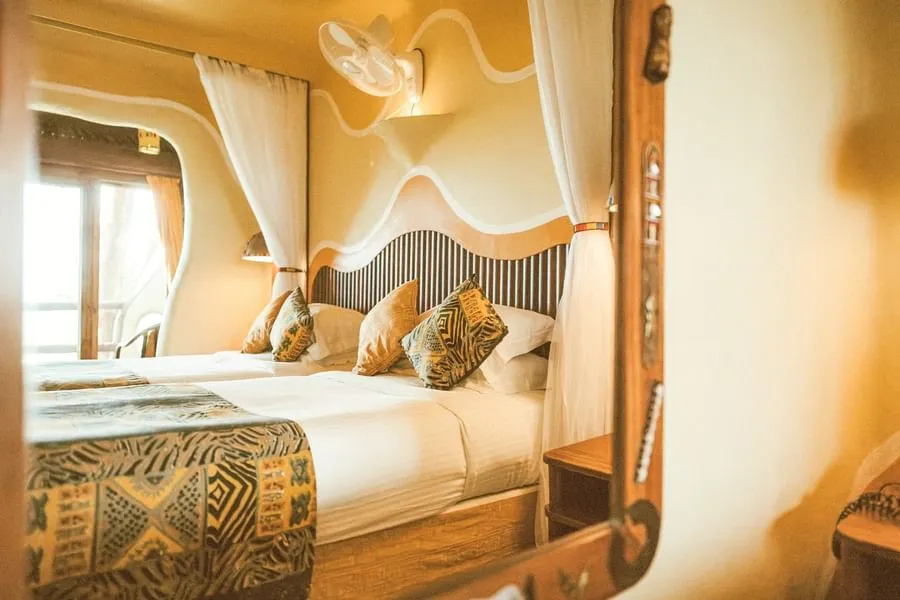
Family room, suite, triple, cottage and villa are not interchangeable. Request the floor plan or exact description.
| Traveller | Confirm before booking |
|---|---|
| Couple | Double or twin bed, privacy, bathroom type and whether special meals are private or shared |
| Family with young children | Connecting door, internal sleeping layout, verandah security and walking distance to common areas |
| Family with teenagers | Separate beds or rooms, supervision rules, charging and Wi-Fi expectations |
| Solo traveller | Single supplement, room position, shared dining and vehicle arrangement |
| Friends | Twin beds, bathroom privacy and how costs are divided |
| Traveller with limited mobility | Steps, gradients, doorway, shower, toilet support, bed height and emergency route |
| Multi-generational group | Room proximity, quiet rooms, child policy and private vehicle |
A room described as "adjacent" may still be in a separate building. A family tent may use a partition rather than a solid door. An extra bed can reduce floor space. Confirm the arrangement for the people actually travelling.
Our Kenya safaris with teenagers and accessible Kenya safaris guides provide more detailed checklists.
Bathrooms, water and power
An en-suite bathroom can mean a full indoor bathroom, a partially open wash area or a bathroom reached through canvas. Ask for toilet, shower, basin, privacy and hot-water details separately.
Remote properties may generate electricity by solar, generator or a combination. Power can be available all day, only at set times or only in a charging station. High-draw equipment such as hair dryers may be prohibited. CPAP machines and medical devices require advance confirmation of voltage, socket, night power and backup.
Water conservation can affect shower pressure and laundry. This is not necessarily poor service. It should be explained before arrival.
Fencing and wildlife in camp
Many safari properties are unfenced or partly fenced. Animals may move through the grounds. Guests are commonly escorted between rooms and common areas after dark.
Ask whether the property is fenced, how escorts are requested, whether children can walk alone, and what happens during a wildlife visit. Never leave the room at night because you hear an animal. Call the camp and wait for instructions.
A fenced property may feel easier for some families, but fencing does not replace supervision. Pools, steps, verandahs and water features still require attention.
Meals and dining style
Safari properties may use buffets, set menus, communal tables, private tables or flexible combinations. A bush breakfast is usually an arranged experience, not an automatic daily inclusion.
Confirm full board, drinks, picnic meals, early breakfast and late-arrival dinner. Share dietary needs well before travel. Severe allergies require a direct conversation about ingredients, kitchen separation and emergency response.
Communal dining can be a highlight for solo travellers. Couples may prefer one or two private meals. Families need meal timing and children's options. The answer should match the guests rather than the property's default.
Game drives may belong to the lodge, not the package vehicle
Road safaris often use one driver-guide and vehicle throughout. Fly-in camps commonly collect guests at the airstrip and operate their own shared vehicles. Some properties include game drives in the room rate. Others sell room and meals while the tour operator provides the vehicle.
Ask:
- Are drives private or shared?
- What is the maximum vehicle occupancy?
- Is a private vehicle included or available at extra cost?
- Does the guide work for the camp or travel with the guests?
- Which land may the vehicle enter?
- Are reserve visits, conservancy fees and full-day drives included?
- Can children join every drive?
A property can be in the right place while the vehicle arrangement is wrong for a photographer or family.
Match the room and vehicle as one decision
Share your route, travellers, room needs, comfort priorities and preferred activity style. We will compare named properties by real location and daily access.
Activities depend on land access
Night drives and bush walks are not allowed everywhere. A camp should not promise them simply because it is called a conservancy property. The specific land, guide, age, weather and operator rules matter.
Other activities may include bird walks, hides, cultural visits, camel or horseback experiences, conservation visits, boat trips and hiking. Separate what is included, optional, seasonal and subject to availability.
If an activity is the reason for choosing the property, reserve it before travel rather than requesting it after check-in.
Bush houses and private villas
An exclusive-use house can be ideal for a family, several couples or friends who want one shared home. It may provide a private lounge, dining room, several bedrooms, a chef or host and flexible meals. It can also cost more than expected when the house rate excludes guide, vehicle, conservation fees and activities.
Count the bedrooms and usable beds rather than the advertised guest capacity. Decide which rooms have en-suite bathrooms, whether any bedrooms are reached from outside, and how children are supervised at night. Ask whether staff live on site and whether the house is fenced.
Exclusive use of the building does not always mean exclusive use of every service. A guide, vehicle, pool, airstrip transfer or conservation activity may still be shared or separately priced. Put each one into the comparison.
The format becomes especially valuable when different generations want different rhythms. Some guests can take an early drive while others have breakfast at the house, provided a second vehicle or transfer arrangement exists. Without that operational detail, a private house can leave the whole group tied to one schedule.
Bandas, KWS homes and self-catering stays
KWS homes and bandas can place travellers inside remarkable landscapes without a full-service lodge. They suit self-sufficient visitors and organised groups that understand the facilities. They should not be booked as a cheaper lodge substitute without checking what is supplied.
Confirm bedding, towels, cooking equipment, crockery, refrigerator, electricity, water, housekeeping, firewood, food storage and the nearest place to buy supplies. Establish whether a caretaker is present and whether guests must hire a cook. Park entry, vehicle, guide and fuel normally remain separate decisions.
Arrival before dark is particularly important when the property is remote. The group should know the gate, key collection, contact and what happens if a vehicle is delayed.
Public and special campsites
KWS describes public campsites as shared sites with basic facilities where available, while special campsites are reserved for one group and may require complete self-sufficiency. A special campsite is private ground, not a pre-built camp.
A supported camping safari needs an equipment and staffing list. It should identify tents, beds or mattresses, bedding, chairs, lighting, kitchen, drinking water, shower, toilet, waste handling, cook, camp crew, ranger or security where required and vehicle support.
Ask who sets up and removes the camp, how food is stored from animals, how waste leaves the park and where staff sleep. A low-impact camp should leave the site clean and follow fire restrictions. Privacy should never come at the cost of poor sanitation or wildlife safety.
Independent camping requires its own competence. Do not assume a public campsite provides food, tent hire or a ranger. Rules and facilities vary by park and can change.
Compare lodges, houses, bandas and camping
Share your route, travellers, room needs, comfort priorities and preferred activity style. We will compare named properties by real location and daily access.
Seasonal and mobile camps
A mobile camp can follow a seasonal wildlife area or move as part of a walking or expedition route. The attraction is access and intimacy, not necessarily hardship. Some mobile camps are highly serviced, while others deliberately keep facilities simple.
Ask how often the camp moves, whether the booked site is confirmed, what road or airstrip serves it, and how weather affects access. A camp name may operate in more than one location during the year. The itinerary must state the location for the travel dates.
Water, toilets, showers, charging, luggage and emergency support matter more when infrastructure moves. If the camp closes in heavy rain or relocates, the substitution policy should name the likely alternative and who pays any transfer difference.
Nairobi, gateway towns and airport hotels
The first and last nights are part of the safari. A Nairobi hotel should be chosen by arrival airport, next departure point and the activities planned in the city. Jomo Kenyatta International Airport and Wilson Airport serve different flights and sit in different traffic patterns.
An airport hotel works for a late arrival or early international departure. A Karen property suits visits around the Giraffe Centre, museums and the southern side of the city. A central or Westlands hotel can suit restaurants and city appointments. One is not universally more convenient.
In gateway towns such as Naivasha, Nanyuki and Voi, a hotel may support a train, flight or road connection rather than provide the safari itself. State that purpose clearly. A night can be valuable when it protects an onward transfer, but it should not be marketed as a full wildlife stay if the property sits outside the protected area.
Coast accommodation after safari
Diani, Mombasa, Watamu and Malindi have resorts, boutique hotels, apartments and private villas. The right coast stay depends on beach section, tide, meal plan, pool, nightlife, diving or family facilities and the transfer from the safari.
All-inclusive can be useful after early safari mornings, but it may not include marine activities, premium drinks, spa treatments or transport. A self-catering apartment gives space and independence while adding grocery, cooking and security decisions.
Check whether the beach is directly accessible, whether sunbeds sit on private grounds or public sand, and how the property handles late arrivals. If swimming, diving or kitesurfing matters, the exact beach and season matter more than the room view.
Read photographs like evidence
Property galleries are useful when you ask what each image proves.
A bedroom photograph should show the booked category, not the most expensive suite. A bathroom image should reveal shower, toilet and privacy. An aerial view should show the distance between rooms and common areas. A landscape image should distinguish a view from the property from a sight reached on a long drive.
Look for paths, steps, railings, screens, doors, bedside sockets, shade and room spacing. Ask when the images were taken and whether renovations changed the layout. If family or accessibility needs matter, request current phone photographs or measurements rather than relying on a wide-angle gallery.
Where to stay on a Kenya safari becomes much easier once every attractive image is connected to a practical question.
Named accommodation examples by region
These examples show variety. They are not a complete directory and their price position changes by date and room.
Masai Mara
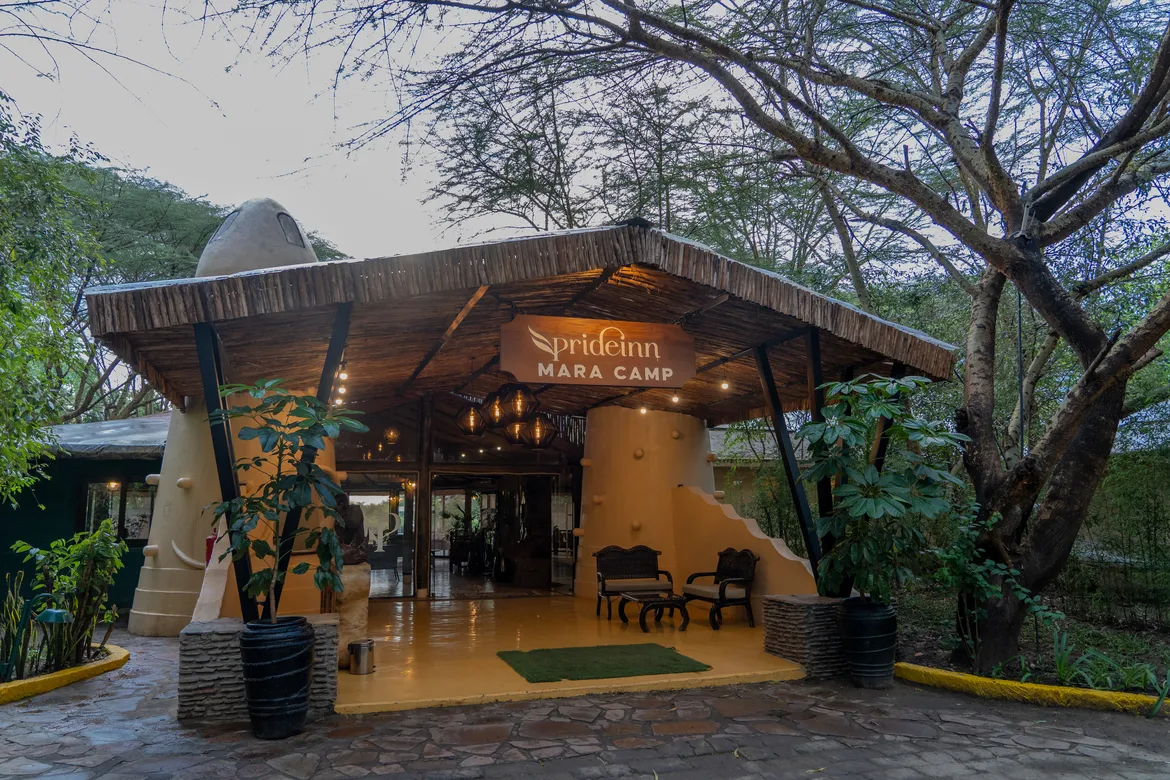
Large and established lodge examples include Mara Serena Safari Lodge, Keekorok Lodge and Masai Mara Sopa Lodge. Tented options include PrideInn Mara Camp, Ashnil Mara Camp, Enkorok Mara Camp and many smaller conservancy properties. Mara North lists member camps such as Elephant Pepper Camp, Karen Blixen Camp, Kicheche Mara Camp, Offbeat Mara Camp, Royal Mara Safari Lodge, Saruni Basecamp and Alex Walker's Serian.
Compare reserve or conservancy, river sector, property size, airstrip, room, vehicle and reserve-access day. The where to stay in the Masai Mara page breaks the ecosystem into areas.
Amboseli and Chyulu
Inside-park examples include Ol Tukai Lodge and Amboseli Serena Safari Lodge. Outside and wider-ecosystem examples include Kibo Safari Camp, Sentrim Amboseli, AA Lodge Amboseli, Amboseli Sopa Lodge, Tortilis Camp and properties toward the Chyulu Hills.
Compare gate time, mountain orientation, wetland access, private-land activities and the road onward to Tsavo or Nairobi.
Tsavo East and Tsavo West
Tsavo East examples include Voi Safari Lodge, Ashnil Aruba Lodge, Sentrim Tsavo, Satao Camp and Galdessa Camp. Tsavo West includes Kilaguni Serena Safari Lodge, Ngulia Safari Lodge, Severin Safari Camp and Finch Hattons at a higher comfort tier.
Use the future where to stay in Tsavo East and where to stay in Tsavo West guides to match waterholes, springs, gates and road direction.
Samburu, Buffalo Springs and Shaba
Samburu Sopa Lodge, Samburu Simba Lodge, Ashnil Samburu Camp and Sentrim Samburu represent established lodge and camp formats. Smaller or higher-tier properties create different vehicle and activity arrangements. Compare reserve side, river location, bridge access and airstrip transfer in the planned Samburu accommodation guide.
Laikipia, Lewa and Ol Pejeta
Lewa lists Kifaru House, Lewa Safari Camp, Sirikoi Lodge, Lewa House and Lewa Wilderness among its accommodation options. The mix includes cottages, tents, houses and small lodges. Ol Pejeta offers its own mix of tented camps, houses, camping and conservation-linked stays.
The important question is not merely Laikipia. It is which conservancy, which activities, which airstrip and whether the property is exclusive-use or shared. See the predetermined where to stay in Laikipia and where to stay in Ol Pejeta pages.
Meru and the Aberdares
Meru's accommodation choices are fewer than the Mara's, which can make location especially important. Elsa's Kopje is a prominent higher-tier example, while camps and lodges outside the park serve different budgets. The Aberdares combine lodges, tree-hotel traditions, KWS homes, bandas and camping.
Forest, altitude, road condition and night temperature belong in the decision. Future guides cover where to stay in Meru National Park and where to stay in the Aberdares.
Lake Nakuru and Lake Naivasha
Lake Nakuru Lodge, Sarova Lion Hill and Lake Nakuru Sopa Lodge create different positions around the park. Naivasha has lakefront resorts, smaller camps, country hotels and houses. The lake may be a wildlife stop, a transfer break or a place for boat and walking activities.
Choose it for purpose rather than convenience alone. See where to stay at Lake Nakuru and where to stay at Lake Naivasha.
Match the property to the traveller
Families
Prioritise exact room layout, pool safety, fencing, meal flexibility, child drive rules and the distance from room to common areas. A private vehicle can matter more than a family suite.
Honeymoons
Privacy, room position, special dining and a slow enough stay matter. Ask whether the property hosts groups or families during the dates. The Kenya honeymoon safaris page explains how to build the wider route around the couple.
Solo travellers
Look at single supplement, communal dining, hosted atmosphere, shared drives and safe room access. A small camp can be social, while a large lodge can provide anonymity. Read solo Kenya safaris for the full comparison.
Photographers
Location, private vehicle, charging, desk space, dust control and wake-up access matter more than spa facilities. Ask about vehicle capacity and rules before choosing the room.
Seniors and limited mobility
Request a measured path and room audit. Ramps, steps, shower, toilet, bed height, vehicle boarding and emergency access all matter. Do not accept "ground floor" as a complete accessibility answer.
Cost and inclusions
Rates may be per person sharing, per room, per house or per campsite. Conservancy fees, park entry, game drives, transfers, drinks, laundry and activities can sit inside or outside the accommodation rate.
| Cost line | Confirm |
|---|---|
| Room | Exact category, occupancy and single supplement |
| Meals | Full board, transfer-day meals and dietary arrangements |
| Drinks | Water, soft drinks, house alcohol and premium drinks |
| Game drives | Shared or private, hours, vehicle and land access |
| Fees | Park, conservancy, activity and community levies |
| Transfers | Road, airstrip, station and inter-camp movements |
| Laundry | Included, charged or unavailable for certain garments |
| Activities | Included, optional, seasonal or pre-booked |
| Child terms | Age bands, room policy, drive policy and conservation fees |
The all-inclusive Kenya safari packages and mid-range Kenya safaris pages help interpret these lines.
What travellers say about camps and lodges
One traveller admitted, "I was a bit skeptical regarding tented camps," then found that all had "hot water, electricity and mosquito's net." Read the full independent Kenya safari account for the route and context.
Another first-time safari review said, "The lodge buildings and grounds were gorgeous," and described camp staff as "warm, attentive." The complete property-by-property review also shows how room, landscape and service can feel different at every stop.
These are personal reactions, not universal rankings. They are useful because they focus on how a stay felt rather than treating canvas or walls as a quality score.
Red flags when choosing accommodation
- The itinerary says "or similar" without an approval process
- The property is shown on the wrong side of a park or gate
- The room category is missing
- Tented camp is presented as proof of either luxury or hardship
- Private conservancy access is claimed without naming the land
- Game drives are shown but vehicle sharing is hidden
- A family room is promised without a floor plan or bed list
- Accessibility is reduced to one ramp photograph
- The lodge is far from the intended wildlife sector
- Activities appear in photographs but not inclusions
- The rate basis changes between per room and per person
- Conservation fees are missing or counted for the wrong days
A step-by-step accommodation shortlist
- Choose the destination and wildlife sector.
- Mark the gate, conservancy, airstrip and next route connection.
- Decide inside park, outside gate or conservancy.
- Choose lodge, tent, house, banda or campsite style.
- Set the maximum property size and desired social atmosphere.
- Confirm the exact room, bed and bathroom.
- Match the vehicle and guide arrangement.
- Check meals, water, power, Wi-Fi and laundry.
- Verify age, mobility, fencing and escort policies.
- Itemise fees, transfers and optional activities.
- Review the cancellation and substitution terms.
- Approve the named property before deposit.
Build my Kenya accommodation shortlist
Share your route, travellers, room needs, comfort priorities and preferred activity style. We will compare named properties by real location and daily access.
Frequently asked questions about where to stay on safari
Is a tented camp safe?
It can be when professionally operated and guests follow escort and wildlife rules. Ask about fencing, night movement, doors and emergency contact.
Do safari tents have bathrooms?
Many permanent tents are en-suite, while mobile and simpler camps vary. Confirm toilet, shower, hot water and privacy.
Is it better to stay inside a national park?
Inside access can protect early and late viewing time. Outside and conservancy stays may offer value or different activities. Compare the actual gate and route.
What is a conservancy camp?
It is accommodation with access to conservancy land under that conservancy's tourism and conservation arrangements. Fees and reserve access vary.
Are game drives included with the room?
Not always. Fly-in camps often bundle shared drives, while road packages may use the tour operator's vehicle. Confirm each sector.
Are large lodges worse than small camps?
No. They offer different facilities and atmosphere. Vehicle occupancy and location matter more than room count alone.
Can families share one tent?
Some camps have family tents, triples or connected units. The exact bed and partition arrangement must be confirmed.
Do safari lodges have Wi-Fi?
Many do, but coverage, speed and hours vary. It may be limited to common areas.
Can I use a hair dryer or CPAP machine?
Only after checking voltage, sockets, power hours and equipment restrictions. Medical devices need a backup plan.
Can NLS change the lodge in an existing package?
Yes, subject to availability, route logic and revised costs. The rest of the itinerary should be recalculated around the new location.
Sources and further reading
- Kenya Wildlife Service: Stay in the Wild
- KWS accommodation facilities in parks and reserves
- Mara North Conservancy member camps
- Mara North conservation and tourism model
- Mara North landowner partnership
- Lewa Wildlife Conservancy lodges
Plan where to stay on a Kenya safari
Share your route, travellers, room needs, comfort priorities and preferred activity style. We will compare named properties by real location and daily access.
Tell us what each stay needs to do
Share the route, room layout, vehicle, mobility, food, power and social preferences. We will compare named properties and real access.