
Samburu, Buffalo Springs and Shaba Compared: Which Reserve Should You Choose?
Follow the Ewaso Nyiro across Samburu, Buffalo Springs and Shaba, then compare wildlife circuits, scenery, lodge position, access and the time each reserve deserves.

- The three reserves at a glance
- Why the names create confusion
- One ecosystem, three administrations
- The Ewaso Nyiro is the map key
- Samburu National Reserve in one paragraph
- Buffalo Springs in one paragraph
- Shaba in one paragraph
- Wildlife shared across all three
- The Special Five do not belong to one gate
- Elephant experience by reserve
- Predator comparison
- Birding differences
- Landscape comparison
- Photography comparison
- Which reserve feels quietest
- Roads and driving conditions
- Gates and the bridge
- Fees are not one interchangeable ticket
- Airstrips and flying in
- Staying inside Samburu National Reserve
- Staying inside Buffalo Springs
- Staying inside Shaba
- Why lodge location changes the safari
- Can you visit all three in one day
- A three-night plan
- A four-night plan
- Best time to compare the reserves
- Family safari comparison
- Honeymoon comparison
- Accessibility and comfort
- Cultural visits and community conservancies
- Safety and current local advice
- Self-driving the reserve complex
- A road itinerary from Nairobi
- Packing for heat, dust and changing weather
- Responsible game-drive behaviour
- Conservation history in Shaba
- Which reserve has the best value
- Which reserve suits a first northern safari
- Which reserve suits repeat visitors
- Common booking mistakes
- Questions to put in the itinerary
- Decision tree
- Final comparison
Samburu, Buffalo Springs and Shaba are often sold under one convenient word: Samburu. That shorthand helps on an itinerary, but it can also hide the details that determine where you sleep, which gate you use, how long you spend driving and which reserve fee appears on the final bill.
If you want Samburu, Buffalo Springs and Shaba compared properly, begin with the river, county boundaries and lodge locations rather than treating the three names as one park.
The Ewaso Nyiro is the organising line. Samburu National Reserve lies mainly on its northern bank in Samburu County. Buffalo Springs lies across the river in Isiolo County. Shaba is farther east, also in Isiolo County, with volcanic rock, springs, open country and a more spacious feel. Wildlife moves through the wider landscape, but vehicles, tickets and lodge logistics follow administrative boundaries.
The three reserves at a glance
| Decision point | Samburu | Buffalo Springs | Shaba |
|---|---|---|---|
| County | Samburu | Isiolo | Isiolo |
| Position | North of Ewaso Nyiro | South of Ewaso Nyiro | Farther east in Isiolo County |
| Character | Riverine, rocky and wildlife-focused | Dry plains, river access and quieter circuits | Volcanic hills, springs, broad scenery and space |
| Common first choice | Yes | Often paired with Samburu | Usually added for landscape and depth |
| Named lodge examples | Elephant Bedroom, Samburu Intrepids, Samburu Sopa | Ashnil Samburu, Samburu Simba, Surana Buffalo Springs | Sarova Shaba, with other options requiring current confirmation |
| Best stay length | Three nights across Samburu and Buffalo Springs | Combined with Samburu | One or two dedicated nights when route permits |
These are ecological neighbours, not interchangeable hotel zones.
Why the names create confusion
Some properties carry “Samburu” in the name even when they sit in Buffalo Springs. Safari sellers may also use “Samburu” for the entire northern reserve complex. A traveller can therefore believe a lodge is inside Samburu National Reserve when it is actually across the river or farther east in Shaba.
| Booking wording | What to request |
|---|---|
| “Samburu area lodge” | Exact reserve, gate and map pin |
| “Game drives in Samburu” | Which reserve entries are included |
| “Near the river” | Which bank and bridge access |
| “Access to all three” | Time, fees and gate process for each |
| “Samburu airstrip transfer” | Exact airstrip name and drive duration |
The property’s legal location matters more than the marketing name.
One ecosystem, three administrations
Wild animals do not recognise county boundaries, but tourism management does. Samburu County manages Samburu National Reserve. Isiolo County administers Buffalo Springs and Shaba. Payment systems, fee notices and local rules can therefore change separately.
| Ecological reality | Administrative reality |
|---|---|
| Elephants cross between habitats | Vehicles pass gates and may incur separate fees |
| The river connects both banks | A bridge and entry process control vehicle movement |
| Special Five occur across the north | A sighting is not tied to the reserve name |
| Drought and rain affect the whole region | Road maintenance differs by authority and sector |
Confirm current fees directly for the travel date rather than copying an old screenshot.
The Ewaso Nyiro is the map key
In Samburu and Buffalo Springs, the river is both lifeline and boundary. It draws elephants, giraffes, predators, birds and herbivores towards water and shade. The Waso Bridge provides a controlled crossing between the northern and southern reserve systems.
| River feature | Planning effect |
|---|---|
| North bank | Samburu reserve roads and many riverside camps |
| South bank | Buffalo Springs roads and lodge bases |
| Bridge | Practical link, subject to gate process and conditions |
| Changing flow | Wildlife movement and river scenes vary by season |
| Riverine woodland | Strong birding and leopard-search habitat |
A lodge across the water may look close on a map while still requiring a gate and bridge sequence.
Samburu National Reserve in one paragraph
Samburu is the most recognised of the three. Samburu County describes a reserve of roughly 165 square kilometres with doum-palm riverbanks, rocky outcrops, savanna and acacia country. Its established road network and concentration of camps make it the easiest first base for many visitors.
| Samburu strength | Reader value |
|---|---|
| River corridor | Frequent reason to slow for elephants and birds |
| Road variety | Access to open, scrub and riverine habitat |
| Camp range | Luxury tents, traditional lodges and campsites |
| Gate network | Archer's, West, Kalama, Waso Bridge and airstrip services |
| Wider connection | Community conservancies to the west and north |
Use the full Samburu safari guide for wildlife, weather and route planning.
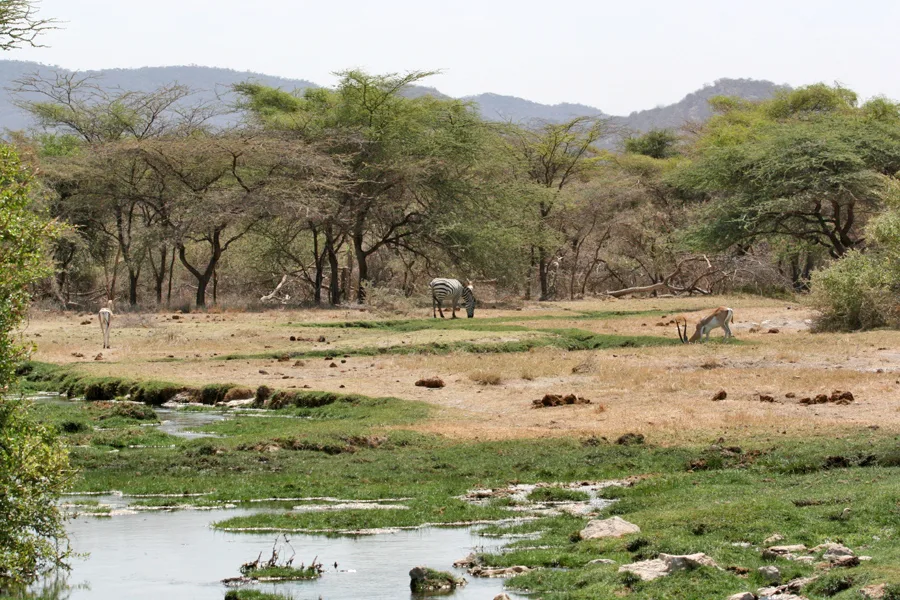
Buffalo Springs in one paragraph
Buffalo Springs occupies the southern side of the river in Isiolo County. Its dry plains, river approaches and natural spring area create a circuit that can feel quieter than central Samburu. The reserve is not merely a road to the bridge. It deserves its own search.
| Buffalo Springs strength | Reader value |
|---|---|
| Southern-bank roads | Different angles on the river and open habitat |
| Special Five | Northern species occur here too |
| Quiet sectors | Patient drives may encounter fewer vehicles |
| Lodge bases | Ashnil Samburu, Samburu Simba and Surana Buffalo Springs |
| Link to Samburu | Bridge makes a two-reserve stay practical when fees permit |
An independent traveller called it a “Superb safari and birdwatching reserve.” The full Buffalo Springs review page shows both excellent and more mixed personal experiences.

Shaba in one paragraph
Shaba lies farther east and has a different visual identity. Volcanic formations, rocky hills, springs, palms and broad grasslands create strong landscape photography. Wildlife can be more dispersed, so Shaba rewards travellers who enjoy searching rather than expecting a rapid sequence of sightings.
| Shaba strength | Reader value |
|---|---|
| Volcanic scenery | A distinct setting from the other two reserves |
| Space | Fewer vehicles in many periods |
| Springs and river habitat | Green pockets within dry country |
| Conservation history | Joy Adamson and the wider Born Free story |
| Established lodge | Sarova Shaba remains a major base |
One traveller wrote, “The landscape is breathtaking.” Their detailed Shaba account also describes the slower search and variety of habitats.
Wildlife shared across all three
The three reserves form part of a connected dry-country ecosystem. Elephants, reticulated giraffes, Grevy’s zebras, Beisa oryx, gerenuk, Somali ostriches, lions, leopards, cheetahs, hyenas, dik-diks and many birds can occur across the wider area.
| Wildlife interest | Samburu | Buffalo Springs | Shaba |
|---|---|---|---|
| Special Five | Strong | Strong | Possible across suitable habitat |
| Elephants | Major riverine presence | River and plains | Present, often more dispersed |
| Big cats | Strong patient-search destination | Rewarding, often quieter | Present with a wider search area |
| River wildlife | Major strength | Major strength | River and spring habitat in eastern setting |
| Birds | Dry-country and riverine mix | Excellent open and riverine mix | Landscape, spring and dry-country variety |
No reserve can guarantee a species list, and sightings can shift after rain.
The Special Five do not belong to one gate
Grevy’s zebra, reticulated giraffe, Beisa oryx, gerenuk and Somali ostrich range through northern Kenya. Calling them the Samburu Special Five does not mean they appear only inside Samburu National Reserve.
| Species | Habitat clue |
|---|---|
| Grevy's zebra | Open dry grassland with access to water |
| Reticulated giraffe | Acacia and mixed browse |
| Beisa oryx | Open arid plain and scrub |
| Gerenuk | Thornbush with browse above grass level |
| Somali ostrich | Open dry country |
Use the Samburu Special Five wildlife guide to identify them wherever the vehicle finds them.
Elephant experience by reserve
Samburu and Buffalo Springs often offer the most efficient river-focused elephant watching. Shaba can produce beautiful elephant sightings in a more spacious landscape, but the search may require more distance and time.
| Elephant scene | Best tendency |
|---|---|
| Close riverbank movement | Samburu or Buffalo Springs |
| Crossing between banks | Near the connected river corridor |
| Broad volcanic landscape | Shaba |
| Lodge-based river watching | Property-specific in all three |
| Lowest vehicle density | Often Buffalo Springs or Shaba sectors |
The best sighting is the one a guide allows to unfold without crowding the herd.
Predator comparison
Lions, leopards and cheetahs occur in the wider ecosystem. Samburu’s riverine woodland is a classic leopard-search area. Buffalo Springs mixes open country and cover. Shaba’s size and landscape can make the search more demanding.
| Predator | Samburu | Buffalo Springs | Shaba |
|---|---|---|---|
| Lion | Plains, shade and river approaches | Open areas and river routes | Rocky hills and grassland |
| Leopard | Riverine trees and dense cover | River and woodland search | Springs, cover and rocky country |
| Cheetah | Open sectors and wider conservancies | Open plains | Possible in suitable open habitat |
| Hyena | Present across the reserve | Present | Present |
More nights and a private vehicle create patience, not certainty.
Birding differences
Buffalo Springs deserves special attention from birders because its open dry habitat and river corridor can be covered with relatively little traffic. Samburu offers a strong mixed list near established routes. Shaba adds spring, rocky and eastern landscape diversity.
| Birding focus | Reserve tendency |
|---|---|
| Riverine birds | Samburu and Buffalo Springs |
| Open dry-country birds | Buffalo Springs |
| Rocky and spring habitats | Shaba |
| Vulturine guineafowl and hornbills | Wider northern ecosystem |
| Raptors | All three, with patient scanning |
Ask for a bird-interested guide before arrival rather than discovering that every small bird is being passed at speed.

Landscape comparison
Samburu is varied and compact, Buffalo Springs feels drier and more open in many areas, and Shaba is the most visually volcanic. The differences become stronger when the drive slows enough to notice geology and vegetation.
| Landscape feature | Samburu | Buffalo Springs | Shaba |
|---|---|---|---|
| River | Central north-bank corridor | Central south-bank corridor | Eastern river and spring story |
| Rock | Outcrops and hills | Open dry terrain with distant relief | Volcanic formations and prominent hills |
| Palms | Doum palms along river | Riverine palms | Springs, river and oasis-like areas |
| Visual mood | Textured and wildlife-rich | Spacious and dry | Dramatic, historic and remote |
Landscape lovers may find Shaba worth a dedicated stay even when wildlife density is lower.
Photography comparison
Samburu suits varied environmental portraits, Buffalo Springs suits uncluttered open-country frames and Shaba suits wide landscapes. All three can be harsh at midday and beautiful after storms.
| Photograph | Best tendency |
|---|---|
| Elephant among palms | Samburu or Buffalo Springs |
| Special Five portrait | Samburu or Buffalo Springs |
| Volcanic panorama | Shaba |
| Empty-road atmosphere | Buffalo Springs or Shaba |
| River behaviour | Samburu and Buffalo Springs |
A private vehicle and a guide willing to wait matter more than changing reserves every few hours.
Which reserve feels quietest
Shaba often feels the least trafficked, followed by quieter Buffalo Springs sectors. Samburu has more camps and central routes, although it is still usually calmer than Kenya’s busiest migration areas.
| Crowd factor | Effect |
|---|---|
| Lodge concentration | More vehicles near common departure routes |
| Bridge access | Creates shared crossing points |
| Predator sighting | Can concentrate vehicles anywhere |
| Season | Holiday demand changes all three |
| Private vehicle | Lets you leave a cluster and explore |
Quiet does not always mean more animals. Decide whether space or sighting frequency matters more.
Roads and driving conditions
Samburu County describes its main reserve road network as generally good to decent, with washboard sections possible. Buffalo Springs and Shaba roads vary with rain, maintenance and vehicle traffic. Black-cotton soil, sand and water crossings can change after storms.
| Road issue | Planning response |
|---|---|
| Corrugation | Use a maintained 4×4 and sensible speed |
| Heavy rain | Confirm same-day gate and track conditions |
| Dry dust | Protect cameras and keep distance from other vehicles |
| River crossing or bridge issue | Retain route flexibility |
| Long Shaba circuit | Carry water and allow daylight |
Current road advice should come from the lodge or reserve team close to travel.
Gates and the bridge
Archer’s Gate is the main Samburu approach near Archer’s Post. Samburu also lists West, Kalama, Waso Bridge and airstrip gate services. Buffalo Springs and Shaba use their own Isiolo County entries. Names and operating processes should be confirmed on the booking documents.
| Movement | What to confirm |
|---|---|
| Archer's Post to Samburu | Archer's Gate hours and payment method |
| Samburu to Buffalo Springs | Waso Bridge status and both reserve entries |
| Isiolo to Buffalo Springs | Correct gate for lodge and road condition |
| Buffalo Springs to Shaba | Route, transfer time and Shaba entry |
| Airstrip to lodge | Which gate or reserve fee applies on arrival |
A map pin and written transfer plan prevent surprises.
Fees are not one interchangeable ticket
Samburu and Isiolo counties can publish or collect fees independently. Old travel reviews contain obsolete figures and payment methods. Do not use them to budget a future trip.
| Fee question | Why it matters |
|---|---|
| Is the fee per day or per 24 hours? | Changes arrival and departure cost |
| Does it cover one reserve or more? | Prevents accidental double budgeting |
| Are vehicle and guide fees separate? | Total may exceed visitor entry |
| Which payment method is accepted? | Gate systems can differ |
| Is the fee included by the lodge? | Full-board and game-package rates differ |
Request an itemised itinerary naming every reserve entry, without customer-facing claims that depend on an old rate sheet.
Airstrips and flying in
The wider Samburu ecosystem has several airstrips serving different camps and sectors. A scheduled flight listing “Samburu” may land at an airstrip that is not closest to the selected lodge.
| Flight detail | Ask |
|---|---|
| Airstrip name | Which exact strip is ticketed? |
| Reserve | Which county or reserve entry follows landing? |
| Transfer time | How long from strip to room? |
| Intermediate stops | How many landings before arrival? |
| Luggage | What soft-bag weight applies? |
The Nairobi to Samburu guide compares road and air without treating airport time as invisible.
Staying inside Samburu National Reserve
Established choices include Elephant Bedroom Camp, Samburu Intrepids, Samburu Sopa Lodge, Samburu Game Lodge, Elephant Watch Camp and other riverside or interior properties. Each has a different scale and position.
| Property example | General style | Verify |
|---|---|---|
| Elephant Bedroom Camp | Small luxury tented camp by river habitat | Current tent count, child policy and drive basis |
| Samburu Intrepids | Established premium tented camp | Room type and private vehicle supplement |
| Samburu Sopa Lodge | Larger lodge format | Exact transfer and room position |
| Samburu Game Lodge | Traditional riverside lodge | Refurbishment status and facilities |
| Elephant Watch Camp | Specialist riverine camp | Seasonal opening and included activities |
The name of the room matters as much as the name of the lodge.
Staying inside Buffalo Springs
Ashnil Samburu Camp is officially located in Buffalo Springs despite its name. Samburu Simba Lodge and Surana Buffalo Springs are also Isiolo-side options. These properties can explore Buffalo Springs directly and cross towards Samburu when the plan includes the required entry.
| Property example | General style | Verify |
|---|---|---|
| Ashnil Samburu Camp | Riverfront tented camp with family and group appeal | Exact package, vehicle and reserve fees |
| Samburu Simba Lodge | Larger lodge within Buffalo Springs | Room category and current facilities |
| Surana Buffalo Springs | High-end suites with privacy emphasis | Transfer, activity and meal inclusions |
Do not move Ashnil into Samburu National Reserve simply because “Samburu” appears in its name.
Staying inside Shaba
Sarova Shaba Game Lodge is the best-established large lodge in Shaba and confirms that it remains open while phased refurbishment occurs. Joy’s Camp appears in local business records, but opening schedules and booking availability need direct confirmation.
| Property example | General style | Verify |
|---|---|---|
| Sarova Shaba Game Lodge | Large full-service riverside lodge | Refurbishment phase, room position and drive package |
| Joy's Camp | Historic boutique camp name | Current opening and operator confirmation |
| Special or public camping | Bush-focused option where permitted | Security, ranger, water and booking rules |
Shaba accommodation should be booked for Shaba itself, not as a vague substitute for central Samburu access.
Why lodge location changes the safari
The first and last hour of light are valuable. A camp far from the intended reserve can spend them at gates or on transfer roads.
| Priority | Better base tendency |
|---|---|
| Samburu river loops at dawn | Inside Samburu |
| Buffalo Springs open-country circuit | Inside Buffalo Springs |
| Shaba landscape and springs | Inside Shaba |
| Two-reserve flexibility | Near bridge, with fees arranged |
| Conservancy walks and night activities | Selected community conservancy outside reserve rules |
Use where to stay in Samburu, Buffalo Springs and Shaba for a property-level comparison.
Can you visit all three in one day
Technically, a vehicle may move between reserves when gates, roads and fees allow. Practically, racing through all three produces more gate time than observation. Shaba especially deserves more than a quick drive-through.
| Available time | Better plan |
|---|---|
| One full day | Explore the reserve containing the lodge |
| Two full days | Divide Samburu and Buffalo Springs |
| Three full days | Add Shaba if scenery and history matter |
| Four or more days | Slow circuits, birding and conservancy activity |
Reserve count is a poor measure of safari quality.
A three-night plan
Three nights usually give two full wildlife days. Base in Samburu or Buffalo Springs and explore both sides only if the bridge and fee arrangement is clear.
| Day | Sensible rhythm |
|---|---|
| Arrival | Short drive near the lodge, no forced cross-reserve race |
| Full day one | Home reserve with dawn and late-afternoon focus |
| Full day two | Second reserve or deeper home-reserve search |
| Departure | Final local drive and transfer |
Shaba should replace one of the two, not be squeezed into both, unless the lodge is already there.
A four-night plan
Four nights create three full days and make Shaba more realistic.
| Day | Route idea |
|---|---|
| Arrival | Settle into Samburu or Buffalo Springs |
| Full day one | Samburu river and interior habitats |
| Full day two | Buffalo Springs circuit |
| Full day three | Dedicated Shaba drive or lodge transfer |
| Departure | Local morning before onward route |
If changing lodges, pack once and stay at least two nights in Shaba rather than arriving late and leaving early.
Best time to compare the reserves
All three are year-round destinations. Dry conditions can concentrate wildlife near water and simplify scanning. Rains bring fresh growth, dramatic skies and possible road disruption. Shaba’s wider landscape may require extra patience when water is widespread.
| Condition | Samburu | Buffalo Springs | Shaba |
|---|---|---|---|
| Dry season | River-focused movement | Open scanning and river access | Long searches with strong scenery |
| Green season | Browse and colour | Fresh plains and birds | Volcanic landscape under dramatic sky |
| Heavy rain | Some track changes | Soil and crossing issues | Longer circuits need careful advice |
Read best time to visit Samburu for month-by-month heat and rain context.
Family safari comparison
Families often prefer a lodge with a pool, family rooms, flexible meals and short wildlife circuits. Samburu and Buffalo Springs offer several established choices. Shaba can suit families who enjoy a larger resort-style lodge and landscape exploration.
| Family need | Best question |
|---|---|
| Interconnecting room | Which exact category connects? |
| Short drives | How far from productive habitat? |
| Pool | Is it supervised and wildlife-safe? |
| Child activities | Which ages and times apply? |
| Private vehicle | Can the family return early? |
The Kenya family safari guide helps match the route to real ages and attention spans.
Honeymoon comparison
Samburu offers intimate river camps, Buffalo Springs has premium private suites, and Shaba offers dramatic scenery and history. The most romantic option is the room that delivers privacy without sacrificing the couple’s wildlife priorities.
| Honeymoon wish | Reserve tendency |
|---|---|
| Small river camp | Samburu |
| High-design privacy | Selected Buffalo Springs property |
| Cinematic landscape and history | Shaba |
| Private vehicle and dining | Available by property, confirm in writing |
Use the Kenya honeymoon safari guide to distinguish room privacy from generic honeymoon language.
Accessibility and comfort
Heat, steps, rough tracks and long game drives matter more than the reserve label. Some newer camps have accessible pathways, while older lodges may include stairs or long distances.
| Comfort question | Why ask |
|---|---|
| Vehicle step height | Every game drive begins with the same climb |
| Air conditioning or fan | Northern afternoons can be hot |
| Room to dining distance | Night walking may require escort |
| Shower threshold | “Walk-in” does not always mean level |
| Private drive | Allows shorter outings and rest |
Compare the exact room and transfer, not a generic accessibility badge.
Cultural visits and community conservancies
The reserve trio sits within a much wider Samburu and Isiolo landscape. Community conservancies offer different activities, employment and conservation models. Cultural visits should be invited, community-led and transparent about fees.
| Respectful question | Good sign |
|---|---|
| Who hosts the visit? | Named community or conservancy group |
| Who receives the fee? | Clear local benefit |
| May guests photograph? | Consent discussed before cameras |
| What is the activity? | Conversation, guided walk or learning with context |
| How long is allowed? | Enough time to avoid a rushed performance |
Read Samburu cultural village visits before adding a vague “village stop.”
Safety and current local advice
Reserve conditions should be separated from the wider road journey. Travellers need a registered guide, a maintained vehicle, lodge communication and current advice for the exact route. Old reviews may describe incidents or conditions that cannot establish today’s risk on their own.
| Safety check | Practical action |
|---|---|
| Road route | Confirm with lodge and driver before departure |
| Gate arrival | Travel within operating hours and keep booking records ready |
| Wildlife in camp | Follow escort rules after dark |
| Remote circuit | Carry water, charged communication and recovery equipment |
| Medical need | Know the lodge response plan and evacuation cover |
No responsible guide should use confidence as a substitute for a current local check.
Self-driving the reserve complex
Experienced Kenya self-drivers can visit the reserves, but navigation, payment, wildlife etiquette and recovery readiness matter. A route that looks short may include corrugation, sand or a gate process. First-time East Africa self-drivers should seriously consider a professional guide.
| Self-drive requirement | Why it matters |
|---|---|
| Proper 4×4 | Rain and sand can change track conditions |
| Offline map and gate names | Mobile signal is not a navigation plan |
| Two spare tyres or repair readiness | Sharp stones and corrugation create risk |
| Water and fuel margin | Shaba circuits can feel remote |
| Wildlife etiquette | Animals must keep the right of way |
Never crowd an elephant, block a predator or leave a marked route because another vehicle did.
A road itinerary from Nairobi
A comfortable northern road safari can use Mount Kenya or Ol Pejeta as a meaningful break rather than forcing a dawn-to-dusk transfer. The return can follow the same corridor or continue towards Meru, depending on conditions and trip length.
| Day | Route idea |
|---|---|
| 1 | Nairobi to Mount Kenya or Ol Pejeta |
| 2 | Continue to Samburu or Buffalo Springs |
| 3 | Home-reserve wildlife day |
| 4 | Cross-reserve day or deeper local circuit |
| 5 | Shaba day or second lodge stay |
| 6 | Return via central Kenya |
The intermediate stop should add wildlife, conservation or rest rather than exist only as a bed beside the highway.
Packing for heat, dust and changing weather
Northern Kenya rewards simple preparation. A light long-sleeved layer protects from sun and dust, while a warmer layer helps on dawn drives. Camera equipment needs dust protection even when the sky looks clear.
| Item | Reason |
|---|---|
| Refillable water bottle | Heat and long drives increase fluid needs |
| Broad hat and sunscreen | Open vehicles provide uneven shade |
| Light scarf | Dust protection on dry tracks |
| Warm dawn layer | Early hours can feel cool before rapid warming |
| Binoculars | Birds and distant animals reward independent viewing |
| Soft bag | Bush flights often restrict hard luggage |
Neutral clothing is useful, but expensive “safari fashion” is not required.
Responsible game-drive behaviour
Quiet reserves can lose their advantage when drivers rush, overtake or form a wall around wildlife. Ask for patient viewing before the first drive, especially when photography or children are involved.
| Behaviour | Better practice |
|---|---|
| Racing to radio calls | Search naturally and judge crowd size |
| Blocking an animal's path | Stop with space and an escape route |
| Engine running beside a resting animal | Switch off when safe and permitted |
| Loud conversation | Lower voices near wildlife |
| Pressuring guide for sightings | Set interests without demanding guarantees |
Respect is not a luxury-camp feature. It is the minimum standard in every reserve.
Conservation history in Shaba
Shaba is closely associated with Joy and George Adamson and the wider Born Free story. The history adds meaning, but it should not be compressed into a claim that every location or lodge is directly tied to Elsa.
| History element | Responsible treatment |
|---|---|
| Joy Adamson | Explain her work and later Shaba connection accurately |
| Elsa the lioness | Separate Meru history from later Shaba work |
| Born Free branding | Verify which property or site carries a genuine link |
| Conservation today | Include current county, community and wildlife management |
The Born Free, Elsa and Meru conservation history guide will separate the locations and timeline.
Which reserve has the best value
Value depends on the lodge, fees, travel time and activity plan. A lower room rate can become expensive if every desired drive requires another reserve entry. A premium camp can offer better value when it protects wildlife hours and includes a private vehicle.
| Cost factor | Compare |
|---|---|
| Room plan | Full board versus game package |
| Reserve entries | Home reserve and cross-reserve days |
| Vehicle | Shared, private or road-safari vehicle |
| Airstrip transfer | Included or charged separately |
| Activities | Walks, cultural visits and special meals |
Use Samburu safari cost for a complete itemised framework.
Which reserve suits a first northern safari
Samburu is the safest general recommendation because of its established wildlife routes and camp choice. Buffalo Springs is equally valid when the selected lodge is there and the itinerary includes cross-river access. Shaba is best chosen deliberately for scenery and space.
| First-trip priority | Choose |
|---|---|
| Broad wildlife and classic base | Samburu |
| Quiet southern-bank lodge | Buffalo Springs |
| Volcanic scenery and history | Shaba |
| Mix of two | Samburu plus Buffalo Springs |
| Four or more full days | Consider all three |
The exact lodge can justifiably reverse the general recommendation.
Which reserve suits repeat visitors
Repeat visitors can give Buffalo Springs and Shaba more weight. They may already know the Samburu river circuit and want quieter roads, different geology or specialist birding.
| Previous experience | Fresh choice |
|---|---|
| Samburu only | Buffalo Springs and Shaba |
| Mara and Amboseli | Any of the three for northern contrast |
| Fast northern circuit | Four slow nights in one or two reserves |
| Wildlife-only trip | Add landscape, birds and conservation history |
Repeat travel is an opportunity to slow down rather than collect another list.
Common booking mistakes
Most confusion begins before arrival.
| Mistake | Better action |
|---|---|
| Assuming Ashnil Samburu is in Samburu Reserve | Note its Buffalo Springs location |
| Treating three reserves as one fee | List each entry separately |
| Booking Shaba for daily central Samburu drives | Stay where the desired drives are |
| Driving all three in one day | Give each reserve time |
| Copying old fee screenshots | Confirm current county notices |
| Ignoring bridge status | Check before cross-river plans |
Geography is part of the product, not a footnote.
Questions to put in the itinerary
A good itinerary should answer these without a separate detective exercise.
| Required detail | Example of clarity |
|---|---|
| Lodge location | “Inside Buffalo Springs National Reserve” |
| Entry plan | “Samburu entry included on day two” |
| Transfer | “Airstrip to camp approximately X under normal conditions” |
| Vehicle | “Private 4×4 for two travellers” |
| Activity | “Full-day Shaba drive with lunch and entry” |
| Payment | “Fees prepaid” or named gate payment method |
Exact language creates confidence because the traveller knows where each day happens.
Decision tree
Start with the lodge experience and desired landscape.
| Question | If yes | If no |
|---|---|---|
| Is this a first northern safari? | Start with Samburu | Continue |
| Is the preferred lodge in Buffalo Springs? | Base there and plan crossings | Continue |
| Is Shaba scenery a priority? | Give Shaba a dedicated day or stay | Continue |
| Do you have only two full days? | Choose Samburu and Buffalo Springs | Avoid all three |
| Do you prefer quiet roads to rapid sightings? | Add Buffalo Springs or Shaba | Stay in central Samburu |
| Do current fees support cross-reserve days? | Combine | Explore the home reserve deeply |
The best answer can be one lodge and two reserves, not three lodges.
Final comparison
Samburu is the strongest all-round first base. Buffalo Springs is a complete reserve on the southern bank, not a supporting annex, and it can be the right base when the lodge and route fit. Shaba has the most distinct scenery and the slowest rhythm, rewarding travellers who value space and history.
| Final priority | Reserve |
|---|---|
| First northern safari | Samburu |
| Quiet open-country circuit | Buffalo Springs |
| Volcanic landscape | Shaba |
| Special Five | Samburu or Buffalo Springs, with no guarantee |
| River elephants | Samburu or Buffalo Springs |
| History and space | Shaba |
| Three-night stay | Samburu and Buffalo Springs |
| Four or five nights | Add Shaba deliberately |
Samburu, Buffalo Springs and Shaba compared properly become easier to book. Map the lodge, name every reserve entry, protect full wildlife days and let the landscape change at a pace you can actually feel.
Sources and further reading
Build your northern Kenya safari
Share your dates, group, wildlife priorities, lodge level and the rest of your Kenya route. We will compare exact reserve locations before recommending a plan.