
Meru vs Masai Mara: Which Kenya Safari Fits You?
Choose between Meru’s varied, quiet wilderness and the Masai Mara’s open-plains abundance by the experience you actually want, or connect both without losing a safari day.

- Meru vs Masai Mara at a glance
- The two landscapes tell different stories
- Wildlife density and the way sightings happen
- Big cats in Meru and the Mara
- Rhinos: Meru has the clearer plan
- The Great Migration changes the Mara decision
- Vehicle numbers and privacy
- Reserve, Triangle and conservancy are not the same Mara
- Meru’s different sectors also matter
- Safari cost: compare the whole chapter
- Road access from Nairobi
- Flying to Meru or the Mara
- Accommodation range
- Families: ease versus quiet
- Honeymoons: two different kinds of privacy
- Photographers: abundance or solitude?
- Birdwatchers should not default to the Mara
- Hot-air balloon safaris
- Walking and night activities
- Community experiences
- Best time for Meru
- Best time for the Masai Mara
- Rain affects the two parks differently
- Ethical game driving matters more in a crowd
- What real travellers notice in Meru
- What real travellers notice in the Mara
- Watch each safari rhythm before deciding
- Three nights in Meru or three in the Mara?
- A six or seven-night Meru and Mara safari
- If you have only five safari nights
- Which should come first?
- Choose Meru if these statements sound like you
- Choose the Masai Mara if these statements sound like you
- Common comparison mistakes
- The final Meru vs Masai Mara decision
The Masai Mara introduces itself quickly. Open grass runs toward a huge sky, a lion may be visible from far across the plain and another safari vehicle often means someone has found something worth watching. Meru asks for a slower introduction. A road disappears between doum palms, riverine forest and red earth. The next bend may hold elephants, a waterbuck or nothing at all until the woodland opens again.
Choosing Meru vs Masai Mara is not choosing a winner. It is choosing the rhythm, wildlife context, landscape and level of tourism that will make your own safari feel right. The Mara is Kenya's clearest first-safari icon and the northern half of the Serengeti-Mara migration system. Meru is a broad, varied national park where quiet roads and the sense of discovery are part of the experience.
Meru vs Masai Mara at a glance
| Decision | Meru | Masai Mara |
|---|---|---|
| Landscape | Rivers, doum palms, woodland, open grass, kopjes and red earth | Wide savannah, river systems, escarpment and rolling plains |
| Wildlife rhythm | Search across varied habitat with very few vehicles | High wildlife density with strong shared sighting information |
| Great Migration | No | Seasonal herds and possible river crossings, never guaranteed |
| Rhinos | Dedicated sanctuary is a major feature | Present in the wider ecosystem but not the reserve's easiest planning promise |
| Big cats | Present, with more searching and privacy | One of the world's strongest big-cat safari contexts |
| Vehicle density | Usually low | Can be high around famous sightings and crossing points |
| First visit | Excellent for travellers who value quiet wilderness | Easiest all-round first Kenya safari choice |
| Minimum stay | 3 nights, preferably 4 | 3 nights, longer in migration season or conservancies |
| Access | Long road journey or limited airstrip choices | Many road itineraries, scheduled flights and camp airstrips |
| Accommodation | Smaller range from KWS cottages to high-end lodge | Enormous range from value camps to ultra-luxury |
The comparison changes again when “the Mara” means a private conservancy rather than the National Reserve. Always name the exact land unit and lodge.

The two landscapes tell different stories
Meru's identity is variety. KWS describes a park crossed by rivers and springs, with a rhino sanctuary, rich birdlife and the heritage of Elsa the lioness. A game drive may move through dense cover into an open plain and then beside palms or water.
The Masai Mara belongs to the wider Serengeti-Mara ecosystem. The reserve and Mara Triangle hold expansive grassland, the Mara and Talek river systems and the Oloololo Escarpment. The Mara Triangle alone covers 510 square kilometres and forms roughly one-third of the National Reserve.
| Traveller reaction | Better fit |
|---|---|
| “I want to see animals across open plains” | Masai Mara |
| “I want the scenery to change during the day” | Meru |
| “I love classic East African savannah photography” | Masai Mara |
| “I want palms, rivers and wooded layers” | Meru |
| “I want both” | Combine them |
Neither is visually superior. They ask the eye to work differently.
Read the Meru National Park guide and Masai Mara safari guide for the full destination context behind this comparison.
Wildlife density and the way sightings happen
The Mara's open habitat and dense resident wildlife make many animals easier to find. Guides exchange information, and an experienced driver can often build a rewarding day around several active areas. That does not mean every drive produces every species.
Meru's wildlife can be widely distributed and partially hidden by vegetation. Few vehicles mean less shared information. A guide reads tracks, habitat, alarm calls and recent movement instead of following a convoy.
| Sighting experience | Meru | Masai Mara |
|---|---|---|
| Long-distance visibility | More limited in woodland | Often excellent on open plains |
| Shared guide information | Fewer vehicles to share updates | Strong guide network, with crowd risk |
| Privacy | Frequently high | Depends on sector, season and sighting |
| Search style | Patient, habitat-led exploration | Productive circuits and rapid response to information |
| Emotional reward | Discovery after a quiet search | Abundance and dramatic interaction |
A traveller who measures success only by the number of species before breakfast will probably prefer the Mara. Someone who treasures the hour before a shy animal appears may prefer Meru.

Big cats in Meru and the Mara
The Mara is famous for lions, cheetahs and leopards because open habitat, prey density and decades of observation create a remarkable big-cat context. It is also where crowding can be most visible. The Mara Triangle restricts viewing time when more than five vehicles are waiting and uses patrol vehicles to improve distance and behaviour.
Meru supports lions, leopards and cheetahs, but thick vegetation and fewer vehicles can make the search longer. A quiet sighting may belong to one vehicle. There may also be a full drive without a cat.
| Big-cat priority | Better choice |
|---|---|
| Highest chance across a short stay | Masai Mara |
| Private-feeling sighting if found | Meru |
| Long-term cheetah or lion observation | Mara camp or conservancy with specialist guides |
| Tracking skill and discovery | Meru with an experienced guide and enough nights |
| Guaranteed leopard | Neither, because wild cats are never guaranteed |
Rhinos: Meru has the clearer plan
Meru's rhino sanctuary is a defined part of the park experience and one of the strongest reasons to include it. The correct package allows time to reach the sanctuary, follows current KWS access rules and never treats a wild animal as a scheduled appointment.
The Mara ecosystem has black rhinos, but their distribution, protection and sighting patterns do not turn them into an easy checklist item for every reserve stay.
| Rhino question | Meru | Masai Mara |
|---|---|---|
| Is rhino a major visitor focus? | Yes, through the sanctuary | Not the main organising feature |
| Can a responsible planner guarantee one? | No | No |
| Does it pair well with other conservation experiences? | Yes, especially with Laikipia | Yes, through a wider Kenya route |
| Is it a reason to choose this park over the other? | Often | Usually not |
If rhinos are the first priority, Meru has the stronger case. Ol Pejeta, Lewa and Solio should also enter the wider comparison.
The Great Migration changes the Mara decision
Meru does not have Great Migration river crossings. The Mara can receive vast herds moving through the northern Serengeti-Mara ecosystem, but the timing, route and behaviour respond to rain and grazing. A booking date is not a crossing appointment.
| Migration expectation | Honest answer |
|---|---|
| “Will the herds be in the Mara in August?” | Often, but annual timing and distribution change |
| “Can you guarantee a river crossing?” | No |
| “Will the reserve be busy?” | Peak movement periods can bring heavy demand and vehicle concentration |
| “Is the Mara worthwhile outside migration?” | Yes, resident wildlife and big cats remain strong reasons to visit |
| “Should I choose Meru if I dislike crowds?” | It is the clearer quiet-park choice, though the Mara can be planned carefully by sector and season |
The migration is a living ecological movement, not a performance. Choose the Mara for the ecosystem, then treat a crossing as extraordinary luck.
Vehicle numbers and privacy
This is the sharpest difference. Meru's low visitor volume can make an ordinary sighting feel personal. The Mara's wildlife density and fame can bring many vehicles to a cheetah, lion or river crossing.
| Privacy tool | How it helps |
|---|---|
| Stay longer | Creates time to leave a crowded sighting and find another |
| Travel outside peak dates | Reduces demand without removing resident wildlife |
| Choose a Mara conservancy | Resident camps and controlled access can change the vehicle rhythm |
| Use a private vehicle | Lets the guide move when a sighting no longer feels right |
| Choose Meru | Makes low traffic part of the destination rather than a paid upgrade |
Privacy is not absolute. A famous animal can attract vehicles in any popular reserve, while one corner of the Mara can remain quiet after other vehicles leave for breakfast.
Reserve, Triangle and conservancy are not the same Mara
The National Reserve, Mara Triangle and surrounding community conservancies form connected wildlife land with different management and tourism systems.
| Mara area | Visitor character |
|---|---|
| Narok sector of National Reserve | Broad public reserve access and many lodge or outside-gate options |
| Mara Triangle | Managed by Mara Conservancy, with escarpment, river and explicit vehicle rules |
| Private or community conservancy | Resident-camp model, controlled vehicle access and activities that may differ from reserve rules |
The package must state where the room sits and which areas each drive enters. “Masai Mara lodge” can describe properties with completely different daily access.
Meru’s different sectors also matter
Meru is quieter, but it is not small or uniform. The accommodation's position affects the rhino sanctuary, Mughwongo and Elsa's history, river circuits, gates and airstrips.
| Meru base decision | Why it matters |
|---|---|
| Inside the park | Easier early starts and less gate dependence |
| Near Murera Gate | Useful value and road access, with gate-hour planning |
| Near rhino sanctuary side | Strong sanctuary logistics, depending on property and gate |
| Fly-in lodge | Match Mughwongo, Kinna or Mulika airstrip to the confirmed transfer |
The where to stay in Meru National Park guide compares these choices by actual safari day rather than room photograph.
Safari cost: compare the whole chapter
The Mara's daily entry can be substantially higher for non-residents in peak season than Meru's KWS fee, but entry is only one line. The Mara has more flights, rooms and competition. Meru may require a longer private road sector or limited air connection.
| Cost line | Meru | Masai Mara |
|---|---|---|
| Person entry | KWS category and chargeable visit | Reserve or conservancy fee by sector, season and visitor category |
| Road transfer | Long from Nairobi, efficient inside a northern circuit | Long from Nairobi, common in classic road circuits |
| Flights | Fewer airstrip and service combinations | Broad scheduled-flight network |
| Accommodation | Smaller spectrum | Very wide spectrum |
| Vehicle | Often private because of road routing | Shared lodge drives or private vehicle options |
| Seasonal premium | Property specific | Strong migration-season pressure in many areas |
Use the Meru safari cost and park fees guide and Masai Mara safari cost guide on the same dates, room basis and vehicle basis.
Road access from Nairobi
Both parks require a substantial road journey from Nairobi. Meru links naturally with Mount Kenya, Laikipia and Samburu. The Mara links naturally with Lake Naivasha, Lake Nakuru or a western Kenya route.
| Road circuit | Better destination fit |
|---|---|
| Nairobi, Mount Kenya, Meru, Samburu | Meru |
| Nairobi, Naivasha, Nakuru, Mara | Masai Mara |
| Nairobi, Meru, Mara | Possible, but a flight or intermediate stop may protect time |
| Nairobi return short break | Mara has more established short-package demand; Meru needs honest transfer time |
Road travel becomes good value when the vehicle and guide continue across several parks. It becomes exhausting when every destination sits on the opposite side of the map.
Flying to Meru or the Mara
The Mara's broad air network is one of its practical advantages. Numerous camp airstrips and scheduled services can turn a long road day into a short flight, though stops, baggage and transfers still matter.
Meru has Kinna, Mulika and Mughwongo airstrip options listed by KWS. Service frequency and the correct lodge transfer require more careful matching.
| Flight question | Ask for both parks |
|---|---|
| Departure airport | Wilson, Jomo Kenyatta connection or another strip? |
| Stops | Direct or collecting passengers elsewhere? |
| Baggage | Soft-bag weight, hand luggage and camera allowance? |
| Arrival transfer | Which airstrip and how long to the room? |
| Game drives | Included shared seat or separately priced private vehicle? |
The fastest flight on paper can become the wrong choice if it lands far from the lodge.
Accommodation range
The Mara has one of Africa's deepest safari-accommodation markets. Travellers can choose simple camps, large lodges, intimate tented properties, family villas and ultra-luxury conservancy stays.
Meru's smaller range is easier to understand. Elsa's Kopje leads the luxury end, Rhino River Camp and iKWETA provide distinct tented options, and KWS cottages and campsites create practical resident or self-sufficient trips.
| Accommodation preference | Better fit |
|---|---|
| Maximum room choice | Masai Mara |
| One distinctive luxury lodge inside a quiet park | Meru |
| Conservancy portfolio | Greater Mara |
| KWS self-catering cottage | Meru |
| Large family villa selection | Masai Mara |
| Supported special campsite | Either, subject to current rules and capable operator |
The number of properties does not decide quality. The exact location, room and daily drive plan do.
Families: ease versus quiet
The Mara's wildlife density can hold a child's attention during a shorter stay, while its large accommodation range offers many pools, family tents and flexible meal plans. Meru's quiet roads and cottages can suit families who value space, independence and a slower rhythm.
| Family need | Meru | Masai Mara |
|---|---|---|
| First safari with limited days | Good, but long transfer and searching matter | Strong fit |
| Resident self-catering trip | Strong KWS cottage option | More limited inside core reserve |
| Many family-room choices | Smaller range | Strong range |
| Quiet sighting environment | Strong | Depends on sector and season |
| Migration spectacle | No | Possible in season |
Check child ages for park fees, room occupancy, walks, open-camp safety and private-vehicle needs in either destination.
Honeymoons: two different kinds of privacy
Meru offers privacy through low traffic, secluded rooms and a park that rarely feels staged. The Mara offers an enormous choice of romantic camps, hot-air balloons, private conservancy drives and dramatic wildlife.
| Honeymoon mood | Better choice |
|---|---|
| “We want the park to feel almost ours” | Meru |
| “We want classic plains, cats and a balloon option” | Masai Mara |
| “We want the widest luxury choice” | Masai Mara |
| “We want history, wilderness and fewer vehicles” | Meru |
| “We want both moods” | Three or four nights in each |
Photographers: abundance or solitude?
The Mara gives photographers a high volume of opportunity. Open ground, visible predators and repeated access to well-known territories can produce exceptional behaviour sequences. It can also produce a frame full of vehicles if guide ethics, sector and timing are poor.
Meru offers fewer rapid opportunities, but more landscape context and a greater chance that one vehicle can work a sighting quietly. Vegetation asks for patience and creative composition.
| Photography priority | Better fit |
|---|---|
| Big-cat behaviour in open habitat | Masai Mara |
| Great Migration herds | Masai Mara in the right period |
| Solitary vehicle and environmental portrait | Meru |
| Doum palms, rivers and woodland layers | Meru |
| Maximum subjects in a short stay | Masai Mara |
| Slow personal project | Four nights in Meru or a longer Mara conservancy stay |
A private vehicle is valuable in both. Confirm roof, door, seat removal, charging, baggage and whether the guide understands light rather than merely approaching the animal.
Birdwatchers should not default to the Mara
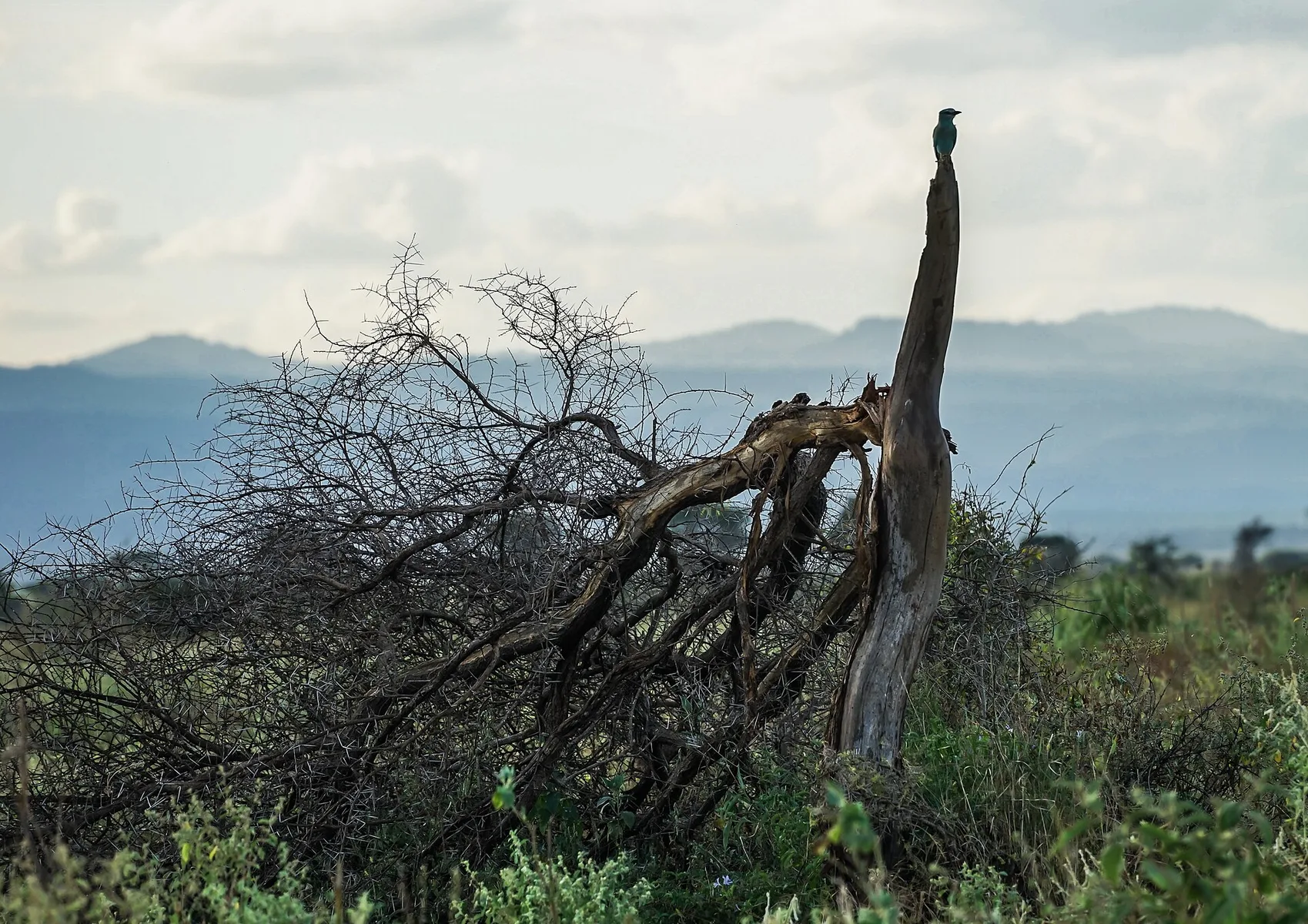
The Mara has excellent raptors, grassland birds, river species and a rich broader ecosystem. Meru's habitat variety gives it a particularly strong birding identity, and KWS describes the park as a birdwatchers' paradise.
| Birding choice | Meru | Masai Mara |
|---|---|---|
| Habitat turnover in one park | Excellent | Strong, with grassland emphasis |
| Specialist-guide availability | Must be arranged carefully | Broad camp choice, still confirm expertise |
| Vehicle traffic | Usually low | Can distract around mammal sightings |
| Combining birds and migration | No migration herds | Strong seasonal combination |
| Slow four or five-night bird trip | Excellent | Excellent in the right camp or conservancy |
Birders may find Meru more rewarding precisely because a guide is not pulled constantly toward someone else's lion report.
Hot-air balloon safaris
The Masai Mara is the clear choice for a classic hot-air balloon flight. Operators launch from selected areas, and the experience may include a dawn flight, landing and bush breakfast. Wind, weather, age, mobility, pickup distance and cancellation terms all matter.
Meru is not the standard Kenyan balloon destination. Its distinctive activities lie elsewhere: game drives, rhino-sanctuary context, birding, heritage, authorised walks, night experiences and lodge-specific bush meals.
| Balloon question | Confirm |
|---|---|
| Pickup | Exact time and drive from the lodge |
| Flight | Weather decision and rescheduling policy |
| Mobility | Basket boarding and landing position |
| Child rule | Current age, height and operator conditions |
| Reserve fees | Included or added for the flight day |
Do not choose the Mara only for a balloon unless every traveller actually wants the early start and physical experience.
Walking and night activities
Activities depend on the exact land-management rules and lodge. Mara conservancies can allow guided walks, night drives and off-road practices that differ from the National Reserve. Reserve rules must be followed inside the reserve.
KWS lists guided nature and night experiences in Meru's visitor context, while individual lodges publish specific activities. Current authorisation, trained guides, ranger requirements, age and weather must be confirmed.
| Activity | Meru | Greater Mara |
|---|---|---|
| Day game drive | Core experience | Core experience |
| Guided walk | Confirm KWS and lodge arrangement | Often a conservancy strength, property specific |
| Night drive | Confirm current authorised arrangement | Usually conservancy land, not ordinary reserve drive |
| Balloon | Not standard | Major Mara option |
| Heritage | Elsa and Pippa context | Maasai community and conservation context, community led |
The word “included” should name the place, duration, staffing and age limit.
Community experiences
The Mara is surrounded by Maasai communities and community conservancies. A respectful visit is hosted, paid transparently and shaped by the community rather than built around intrusive photography or staged poverty.
Meru's surrounding cultural context is different. KWS references Tharaka Nithi cultural heritage and the park also carries Mau Mau and Born Free history. A package should not use “local village” as a generic interchangeable activity.
| Respectful question | Why ask it |
|---|---|
| Who invited and hosts the visit? | Establishes consent and ownership |
| Where does the payment go? | Makes benefit visible |
| Can people refuse a photograph? | Protects dignity |
| Is buying crafts optional? | Removes pressure |
| How long does the visit last? | Prevents it displacing core safari time |
Best time for Meru
Meru is open year round. Drier periods can simplify road movement and make some wildlife easier to find around water. Greener periods can bring lush scenery, dramatic cloud, strong birding and very few visitors, with more route changes after rain.
| Meru preference | Planning direction |
|---|---|
| Easier road movement | Lean toward drier periods |
| Green landscape and storm light | Consider wetter shoulder months |
| Maximum quiet | Avoid major holiday pressure and choose longer stay |
| Birding | Discuss migrants, breeding and rainfall with a specialist |
| Value | Compare current seasonal lodge rates and transport, not room alone |
The best time to visit Meru National Park guide explains the month-by-month trade-offs.
Best time for the Masai Mara
The Mara remains a strong wildlife destination outside the migration period. Peak migration months bring herd expectations, high prices and greater demand. Green months bring dramatic skies, young animals, birds and fewer vehicles, with road and rain considerations.
| Mara preference | Planning direction |
|---|---|
| Migration herds | Travel in the broad seasonal window but keep timing flexible |
| Possible river crossing | Stay longer near the relevant river and accept no guarantee |
| Resident big cats | Travel in any season with a well-positioned camp |
| Lower traffic | Consider green or shoulder season and a conservancy |
| Photography | Choose around grass, cloud, dust, crossings and crowd tolerance |
Season changes the experience, not whether the Mara has value.
Rain affects the two parks differently
Rain can turn either safari beautiful and complicated. Meru's size and varied internal roads make a capable vehicle and flexible route essential. In the Mara, black-cotton soil and river or plain tracks can become difficult while the green landscape creates extraordinary colour.
| Rain response | Good planning |
|---|---|
| A track closes | Let the guide change the circuit rather than force it |
| Flight is delayed | Protect connection time and know who contacts the next lodge |
| River rises | Never pressure a driver to cross unsafely |
| Wildlife disperses | Use habitat knowledge, not a rigid checklist |
| The afternoon clears | Keep the vehicle and guide available for changing light |
The best itinerary contains alternatives before the weather asks for them.
Ethical game driving matters more in a crowd
The Mara Triangle rules explicitly address vehicle numbers, distance, waiting and high-use zones because poor behaviour can disturb wildlife and damage the safari for everyone. Its patrol vehicles help enforce standards.
Meru's low traffic does not remove responsibility. KWS prohibits off-road driving, requires distance and limits speed. A lone vehicle can still block, crowd or frighten an animal.
| Ethical guide behaviour | What the traveller sees |
|---|---|
| Stops at a respectful distance | Animal chooses whether to approach or leave |
| Avoids blocking movement | Herd and predator paths remain open |
| Leaves a crowded sighting | The day gains another chance elsewhere |
| Keeps to authorised tracks | Habitat suffers less damage |
| Explains why not to approach | Safety and conservation outrank a photograph |
Choose the guide as carefully as the park.
What real travellers notice in Meru
A Meru visitor wrote that “the park is also empty and we only saw one other vehicle over the three days we were there”. The full independent Meru National Park review describes private-feeling sightings and the park's unusual palms and baobabs.
Another longer trip report valued the “great freedom of schedules, destinations and preferences” created by a private vehicle. The four-day Meru report is not a source for current prices, but its experience of pace remains relevant.
Meru's praise often returns to space rather than a single animal. That should influence the package design.
What real travellers notice in the Mara
The Mara can produce the opposite reaction. One recent review complained of “More than 30 vehicle waiting in line to see a cheetah”. The full traveller review page is a reminder that guide behaviour, season and location change the experience.
A camp traveller described how staff repeatedly reached a sighting first, then left as others arrived: “Time and time again we were first vehicle in”. The complete Mara camp review page shows why a skilled guide and well-positioned base matter as much as the destination name.
The Mara's challenge is not lack of wildlife. It is protecting quality amid fame.
Watch each safari rhythm before deciding
Independent travel creator Ella McKendrick asks whether the Masai Mara is worth the hype in a first-person video built around two safari days. For Meru, Jeff Hyer's Meru National Park safari vlog shows a sunrise drive, the rhino sanctuary and a quieter park rhythm.
Watch for road width, vegetation, time between sightings, vehicle position and the way the day feels. Do not treat edited wildlife sequences as a guarantee.
Three nights in Meru or three in the Mara?
| Day | Meru three-night shape | Mara three-night shape |
|---|---|---|
| Arrival | Long road or flight, short drive if light allows | Road or flight, reserve or conservancy drive |
| Full day 1 | River, woodland and open-habitat circuit | Big-cat and plains circuit around camp sector |
| Full day 2 | Rhino sanctuary and contrasting sector, heritage if natural | Another sector, migration focus in season or conservancy activities |
| Departure | Final drive or direct onward route | Final drive or airstrip transfer |
Both deserve more than two nights. Meru benefits especially from a fourth because internal variety and lower information-sharing reward another full day.
A six or seven-night Meru and Mara safari
Combining the two creates a stronger first Kenya safari than forcing one to imitate the other.
| Route | Nights | Transport logic |
|---|---|---|
| Nairobi, Meru, Mara, Nairobi | 3 plus 3 | Road or flight to Meru, then planned air connection or Nairobi transit to Mara |
| Nairobi, Mount Kenya, Meru, Mara | 2 plus 3 plus 3 | Road through central Kenya, fly across the country when practical |
| Nairobi, Meru, Laikipia, Mara | 3 plus 3 plus 3 | Northern road sector followed by flight to Mara |
| Nairobi, Mara, Meru, Samburu | 3 plus 3 plus 3 | Fly out of Mara, then use one northern road vehicle |
The connection must be built around real flight days and airstrips. A neat line on a map may hide a full lost day.
If you have only five safari nights
Five nights are not enough for two distant three-night stays once the connection is counted. Choose one park or give one a deliberately shorter supporting role only when transport is unusually clean.
| Five-night priority | Better plan |
|---|---|
| First safari, big cats and classic plains | Five Mara nights or four Mara nights plus a useful regional stop |
| Quiet wilderness, rhinos and northern route | Three or four Meru nights plus Mount Kenya or Laikipia |
| Migration hope | Base all five nights in a well-positioned Mara sector and let the guide follow conditions |
| Birding and landscape | Four or five Meru nights with a specialist guide |
| Both destinations are non-negotiable | Reconsider total holiday length or add a carefully matched flight and accept less depth |
Changing lodges can feel productive while consuming the exact dawn and late-afternoon hours that make a safari worthwhile. Keep the five nights coherent.
Which should come first?
Starting in Meru can let the holiday grow from silence into the high wildlife density and famous plains of the Mara. Starting in the Mara can satisfy the iconic first-safari expectation, then let Meru slow the final days.
| Order | Emotional arc |
|---|---|
| Meru then Mara | Discovery and quiet, followed by abundance and scale |
| Mara then Meru | Immediate safari impact, followed by privacy and reflection |
| Season decides | Put the less flexible flight or migration-region lodge first |
| Coast afterward | Finish with the park that connects most cleanly to the beach route |
There is no universal correct order. Flight logic and the traveller's preferred ending usually decide it.
Choose Meru if these statements sound like you
- I would rather search longer than sit in a vehicle queue.
- I want rhino-sanctuary context and varied habitat.
- Birds, landscape and small wildlife matter alongside cats.
- I enjoy a private vehicle and flexible schedule.
- I am already travelling through Mount Kenya, Laikipia or Samburu.
- Three or four nights in a quiet park sound better than a two-night checklist.
The Meru safari packages guide turns those preferences into road, fly-in, family, cottage and luxury trip shapes.
Choose the Masai Mara if these statements sound like you
- This is my first safari and I want classic open plains.
- Big cats are the leading priority.
- I hope to see migration herds in the right season.
- I want the widest possible lodge and flight choice.
- A balloon safari matters.
- I have limited nights and want a high density of wildlife opportunity.
Choosing the Mara does not require accepting poor crowd behaviour. Choose the exact sector, camp, guide, vehicle and season deliberately.
Common comparison mistakes
| Mistake | Better comparison |
|---|---|
| Comparing Meru with “the Mara” as one uniform place | Name reserve sector, Triangle or conservancy |
| Expecting a migration crossing on a fixed day | Plan for the ecosystem and stay longer |
| Calling Meru empty because wildlife takes longer to find | Value habitat, tracking and privacy |
| Calling the Mara crowded everywhere | Compare sector, season, camp access and guide behaviour |
| Comparing room prices only | Add fees, vehicle, transfers, flights and activities |
| Choosing a two-night Meru stop | Protect at least two full safari days |
| Promising Big Five in either park | Promise preparation, not wild behaviour |
The final Meru vs Masai Mara decision
Choose the Mara when you want Kenya's most famous open-plains wildlife theatre and accept that popularity must be managed carefully. Choose Meru when you want a more varied, private-feeling wilderness in which the search is part of the safari.
The strongest answer for many travellers is not “or”. It is a thoughtfully connected “and”. Three or four nights in Meru teach the eye to slow down. Three or four in the Mara show what abundance and open habitat can do. Together they reveal two honest versions of Kenya rather than one park forced to carry every expectation.
Find your Kenya safari fit
Share dates, travellers, wildlife priorities, crowd tolerance, room style, transport and budget. We will compare Meru and the Mara on the same basis.