
Masai Mara vs Serengeti: Two Halves of One Wild Story
The grass does not recognise the Kenya and Tanzania border. Travellers do, because each side creates a different kind of safari day.

The Masai Mara vs Serengeti question sounds like a contest until you stand in either landscape. Wildebeest cross the same ecosystem, lions patrol both sides and the Mara River refuses to care which passport sits in the vehicle.
- The same ecosystem is not the same safari
- Wildlife density, big cats and the Big Five
- Where the Great Migration may be
- Crowds, vehicles and finding quiet
- Where you sleep and how often you move
- Combining the Mara and Serengeti
- Cost, fees and value
- Three sensible ways to build the itinerary
- Who usually loves each side
- Traveller opinions
- FAQs
The same ecosystem is not the same safari
The Serengeti lies in northern Tanzania and continues into Kenya as the Greater Mara ecosystem. Animals move across a broad, unfenced landscape, although protected areas, community land and private conservancies have different rules. The famous wildebeest migration spends much of its annual cycle in Tanzania and may enter the Mara during the drier middle of the year.
The Serengeti is vast and divided into regions that feel different: southern short-grass plains, the central Seronera area, western corridor and northern river country. The Masai Mara National Reserve and surrounding conservancies cover a smaller space with hills, river lines and high wildlife density. That difference in scale changes how far you drive, how often other vehicles appear and how much time the itinerary needs.
| Question | Masai Mara | Serengeti |
|---|---|---|
| Scale | Compact and relatively quick to explore | Vast, with distinct regions and long transfers |
| Typical first stay | 3 to 5 nights | 4 to 7 nights across one or more regions |
| Gateway | Nairobi or Wilson Airport | Arusha, Kilimanjaro Airport and bush airstrips |
| Signature feeling | Wildlife intensity and close geographical variety | Space, horizons and a moving expedition |
Wildlife density, big cats and the Big Five
The Mara can feel generous very quickly. Lions, elephants, giraffes, buffalo, hyenas and plains game live here year-round. Leopards and black rhinos are possible but never routine. Because the ecosystem is compact, a good guide may move between habitats without a long empty transfer. That helps travellers with only three nights.
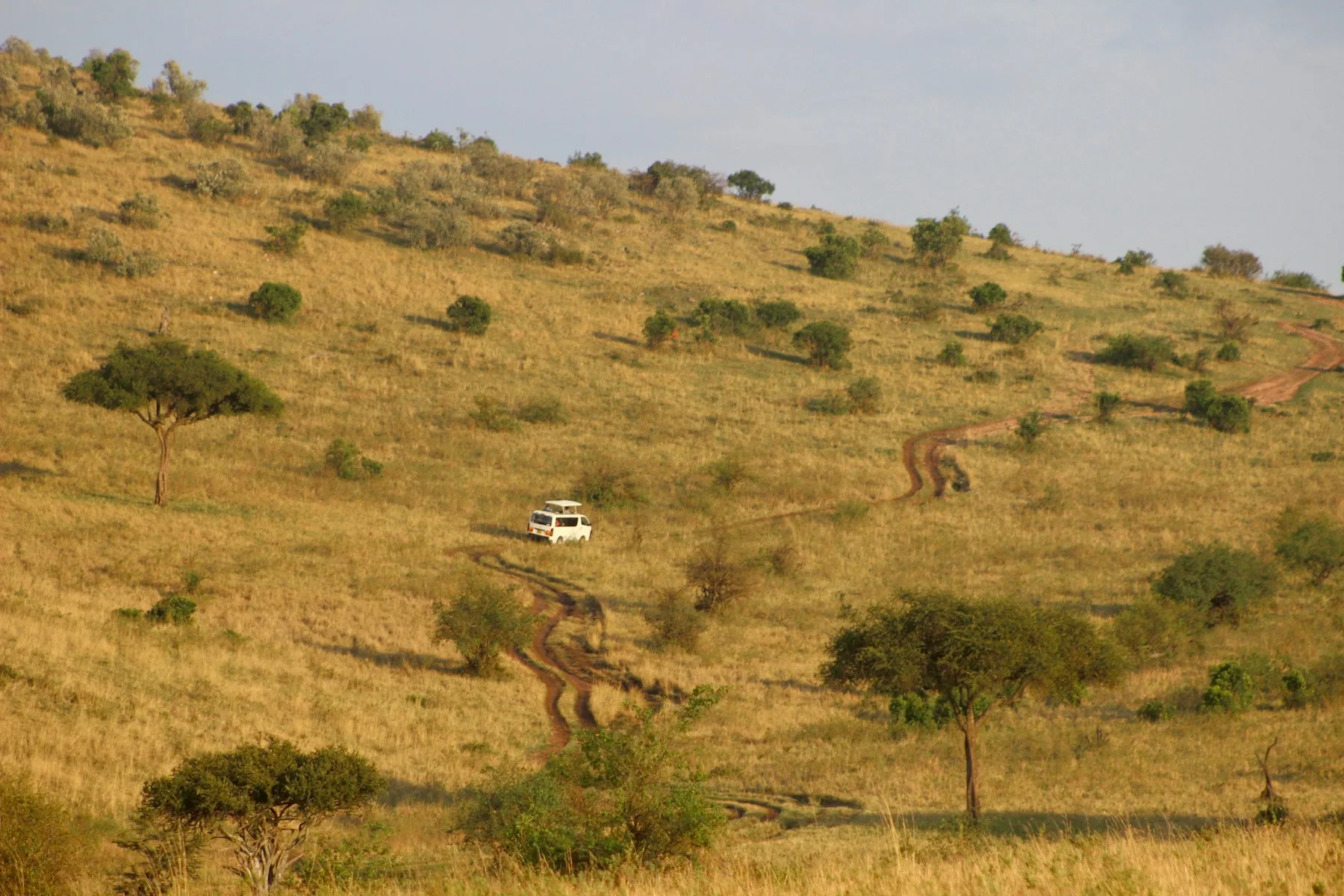
The Serengeti contains extraordinary wildlife, but animals can be spread across an immense area. Central Serengeti is known for resident game and cats, while the seasonal herds draw attention elsewhere. The reward is not only a species list. A kopje with lions and no other vehicle, or a road disappearing across open plain, is part of why travellers remember its scale.
For concentrated game viewing
The Mara often gives a strong first safari quickly, especially with a skilled local guide.
For landscapes and ecological scale
The Serengeti asks for more time and returns a deeper sense of distance.
For cats
Both are excellent. Location, season and patient guiding matter more than a national border.
Where the Great Migration may be
The migration is a year-round search for water and fresh grazing. Calving is associated with the southern Serengeti and Ndutu area early in the year. The herds may move through central and western Tanzania before reaching the northern Serengeti and Greater Mara during the middle and later part of the dry season. Rain can accelerate, delay or divide that movement.
A Mara River crossing can happen in northern Tanzania or Kenya, and the same animals may cross more than once. A two-night stay cannot guarantee that the herd will gather, decide and enter the river while you are present. Choose a well-informed location, stay several nights and treat every crossing as a possibility rather than the only measure of a successful safari.
| Broad period | Likely focus | Planning note |
|---|---|---|
| January to March | Southern Serengeti and calving country | Mobile or seasonal camps may follow the herds |
| April to June | Movement north and west through Tanzania | Rain and road conditions shape access |
| July to October | Northern Serengeti and Greater Mara | River interest, high demand and possible crowds |
| November to December | Movement back toward Tanzania | Short rains can change the route quickly |
Crowds, vehicles and finding quiet
A famous cat or river crossing can draw many vehicles on either side of the border. The Mara feels this more visibly because it is smaller. Staying in a private conservancy can create quieter drives and a controlled number of beds, while selected reserve days keep the wider Mara experience. In the reserve, an early start and a guide willing to leave a busy sighting can change the mood.
The Serengeti can also be busy around central roads, well-known kopjes and migration gatherings. Its size gives a guide more ways to create distance, but that may require fuel, time and a camp in the right seasonal region. Quiet is rarely delivered by a country name. It comes from location, camp density, guide judgement and the freedom to travel beyond the obvious circuit.
Where you sleep and how often you move
The Mara has everything from large permanent lodges to intimate conservancy camps. A single base can work for four nights when it is well located. A split between reserve and conservancy adds different rules and atmosphere, but the transfer should not consume a prime wildlife morning.
The Serengeti is especially suited to seasonal and mobile camps that move in broad response to the migration. Permanent camps provide established rooms and public areas. A northern camp in February or a southern camp in August may be a beautiful property in the wrong place for the herds, so region matters before brand.
| Stay style | Mara use | Serengeti use | Best question |
|---|---|---|---|
| One permanent lodge | Easy base for a short trip | Works when focused on one region | Which wildlife areas are within a normal drive? |
| Small tented camp | Strong sense of place and personal guiding | Available across several regions | Is it seasonal or open all year? |
| Split stay | Reserve plus conservancy or east plus west | Two or more ecological regions | How long is the transfer and what does it add? |
| Mobile camp | Less common as a core pattern | Designed around seasonal migration areas | When and where will this exact camp operate? |

Combining the Mara and Serengeti
There is no tourist road gate that lets a safari vehicle drive directly from the Mara into the Serengeti. A combined journey usually uses flights, changes vehicle and guide, or travels through formal border points on a longer road route. That is why a seven-day itinerary that rushes Nairobi, Mara, Serengeti and Ngorongoro can feel more like logistics than safari.
With ten to fourteen safari days, the combination becomes much more rewarding. Spend at least three nights in the Mara, allow the international transfer to breathe and give Tanzania enough time for the Serengeti region and Ngorongoro if that is part of the plan. If you have only a week, one country often creates the richer experience.
- Do not assume a direct park-to-park road crossing
- Check baggage limits on every light-aircraft sector
- Allow time for immigration and vehicle changes
- Avoid one-night camps across multiple regions
- Protect at least three nights in the Mara
- Use one-country depth when the total trip is short
Cost, fees and value
The Mara can be reached by road from Nairobi, which creates a strong-value private safari for a small group. Fly-in conservancy stays rise in price through flights, conservation fees and camp vehicles. Tanzania often involves longer circuits, higher transfer costs and more nights, although the exact comparison depends on season and accommodation.
Do not compare only a daily rate. Compare nights, fee days, private or shared vehicle, internal flights, camp region, room, drinks, laundry and activities. A four-night Serengeti trip in the correct region may offer better value than a cheaper trip that spends two days driving toward the wildlife. The same logic applies to a Mara camp outside a distant gate.
Three sensible ways to build the itinerary
For a Kenya-focused week, spend three or four nights in the Mara and use the remaining time for Nairobi, Amboseli, Samburu, a Rift Valley lake or a flight to the coast. This route keeps the border out of the safari and lets a private guide stay with the group. It is especially comfortable for a first visit with children or a beach ending.
For a Tanzania-focused week, use Arusha as the gateway and give the Serengeti several nights in a region chosen for the season. Add Ngorongoro or Tarangire only when the road sequence remains comfortable. One-night stops scattered across the northern circuit create impressive destination lists but leave little time for animals.
For a combined East Africa journey, think in terms of twelve or more safari days rather than squeezing both names into a week. A strong version might use three or four Mara nights, a planned air or land transfer, then four or five Serengeti nights and time for another Tanzanian ecosystem. The goal is not to cross a border. It is to understand why the landscape feels different after it.
| Route | Comfortable safari time | Natural additions |
|---|---|---|
| Kenya depth | 3 to 5 Mara nights | Amboseli, Samburu, coast or Rift Valley |
| Tanzania depth | 4 to 7 Serengeti nights | Ngorongoro, Tarangire or Lake Manyara |
| Both countries | 10 to 14 safari nights | Flight connection and a slower regional journey |
Who usually loves each side
Choose the Mara when time is limited, Kenya is already the focus, you want an easy safari-and-beach combination, or close wildlife density matters more than an epic overland journey. It also suits families and first-time travellers who want a strong experience without moving camp every two nights.
Choose the Serengeti when the scale of the landscape is a central dream, you have enough time for regions to unfold and Tanzania’s northern circuit already makes sense. Choose both when you have the days and budget to let each be itself. The best answer is not a winner. It is the trip whose rhythm matches yours.
What travellers say after the trip
These are exact words from public reviews and discussions. Each person had their own route, budget and expectations, so the value is in the detail rather than treating one experience as a promise.
I have visited both the Serengeti and the Maasai Mara and I don’t think you can really choose which is better as they are both slightly different.
A traveller comparing the Serengeti’s scale with the Mara’s strength for a shorter safari.
It’s the space that gets you.
A Serengeti visitor remembering the view from a rise and plains running to the horizon.
I agree – I’ve been to both the Masai Mara and the Serengeti and the experience on the Mara side was so much better.
One traveller preferred the Mara because wildlife felt more concentrated, while still calling the Serengeti amazing.
Masai Mara vs Serengeti questions
What is the short answer about Masai Mara vs Serengeti?
The Mara is more compact and easier to combine with a short Kenya itinerary. The Serengeti is much larger and rewards more time across several regions.
How many safari nights should I allow?
Allow at least three nights for the Mara. Give the Serengeti four to six nights if you want to move between regions rather than stay only in the central area.
Will I see the Big Five?
No ethical safari can guarantee particular animals. A skilled guide, a good location and enough time improve the chance while keeping the experience honest.
Is the Great Migration guaranteed?
No. The migration is a continuous natural movement shaped by rain and grazing. River crossings are unpredictable events, not appointments.
Is a private vehicle worth the cost?
It is valuable for photographers, families and travellers who want control over pace. Shared drives cost less and can be sociable, but the group agrees on timing and sighting length.
Can I travel in the rainy season?
Yes. Expect greener landscapes, fewer vehicles and the chance of muddy tracks. A capable vehicle and flexible itinerary matter.
Should I fly or drive?
The Mara is accessible by road or a short flight from Nairobi. Serengeti circuits commonly begin near Arusha and may combine road and bush flights.
Can children enjoy this trip?
Yes, when drive length, room layout, meal times, pool safety and toilet breaks are planned around their ages.
How far ahead should I book?
Migration months, festive periods and small camps fill first. For flexible green-season dates, there is often more room to compare.
How can NLS Safaris help?
We can design the Kenya part of the journey around your dates, preferred Mara area, accommodation style, vehicle choice and onward beach or regional travel.
Sources and further reading
Official park, heritage, tourism, aviation and regulatory sources support the practical details in this guide.
Turn the comparison into your safari
Tell us when you are travelling, how many days you have and whether Kenya, Tanzania or both are already in your plans.
Plan your East Africa safari
Share the dates, total nights and the wildlife moments you care about. We can help shape the Kenya route and connect it sensibly with the wider region.