
Samburu Cultural Village Visits: How to Make the Experience Respectful and Worthwhile
Learn how to choose a community-led Samburu visit, understand where the fee goes, prepare for photography and shopping, and arrive ready for a genuine two-way conversation.
- Samburu cultural village visits at a glance
- What a cultural village visit actually is
- Respectful means more than being polite
- Community-led is the most important test
- The Samburu are not a safari attraction
- Samburu and Maasai identity are not interchangeable
- No two Samburu communities are identical
- Where cultural visits take place
- A lodge-arranged visit can be excellent
- A conservancy-led visit adds a land story
- Umoja needs its own context
- What may happen when you arrive
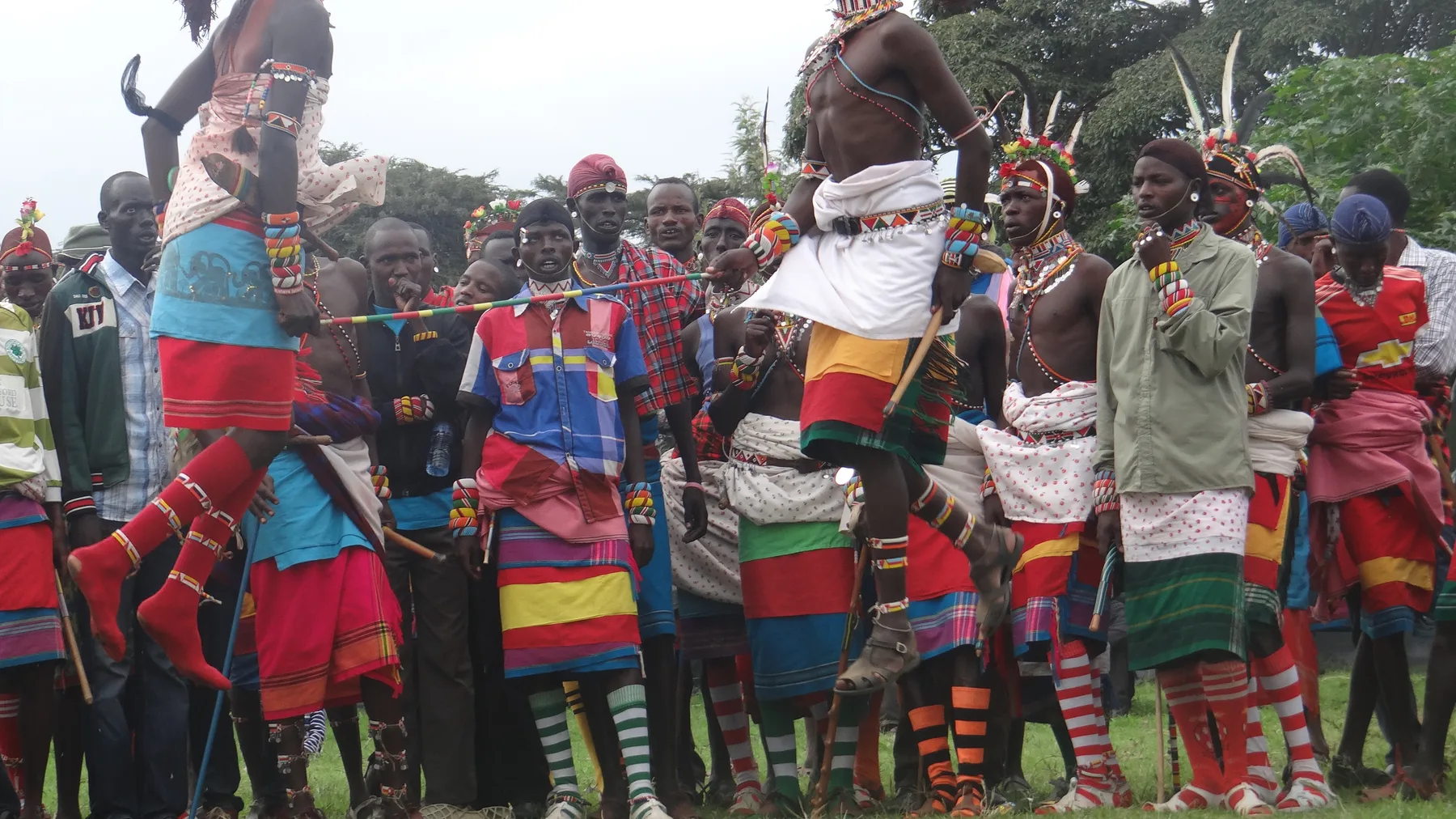
- Welcome songs and dance are not background entertainment
- A homestead is somebody’s home
- Livestock opens a deeper conversation
- Beadwork is skill, time and enterprise
- Shopping should never become a pressure tunnel
- Bargaining needs judgment
- How fees and payments should work
- Tipping is not a substitute for fair payment
- Gifts can help or complicate the visit
- School visits require extra care
- Photographing adults requires individual permission
- Photographing children needs a higher standard
- Video and social media need separate thought
- Conversation is better than a checklist interview
- Topics that deserve sensitivity
- Language and interpretation shape the experience
- How long should a visit last
- The best time of day depends on community life
- Dress for sun, dust and respect
- Children can gain a great deal from the visit
- Accessibility must be discussed before arrival
- Toilets and comfort are practical, not embarrassing
- Safety around livestock, fires and dogs
- Health precautions should remain proportionate
- What independent travellers have said
- Signs of a well-designed visit
- Warning signs before you book
- Questions to ask your safari planner
- How to place the visit in a safari day
- Pair culture with the wider Samburu landscape
- A village visit should not replace a fair safari itinerary
- Cultural visits for honeymooners
- Cultural visits for photographers
- Cultural visits for large groups
- What direct community benefit can look like
- How climate and drought change a visit
- The visit can evolve without becoming less authentic
- If a visit feels uncomfortable, respond calmly
- How to leave well
- A simple planning checklist
- Build the right Samburu experience
A good Samburu cultural village visit does not begin with a dance or a camera. It begins with an invitation. Someone from the community has agreed to host you, decided what can be shared and set aside time that could otherwise be spent herding livestock, making beadwork, caring for children or running a local business.
That changes the way the visit should feel. You are not walking into an exhibit of a culture fixed in the past. You are meeting people whose lives move between tradition and modern Kenya, often with mobile phones, school timetables, livestock, small enterprises and family responsibilities all occupying the same day.
This guide explains how Samburu cultural village visits can be arranged with respect. It covers community-led experiences, fees, photography, beadwork, dance, schools, gifts, children and the questions that reveal whether local people are genuinely benefiting.
Samburu cultural village visits at a glance
| Question | A good answer |
|---|---|
| Who invited the group? | A named community, cultural centre, conservancy or host |
| Who receives the fee? | The payment route and community benefit are explained |
| Can I take photographs? | Only after asking, with a clear chance to say no |
| Must I buy beadwork? | No, shopping is optional and prices are discussed openly |
| Is every visit the same? | No, activities depend on the hosts, place and day |
| How long should I allow? | Usually enough time for conversation, not a rushed photo stop |
Place the experience inside a sensible Samburu safari itinerary and read the wider Samburu safari guide before deciding where it fits.
What a cultural village visit actually is
The phrase covers several different experiences. It might mean a hosted visit to a manyatta or homestead, a community cultural centre, time with beadwork artisans, a guided walk with local interpretation, a conversation with elders or a women-led enterprise. A short performance may be included, but performance alone does not define the visit.
| Format | What may be shared | Best expectation |
|---|---|---|
| Homestead visit | Livestock, home life, building methods and conversation | Personal, small and permission-led |
| Cultural centre | Demonstrations, displays, crafts and organised performance | Structured and easy to interpret |
| Artisan visit | Beadwork process, design and sales | Focused on skill and enterprise |
| Conservancy experience | Culture, land use and wildlife coexistence | Links daily life with conservation |
| Hosted walk | Plants, grazing country, water and local history | Landscape understood through local knowledge |
The itinerary should name the format rather than hide everything behind “village visit.”
Respectful means more than being polite
Politeness matters, but respectful tourism also concerns power and money. Hosts should control access. They should be able to decline a photograph, change the programme or cancel when community life requires it. They should know how fees are collected and have a voice in what visitors are told.
| Respect in practice | What it looks like |
|---|---|
| Consent | The community knows you are coming and agrees to host |
| Control | Hosts choose what is shown and discussed |
| Fair exchange | Time, knowledge and performances are compensated |
| Dignity | People are introduced by name and role, not displayed as scenery |
| Privacy | Homes, children and ceremonies are not assumed to be public |
| Accuracy | Samburu people describe their own lives and identity |
A warm smile from a host does not remove the visitor's responsibility to ask.
Community-led is the most important test
Community-led does not necessarily mean that no lodge, guide or tour company is involved. It means local people shape the experience and receive a meaningful benefit. A good guide can translate, prepare guests and prevent awkward mistakes, while still allowing the host to lead.
| Arrangement | Useful question |
|---|---|
| Lodge introduces a nearby community | Who agreed the programme and fee? |
| Conservancy employs cultural guides | Are they community members and paid guides? |
| Independent host welcomes visitors | How is the visit booked and compensated? |
| Cultural centre runs set visits | Who manages the centre and its income? |
| Outside guide brings guests | Has the community confirmed the visit? |
The words “authentic” and “local” are not proof. Follow the decision-making and the money.
The Samburu are not a safari attraction
Wildlife can be watched from a vehicle. People should not be approached in the same way. Avoid language that promises “tribes on display,” “untouched natives” or access to “primitive life.” It turns neighbours, hosts and professionals into props for somebody else's adventure.
| Avoid this frame | Use this understanding |
|---|---|
| A people frozen in time | A living culture adapting and choosing |
| Costumes for tourists | Clothing and adornment with social meaning |
| A generic tribal village | A named community with its own story |
| Free photographs | Images made with individual permission |
| Poverty sightseeing | A fair exchange of time, knowledge and income |
You do not need to make the visit solemn. Laughter and curiosity are welcome when the relationship begins with equality.
Samburu and Maasai identity are not interchangeable
The Samburu and Maasai are related culturally and linguistically, but they are not the same community. Calling every red-clad pastoralist “Maasai” erases Samburu identity. Your host or guide can explain relationships, differences and the words people prefer for themselves.
| Point | Visitor practice |
|---|---|
| Identity | Say Samburu when visiting a Samburu community |
| Language | Ask which language is spoken in that household |
| Dress | Do not assume colours and beadwork carry identical meanings elsewhere |
| History | Let local interpreters explain relationships and change |
| Names | Learn and use the host's name when invited |
Samburu County is also home to Rendille, Turkana, Borana, Pokot and people from many other Kenyan communities. Geography alone does not tell you someone's identity.
No two Samburu communities are identical
Families differ in religion, education, livelihoods, age, wealth and willingness to host tourists. One village may run a formal cultural centre. Another may offer occasional visits through a conservancy. A women-led enterprise may focus on beadwork and household income, while a pastoral household may centre the conversation on livestock and water.
| Difference | Why it changes the visit |
|---|---|
| Near reserve versus remote county | Visitor frequency and access differ |
| Conservancy membership | Tourism may connect to land and wildlife income |
| Women-led enterprise | Beadwork, savings and household priorities may lead |
| School calendar | Children should be learning, not waiting for tourists |
| Drought or rain | Herding and water responsibilities change |
| Family preference | Some topics or spaces remain private |
Do not demand that one host confirm everything you have read about Samburu culture.
Where cultural visits take place
Visits are possible around Archer's Post, the reserves, community conservancies and other parts of Samburu County. The county government describes cultural talks, traditional performances and village visits among activities communities may organise. Availability still depends on local arrangements, distance and the day.
| Setting | Planning implication |
|---|---|
| Near Samburu National Reserve | Easy to combine with a morning or afternoon drive |
| Buffalo Springs side | Route must match the bridge, gate and lodge position |
| Shaba area | A separate transfer may be needed |
| Community conservancy | Experience may connect culture, grazing and wildlife |
| Maralal and wider county | More time and a different northern Kenya itinerary |
Use Samburu, Buffalo Springs and Shaba compared to understand the geography before adding transfers.
A lodge-arranged visit can be excellent
A lodge can provide transport, a trusted introduction and a guide who explains etiquette before arrival. The best lodge-arranged visits are built on an ongoing relationship rather than a last-minute stop wherever a vehicle happens to pass.
| Ask the lodge | What the answer reveals |
|---|---|
| Which community will host us? | Whether the visit is named and planned |
| Who leads it? | Whether local people control the conversation |
| What does the fee support? | Whether benefit is clear |
| Is craft buying optional? | Whether guests will face pressure |
| May the community cancel? | Whether real life takes priority |
| How many guests attend? | Whether conversation is possible |
When choosing accommodation, consult where to stay in Samburu, Buffalo Springs and Shaba, then ask each property how its community relationship works.
A conservancy-led visit adds a land story
Community conservancies can connect culture with grazing, water, wildlife corridors, ranger employment and tourism revenue. That context prevents the visit from becoming a disconnected performance. It helps guests understand why cattle, elephants, drought and tourism all belong to the same landscape conversation.
| Topic | What a local guide may explain |
|---|---|
| Grazing | How herds move and pasture is managed |
| Water | Why rivers, wells and rainfall matter |
| Wildlife | Costs and benefits of living beside animals |
| Employment | Guiding, rangers, hospitality and enterprise |
| Governance | How community decisions are made locally |
Not every conservancy works in the same way. Ask about the specific institution rather than praising “community conservation” as a vague idea.
Umoja needs its own context
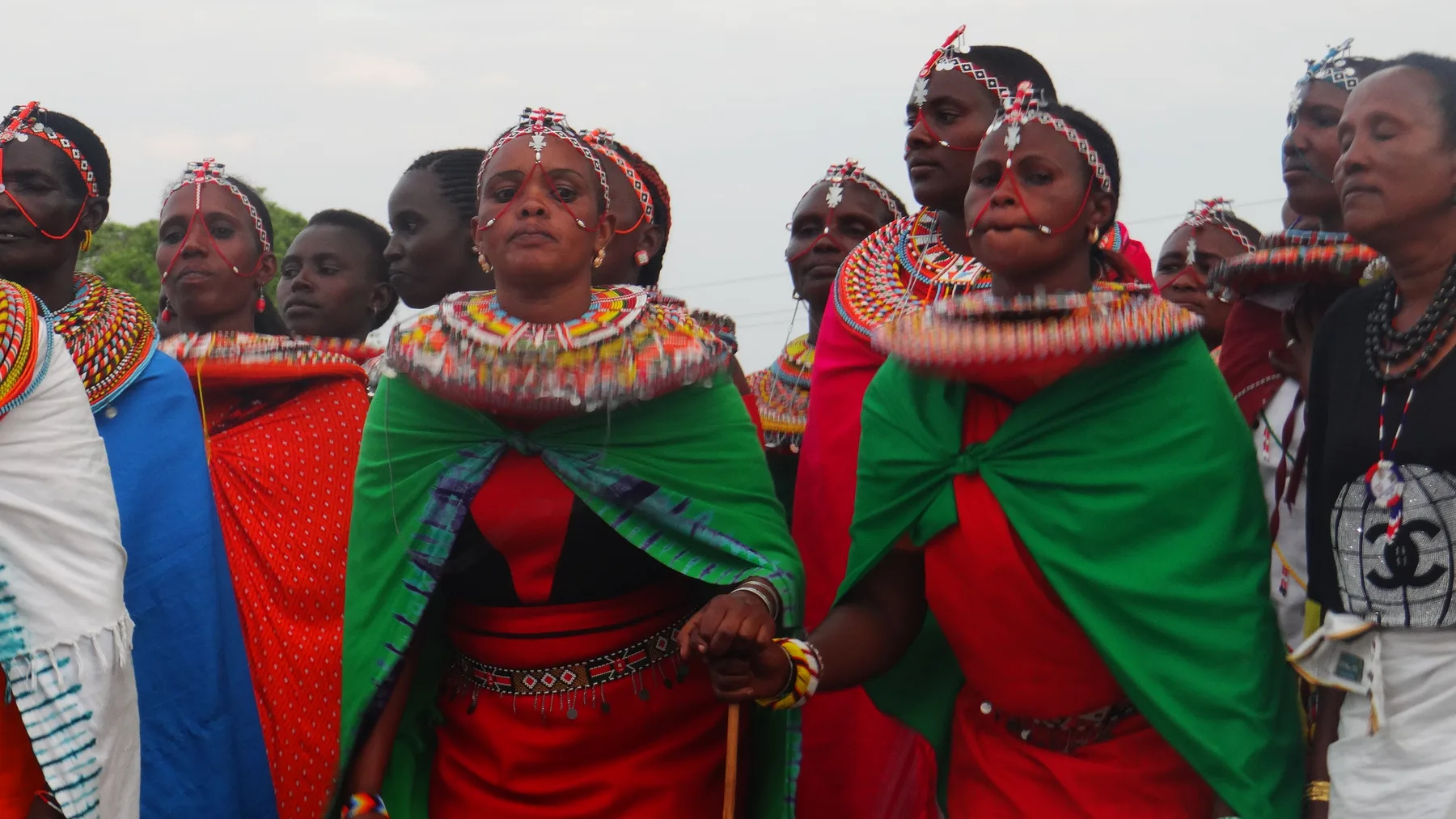
Umoja is widely known as a women-founded village near Archer's Post. Visitors should resist reducing it to a dramatic headline. If you visit, listen to how the women themselves describe the community, its work and its history. Buy beadwork because you value the work, not because a simplified story makes refusal feel impossible.
| Before visiting | During the visit |
|---|---|
| Confirm that Umoja is the actual host | Let the hosts tell their own story |
| Ask how the fee is handled | Request permission before portraits |
| Understand the group size | Give artisans time to explain their work |
| Leave room in the schedule | Shop by choice, not obligation |
Umoja is one community, not a shortcut for understanding every Samburu woman's life.
What may happen when you arrive
The sequence varies. A host might welcome the group, explain the place, introduce family members, discuss livestock or homes, demonstrate beadwork and invite questions. Song or dance may be part of the welcome. It should not be treated as a guaranteed show that must begin the moment the safari vehicle stops.
| Possible element | Good visitor response |
|---|---|
| Spoken welcome | Listen before lifting a camera |
| Introductions | Share your own name too |
| Walk through the settlement | Follow guidance on private spaces |
| Demonstration | Ask what the skill means today |
| Conversation | Avoid turning people into interview subjects |
| Craft display | Browse without assuming a purchase is required |
The most valuable part may be a quiet conversation that no itinerary could script.
Welcome songs and dance are not background entertainment
Song and dance can carry social, celebratory and spiritual meanings. A visitor does not need to decode every movement, but should understand who is performing, why that form was chosen and whether joining is genuinely welcomed.
| Moment | Respectful response |
|---|---|
| Performance begins | Watch first and follow the host's lead |
| You are invited to join | Accept or decline warmly |
| You want video | Ask before recording |
| A child performs | Confirm adult and child consent |
| Meaning is unclear | Ask an open question afterwards |
Applause is fine. Treating the performance as a competition for the highest jump or best photograph can flatten its meaning.
A homestead is somebody’s home
Construction methods, cooking areas, sleeping spaces and livestock enclosures can be fascinating. They are still part of a household. Enter only where invited. Do not open objects, peer into closed spaces or photograph interiors merely because a guide walked ahead.
| Home etiquette | Reason |
|---|---|
| Wait at the entrance | The host controls access |
| Ask before sitting | Places may have a purpose or owner |
| Keep food packed away | Avoid litter and awkward sharing |
| Supervise children | Homes and livestock are not playgrounds |
| Leave everything in place | Objects are used, not staged props |
If the host says a space is private, that answer needs no further explanation.
Livestock opens a deeper conversation
Cattle, goats, sheep and camels can be central to livelihoods, identity and household security. Ask about breeds, grazing, water or how families respond to drought. Avoid asking only how many animals somebody owns, which can be personal in the same way that demanding a stranger's bank balance is personal.
| Better question | Why it works |
|---|---|
| Which animals cope best in dry years? | Invites knowledge, not a wealth tally |
| How has grazing changed? | Connects climate and land use |
| Who looks after young animals? | Opens a family and work discussion |
| What makes a healthy herd? | Values expertise |
| How do wildlife and livestock share space? | Connects the cultural and safari landscapes |
Beadwork is skill, time and enterprise
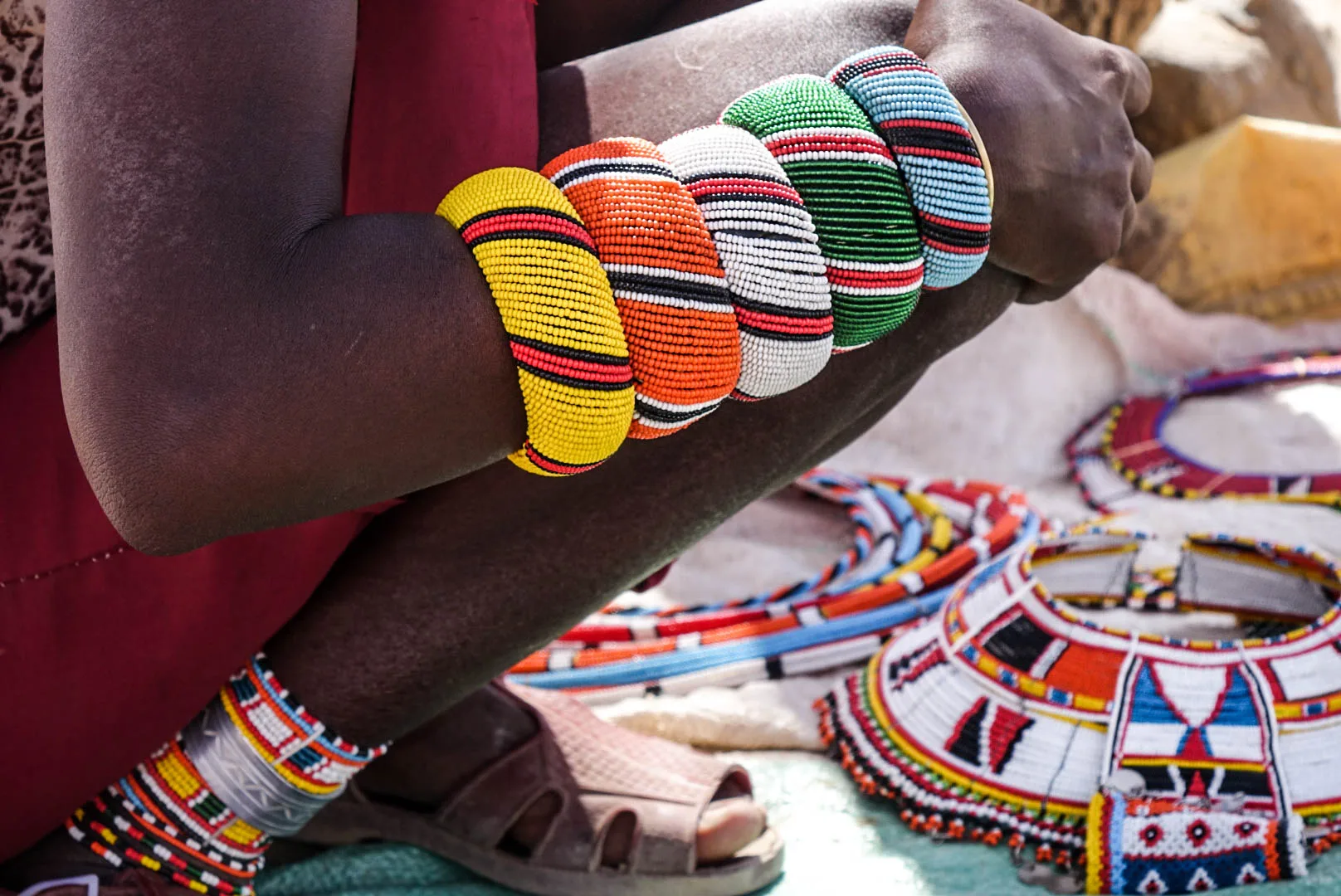
Samburu beadwork is visually striking, but colour and form should not be treated as a codebook that outsiders can decode from one necklace. Meanings can depend on the maker, wearer, occasion and local practice. Ask the artisan what a piece means to her and how long it took to make.
| What to notice | What to ask |
|---|---|
| Pattern | How was the design chosen? |
| Materials | Where do the beads and findings come from? |
| Time | How many hours or days did it take? |
| Wear | Is it made for daily use, ceremony or visitors? |
| Income | Does the maker set or receive the selling price? |
Buying directly can make the exchange tangible, provided the purchase remains voluntary and the price respects the work.
Shopping should never become a pressure tunnel
Some visitors enjoy buying jewellery, belts, ornaments or small household pieces. Others may have limited luggage or no interest in shopping. Both are valid. The host should be able to offer work without surrounding, shaming or preventing guests from leaving.
| Healthy craft sale | Warning sign |
|---|---|
| Prices are visible or calmly discussed | Each item triggers a new emotional demand |
| Makers are identified | Nobody can explain who receives payment |
| Browsing is comfortable | Guests are physically crowded |
| Declining is accepted | A guide says buying is compulsory |
| Payment options are clear | Prices change wildly without explanation |
If you do buy, allow time to choose thoughtfully instead of treating the table as a final obstacle before the vehicle.
Bargaining needs judgment
Bargaining may be expected in some settings, but turning a handmade item into a battle over a few dollars can feel unkind. Ask whether prices are fixed. If negotiation is welcome, keep it light, bundle items fairly and stop if the maker appears uncomfortable.
| Situation | Sensible approach |
|---|---|
| Fixed-price cooperative | Pay the marked price |
| Maker invites negotiation | Offer respectfully and explain your budget |
| Several items | Ask for a fair combined price |
| Price is beyond your budget | Thank the maker and decline |
| You are uncertain about quality | Ask about materials and construction |
The goal is a purchase both people feel good about, not a story about how little you paid.
How fees and payments should work
There is no universal price for Samburu cultural village visits. Duration, group size, transport, guiding, location and programme all matter. What should be universal is clarity. Know what the visit fee covers, who collects it and whether craft purchases are separate.
| Cost line | Confirm before arrival |
|---|---|
| Community visit fee | Per person, per group or included in itinerary |
| Local guide | Included or paid separately |
| Vehicle | Waiting time and distance included |
| Performance | Part of the visit or separately requested |
| Crafts | Optional and bought directly |
| Gratuity | Optional, with no forced amount |
A transparent fee respects the host more than pretending the encounter is free and then creating pressure at the end.
Tipping is not a substitute for fair payment
A tip can recognise a thoughtful host or guide, but the basic arrangement should already compensate people fairly. If the entire benefit depends on visitors guessing a tip, the system puts hosts and guests in an uncomfortable position.
| Payment type | Purpose |
|---|---|
| Agreed visit fee | Pays for the hosted experience |
| Guide fee or salary | Compensates interpretation and coordination |
| Craft purchase | Pays for a chosen item |
| Optional tip | Recognises exceptional personal service |
| Donation | Supports a named project with accountability |
Ask your planner how gratuities are usually handled locally, then give discreetly rather than making money part of a public performance.
Gifts can help or complicate the visit
Bringing sweets, pens or clothing may feel generous, but unplanned distribution can create competition, undermine local shops or place the host in an awkward position. Ask what is genuinely useful and give through an agreed adult, school or organisation.
| Gift idea | Better approach |
|---|---|
| Sweets for children | Avoid or provide through an agreed programme |
| Pens and notebooks | Ask the school what quantities and types are needed |
| Used clothing | Confirm need, size and distribution first |
| Printed photographs | Arrange delivery rather than promising casually |
| Cash | Use the agreed fee or named community fund |
Often the fairest contribution is simply paying properly, buying work you like and behaving as a considerate guest.
School visits require extra care
A classroom exists for students, not for visitors to collect photographs. Visit only with school approval, avoid interrupting lessons and never hand gifts directly to individual children. The school should decide what is useful and how it is distributed.
| Before a school visit | Minimum standard |
|---|---|
| Permission | Head teacher and community approval |
| Purpose | Clear learning or partnership value |
| Timing | Does not disrupt teaching or exams |
| Photography | School, guardian and child safeguards |
| Donations | Based on stated needs and recorded delivery |
If the only purpose is to watch children sing for tourists, reconsider the visit. Time with artisans, guides or conservation staff may offer a more equal exchange.
Photographing adults requires individual permission
Community approval for the group to visit is not automatic permission to photograph every person. Ask before making a portrait, especially inside a home or while somebody is working. A nod from the guide may not be enough if the subject has not been consulted.
| Photograph | Permission needed |
|---|---|
| Wide scene during an agreed welcome | Confirm the group policy first |
| Individual portrait | Ask the person directly through the guide if needed |
| Inside a home | Host and subject permission |
| Artisan at work | Ask before moving close or directing poses |
| Image intended for business use | Explain the use and obtain proper consent |
Show the photograph when practical. Do not promise to send it unless you have a reliable delivery route.
Photographing children needs a higher standard
Children may be curious about cameras, but enthusiasm is not sufficient consent. An adult responsible for the child and the community's own safeguards matter. Avoid close portraits, identifying details and social posts that you would not make of an unfamiliar child at home.
| Do | Avoid |
|---|---|
| Ask the responsible adult | Photographing from the vehicle window |
| Keep the context dignified | Images centred on poverty or distress |
| Accept a refusal immediately | Offering money for a child's portrait |
| Put the camera away during private moments | Posting names and locations casually |
| Follow school policy | Treating a classroom as a photo set |
Children are participants in their own lives, not proof that a traveller reached somewhere “real.”
Video and social media need separate thought
A person may agree to one photograph but not to video, livestreaming or commercial use. Explain if an image will be posted publicly. Geotagging can also reveal a home, school or sensitive location.
| Intended use | What to say |
|---|---|
| Personal album | Ask for a personal photograph |
| Public social account | Explain that it may be seen widely |
| Travel blog | Describe the article and audience |
| Business promotion | Obtain explicit, recorded permission |
| Livestream | Ask before the broadcast begins |
When in doubt, enjoy the conversation without recording it. A visit does not become less real because it stays off the internet.
Conversation is better than a checklist interview
Questions can create connection, but rapid-fire enquiries about marriage, circumcision, wealth or conflict can feel intrusive. Begin with the host's work and interests. Share something about yourself so the exchange does not resemble an interrogation.
| Good opening | Why it helps |
|---|---|
| What would you like visitors to understand about this place? | Gives the host control |
| How did you learn this skill? | Centres knowledge and experience |
| What changes most between dry and rainy seasons? | Connects daily life to the landscape |
| Which part of the work do you enjoy? | Makes the conversation personal |
| What do visitors often misunderstand? | Invites correction without demanding secrets |
Let silence happen. The interpreter may need time to carry meaning between languages.
Topics that deserve sensitivity
Religion, age-set traditions, gender, marriage, initiation and family relationships may be discussed when hosts choose to explain them. Do not push for private detail or ask a person to represent every Samburu view.
| Sensitive topic | Better practice |
|---|---|
| Ceremony | Ask what can be shared publicly |
| Marriage | Avoid personal questions unless invited |
| Initiation | Do not seek private ritual detail |
| Religion | Listen without debating belief |
| Gender roles | Ask how life is changing, without judging an individual |
| Conflict | Do not demand traumatic stories |
Curiosity becomes respectful when the other person can redirect or decline.
Language and interpretation shape the experience
Samburu, Kiswahili and English may all be used, depending on the hosts. A skilled local interpreter does more than translate nouns. They explain context, notice discomfort and help guests understand humour without stealing the host's voice.
| Interpretation choice | Effect |
|---|---|
| Community member interprets | Strong local context and direct benefit |
| Safari guide interprets | Useful continuity, but local lead still matters |
| No shared language | Demonstrations can work, though discussion is limited |
| Very large group | Translation becomes slow and impersonal |
| Small group | Easier questions and name learning |
Speak in short sentences, face the person rather than the translator and leave time for the answer.
How long should a visit last
A rushed twenty-minute stop can become a sequence of performance, photographs and hurried shopping. Around one to two hours often allows more space, though the right length depends on the activity and hosts. Artisan workshops or guided walks may deserve longer.
| Visit length | Likely shape |
|---|---|
| Under 30 minutes | Usually too rushed for meaningful conversation |
| About one hour | Welcome, introduction and one focused activity |
| Ninety minutes | More time for questions and craft browsing |
| Two hours or more | Suitable for a walk, workshop or deeper exchange |
| Half day | Only with a clearly designed community programme |
Leave enough flexibility for the visit to finish naturally without making the community wait for a late vehicle.
The best time of day depends on community life
Safari planners often put cultural visits into the hottest midday hours between game drives. That may be convenient for guests but not for hosts. Herding, markets, school, water collection, meals and heat all affect the day.
| Timing question | Why it matters |
|---|---|
| When do hosts prefer visitors? | Respects the community schedule |
| Is the group coming after a drive? | Late arrival should not make people wait |
| Is it market day? | Residents may have other priorities |
| Are children in school? | A visit should not pull them from class |
| Is rain or heat affecting access? | Comfort and road conditions change |
The community's preferred time should lead, with the safari schedule built around it.
Dress for sun, dust and respect
There is no need to imitate local clothing. Wear practical safari clothes that cover you comfortably, protect against sun and allow you to sit or walk without fuss. Avoid turning borrowed adornment into a comic costume or using sacred-looking objects as props.
| Bring | Why |
|---|---|
| Hat and sunscreen | Shade may be limited |
| Closed or secure shoes | Dust, thorns and uneven ground |
| Water | Heat can be intense |
| Modest, comfortable layers | Suitable for homes and community spaces |
| Small bag | Keeps hands free and reduces clutter |
If hosts invite you to try an item, ask how it should be worn and treat it carefully.
Children can gain a great deal from the visit
A well-prepared family visit can make culture, geography and conservation feel human. Explain beforehand that homes are private, gifts are not handed out and photographs require permission. Encourage children to prepare one genuine question rather than expecting local children to entertain them.
| Child preparation | Simple explanation |
|---|---|
| Greeting | Wait for the guide and introduce yourself |
| Camera | Ask before every portrait |
| Animals | Follow the host around livestock |
| Shopping | Choose a budget before arrival |
| Questions | Be curious without commenting on possessions |
| Gifts | Give only through the agreed adult |
Young travellers often respond best when they can watch a skill, compare daily routines or learn a word, not when adults deliver a long lecture.
Accessibility must be discussed before arrival
Many homesteads and village paths have sand, stones, thorny ground, low entrances and limited seating. A cultural centre may be easier than a household visit for somebody using a wheelchair or walking aid, but facilities vary.
| Need | Confirm in advance |
|---|---|
| Wheelchair | Surface, steps, doorway width and accessible toilet |
| Limited walking | Vehicle drop-off and seating distance |
| Heat sensitivity | Shade, visit time and water |
| Hearing | Quiet discussion space and interpreter position |
| Visual impairment | Guided touch only where hosts approve |
Do not promise accessibility from a photograph. Ask the host, describe the traveller's needs and choose the format that preserves dignity.
Toilets and comfort are practical, not embarrassing
Facilities may be simple or unavailable at a small homestead. Use lodge facilities before leaving, carry water and ask your guide what to expect. Never wander behind homes looking for privacy without permission.
| Practical need | Plan |
|---|---|
| Toilet | Ask before departure and use lodge facilities first |
| Handwashing | Carry sanitiser without making a display of it |
| Seating | Request a chair in advance if medically needed |
| Shade | Choose timing and bring a hat |
| Medication | Keep personal medicines with you |
Preparation lets you focus on the hosts instead of becoming anxious about basic needs.
Safety around livestock, fires and dogs
Children and adults should follow local guidance near cattle, goats, camels, cooking fires and guard dogs. A calm domestic setting is not the same as a petting zoo. Animals may protect young, food or territory.
| Risk | Safe response |
|---|---|
| Livestock moving through the settlement | Stand where the host directs |
| Guard dog | Do not approach or feed it |
| Cooking fire | Keep children close and bags clear |
| Thorns and uneven ground | Wear secure shoes |
| Heat | Drink water and shorten the visit if unwell |
| Sudden weather | Follow the guide's route back to the vehicle |
The host knows the space. Their instruction takes priority over getting a better angle for a photograph.
Health precautions should remain proportionate
Normal travel hygiene is enough for most visits. Do not wear masks, gloves or use sanitiser in a way that suggests the community itself is unclean. If you are ill, particularly with a contagious respiratory or stomach infection, postpone the visit rather than exposing hosts.
| Situation | Considerate action |
|---|---|
| Fever or contagious symptoms | Do not attend |
| Open wound | Cover it before arrival |
| Food is offered | Ask what it is and decline kindly if necessary |
| Animal contact | Wash hands afterwards |
| Dust sensitivity | Carry personal medication discreetly |
Respect includes protecting the health of people who did not choose your travel exposure.
What independent travellers have said
Personal reviews do not prove that every visit will be good, but they reveal what stays with people. One reserve reviewer wrote, “The visit to the Samburu village outside the reserve is also worthwhile.” Read the full Samburu National Reserve review context rather than treating one sentence as a guarantee.
Another traveller wrote, “For culture northern Kenya is highly recommended.” The longer safari discussion explains why the north felt distinct to that visitor.
| What reviews can tell you | What they cannot tell you |
|---|---|
| Whether conversation felt meaningful | Whether your host will offer the same programme |
| Whether pressure to shop occurred | The current fee or community arrangement |
| Whether timing worked | Whether every resident shared the reviewer's view |
| Whether a guide prepared guests | Whether photographs had proper consent |
Use reviews as questions to investigate, not as permission to expect a performance.
Signs of a well-designed visit
The strongest experiences usually have a named host, small group, clear payment, realistic timing and space for unscripted questions. Photography and shopping rules are explained before arrival.
| Good sign | Why it matters |
|---|---|
| Named community or centre | The visit has a real destination |
| Local host leads | Knowledge and authority remain local |
| Fee is explained | Benefit is less likely to be improvised |
| Small group | Conversation becomes possible |
| Optional crafts | Enterprise without coercion |
| Permission briefing | Hosts are not treated as public property |
| Cancellation is possible | Community life remains real |
A simple programme can be more responsible than an elaborate show if the relationship behind it is stronger.
Warning signs before you book
Be cautious when an itinerary promises a “free tribal village,” refuses to name the community or guarantees unrestricted photography. Also question a stop invented by a driver on the road without a confirmed host.
| Warning sign | Why to pause |
|---|---|
| “Authentic tribe” with no name | Marketing replaces accountability |
| No visit fee but expected donations | Pressure may appear at the end |
| Children waiting during school hours | Tourism may disrupt education |
| Photography described as unlimited | Individual consent is ignored |
| Forced craft purchase | Enterprise becomes coercion |
| Huge bus group | Privacy and conversation suffer |
| Guide cannot explain who benefits | Community value is unclear |
Ask for a different arrangement rather than assuming all cultural tourism works this way.
Questions to ask your safari planner
Specific questions turn a vague line on an itinerary into an accountable plan. The planner should be comfortable finding answers from the host instead of guessing.
| Ask | Strong answer contains |
|---|---|
| Which community hosts the visit? | A name and location |
| Who leads the experience? | A local guide, artisan, elder or group |
| What is included? | Duration, activities and transport |
| How are fees handled? | Amount, collection and community benefit |
| What is the photography policy? | Permission, children and private spaces |
| Is shopping optional? | A clear yes |
| Can mobility needs be accommodated? | A host-confirmed description |
If these details cannot be confirmed, leave the visit out until they can.
How to place the visit in a safari day
A cultural experience needs enough time and energy. Avoid sandwiching it between an overlong morning drive and a fixed sunset activity. The host should not absorb delays caused by wildlife sightings elsewhere.
| Safari-day pattern | How it works |
|---|---|
| Morning drive, lodge lunch, afternoon visit | Comfortable when the host prefers late afternoon |
| Early visit, later game drive | Useful when community activity happens in the morning |
| Dedicated half day | Best for a walk, workshop or conservancy story |
| Transfer-day stop | Works only with confirmed timing and no rush |
| Arrival-day visit | Risky after flights or a long Nairobi drive |
Check Nairobi to Samburu by road or air before using the arrival day.
Pair culture with the wider Samburu landscape
The experience becomes richer when visitors understand the Ewaso Nyiro River, dry-country wildlife, grazing and the Samburu Special Five. Culture and conservation should not occupy separate boxes on the itinerary.
| Related experience | Connection |
|---|---|
| Game drive | Wildlife costs and benefits for neighbouring communities |
| Guided walk | Plants, tracks, water and local knowledge |
| Beadwork visit | Enterprise linked to tourism income |
| Conservancy briefing | Land governance and wildlife coexistence |
| Reteti visit on a wider route | Indigenous-led elephant conservation and livelihoods |
Read the Samburu Special Five wildlife guide and best time to visit Samburu to build the natural history around the human story.
A village visit should not replace a fair safari itinerary
Adding a cultural stop does not make an otherwise rushed route responsible. Long transfers, one-night stays and constant packing leave little patience for real conversation. Give Samburu enough nights for wildlife, rest and a community experience that is not squeezed into leftover minutes.
| Stay length | Cultural planning |
|---|---|
| One night | Usually too tight after transport and game drives |
| Two nights | Possible, but choose priorities carefully |
| Three nights | Better balance of wildlife, rest and culture |
| Four or more nights | Room for conservancy activities and slower encounters |
Compare the destination with Samburu vs Amboseli and Samburu vs Masai Mara if the overall route is still undecided.
Cultural visits for honeymooners
Honeymooners often want something personal rather than a large group stop. Ask for a small hosted visit, artisan conversation or guided walk, then keep the rest of the day unhurried. Avoid turning the community into a stage for romantic photographs.
| Honeymoon preference | Better fit |
|---|---|
| Privacy | Small group or private hosted visit |
| Meaningful purchase | Choose a handmade keepsake together |
| Photography | One consented portrait rather than constant filming |
| Slow pace | Pair with lunch or sundowner, not three other activities |
| Celebration | Share the occasion only if it arises naturally |
The Kenya honeymoon safari guide can connect Samburu with a wider romantic route.
Cultural visits for photographers
Photographers should agree the purpose, time and compensation before arrival. A general visit fee may not cover a directed portrait session or commercial use. Natural conversation should not be interrupted repeatedly to rearrange people and objects.
| Photography plan | Requirement |
|---|---|
| Casual travel images | Individual consent and community rules |
| Extended portrait session | Time agreement and fair compensation |
| Video interview | Informed consent and intended audience |
| Commercial campaign | Written releases and professional fees |
| Drone | Legal compliance plus explicit community consent |
Carry minimal equipment, avoid flashes inside small homes and show respect when somebody changes their mind.
Cultural visits for large groups
Large groups can overwhelm a household, make translation impossible and turn a conversation into a performance. Split into smaller hosted groups only if the community has enough guides and agrees to the arrangement.
| Group issue | Better design |
|---|---|
| Twenty people around one speaker | Several small groups with local hosts |
| Many cameras | A clear photography briefing and limited time |
| Slow craft buying | Stagger browsing without blocking artisans |
| Bus arrival | Confirm parking, toilets and disturbance |
| Fixed departure | Tell hosts the true time before arrival |
The community should set its own maximum, not feel pressured to accept the operator's vehicle capacity.
What direct community benefit can look like
Benefit is not limited to cash handed over at the gate. It may include paid guiding, artisan income, conservancy revenue, employment, transport, a community fund or repeat partnership. The key is that local people can explain and influence the arrangement.
| Benefit route | Accountability question |
|---|---|
| Visit fee | Who records and allocates it? |
| Guide wage | Is the local guide paid directly or employed? |
| Craft sales | Does the maker receive the price? |
| Conservancy tourism income | How is it governed and shared? |
| Community project | Who chose the priority and reports progress? |
| Lodge partnership | Is the relationship ongoing and locally understood? |
Do not demand private financial records from a host. Ask the organiser for enough clarity to choose responsibly.
How climate and drought change a visit
In dry periods, water and grazing work may take priority. Families or livestock may move, hosts may be unavailable and dust or heat can intensify. Tourism should adapt rather than expecting the village to remain staged in one place.
| Condition | Possible change |
|---|---|
| Drought | Herding distances and household pressure increase |
| Heavy rain | Access roads and walking routes may change |
| Extreme heat | Shorter visits or earlier timing are kinder |
| River conditions | Conservancy routes can be affected |
| Livestock movement | Some family members may be away |
This flexibility is a sign of a real community relationship, not poor organisation.
The visit can evolve without becoming less authentic
Plastic water tanks, solar panels, school uniforms and phones do not make a Samburu community inauthentic. They show people solving present-day problems and choosing tools. Visitors who arrive searching only for an imagined past may ignore the most interesting story: how culture continues through change.
| Old expectation | More useful question |
|---|---|
| Everything must be handmade | Which skills remain important and why? |
| Modern objects spoil photographs | How has technology changed daily work? |
| Tradition never changes | Who decides what to keep or adapt? |
| Young people should stay the same | What opportunities do young people want? |
| Tourism preserves everything | What does the community want tourism to support? |
Authenticity belongs to the people living the culture, not to a visitor's visual checklist.
If a visit feels uncomfortable, respond calmly
Pressure to buy, unclear fees or intrusive photography by other guests can spoil the experience. Do not argue publicly with hosts or make assumptions about who caused the arrangement. Speak quietly to your guide, decline purchases politely and report serious concerns to the organiser afterwards.
| Problem | Immediate response |
|---|---|
| Unexpected extra fee | Ask the guide to clarify privately |
| Shopping pressure | Say no clearly and step away |
| Other guests photographing without consent | Alert the guide or group leader |
| Child safeguarding concern | Stop participating and report it |
| Host appears unprepared | Shorten the visit respectfully |
Thoughtful feedback should improve the partnership, not punish the community for an operator's poor briefing.
How to leave well
Thank the hosts, settle agreed payments, finish purchases without rushing and leave when the visit ends. Do not linger near private homes or continue photographing from the departing vehicle. If you promised to send images, obtain a reliable contact and follow through.
| Before departure | Check |
|---|---|
| Fee | Paid through the agreed route |
| Crafts | Items and change confirmed calmly |
| Tip | Given discreetly if desired |
| Photographs | Delivery contact recorded only with consent |
| Litter | Nothing left behind |
| Thanks | Offered directly to hosts, not only the safari guide |
A respectful departure is part of the experience, not merely the point when the next game drive begins.
A simple planning checklist
| Stage | Action |
|---|---|
| Choose | Name the community and visit format |
| Verify | Confirm community leadership and fee route |
| Prepare | Brief every traveller on photography and gifts |
| Schedule | Use the hosts' preferred time |
| Arrive | Listen before recording |
| Participate | Ask, share and follow local guidance |
| Purchase | Buy by choice and pay fairly |
| Leave | Thank hosts and keep promises |
| Review | Describe people and place with dignity |
The checklist is short because the central principle is simple: the people hosting you remain in control.
Build the right Samburu experience
A cultural visit can become one of the most human parts of a northern Kenya safari. It works when it is named, prepared and given time. It fails when it is sold as a free spectacle, used to fill midday or measured only by the number of photographs made.
Tell us what you hope to learn, who is travelling and where you plan to stay. We can match the visit to the route, ask the practical questions in advance and leave room for the community to lead the experience in its own way.
Sources and further reading
Plan a community-led Samburu visit
Share your dates, lodge, travellers, access needs and interests. We will confirm the visit with the host and prepare the practical details.