
Amboseli vs Masai Mara: Which Safari Is Right for You?
Compare elephants and Kilimanjaro with big cats, migration and sweeping Mara grasslands, then choose the experience that fits your actual holiday.

- Amboseli vs Masai Mara at a glance
- The landscapes feel completely different
- Which is better for elephants?
- Which is better for lions, cheetahs and leopards?
- The Great Migration does not make the Mara seasonal
- Kilimanjaro is not visible on command
- Wildlife variety beyond the headline animals
- Reserve, park and conservancy are not interchangeable
- Crowds depend on the exact sector and season
- Road or fly: the routing difference
- How many nights does each destination need?
- Which is better for a first safari?
- Which is better for families?
- Which is better for honeymooners?
- Which is better for photographers?
- Weather and season beyond the migration calendar
- Cost differences that matter
- Should you combine both parks?
- What travellers noticed after doing both
- When Amboseli is the clear choice
- When the Masai Mara is the clear choice
- The booking questions that make the choice clear
- The final verdict
- Related guides
- Sources and traveller accounts
There is a moment in Amboseli when an elephant family leaves the green edge of a swamp and walks onto pale, open ground. Dust lifts around their feet. If the clouds cooperate, Kilimanjaro appears behind them, much larger than it looked five minutes earlier. The scene is spacious and quiet enough to make a familiar photograph feel new.
The Masai Mara makes a different entrance. Grass rolls beyond the vehicle, a topi stands on a termite mound and a lioness disappears into a fold in the plain. During the migration season, wildebeest can occupy an entire horizon. Outside those months, the herds thin, but resident predators, plains game and the scale of the ecosystem remain.
Neither destination is a substitute for the other. Amboseli is a national park within a much wider elephant landscape. The Mara is a national reserve joined to community conservancies and the Serengeti ecosystem. One can produce an extraordinary morning with elephants and a mountain. The other can give you a week of changing predator, river, grassland and conservancy stories.
The useful question in an Amboseli vs Masai Mara decision is not “Which park is better?” It is “Which experience fits my wildlife priorities, season, available nights, pace and route?”
Amboseli vs Masai Mara at a glance
| Question | Amboseli | Masai Mara |
|---|---|---|
| Signature wildlife | Elephants, including large families and mature bulls | Big cats, plains game and seasonal migrant herds |
| Signature landscape | Swamps, dry lake basin, open plain and Kilimanjaro | Rolling grassland, river systems and escarpment |
| Protected-area type | National park managed by KWS | National reserve managed by county authorities, with Mara Triangle management and surrounding conservancies |
| Approximate protected core | About 390 sq km | About 1,510 sq km for the reserve, including the 510 sq km Mara Triangle |
| Best short stay | 2 to 3 nights | 3 to 4 nights |
| Strongest specialist interest | Elephants, landscape photography and wetland ecology | Predators, migration ecology and varied game viewing |
| Typical road access from Nairobi | Easier south-eastern road route | Longer south-western road journey |
| Flight value | Useful, but road often practical | Strong time-saver, especially on a short trip |
| Conservancy options | Present in the wider ecosystem, with varied models | Extensive community conservancy network |
| Main expectation risk | Kilimanjaro hidden by cloud | Migration or river crossing treated as guaranteed |
The landscapes feel completely different
Amboseli sits in a basin beneath Kilimanjaro. Water moving underground from the mountain feeds permanent springs and swamps. The result can look improbable: green wetland against dust, elephants standing belly-deep in vegetation and a white mountain rising beyond an otherwise dry plain.
The Mara is a grassland system of hills, streams, riverine woodland and open valleys. The Mara and Talek rivers shape wildlife movement. The Oloololo Escarpment defines the western edge of the Mara Triangle, while the southern boundary opens ecologically into Tanzania's Serengeti.
Landscape comparison
| Feature | Amboseli experience | Mara experience |
|---|---|---|
| Horizon | Flat basin and strong mountain backdrop | Rolling plains and broad valleys |
| Water | Permanent swamps and seasonal lake | Rivers, streams and seasonal pools |
| Woodland | Acacia and palm woodland in selected sectors | Riverine woodland and scattered acacia |
| Open country | Dry lakebed and plains | Extensive red-oat grassland |
| Visual drama | Elephant scale against Kilimanjaro | Predators and herds within immense grassland |
| Weather effect | Mountain can disappear behind cloud | Rain changes grass height, roads and migration distribution |
One traveller who visited both valued “the change in scenery after 3 days in Maasai”. That is the strongest reason to combine them. The second destination resets your eyes.
Which is better for elephants?
Amboseli is the clearer choice for an elephant-centred trip. Its long-running research project has followed known families across generations. Permanent water draws families into open viewing areas, and mature bulls use both the park and wider community landscape.
The Mara also has elephants, sometimes in impressive groups, but they share attention with predators and plains game. In riverine woodland, encounters can be intimate and beautiful. They are simply not the destination's defining promise in the same way.
Elephant comparison
| Priority | Better starting point | Why |
|---|---|---|
| Large family groups | Amboseli | Swamp and plain habitats make social groups visible |
| Named research history | Amboseli | Decades of individual and family records |
| Elephant with mountain | Amboseli | Kilimanjaro creates the classic composition when visible |
| Elephant in grassland and woodland | Both | Habitat and season shape each encounter |
| Super-tusker history | Amboseli wider ecosystem | Craig, Tim and Tolstoy are documented examples |
| Elephants plus intensive predator focus | Mara | Wider predator and plains-game context |
Use the Amboseli super tuskers guide for the documented history, and read ethical elephant viewing in Amboseli before entering the park.

Which is better for lions, cheetahs and leopards?
The Masai Mara is the stronger all-round choice for big-cat enthusiasts. Open plains help guides scan for lions and cheetahs. Riverine trees and drainage lines create leopard habitat. Resident prey supports predators throughout the year, not only when migrant wildebeest arrive.
Amboseli has lions, cheetahs and hyenas, but sightings can be less central to the experience. Tall vegetation, woodland and the distribution of prey change search conditions. A visitor who has already spent several days in the Mara should not judge Amboseli by whether it delivers another lion pride.
Predator comparison
| Cat or behaviour | Amboseli | Masai Mara |
|---|---|---|
| Lion | Present, with park and community-land stories | Major year-round focus across reserve and conservancies |
| Cheetah | Possible on open ground | Strong habitat and frequent specialist interest |
| Leopard | Present but often elusive | Riverine and conservancy habitats offer more opportunity |
| Hunt behaviour | Possible and unpredictable | More sustained predator-prey opportunity |
| Vehicle pressure | Can occur at rare sightings | Can be intense around cats, especially in busy sectors |
| Ethical control | KWS park rules | Reserve, Triangle and conservancy rules differ |
The Mara Triangle states that when more than five vehicles are waiting at an animal, viewing time may be restricted to ten minutes, with waiting vehicles kept back. The rule exists because a famous cat can draw a crowd quickly.
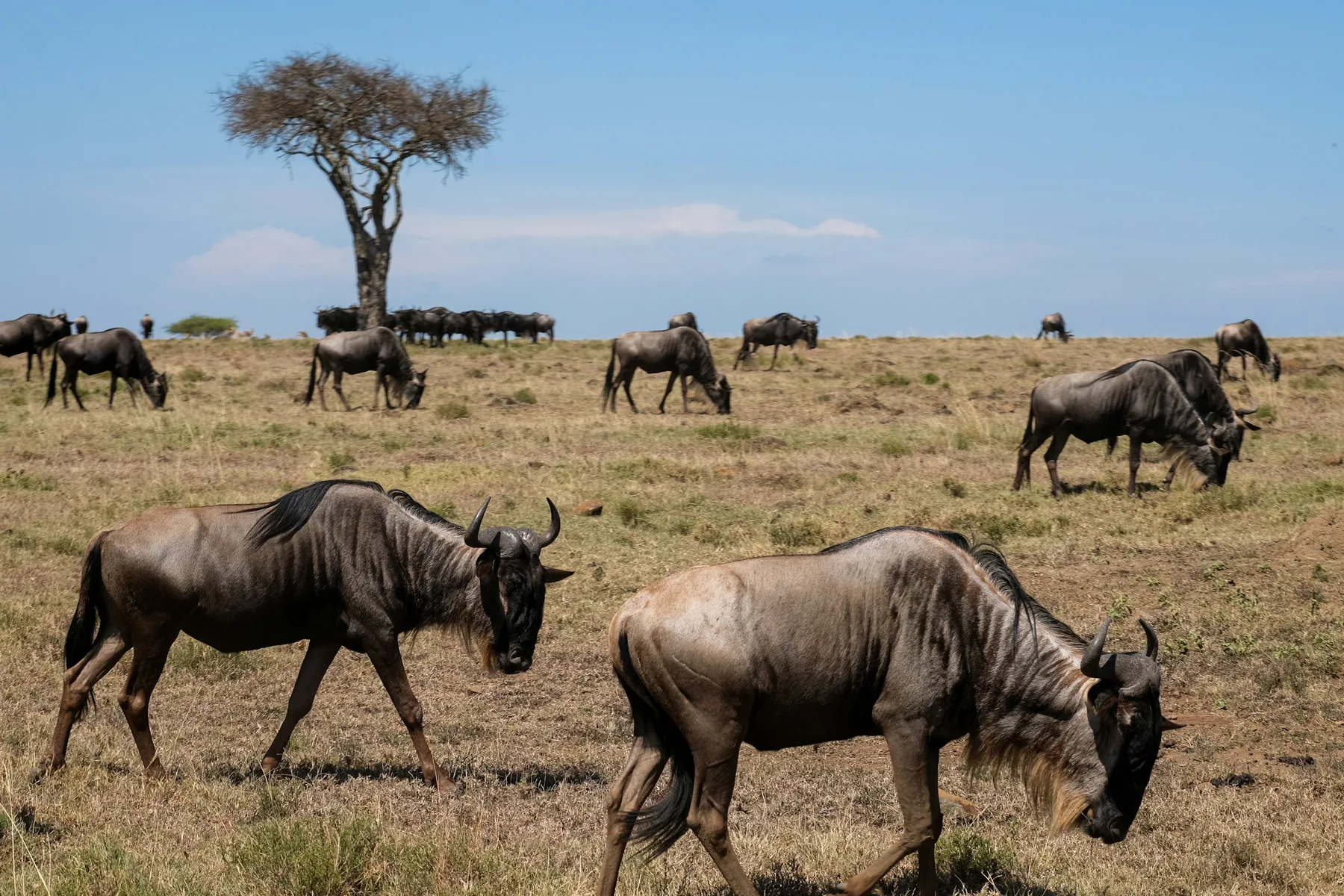
The Great Migration does not make the Mara seasonal
The Masai Mara remains a strong wildlife destination throughout the year. Resident lions, cheetahs, leopards, elephants, giraffes, buffalo, antelope and smaller species do not leave when the large migrant herds move south.
Migration timing adds enormous scale, but it is not a train timetable. The Mara Conservancy explains that herds usually begin arriving around June or July and may remain into November. Rain and grazing drive movement. River crossings are even less predictable. Wildebeest can gather at a bank and turn away for hours or days.
Migration expectation table
| Expectation | Reality |
|---|---|
| “The migration is July to October” | A broad planning window, not a fixed arrival date |
| “A three-night stay includes a crossing” | No crossing can be guaranteed |
| “The Mara is empty outside migration” | Resident wildlife remains year-round |
| “More herds always mean better photographs” | Dust, crowds, distance and light still matter |
| “A river camp sees every crossing” | Herds use different crossing points and banks |
| “Crossings should be pushed to start” | Vehicles must not block or harass wildebeest |
For timing and ethics, use the Great Migration guide and Mara river crossings guide.
Kilimanjaro is not visible on command
Amboseli's mountain view is a possibility, not a room amenity that can be switched on. Cloud and haze often hide all or part of Kilimanjaro. Early morning and late afternoon can bring clearer air, but weather still wins.
A traveller choosing between the parks warned that “Kilimanjaro does not always play nice for photographers”. Another who had cloudy weather still caught “a glimpse of Kili for a few hours”.
Mountain-view planning
| Choice | Helps | Does not guarantee |
|---|---|---|
| Three nights instead of one | More dawn and evening chances | Clear summit |
| Flexible breakfast | Keeps vehicle in good light | Elephant in the right foreground |
| Eastern or central angle | Familiar mountain alignment | Cloud-free air |
| Private vehicle | Lets you wait for composition | Permission to leave roads |
| Long lens | Enlarges mountain behind subject | Atmospheric clarity |
| Wider lens | Shows habitat and sky | A dramatic summit |
The Amboseli and Kilimanjaro guide explains light, position and realistic expectations in detail.
Wildlife variety beyond the headline animals
Amboseli's swamps support hippos, buffalo, waterbirds and a striking mix of wetland and dry-country species. Giraffes, zebras, wildebeest, gazelles, hyenas and birds of prey fill the wider day. Flamingos may use the lake basin when water and food conditions suit them.
The Mara's larger grassland and river system supports a broader-feeling safari: topi, hartebeest, eland, wildebeest, zebra, giraffe, buffalo, hippo, crocodile, jackals, hyenas and rich birdlife. Smaller observations often become highlights after the first big-cat excitement settles.
Wildlife interest table
| Interest | Amboseli advantage | Mara advantage |
|---|---|---|
| Wetland birds | Permanent swamps and marsh edges | River and seasonal wetland variety |
| Plains antelope | Good open-basin viewing | Greater abundance and variety across broad grassland |
| Hippo | Swamps and pools | Mara and Talek river systems |
| Crocodile | Limited focus | Strong river context, especially during migration |
| Giraffe | Beautiful plain and acacia compositions | Wide distribution and rolling-landscape views |
| Nocturnal species | Selected outside-land activities | Conservancy night drives can be a major addition |
| Birding plus mammals | Excellent compact contrast | Excellent across more varied sectors |
Reserve, park and conservancy are not interchangeable
Amboseli National Park is managed by Kenya Wildlife Service. KWS controls its gates, roads, fees and visitor rules. The wider Amboseli ecosystem includes conservancies, sanctuaries, ranches and private land with separate access.
The Masai Mara National Reserve is a county reserve. The western Mara Triangle is managed by the Mara Conservancy, while the larger Narok side follows reserve management. Beyond the reserve, community conservancies operate under their own agreements, camp access and activity rules.
Land model comparison
| Land | Authority or arrangement | Visitor implication |
|---|---|---|
| Amboseli National Park | KWS | One park rule and fee system |
| Wider Amboseli conservancy | Named local management | Access and activities must be confirmed |
| Kimana Sanctuary | Community wildlife sanctuary arrangement | Separate from park entry |
| Narok side of Mara Reserve | Narok County reserve management | Reserve rules and gates |
| Mara Triangle | Mara Conservancy management within reserve | Distinct ticketing and detailed sector rules |
| Mara community conservancy | Landholder lease and conservancy governance | Often camp-linked access and lower vehicle density |
Do not book a “private Mara” or “private Amboseli” without the legal land name. The Mara conservancies guide and Amboseli park versus wider ecosystem guide make the difference visible.
Crowds depend on the exact sector and season
Both destinations can feel quiet at one moment and crowded at the next. In Amboseli, vehicles collect around a lion, cheetah or well-positioned elephant family. In the Mara, a cat close to a main road or wildebeest massing near the river can attract many vehicles.
The Mara's size offers room to spread out, but peak migration demand concentrates guests. Conservancies can reduce the number of authorised vehicles per area, although every conservancy has its own camp and access arrangement. Amboseli's compact core makes it easier to reach known habitats, but also easier for vehicles to converge.
Crowd-control choices
| Choice | Likely effect | Tradeoff |
|---|---|---|
| Travel outside peak migration | Fewer Mara vehicles | No large migrant herds |
| Stay in a Mara conservancy | Lower authorised density and extra activities | Reserve drives may require travel and extra fees |
| Private vehicle | Leave a crowded sighting sooner | Higher trip cost |
| Three nights | More time to find quiet periods | More accommodation cost |
| Avoid radio chasing | Calmer, deeper observations | May miss a famous sighting |
| Amboseli shoulder season | Different light and fewer peak visitors | Rain or dispersed wildlife |
Road or fly: the routing difference
Amboseli is often easier to include by road from Nairobi or between Nairobi and Tsavo. The main drive is still substantial, but it can form a logical southern circuit.
The Mara road journey is longer and the final approach can be tiring, depending on gate and camp. Flying from Nairobi's Wilson Airport can save much of a day, but the correct airstrip must match the accommodation. Luggage limits and transfer arrangements matter.
Moving directly between Amboseli and the Mara by road creates a long transfer and often passes around Nairobi. A flight may require a connection or private charter rather than a simple nonstop scheduled service on every date.
Transport comparison
| Route | Road logic | Flight logic |
|---|---|---|
| Nairobi to Amboseli | Practical start to southern circuit | Useful for luxury or very short itinerary |
| Nairobi to Mara | Long but common | Major time saving |
| Amboseli to Tsavo West | Natural road pairing | Flight rarely necessary for most routes |
| Mara to Lake Nakuru | Common road link | Road usually integrates better |
| Amboseli to Mara | Long transfer with limited safari value | Check current schedules and connection |
| Coast to either | Long by road | Flying usually protects holiday time |
Use Nairobi to Amboseli and Nairobi to Masai Mara for the route details.
How many nights does each destination need?
Amboseli's compact protected core makes two nights workable. Three are better for mountain weather, elephant behaviour and an unhurried pace. Four nights suit photographers or a split between the park and genuinely different wider-ecosystem land.
The Mara deserves at least three nights. Four to five nights allow different sectors, repeated predator searches and weather recovery. A reserve plus conservancy split works best with enough time to experience both rather than spending the holiday repacking.
Stay-length table
| Available safari nights | Strongest use |
|---|---|
| 2 | Amboseli only, with realistic arrival and departure drives |
| 3 | Mara only for variety, or Amboseli for deep elephant focus |
| 4 | Mara only, or three Amboseli nights plus one route night elsewhere |
| 5 | Three Mara plus two Amboseli only if flying or accepting transfer time |
| 6 | Three nights in each, carefully routed |
| 7 to 8 | Four Mara plus three Amboseli, with travel buffer |
| 9 or more | Add conservancy split, Lake Nakuru, Laikipia, Samburu or Tsavo thoughtfully |
One traveller thought Amboseli was worthwhile for “tons of elephants and a different terrain with the mountain” but preferred the Mara for wildlife variety. That balanced response is more useful than a universal winner.
Which is better for a first safari?
For a first and possibly only African safari with three or four nights, the Mara is usually the stronger single choice. It offers a wide species range, strong predator opportunity and enough landscape variety to make every drive feel different.
Amboseli can be the better first choice when elephants are the reason for travel, Kilimanjaro has personal meaning, the route continues to Tsavo or the traveller wants a shorter road circuit from Nairobi. Birders and photographers may also prefer its particular visual language.
First-time decision
| Traveller statement | Better fit |
|---|---|
| “I want the broadest classic safari.” | Masai Mara |
| “Elephants are the entire reason I am coming.” | Amboseli |
| “I want big cats and possible migration.” | Masai Mara |
| “I have only two nights.” | Amboseli, if road routing is efficient |
| “I have four nights and can fly.” | Masai Mara |
| “I am driving on to Tsavo and the coast.” | Amboseli |
| “I want different landscapes over a week.” | Both |
Which is better for families?
Families need more than wildlife density. Drive length, bathroom access, pool time, room layout, meal flexibility and a private vehicle can decide whether a safari feels exciting or exhausting.
Amboseli's compact circuit works well for younger children, especially from a lodge with easy park access. The Mara offers more variety for older children and teenagers, but longer drives and a migration-season river search can test patience.
Family comparison
| Family need | Amboseli | Mara |
|---|---|---|
| Shorter game drives | Easier to arrange in compact park | Possible, especially from well-located camp |
| Big-cat excitement | Possible but not dominant | Strong advantage |
| Elephant learning | Outstanding | Good, but one interest among many |
| Pool and lodge break | Many practical options | Many options across price levels |
| Private vehicle value | High | Very high due to long sightings and distances |
| Teen photography | Strong landscape and elephant work | Strong action, cats and variety |
| Migration patience | Not relevant | Requires realistic expectations |
Which is better for honeymooners?
The answer depends on whether the couple imagines romance as privacy or spectacle. Amboseli offers mountain sunrises, elephants, intimate camps and a natural link to Tsavo or the coast. The Mara offers a wider luxury range, conservancy exclusivity, balloon flights, big cats and a longer standalone stay.
Do not let a honeymoon become two daily six-hour game drives unless both people want that. Build private dining, a slow afternoon, spa time or a shorter drive into the plan.
Honeymoon priorities
| Priority | Stronger option |
|---|---|
| Iconic mountain sunrise | Amboseli |
| Broadest luxury-camp choice | Mara |
| Balloon safari | Mara has the widest established choice, while selected Amboseli operations may be available |
| Easy coast pairing | Either by air, with Amboseli useful in a southern road route |
| Private conservancy feel | Mara offers more established choices |
| Elephant-centred romance | Amboseli |
| Big-cat drama | Mara |
Which is better for photographers?
Amboseli rewards patience with graphic compositions: elephants against dust, water, sky and mountain. The light can be severe, and the summit may stay hidden. A private vehicle and three nights make a larger difference than buying another lens.
The Mara offers more behavioural variety: hunts, cubs, territorial interactions, raptors, river movement and broad environmental portraits. During peak season, vehicle position becomes the challenge. Conservancy access and an experienced guide can matter more than the most expensive camp.
Photography comparison
| Assignment | Amboseli | Mara |
|---|---|---|
| Environmental elephant portrait | Exceptional | Strong |
| Big-cat behaviour | Good with luck | Exceptional |
| Migration scale | Not applicable | Exceptional in broad season |
| River-crossing action | Not applicable | Possible, never guaranteed |
| Dust and silhouette | Strong | Strong in dry periods |
| Wetland reflection | Strong | Localised |
| Night photography | Outside-land rules apply | Conservancy rules may provide options |
Weather and season beyond the migration calendar
Amboseli can be dry and dusty, green after rain, windy across the basin or clouded around Kilimanjaro. Permanent wetlands make the park viable even when the surrounding plain looks harsh.
The Mara sits higher and can feel cooler, especially at dawn. Rain affects grass height, river levels, roads and migration movement. April and May often bring heavier rain and quieter tourism, but yearly patterns vary.
Seasonal choice table
| Travel period | Amboseli character | Mara character |
|---|---|---|
| January to February | Often warm with good general wildlife | Resident game and predators, generally outside main migration |
| March to May | Greener, rain possible, local road changes | Long-rain potential, lush scenery and lower demand |
| June | Drying landscape and strong elephant context | Migration may begin approaching, timing variable |
| July to October | Dry-season concentration and peak demand | Main migration window and highest pressure |
| November | Short-rain possibility and fresh colour | Herds may still be present early, then movement south |
| December | Green conditions possible | Resident wildlife and festive demand |
Read Amboseli weather, best time for Amboseli and best time for the Masai Mara before choosing dates.
Cost differences that matter
Park fees change, accommodation uses seasonal pricing and internal flights alter the comparison. A low room rate outside the protected area may add gate travel, park fees and vehicle time. A higher conservancy rate may include activities or fees that a cheaper quote separates.
Do not compare one headline total. Compare the same nights, room basis, vehicle privacy, protected-area access, flights, transfers and activities.
Quote comparison table
| Cost line | Amboseli question | Mara question |
|---|---|---|
| Accommodation | Inside park, gate side or outside land? | Reserve, Triangle or named conservancy? |
| Entry fees | How many park-entry days? | Reserve and conservancy fees both included? |
| Vehicle | Shared or private, from Nairobi or camp? | Camp vehicle, road vehicle or both? |
| Flight | Which Amboseli airstrip and transfer? | Which Mara airstrip and camp transfer? |
| Activities | Park drives, walk, balloon or community visit? | Reserve drives, conservancy drives, night drive, walk or balloon? |
| Meals | Full board or all drinks and laundry? | Same board basis and premium-drink terms? |
| Single room | Actual supplement by season? | Actual supplement by camp and season? |
| Child rate | Age band and room sharing? | Age band, conservancy fee and vehicle seat? |
Should you combine both parks?
Yes, when you have at least six safari nights or a flight plan that protects time. Three nights in each is a strong introduction. Four Mara nights and three Amboseli nights give photographers and wildlife enthusiasts more breathing room.
Combining them becomes weak when a six-day itinerary counts two long road transfers as safari days, adds one-night stops and reaches each park too late for a useful drive. Fewer bases with more dawns usually produce the deeper trip.
Combination options
| Itinerary | Best for | Watch for |
|---|---|---|
| 3 Amboseli + 3 Mara | Balanced first safari | Long road link or flight connection |
| 2 Amboseli + 4 Mara | Variety with elephant contrast | Only one full Amboseli day |
| 3 Amboseli + 4 Mara | Strong unhurried combination | Seven safari nights plus transfers |
| 3 Amboseli + 3 Mara + coast | Honeymoon or first Kenya holiday | Use flights to protect beach time |
| 3 Amboseli + 2 Tsavo + 3 Mara | Landscape-rich circuit | Too much driving if compressed |
| 4 Mara only | Short safari with maximum variety | Misses the southern ecosystem contrast |
What travellers noticed after doing both
Real accounts are useful when they preserve personal priorities instead of pretending to settle the question for everyone.
One traveller voted for the Mara because of “the sheer size of the park and type of wildlife”. Another said the “Masai Mara was the best for actually seeing wildlife” but still recommended Amboseli for terrain and elephants.
A third chose Amboseli because it offered “a different experience and good to have in itinerary”. A recent writer put the same feeling more bluntly: “Amboseli often gets treated as an add-on. It shouldn't be.”
Reading the reviews properly
| Opinion | What it reveals | What it cannot prove |
|---|---|---|
| Mara had more wildlife | The writer valued variety on those dates | Every Mara drive beats every Amboseli drive |
| Amboseli changed the scenery | Contrast improved the itinerary | One night is always enough |
| Mountain was partly visible | Patience produced a brief opportunity | The same month guarantees visibility |
| Elephants were abundant | Amboseli met the traveller's priority | A named family stays in one sector |
| Mara size impressed | More sectors reward time | Longer daily driving is always better |
When Amboseli is the clear choice
Choose Amboseli without apology when elephants are your main wildlife interest, you want the Kilimanjaro landscape, you have two or three nights, you are building a Nairobi to Tsavo route, or you prefer a compact park with strong wetland contrast.
It is also the better specialist choice for travellers following elephant research, community coexistence, super-tusker history or the ecology of a small protected core within a vast seasonal ecosystem.
Amboseli decision signals
| Strong signal | Why |
|---|---|
| Elephants rank first | They shape the destination |
| Only two nights are available | Compact circuit uses limited time well |
| Tsavo follows | Road geography fits |
| Mountain photography matters | Only Amboseli offers this relationship |
| Wetland birding matters | Swamps add a distinct habitat |
| You have already done the Mara | Amboseli adds contrast rather than repetition |
When the Masai Mara is the clear choice
Choose the Mara when this may be your only safari, big cats matter most, you want the widest classic wildlife mix, you have at least three nights or your dates overlap the broad migration season and you understand that a crossing is uncertain.
It is also the stronger choice when a community conservancy stay, night drives, guided walks or a split reserve-conservancy experience is central to the holiday.
Mara decision signals
| Strong signal | Why |
|---|---|
| First and only safari | Broad wildlife variety |
| Big cats rank first | Strong year-round predator focus |
| Four or five nights available | Enough time for sectors and behaviour |
| Migration ecology matters | Seasonal herds use the Mara-Serengeti system |
| Conservancy activities matter | Large choice of established models |
| Flying from Nairobi | Efficient access to many airstrips |
The booking questions that make the choice clear
Ask the same questions of both proposals. A good comparison names land, time and access rather than relying on reputation.
Final comparison checklist
| Question | Why it changes the answer |
|---|---|
| How many full dawn drives do I get? | Arrival labels can hide lost wildlife time |
| Is the vehicle private? | Controls pace, seats and sighting decisions |
| Which gate or airstrip serves the camp? | Determines transfer time |
| Is the camp inside protected land? | Changes fees, access and early starts |
| Which conservancy is included? | Marketing words are not access rights |
| Are all park and land fees included? | Prevents false price comparison |
| What happens if migration or mountain fails? | Reveals the depth of the itinerary |
| How many camps share the land? | Indicates possible vehicle density |
| Can meals flex around wildlife and light? | Protects the best hours |
| Is the route road or air between parks? | Determines whether combining them is sensible |
The final verdict
The Masai Mara is the stronger all-round first safari. Amboseli is the stronger elephant and Kilimanjaro safari. That is a useful starting point, not a ranking of natural value.
There is also no need to force the decision through animal checklists alone. Think about the mornings you want. In Amboseli, that might be a quiet wait beside a swamp while an elephant family chooses its route. In the Mara, it might be following fresh lion tracks across a valley, then stopping for giraffes against a storm-dark sky. Both destinations reward travellers who stay long enough to watch behaviour rather than collect names. The better park is the one whose ordinary day still sounds exciting after the famous photograph or migration promise has been removed.
Choose the Mara if you want breadth: predators, plains game, river systems, migration possibility and a reserve-conservancy choice that can sustain four or five nights. Choose Amboseli if you want focus: elephants, known family histories, open-basin light, permanent swamps and the visual relationship with Africa's highest mountain.
If the itinerary has room, do both. Let the Mara provide scale and drama. Let Amboseli slow the story down until one elephant family becomes more interesting than a list of species. The contrast is the point.
Related guides
- Amboseli safari guide
- Masai Mara safari guide
- Where to stay in Amboseli
- Where to stay in the Masai Mara
- Amboseli National Park versus the wider ecosystem
- Masai Mara reserve versus conservancies
- Best time to visit Amboseli
- Best time to visit the Masai Mara
- Nairobi to Amboseli
- Nairobi to Masai Mara
Sources and traveller accounts
- KWS Amboseli National Park for current park attractions, gates and visitor rules.
- Amboseli National Park Management Plan 2020 to 2030 for park size, ecosystems and management context.
- Masai Mara National Reserve Management Plan 2023 to 2032 for official reserve geography, values and management.
- Greater Maasai Mara Ecosystem Management Plan 2023 to 2032 for reserve, conservancy and non-protected landscape relationships.
- Mara Triangle visitor information for the Triangle's 510 sq km area, gates and operation.
- Mara Triangle migration guide for broad timing, unpredictability and crossing ethics.
- Mara Triangle park rules for crowding controls and responsible viewing.
- Traveller discussion comparing one Amboseli night with more Mara time for exact short first-hand opinions on wildlife, scenery and Kilimanjaro.
- Independent Amboseli reflection for an exact short view on Amboseli being treated as an add-on.
Let us compare Amboseli and the Masai Mara
Share dates, travellers, nights, route, wildlife priorities, room style and budget. We will compare complete safari time, not just famous names.