
Amboseli Elephants: Families, Tuskers and a Living History
The matriarch steps into the swamp first. Calves disappear between legs, adolescents test one another with their trunks and an egret rides the movement through wet grass. In Amboseli, the longer you stay with one family, the less the sighting feels like a checklist.
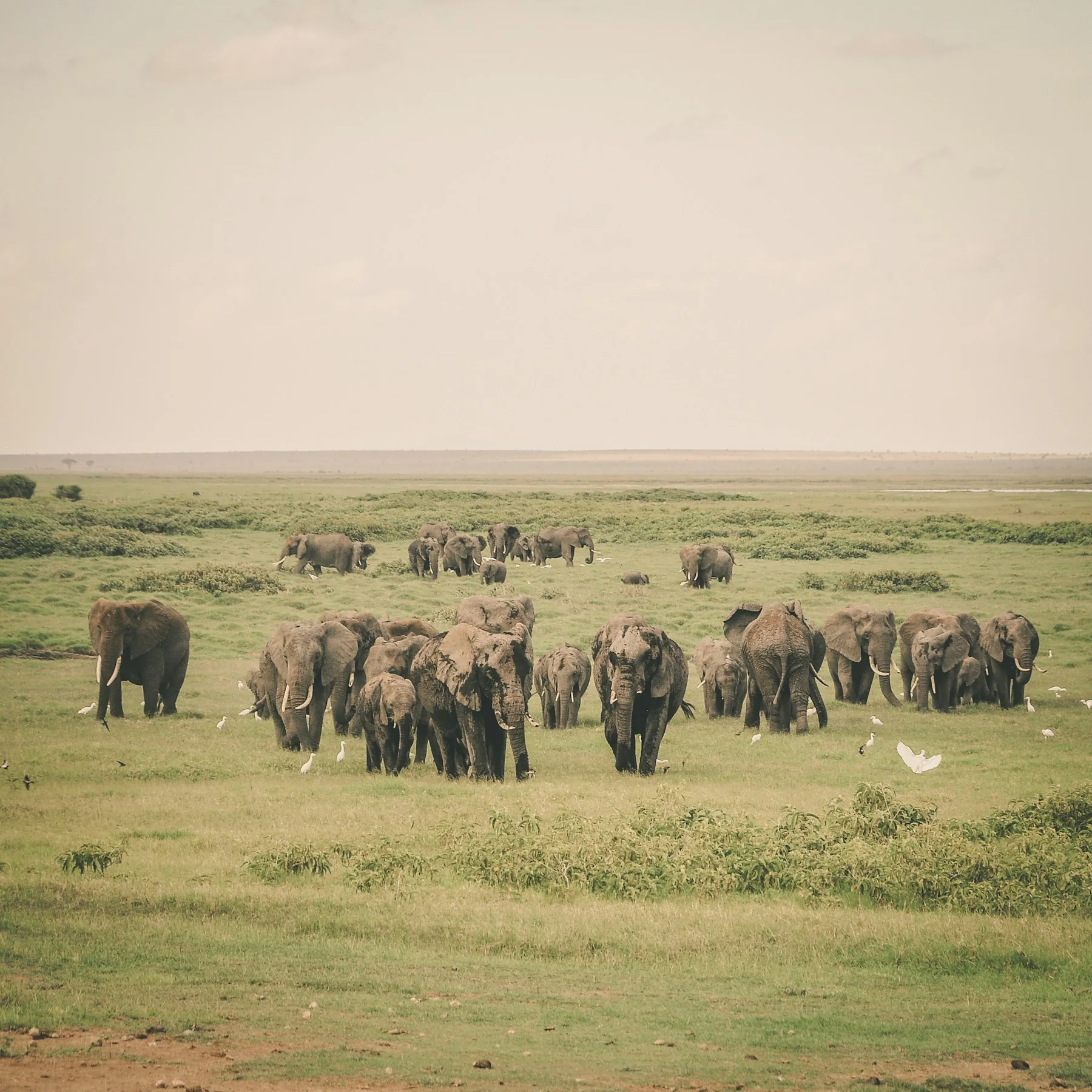
Amboseli elephants are famous for large, visible family groups, old bulls and the mountain landscape, but their real importance goes deeper. Researchers have followed known individuals and families here since 1972, creating one of the world’s longest continuous studies of wild elephants.
- Why Amboseli elephants are different to watch
- Families, matriarchs and generations
- How an elephant family fits together
- Calves learn through touch, play and protection
- Bulls, musth and the great tuskers
- Water, grass and the daily rhythm
- Five decades of Amboseli elephant research
- How to recognise an individual elephant
- Rumbles, touch, scent and body language
- When to see Amboseli elephants
- Responsible viewing in Amboseli
- Better elephant pictures without chasing the mountain
- Coexistence beyond the national park
- The 2026 Amboseli-Kimana elephant deaths
- How to plan an Amboseli elephant trip
- Traveller opinions
- FAQs
Why Amboseli elephants are different to watch
Amboseli’s open lake basin, short grass and permanent wetlands make elephants unusually visible. Families cross pale plains in long lines, feed chest-deep in green swamp vegetation and sometimes pass beneath a clear Kilimanjaro. The scene is famous because scale becomes legible: an enormous animal can look small beneath the mountain, then fill the frame as the herd approaches.
Visibility also created a rare scientific opportunity. Researchers could recognise individuals, record births and deaths, map associations and return to the same families across decades. A guide who knows that history can turn “a herd of twenty” into grandmothers, sisters, calves and adolescent males with different relationships.
Families, matriarchs and generations
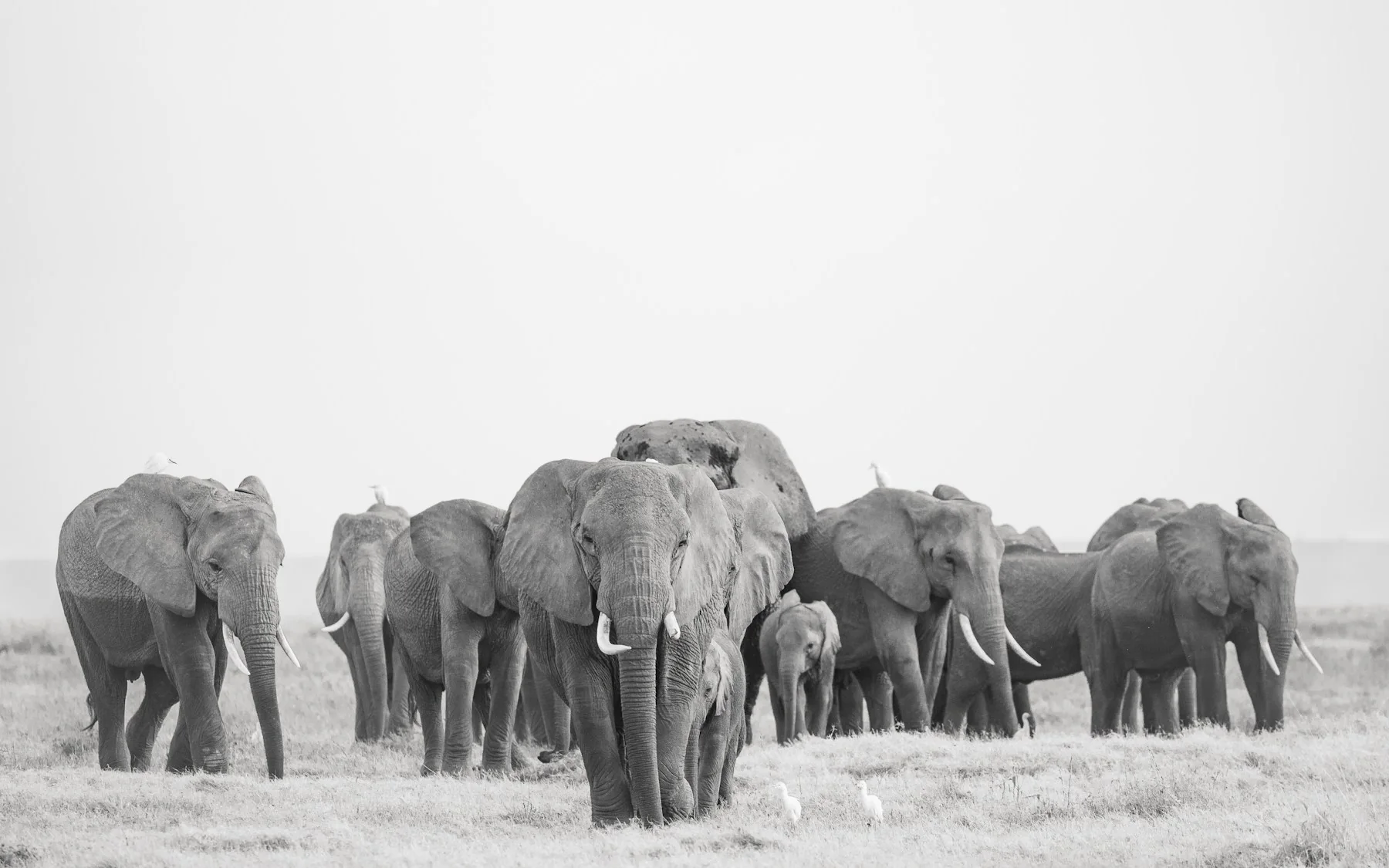
The core family contains related adult females and their young. An experienced matriarch often carries ecological memory that matters during drought, danger and movement between water and feeding areas. Leadership is not a permanent parade position. Watch who pauses, who others attend to and how the group responds when a senior female changes direction.
Families can split into smaller units and come together in larger aggregations when food and water support them. The Amboseli Trust for Elephants has documented family histories that grow, fragment and sometimes disappear after severe loss. This long view is why a photograph of one matriarch can hold decades of births, droughts and decisions.
| Group member | What to notice | Avoid assuming |
|---|---|---|
| Matriarch | Attention, decisions and group response | Always the largest elephant |
| Adult females | Calf care and social bonds | Every female is the calf’s mother |
| Calves | Play, nursing and protection | A close calf means the herd accepts vehicles |
| Adolescents | Testing, play and growing independence | Every mock charge is aggression |
How an elephant family fits together
A family is not a random gathering of animals. Related females and their young form the core. Mature males gradually leave that daily family unit, while several related families may meet as a bond group or larger clan.
Calves learn through touch, play and protection
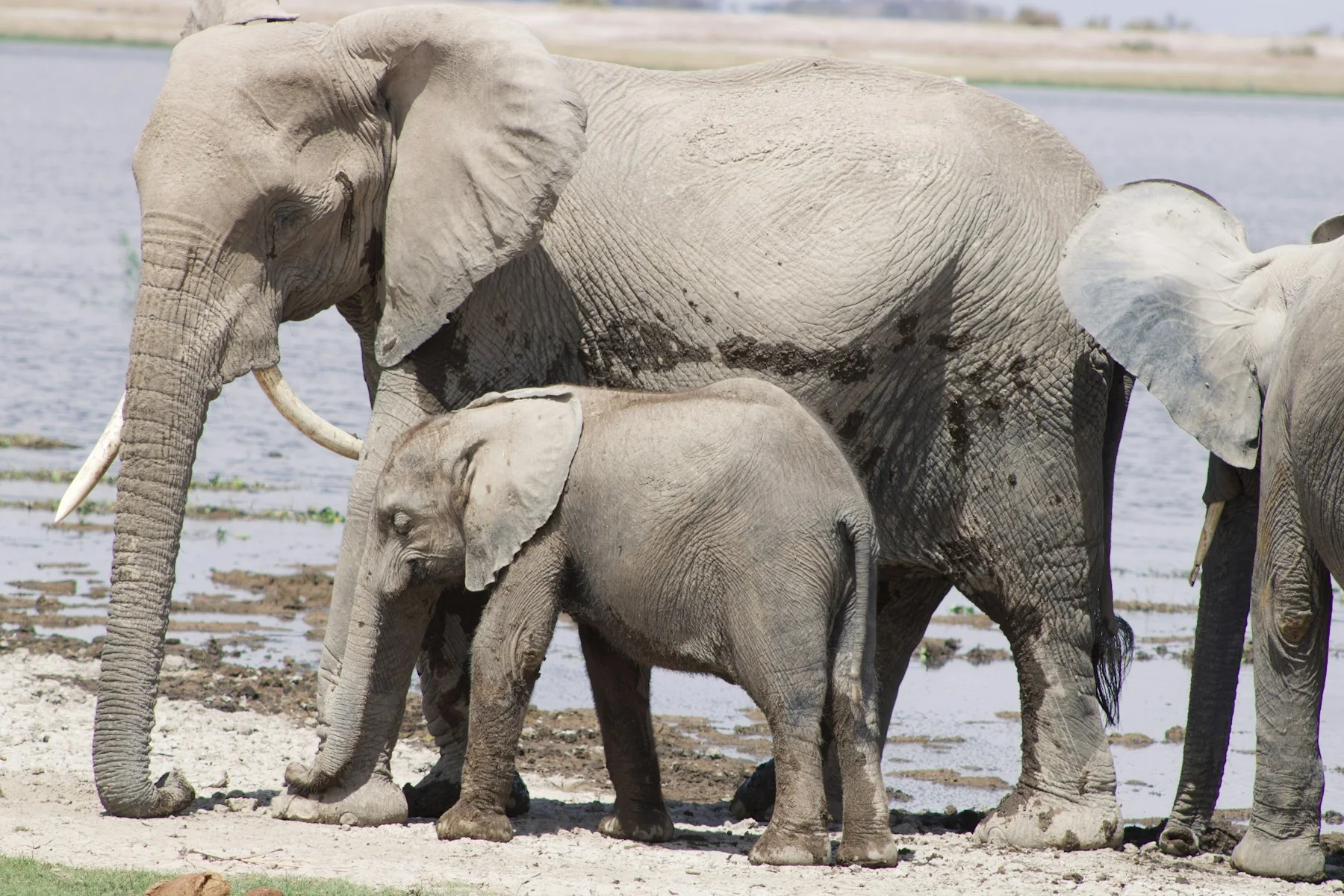
A small calf may be almost hidden beneath its mother. Other females can help guard, guide and comfort young animals, while siblings and age-mates turn trunks, dust and shallow water into play. Calves learn what to eat, where to walk and how to interpret the social world by following older elephants.
Give a family with a newborn extra room. A vehicle blocking the travel line can force adults to bunch around the calf. Do not ask the driver to move closer because the baby looks relaxed. Watch ears, heads, pace and the way adults position themselves. The best photograph is never worth making a mother change course.
Bulls, musth and the great tuskers
Young males gradually leave the family world and spend more time alone or with other males. Adult bulls are not simply solitary wanderers. They form associations, learn from older males and move across large areas in search of food, water and breeding opportunities. A mature bull can appear calm while communicating through posture, scent and low-frequency sound beyond human hearing.
Musth is a period of heightened reproductive activity in adult males, often accompanied by temporal-gland secretion, urine dribbling and purposeful movement. Give a musth bull generous space and never position the vehicle in his path. Amboseli’s old bulls became symbols because age, genetics and protection allowed their tusks and individual histories to grow extraordinary. Tim died naturally in 2020. Craig, another celebrated super tusker, died naturally at the age of 54 in January 2026. Their stories matter because living to old age is itself a conservation achievement.
| Sign | Possible meaning | Visitor response |
|---|---|---|
| Steady feeding, loose body | Relaxed behaviour | Stay quiet and observe |
| Head high, watching vehicle | Heightened attention | Stop approaching |
| Ears spread, head shake | Warning or agitation | Increase space calmly |
| Purposeful bull with musth signs | Reproductive state | Do not block movement |
| Family bunches around calves | Concern or protection | Back away and clear route |
Water, grass and the daily rhythm
Water reaches Amboseli’s wetlands through the wider Kilimanjaro system. In dry months, elephants often travel from feeding areas toward permanent swamps, drink, cool their bodies and pull long wet vegetation with their trunks. Egrets and other birds follow disturbed insects, creating the lively scenes associated with Enkongo Narok and Longinye.
Elephants do not live only inside the national park. They move through community land, conservancies, farms and routes that connect water and forage across the ecosystem. Rain spreads resources and can disperse families beyond familiar circuits. Dryness concentrates them, but severe drought also brings hunger, calf mortality and conflict. A dense sighting is not automatically a sign that everything is easy.
Five decades of Amboseli elephant research
The Amboseli Elephant Research Project began in 1972. Researchers built records from repeated sightings of known elephants with family histories, births, deaths, associations and movement. The Trust’s reporting describes tens of thousands of sightings and work on family stability, leadership, reproduction, communication and responses to ecological change.
Long-term research catches patterns a short study misses. A matriarch’s death may reshape a family years later. A drought can alter reproduction and survival. Family size changes through births, losses and splits. The archive also lets scientists ask how elephants respond to people and landscapes over generations, not just during one field season.
Watch the history behind the names
PBS Nature followed Echo’s family and later returned to the elephants researchers had known for decades. Explore Echo’s family tree and the Unforgettable Elephants film.
| Research record | What it helps reveal |
|---|---|
| Individual identification | Life history and survival |
| Family censuses | Growth, splits and association |
| Birth and death records | Reproduction and drought effects |
| Movement observations | Use of park and community land |
| Behavioural notes | Leadership, communication and social bonds |
How to recognise an individual elephant
Begin with the ears. Tears, holes, notches and vein patterns create recognisable outlines. Then compare tusks: length, curve, thickness, symmetry and broken tips. Tail hair, body shape, scars and the relationship to known companions add evidence. Researchers use careful catalogues and repeated confirmation rather than naming an elephant from one dramatic feature.
Visitors can try the same discipline without pretending expertise. Photograph both sides when the animal turns, note companions and location, and ask the guide what is known. Do not invent a famous identity for social media. A very large bull is not automatically a named super tusker, and a damaged tusk does not reveal how it happened.
Rumbles, touch, scent and body language
Elephants communicate with audible calls, low-frequency rumbles, touch, scent and visual posture. A greeting can involve trunks, mouths, ears and intense contact. Calves call when separated or distressed. Adults may freeze and listen to signals people cannot locate. Turn off music and reduce conversation when the family becomes attentive.
Body language must be read in context. Ear flapping can cool the body, while a deliberate ear spread paired with a raised head may warn. A trunk lifted into the air can sample scent. Dusting may protect skin and regulate comfort. The guide should interpret a sequence, not turn one gesture into a theatrical story.
When to see Amboseli elephants
June through October and the shorter January to February dry period often make elephants easier to find around reliable water. The late dry season brings dust, strong contrasts and concentrated use of wetlands. It can also bring heat, crowded sightings and ecological stress. Early departures help with light and animal comfort.
During rains, families can spread into greener areas, cloud can cover Kilimanjaro and roads may slow. In return, the landscape has colour, calves play in mud and the sky becomes part of the photograph. No month promises a particular family or a clear mountain. Two or three dawns create opportunity without pretending certainty.
| Seasonal condition | Elephant pattern | Photography character |
|---|---|---|
| Early dry season | Increasing wetland use | Some green, cool mornings |
| Late dry season | Stronger concentration near water | Dust, pale plains and heat shimmer |
| Long rains | Wider dispersal | Green grass and storm light |
| Short rains | Rapid landscape change | Fresh colour and variable cloud |
Responsible viewing in Amboseli
KWS guidance asks vehicles to stay on established roads, keep at least twenty metres from wildlife, remain below forty kilometres per hour and give animals right of way. Those are minimum rules, not a target distance. A family moving toward the road may come closer by choice. The driver should not surround, pursue or cut across it to create the same result.
Keep voices low, phones silent and limbs inside the vehicle. Never feed an elephant or call to make it look up. Avoid crowding a narrow crossing. If several vehicles are present, take a position that leaves an open route and depart before the animals must push through. Ethical viewing produces calmer behaviour and more truthful photographs.
Better elephant pictures without chasing the mountain
A wide lens can place the herd within wetland, dust and mountain, while a longer lens isolates an ear, trunk or interaction from a respectful distance. Use a faster shutter for walking calves and birds; slow down only when stability and animal movement allow it. Expose for pale sky carefully when Kilimanjaro is bright behind dark bodies.
The strongest story may be a calf touching an aunt, a matriarch waiting for the family or an old bull selecting one mouthful at a time. Ask for a private vehicle if photography is central, because shared guests may reasonably prefer variety. Protect cameras from fine dust and avoid changing lenses when wind crosses the lake bed.
Coexistence beyond the national park
Amboseli elephants cross a human landscape of pastoral livelihoods, farms, roads, settlements and conservation areas. When routes narrow or crops offer food, encounters can cost people sleep, income, safety and sometimes life. Elephants are also injured or killed. Calling every movement a tourism success ignores the households sharing the ecosystem.
Conservation therefore includes community-led land protection, conflict response, benefit sharing, ranger work and keeping movement routes viable. Travellers can ask how a property leases land, employs locally, supports water and waste systems and contributes to coexistence. A village visit should be hosted with consent and payment transparency, not added as a quick costume stop after elephants.
The 2026 Amboseli-Kimana elephant deaths
Between late June and August 2026, an unusual cluster of elephant deaths was recorded in the wider Amboseli ecosystem. By 25 August, Big Life reported that 18 deaths were under investigation. Preliminary tests pointed toward exposure to a toxic substance, with cyanide among the possibilities being examined, but the source and circumstances had not been established.
The careful response is to follow the investigation, not turn an unfinished inquiry into a simple story about farms, deliberate poisoning or one confirmed chemical pathway. Big Life urged the same caution while rangers maintained heightened vigilance. The episode shows why elephant conservation cannot end at a park gate. Water, crops, chemicals, movement corridors and community livelihoods meet on the same landscape.
Read Big Life’s 25 August investigation update and the Associated Press report from Kimana.
How to plan an Amboseli elephant trip
Stay at least two nights, and choose three for dedicated observation or photography. Ask where the lodge sits in relation to the park, swamps and gates. A private vehicle lets the guide remain with a family as behaviour unfolds. Include binoculars even for elephants, because details across a wetland can be wonderful.
Read about family histories before travel, then leave room for discovery. The herd you meet may not be famous. Kilimanjaro may remain behind cloud. A quiet hour with an unnamed mother, calf and grandmother can still become the reason Amboseli follows you home.
What travellers say after the trip
These are exact words from public reviews and discussions. Each person had their own route, budget and expectations, so the value is in the detail rather than treating one experience as a promise.
If you’ve ever imagined an Africa safari, Amboseli is probably what you imagined!
A recent visitor introducing photographs and memories from an Amboseli safari.
Amboseli was beautiful scenery and lots of elephants (herds of 50+), but you have to stay on the roads as it’s not a conservancy.
A traveller comparing public-park viewing with a private conservancy and remembering the scale of the elephant herds.
There is an abundance of large elephant herds there.
A safari discussion participant explaining why Amboseli remained high on their destination list.
Amboseli elephant questions
Why are Amboseli elephants famous?
They are visible in open country, include well-known families and old bulls, and have been followed by a long-running individual-based research programme.
Are elephants guaranteed in Amboseli?
No wild sighting is guaranteed, but Amboseli is one of Kenya’s strongest elephant destinations because herds regularly use its wetlands and wider ecosystem.
Who studies the Amboseli elephants?
The Amboseli Elephant Research Project, associated with the Amboseli Trust for Elephants, has followed known individuals and families since 1972.
How can researchers recognise individual elephants?
They use features such as ear tears and holes, tusk shape, body characteristics and family associations, supported by long sighting histories.
What is an elephant matriarch?
A matriarch is an experienced female whose knowledge and decisions help guide a family group.
Do adult male elephants live in families?
Males gradually become independent as they mature. They may travel alone or in loose associations and still maintain a complex social life.
What was Tim the elephant known for?
Tim was a celebrated Amboseli ecosystem bull and one of Kenya’s great tuskers. He died naturally in 2020.
What is the best season for elephants in Amboseli?
Dry periods often concentrate elephants around permanent water. Wet periods can bring green scenery and larger dispersal across the ecosystem.
How close may vehicles approach elephants?
KWS park guidance says visitors should view wildlife from at least twenty metres, stay on established roads and give animals right of way.
How many nights are best for elephant enthusiasts?
Three nights provide two full days and enough time to follow behaviour without rushing every sighting.
Sources and further reading
Elephant research, conservation organisations, official park guidance and independent reporting support the details in this guide.
- Kenya Wildlife Service Amboseli National Park
- KWS conservation fees
- Amboseli Trust for Elephants
- Big Life Foundation Amboseli ecosystem
- Amboseli Trust for Elephants annual report
- Amboseli Trust for Elephants family histories
- KWS Focus on Elephants
- IUCN African savanna elephant assessment
- PBS Nature: Echo’s family tree and Unforgettable Elephants
- Associated Press: Craig the super tusker
- Big Life: August 2026 investigation update
Come for the elephants, stay long enough to meet them
Tell us what draws you to Amboseli and how you like to watch wildlife. We will build the lodge, guide, vehicle and number of mornings around a quieter, deeper encounter.
Plan an elephant-focused Amboseli safari
Share your dates, group, photography interests, preferred pace and the other Kenya destinations you want to include.